
Intro
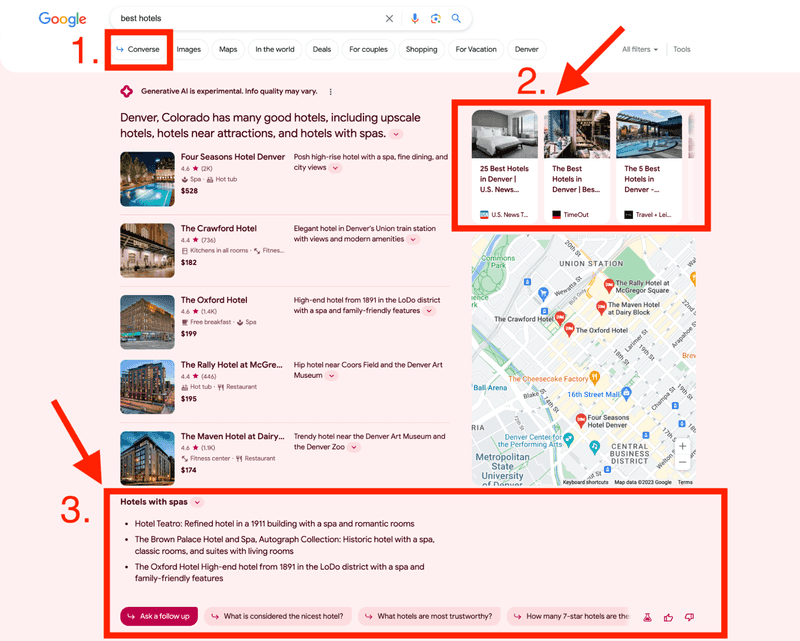
Hotel and accommodation websites sit at a critical conversion point in travel search.
They influence:
- Where travellers stay
- How much they pay
- Expectations around comfort, location, and experience
- Cancellation, refund, and review outcomes
Because accommodation decisions are both financial and experiential, Google treats hotel queries as decision-shaping, not purely transactional.
AI Overviews now appear before travellers compare rooms, rates, or reviews.
Google is no longer just ranking hotel pages or OTAs by SEO signals. It is summarising availability pressure, typical price ranges, location trade-offs, and suitability by traveller type — directly in the SERP.
For hotel and accommodation sites, this is not a traffic issue. It is a value-framing, accuracy, and expectation-alignment issue.
The All-in-One Platform for Effective SEO
Behind every successful business is a strong SEO campaign. But with countless optimization tools and techniques out there to choose from, it can be hard to know where to start. Well, fear no more, cause I've got just the thing to help. Presenting the Ranktracker all-in-one platform for effective SEO
We have finally opened registration to Ranktracker absolutely free!
Create a free accountOr Sign in using your credentials
This article is part of Ranktracker’s AI Overviews series and explains how AI Overviews affect hotel & accommodation websites, how traveller behaviour changes, how Google evaluates lodging credibility, what content still shapes AI summaries, and how accommodation brands can win when Google pre-frames stay decisions before the click.
1. Why AI Overviews Are So Powerful in Accommodation Search
Accommodation queries are:
- Time-bound (dates matter)
- Price-sensitive
- Highly subjective (comfort, noise, location)
- Influenced by availability pressure
This makes them ideal for AI Overviews.
Hotel & Accommodation Queries That Trigger AI Overviews
Examples include:
- “Best hotels in [city]”
- “Where to stay in [destination]”
- “Is it better to stay downtown or near the airport?”
- “Average hotel prices in [city]”
- “Hotel vs apartment stay”
Google now responds with:
- Typical price ranges by area
- Location pros and cons
- Availability pressure by season
- Suitability by traveller type (business, family, budget)
If your site relies on generic star ratings or listicles, AI Overviews answer the question first.
AI Overviews Replace Ranking-First Hotel Discovery
Historically:
- Hotels competed on rankings and reviews
- SEO rewarded “best hotel” pages
- Nuance lived deep in descriptions
AI Overviews now:
- Surface trade-offs immediately
- Reduce blind comparison clicks
- Penalise misleading “best” framing
Hotel sites no longer compete on who ranks highest. They compete on who sets the most accurate expectations.
2. How AI Overviews Change Traveller Behaviour
AI Overviews reshape why travellers click accommodation sites.
Awareness → Expectation Calibration
Before clicking, travellers now:
- See realistic price bands
- Understand location compromises
- Learn when availability is tight
This filters out mismatched searches.
Consideration → Fit Over Promotion
When users do click, they want to know:
- “Is this right for my trip type?”
- “Are the prices realistic for my dates?”
- “What are the downsides?”
Generic photo-heavy pages bounce quickly.
Conversion → Confidence Over Urgency
Bookings convert when:
- Room differences are clear
- Location trade-offs are honest
- Policies are transparent
Artificial urgency (“last room!” without context) damages trust.
3. The Hotel Traffic Illusion
Many accommodation sites see:
- Fewer organic sessions
- Lower CTR on generic queries
- Higher booking intent
- Better review alignment post-stay
This can feel like decline.
In reality:
AI Overviews are filtering browsing traffic, not booking demand.
The shift is from comparison clicks to commitment-ready visits.
4. How Google Evaluates Hotel & Accommodation Sites for AI Overviews
Google applies experience and consumer-safety heuristics.
4.1 Availability & Pricing Context Beat Static Rates
AI Overviews favour sites that:
- Explain seasonal pricing
- Use ranges instead of teaser rates
- Update availability messaging
Static “from $99” claims are downgraded.
4.2 Location Transparency Matters
AI distrusts:
- Vague location descriptions
- Misleading “central” claims
- Ignoring transport reality
Clear location context builds trust.
4.3 Entity-Level Trust Overrides Page SEO
Hotels and accommodation brands are evaluated as experience providers, not content publishers.
Signals include:
- Consistency between descriptions and reviews
- Alignment across room pages, FAQs, and policies
- Conservative, accurate language
One misleading room page can weaken site-wide trust.
5. The Strategic Shift for Hotel SEO
Old Hotel SEO
- Rank city + hotel keywords
- Push best-rate guarantees
- Optimise images and reviews
- Monetise volume
AI-First Hotel SEO
- Explain who each room suits
- Frame pricing variability
- Clarify trade-offs early
- Monetise expectation-aligned bookings
If Google doesn’t trust your framing, it will satisfy the query before the click.
6. Hotel Content That Influences AI Overviews
6.1 “Where to Stay” Location Guides
AI Overviews rely heavily on content that:
- Explains neighborhoods
- Frames pros and cons
- Avoids universal recommendations
These shape SERP summaries directly.
6.2 Room Type & Suitability Content
AI values pages explaining:
- Who each room is for
- Noise, size, and layout trade-offs
- What’s included vs optional
Specificity beats generic descriptions.
6.3 Pricing & Seasonality Explainers
AI prefers content that:
- Explains peak vs off-peak pricing
- Uses realistic ranges
- Avoids misleading anchors
Transparency increases visibility.
6.4 Policies & Post-Booking Reality
AI cannot infer:
- Cancellation friction
- Resort fees
- Service limitations
Hotels that explain this honestly gain authority.
7. How Hotel & Accommodation Sites Should Structure Pages for AI Overviews
Lead With Fit & Context
Key pages should open with:
- Who the property suits
- Typical price ranges
- Location reality
AI extracts early content aggressively.
Avoid “Best Hotel” Absolutes
Winning accommodation sites:
- Explain trade-offs
- Acknowledge downsides
- Avoid one-size-fits-all language
AI penalises over-optimisation.
Standardise Experience Language
Authority hotel brands:
- Align descriptions, FAQs, and booking pages
- Use consistent room naming
- Avoid contradictory amenity claims
Consistency compounds AI trust.
8. Measuring Hotel SEO Success in an AI Overview World
Traffic alone is no longer the KPI.
Hotel and accommodation sites should track:
- AI Overview inclusion
- Brand mentions in summaries
- Booking conversion rate
- Cancellation and refund rates
- Desktop vs mobile AI visibility
SEO becomes expectation-fit optimisation, not traffic growth.
9. Why AI Overview Tracking Is Critical for Hotel & Accommodation Sites
Without AI Overview tracking, accommodation brands cannot see:
- How Google frames value and location
- Whether pricing context aligns with SERPs
- Which competitors shape summaries
- When trust erosion starts pre-booking
This is where Ranktracker becomes strategically essential.
The All-in-One Platform for Effective SEO
Behind every successful business is a strong SEO campaign. But with countless optimization tools and techniques out there to choose from, it can be hard to know where to start. Well, fear no more, cause I've got just the thing to help. Presenting the Ranktracker all-in-one platform for effective SEO
We have finally opened registration to Ranktracker absolutely free!
Create a free accountOr Sign in using your credentials
Ranktracker enables hotel and accommodation sites to:
- Track AI Overviews for lodging and destination queries
- Monitor desktop and mobile summaries
- Compare AI visibility with Top 100 rankings
- Detect value and trust gaps early
You cannot manage accommodation SEO without AI-layer insight.
10. Conclusion: AI Overviews Reward Accommodation Sites That Set Expectations, Not Just Sell Rooms
AI Overviews do not harm hotel and accommodation websites. They harm misleading, hype-driven lodging content.
In an AI-first accommodation SERP:
- Context beats ranking
- Fit beats promotion
- Transparency beats urgency
- Trust beats traffic
Hotel and accommodation sites that adapt will:
- Attract better-matched guests
- Reduce cancellations and complaints
- Improve review quality
- Build durable destination authority
The accommodation SEO question has changed.
It is no longer:
The All-in-One Platform for Effective SEO
Behind every successful business is a strong SEO campaign. But with countless optimization tools and techniques out there to choose from, it can be hard to know where to start. Well, fear no more, cause I've got just the thing to help. Presenting the Ranktracker all-in-one platform for effective SEO
We have finally opened registration to Ranktracker absolutely free!
Create a free accountOr Sign in using your credentials
“How do we rank hotel pages?”
It is now:
“Does Google trust us to prepare travellers for the stay they’re about to book?”
Brands that earn that trust don’t lose visibility — they become the stay-selection layer AI relies on before travellers commit to a booking.

