
Intro
Local multi-location businesses live in a complex middle ground.
They are:
- Local in delivery
- Centralised in brand
- Fragmented in data
- Judged one location at a time
Think retail chains, franchises, healthcare groups, gyms, restaurants, home service networks, and service brands with dozens—or hundreds—of locations.
AI Overviews now sit between customers and every single one of those locations.
Google is no longer just ranking “near me” pages or individual Google Business Profiles. It is summarising what a brand offers, what locations typically provide, how consistent the experience is, and whether a specific branch is a good fit — directly in the SERP.
For multi-location businesses, this is not a traffic problem. It is a brand interpretation, consistency, and expectation-management problem.
The All-in-One Platform for Effective SEO
Behind every successful business is a strong SEO campaign. But with countless optimization tools and techniques out there to choose from, it can be hard to know where to start. Well, fear no more, cause I've got just the thing to help. Presenting the Ranktracker all-in-one platform for effective SEO
We have finally opened registration to Ranktracker absolutely free!
Create a free accountOr Sign in using your credentials
This article is part of Ranktracker’s AI Overviews series and explains how AI Overviews affect local multi-location businesses, how customer behaviour changes, how Google evaluates distributed brands, what content shapes AI summaries, and how multi-location companies can win when AI pre-qualifies customers before they ever choose a location.
1. Why AI Overviews Are Uniquely Disruptive for Multi-Location Brands
Multi-location search queries are:
- Local but brand-influenced
- Comparison-heavy
- Highly expectation-driven
- Sensitive to inconsistency
This makes them prime AI Overview targets.
Multi-Location Queries That Trigger AI Overviews
Examples include:
- “Is [brand] good?”
- “[Brand] locations near me”
- “Does [brand] offer [service]?”
- “Are all [brand] locations the same?”
- “[Brand] vs local alternative”
Google now responds with:
- Brand-level summaries
- Typical services and pricing expectations
- Consistency assumptions across locations
- Common pros and cons
If your locations vary widely but your content doesn’t explain that, AI Overviews will assume uniformity — and customers will be disappointed.
AI Overviews Replace Manual Comparison With Brand Interpretation
Historically:
- Users compared individual location pages
- Differences surfaced late
- Staff handled expectation mismatches
AI Overviews now:
- Form expectations instantly
- Generalise across locations
- Reduce exploration clicks
Multi-location brands no longer compete on how many pages they rank. They compete on how accurately AI understands and communicates variation.
2. How AI Overviews Change Customer Behaviour for Multi-Location Businesses
AI Overviews fundamentally reshape which location customers choose.
Awareness → Brand Assumptions Form in the SERP
Before clicking, users now:
- Assume service availability
- Expect consistent pricing and quality
- Decide if the brand fits their needs
Wrong assumptions increase complaints.
Consideration → Location Validation
When users do click, they want to confirm:
- “Does this specific location offer that?”
- “Are hours, services, and staff the same?”
- “Is this location better or worse than others?”
Thin location pages bounce instantly.
Conversion → Trust Beats Proximity
Customers convert when:
- The local experience matches brand expectations
- Differences are explained clearly
- No surprises occur after booking or arrival
Inconsistency kills loyalty.
3. The Multi-Location Traffic Illusion
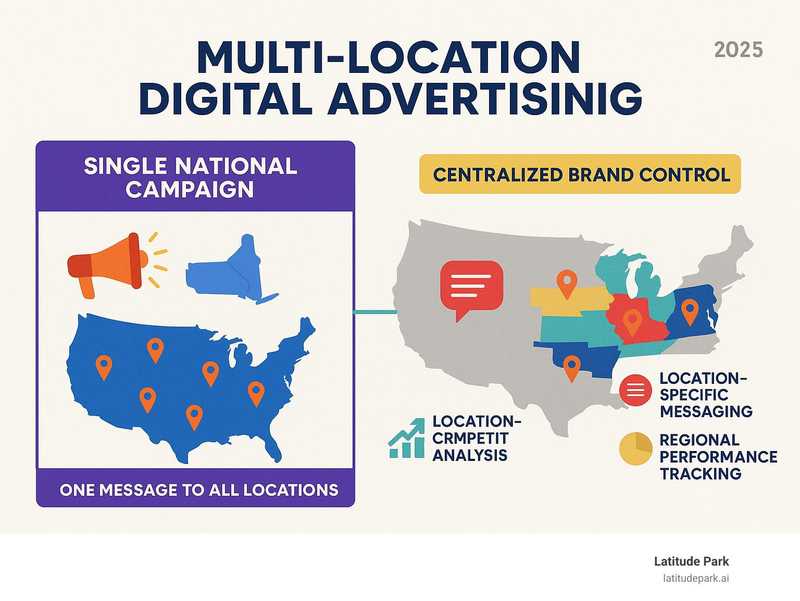
Many multi-location brands notice:
- Lower overall organic traffic
- Fewer exploratory visits
- Higher conversion per visit
- More location-specific intent
This can feel like decline.
In reality:
AI Overviews are filtering casual brand browsers, not local demand.
The shift is from brand curiosity to location-ready intent.
4. How Google Evaluates Multi-Location Businesses for AI Overviews
Google applies brand-consistency and local trust heuristics.
4.1 Brand Definition Must Be Clear
AI Overviews favour brands that:
- Clearly define core offerings
- Avoid location-level contradictions
- Explain what is standard vs optional
Ambiguity leads to incorrect generalisation.
4.2 Location-Level Accuracy Is Critical
AI distrusts brands where:
- Location pages conflict with brand promises
- GBP data is inconsistent
- Reviews contradict website claims
One bad location can affect brand-level summaries.
4.3 Entity-Level Trust Overrides Page SEO
Multi-location businesses are evaluated as brand systems, not individual listings.
Signals include:
- Consistency across hundreds of pages
- Alignment between brand and local messaging
- Long-term accuracy across locations
Fragmentation weakens AI trust.
5. The Strategic Shift for Multi-Location SEO
Old Multi-Location SEO
- Create location pages at scale
- Optimise “near me” keywords
- Push brand authority
- Fix issues reactively
AI-First Multi-Location SEO
- Define brand-wide expectations
- Explain location-level variation
- Standardise messaging
- Optimise for expectation accuracy
If Google misunderstands your brand structure, it will describe it incorrectly at scale.
6. Content That Shapes AI Overviews for Multi-Location Brands
6.1 Brand-Level “What We Offer” Pages
AI Overviews rely heavily on content that:
- Defines core services
- States what all locations provide
- Avoids location-specific assumptions
These shape brand summaries.
6.2 Location Differentiation Content
AI values content that:
- Explains why locations differ
- Highlights optional services
- Avoids “one size fits all” claims
Clarity prevents disappointment.
6.3 Pricing & Policy Transparency
AI prefers brands that:
- Explain pricing ranges
- Clarify franchise vs corporate differences
- Avoid misleading offers
Transparency builds trust.
6.4 “Is This Location Right for Me?” Content
AI cannot infer:
- Staff expertise differences
- Equipment or service gaps
- Local demand constraints
Brands that explain this regain relevance.
7. How Multi-Location Businesses Should Structure Content for AI Overviews
Lead With Brand Promise, Then Location Reality
Key brand pages should open with:
- What is consistent everywhere
- What may vary by location
- How to check local availability
AI extracts early content aggressively.
Avoid Over-Standardisation Language
Winning multi-location brands:
- Embrace controlled variation
- Explain differences openly
- Avoid “identical everywhere” claims
AI penalises false uniformity.
Standardise Core Messaging Across Locations
Authority brands:
- Use shared templates
- Enforce naming and service standards
- Align GBP, site, and reviews
Consistency compounds AI trust.
8. Measuring Multi-Location SEO Success in an AI Overview World
Traffic alone is no longer the KPI.
The All-in-One Platform for Effective SEO
Behind every successful business is a strong SEO campaign. But with countless optimization tools and techniques out there to choose from, it can be hard to know where to start. Well, fear no more, cause I've got just the thing to help. Presenting the Ranktracker all-in-one platform for effective SEO
We have finally opened registration to Ranktracker absolutely free!
Create a free accountOr Sign in using your credentials
Multi-location businesses should track:
- AI Overview inclusion
- Brand vs location-level summaries
- Conversion by location page
- Complaint and review mismatches
- Desktop vs mobile AI visibility
SEO becomes expectation alignment at scale, not page count.
9. Why AI Overview Tracking Is Critical for Multi-Location Businesses
Without AI Overview tracking, brands cannot see:
- How Google summarises the brand
- Whether location variation is misunderstood
- Which competitors dominate brand narratives
- When AI assumptions diverge from reality
This is where Ranktracker becomes strategically essential.
Ranktracker enables multi-location businesses to:
- Track AI Overviews for brand and local queries
- Monitor desktop and mobile summaries
- Compare AI visibility with Top 100 rankings
- Identify expectation and consistency gaps early
You cannot manage brand perception across locations without AI-layer visibility.
10. Conclusion: AI Overviews Reward Multi-Location Brands That Explain Consistency Honestly
AI Overviews do not hurt multi-location businesses. They hurt brands that hide variation or over-promise uniformity.
In an AI-first local SERP:
- Consistency beats scale
- Clarity beats coverage
- Honesty beats branding
- Trust beats traffic
Multi-location businesses that adapt will:
- Attract better-fit customers
- Reduce complaints and churn
- Improve local reviews
- Strengthen brand equity across locations
The multi-location SEO question has changed.
It is no longer:
The All-in-One Platform for Effective SEO
Behind every successful business is a strong SEO campaign. But with countless optimization tools and techniques out there to choose from, it can be hard to know where to start. Well, fear no more, cause I've got just the thing to help. Presenting the Ranktracker all-in-one platform for effective SEO
We have finally opened registration to Ranktracker absolutely free!
Create a free accountOr Sign in using your credentials
“How do we rank all our locations?”
It is now:
“Does Google understand what is consistent — and what isn’t — across our locations?”
Brands that answer that clearly don’t lose visibility — they become the local brand context layer AI relies on when customers choose not just a business, but the right location within it.

