
Intro
Marketing technology lives and dies by explanation.
CRMs, CDPs, marketing automation, analytics, attribution, experimentation, SEO, CRO, lifecycle tools — MarTech buyers do not wake up wanting software. They wake up trying to understand why growth stalled, attribution broke, data fragmented, or channels stopped scaling.
AI Overviews now sit directly between that confusion and the solution.
Google is no longer just ranking MarTech vendors. It is teaching marketers how marketing works — often before a single vendor page is clicked.
For MarTech SaaS companies, this is not a minor SEO shift. It is a power shift in who defines:
- Marketing best practices
- Tool categories
- “Correct” workflows
- Acceptable trade-offs
This article is part of Ranktracker’s AI SEO series and goes deep into how AI Overviews impact MarTech SaaS specifically, why MarTech is uniquely exposed, how Google selects sources, what content actually feeds AI explanations, and how MarTech teams can protect and grow visibility in an AI-first SERP.
1. Why AI Overviews Hit MarTech SaaS Harder Than Most SaaS Categories
MarTech is one of the most AI-Overview-sensitive verticals in search.
The All-in-One Platform for Effective SEO
Behind every successful business is a strong SEO campaign. But with countless optimization tools and techniques out there to choose from, it can be hard to know where to start. Well, fear no more, cause I've got just the thing to help. Presenting the Ranktracker all-in-one platform for effective SEO
We have finally opened registration to Ranktracker absolutely free!
Create a free accountOr Sign in using your credentials
Why?
MarTech Buyers Search to Learn, Not to Buy
Typical MarTech queries include:
- “What is marketing attribution?”
- “How does multi-touch attribution work?”
- “Best way to measure ROI across channels”
- “Difference between CDP and CRM”
- “How to structure a marketing tech stack”
These are pure AI Overview triggers.
If Google answers these questions directly, the buyer may:
- Never click
- Never see your landing page
- Still internalize a mental model that favors (or excludes) your platform
MarTech Is Fragmented and Conceptually Confusing
MarTech suffers from:
- Overlapping categories
- Inconsistent definitions
- Vendor-driven terminology
- Conflicting best practices
AI Overviews attempt to standardize this chaos.
Whoever influences those explanations controls the narrative.
2. How AI Overviews Reshape the MarTech Buyer Journey
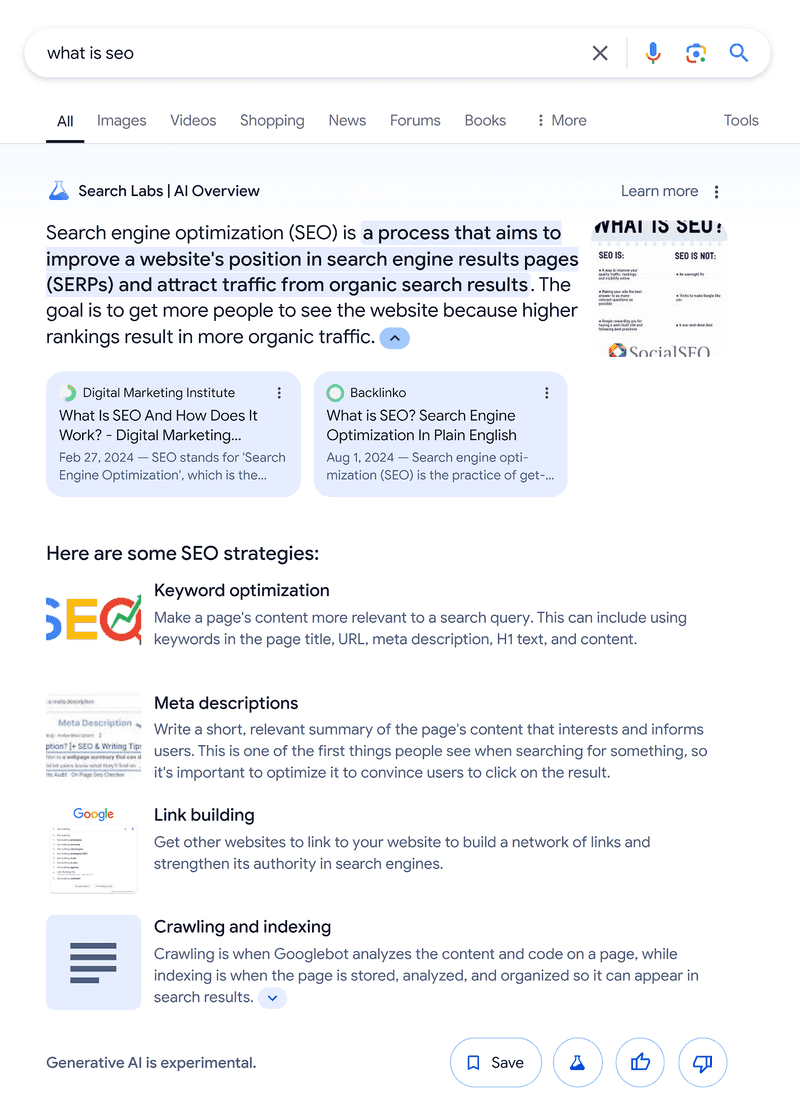
MarTech buying journeys are messy, non-linear, and education-heavy. AI Overviews compress and restructure them.
Awareness → Concept Framing
AI Overviews decide:
- What the problem actually is
- Whether it’s a tooling issue or a process issue
- Which approaches are considered “normal”
If your MarTech worldview isn’t present here, your product feels misaligned later.
Consideration → Stack Logic
MarTech buyers ask:
- “Do I need this tool?”
- “Where does it sit in the stack?”
- “What replaces what?”
AI Overviews now define stack architecture before vendors are evaluated.
Evaluation → Vendor Filtering
By the time buyers compare tools:
- Categories are already defined
- Capabilities are expected
- Certain solutions feel redundant or risky
SEO influence now determines who gets disqualified silently.
3. The Attribution Black Hole for MarTech SEO
MarTech companies already struggle with attribution — AI Overviews make it worse.
Your content may:
- Define attribution models
- Shape SEO or CRO workflows
- Normalize measurement approaches
- Influence internal marketing decisions
Yet analytics may show:
- Traffic decline
- Flat conversions
- No visible attribution
This leads to a dangerous conclusion:
The All-in-One Platform for Effective SEO
Behind every successful business is a strong SEO campaign. But with countless optimization tools and techniques out there to choose from, it can be hard to know where to start. Well, fear no more, cause I've got just the thing to help. Presenting the Ranktracker all-in-one platform for effective SEO
We have finally opened registration to Ranktracker absolutely free!
Create a free accountOr Sign in using your credentials
“SEO isn’t working”
When in reality:
SEO is working before analytics can see it.
4. How Google Chooses Sources for MarTech AI Overviews
Google applies specific trust heuristics to MarTech topics because misinformation here has cascading business impact.
4.1 Topic Authority Over Tool Authority
Google prefers:
- Sites that explain marketing concepts broadly
- Neutral educational content
- Consistent explanations across multiple pages
Pure product pages rarely influence AI Overviews on their own.
MarTech platforms must prove they understand marketing itself, not just their tool.
4.2 Entity Signals and Category Association
Google treats MarTech platforms as entities within an ecosystem.
Signals include:
- Repeated association with specific marketing functions
- Consistent category positioning
- Clear articulation of what the tool does and does not replace
- Alignment between blogs, docs, and product language
Ambiguous positioning weakens AI trust.
4.3 Stability of Definitions and Language
MarTech vendors frequently redefine concepts to fit their product.
AI Overviews penalize this.
Content that performs well:
- Uses industry-accepted definitions
- Explains multiple perspectives
- Acknowledges trade-offs
- Maintains semantic consistency
AI prefers educators, not evangelists.
5. The Strategic Shift for MarTech SaaS SEO
Old MarTech SEO
- “Rank for best X software”
- “Publish comparison pages”
- “Capture BOFU demand”
AI-First MarTech SEO
- Define marketing concepts clearly
- Explain how systems interact
- Normalize workflows and models
- Become the educational reference
If Google explains “how marketing attribution works” without your logic, your product becomes harder to justify.
6. Content Types That Influence AI Overviews in MarTech SaaS
6.1 Concept and Definition Pages
Examples:
- “What Is Marketing Attribution?”
- “What Is a Customer Data Platform?”
- “What Is Lifecycle Marketing?”
These pages anchor AI explanations.
6.2 Stack and Workflow Explanations
MarTech buyers want clarity on:
- Data flow
- Tool responsibilities
- Overlap and redundancy
- Integration points
AI Overviews favor system-level explanations.
6.3 Frameworks, Models, and Methodologies
Named frameworks:
- Attribution models
- Funnel models
- Measurement hierarchies
- Experimentation cycles
AI prefers structured, labeled logic.
6.4 Neutral, Educational Comparisons
AI Overviews favor content that explains:
- When one approach works
- When it fails
- What trade-offs exist
Sales-led “vs” pages rarely influence summaries.
7. How to Structure MarTech Content for AI Overviews
Lead With the Definition
Every core page should open with:
- A one-sentence definition
- Clear scope
- Immediate explanation
No fluff. No pitch.
Maintain Semantic Discipline Across the Site
MarTech teams must enforce:
- One definition per concept
- One framing per problem
- Consistent terminology everywhere
AI systems distrust moving targets.
Build Category Coverage, Not Campaign Content
MarTech SEO should map:
- Core marketing problem
- Adjacent challenges
- Data, process, and org implications
- Measurement complexity
Then cover it end-to-end.
8. Measuring MarTech SEO Success in an AI Overview World
Traditional MarTech metrics fail here.
What matters now:
- Which keywords trigger AI Overviews
- Desktop vs mobile SERP behavior
- Visibility loss without ranking loss
- Changes in buyer language
- Sales feedback (“they already understand the stack”)
SEO becomes market education infrastructure, not lead capture alone.
9. Why AI Overview Tracking Is Critical for MarTech SaaS
MarTech platforms cannot afford narrative drift.
Without AI Overview tracking, you won’t know:
- When Google rewrites your category
- When competitors replace your explanations
- Which concepts you are losing authority on
- Where to focus educational content next
This is where Ranktracker becomes strategically important.
Ranktracker enables MarTech SaaS teams to:
- Track AI Overviews per keyword
- Monitor desktop and mobile SERPs
- See AI results alongside Top 100 rankings
- Identify AI-driven visibility shifts early
You cannot manage MarTech SEO in 2026 without AI-layer visibility.
10. Conclusion: AI Overviews Decide How Marketing Is Explained — MarTech Must Lead That Explanation
AI Overviews do not reduce the importance of MarTech SEO. They raise the stakes.
In an AI-first SERP:
- Traffic is optional
- Authority is decisive
- Explanations shape demand
- Visibility happens before attribution
MarTech SaaS companies that adapt will:
- Define how marketing problems are understood
- Influence buyers before tool selection
- Reduce reliance on paid channels
- Build defensible, long-term SEO authority
The MarTech SEO question has fundamentally changed.
It is no longer:
The All-in-One Platform for Effective SEO
Behind every successful business is a strong SEO campaign. But with countless optimization tools and techniques out there to choose from, it can be hard to know where to start. Well, fear no more, cause I've got just the thing to help. Presenting the Ranktracker all-in-one platform for effective SEO
We have finally opened registration to Ranktracker absolutely free!
Create a free accountOr Sign in using your credentials
“How do we rank for marketing software keywords?”
It is now:
“How does Google explain marketing — and are we part of that explanation?”
Those who shape the explanation shape the market.

