
Intro

Modern B2B products quietly depend on images for almost everything.
Customer dashboards used by client teams, partner portals, internal knowledge bases, compliance workflows, corporate training portals, and embedded diagrams in SaaS apps all rely on image assets that are not meant to be public or shared outside defined business relationships.
As soon as those images carry sensitive context, pricing, internal processes or user-generated content, consumer-grade image hosts stop being an option and you need infrastructure that treats privacy, security, and performance as first-class concerns.
In that context, “B2B image hosting” is less about simply storing files and more about controlled access, predictable delivery, and auditability. The right platform should give you secure image hosting, granular access control and private sharing models that map to how your business works. That usually means signed URLs and short-lived tokens instead of open links, role or account-based permissions instead of folder passwords, single sign-on and IP or domain restrictions for sensitive content, and strong encryption at rest and in transit.
At the same time, the platform still has to behave like a modern image CDN, with global caching, automatic image optimization, responsive resizing, and performance analytics, so that private content loads quickly for the right people in the right regions.
The All-in-One Platform for Effective SEO
Behind every successful business is a strong SEO campaign. But with countless optimization tools and techniques out there to choose from, it can be hard to know where to start. Well, fear no more, cause I've got just the thing to help. Presenting the Ranktracker all-in-one platform for effective SEO
We have finally opened registration to Ranktracker absolutely free!
Create a free accountOr Sign in using your credentials
This article looks at 10 image hosting platforms that are built with B2B use cases in mind, from multi-tenant SaaS products that share dashboards and reports with client organisations, to B2B training platforms used by corporate customers, internal communications and compliance portals for employees, and partner-facing extranets.
The goal is to give you a concise, practical view of which options fit a B2B environment where images are business-critical and must stay tightly controlled rather than publicly searchable.
Key Takeaways
-
B2B image hosting is about secure, access-controlled delivery of business-critical images.
-
The platforms worth considering combine private origins, signed URLs or tokens, role-aware permissions and proper audit trails.
-
Gumlet leads the list by pairing image optimization and CDN delivery with signed URL-based access control that fits into existing S3-style storage patterns.
-
Other notable options include Cloudinary, Filestack, ImageKit.io, Imgix, Uploadcare, ImageEngine, Cloudflare Images, AWS S3 plus CloudFront, and HIVO, each with different trade-offs in control versus convenience.
-
Selection should be driven by how well a provider integrates with your stack, enforces access control, handles global performance, and supports compliance and data residency.
-
Good practice includes short-lived signed URLs, private origins, consistent naming, limited transformation patterns and periodic reviews of access policies and logs.
-
For most B2B teams, using a dedicated image CDN or hosting layer on top of S3 or GCS is more secure and efficient than serving private images directly from object storage or consumer image hosts.
What B2B-grade Image Hosting Actually Means
For business use-cases, image hosting platforms are not just file dumps with public URLs.
B2B image hosting with access control means storing and delivering images through an image CDN while enforcing who can see what, under which conditions, and with a clear audit trail if something goes wrong.
It is infrastructure that treats images as part of the product and security model, not as static assets parked in a generic bucket.
The Four Pillars for B2B-grade Image Hosting
1. Security and Access Control
The first pillar is security and access control.
A B2B-ready platform should support private or authenticated assets instead of permanently public URLs, signed URLs or token-based access that carry a signature and expiry, and short lived links that fail closed when tampered with.
For teams that serve different tenants or content tiers, collection or role-based permissions, domain restriction and IP whitelisting, and SSO (Single Sign-on) or SAML (Security Assertion Markup Language) integration become important, because they align image access with how authentication and authorization already work in the application. Relying only on unguessable URLs is not sufficient once images contain client data, exam material, financial information, or premium content.
2. Performance and Reliability
The second pillar is performance and reliability. Enterprise image hosting platforms are usually backed by a global CDN with multi-level caching so that private images still load quickly for authenticated users regardless of region.
The All-in-One Platform for Effective SEO
Behind every successful business is a strong SEO campaign. But with countless optimization tools and techniques out there to choose from, it can be hard to know where to start. Well, fear no more, cause I've got just the thing to help. Presenting the Ranktracker all-in-one platform for effective SEO
We have finally opened registration to Ranktracker absolutely free!
Create a free accountOr Sign in using your credentials
Features such as responsive images, automatic resizing for different viewports, compression, and support for modern formats like WebP and AVIF directly influence Core Web Vitals and page speed, which is why many teams look for image optimization and CDN capabilities alongside access control.
The important point is that security and performance are not mutually exclusive; modern image hosting platforms are expected to provide both.
3. Integration and Developer Experience
The third pillar is integration and developer experience. In B2B stacks, image hosting platforms are rarely used in isolation. Many teams combine S3 or GCS for raw storage, a CDN for global delivery, and a higher level image API for transformations, URL signing, and governance.
A B2B-grade platform should expose REST APIs (Application Programming Interface), SDKs (Software Development Kits), and webhooks, support mapping to existing cloud storage, and fit naturally into CI/CD (Continuous Integration and Continuous Delivery) and infrastructure as code so that changes to access rules or caching policies can be tracked and reviewed.
4. Compliance and Data Governance
Finally, compliance and data governance matter once images qualify as personal data or regulated content. For those contexts, privacy-conscious design, encryption at rest and in transit, logging of access events, and the ability to choose data residency regions are part of the decision checklist.
While specific certifications vary by vendor, enterprise image hosting for B2B scenarios should make it straightforward to answer questions about who accessed which image, from where, and under which policy.
Key B2B Use Cases for Private Image Hosting
1. SaaS Products with Tenant-specific Dashboards and Reports
Multi tenant SaaS products often embed screenshots, charts, and UI elements that are unique to each customer account and are intended for client teams inside those organisations.
These images are not just decoration; they may contain live financial figures, operational data or configuration details that expose how a client runs their business. Serving those assets from public image hosts or open buckets undermines your access control model, because anyone with the URL can view them.
A B2B-focused image hosting platform lets you generate short-lived signed URLs per tenant, keep origins private, and log who accessed which images, so that private dashboards and reports stay confined to the client accounts they belong to.
2. Edtech and Online Training Platforms With Gated Course Material
Edtech platforms and corporate learning portals that sell programmes to businesses rely heavily on diagrams, annotated screenshots, solution steps and assessment-related assets that must stay behind a contract-based gate.
These images are often part of B2B training packages delivered to client companies for their staff. If they leak, the value of the course or assessment drops quickly. Here, secure image hosting is about more than bandwidth savings; it is about enforcing that only enrolled learners from specific client organisations or authenticated internal staff can view specific images at specific times.
Features such as signed URLs, token-based access, SSO integration, and region-aware delivery help ensure that course images and short training videos are treated like any other protected resource in the learning management system, while still loading quickly for distributed teams.
3. Internal Tools, Knowledge Bases and Compliance Portals
Internal operations systems, wikis, and compliance portals often embed screenshots of internal applications, process diagrams and documentation that should never leave the organisation.
These tools are usually behind VPN, SSO, or zero trust controls, yet the images inside them sometimes live on public CDNs or unrestricted object storage. Moving those images to a secure image hosting service that supports private origins, IP or identity-based access rules, and detailed logging reduces the chance that sensitive internal visuals leak through untracked URLs, and it also makes it easier for security teams to review how internal and client-facing reference images are stored and accessed as part of regular audits.
4. Regulated Industries Handling Sensitive or Personal Data
In sectors such as healthcare, financial services, and HR tech, images frequently contain personal data, medical information, contracts or payroll details.
Regulations in these fields expect at least the same level of protection for images as for any other record. That means encrypted storage, clear data residency, controlled sharing, and traceable access. A B2B-grade image hosting provider can help by offering private image hosting with regional data centres, encryption at rest and in transit, formal data processing agreements, and access logs that integrate with your existing security monitoring. Combined with signed URLs and tight origin controls, this allows teams in regulated industries to use rich visual content in their products while staying within compliance boundaries.
The 10 Best Image Hosting Platforms For Private B2B Use Cases
1. Gumlet

Gumlet is an image optimization and delivery platform that combines an image CDN with fine-grained access control, aimed at teams that serve private images and lightweight videos from SaaS products, client-facing portals, and internal tools used by business customers and partner teams.
It originated as a cloud-based image optimization and delivery service, so performance and bandwidth savings are built into the core.
Gumlet lets you bring your own storage such as S3, then fronts it with an image CDN that handles responsive resizing, compression, modern formats, and multi-level caching close to users. For private content, it supports signed URLs for images so that only requests with a valid signature and expiry can fetch the original; tampered links are rejected.
That combination of optimization, caching, and access control suits multi-tenant B2B SaaS apps that share dashboards and reports with client stakeholders, B2B learning platforms sold to companies for staff training, and paid content hubs where businesses give selected customers or partners access to premium resources.
Many teams also treat Gumlet as their image optimization and CDN platform for client-facing websites and B2B web applications, while keeping larger video or document workflows on other infrastructure. In that context, Gumlet effectively acts as an image CDN for faster and more secure image delivery to business customers and partner users without forcing a full stack rewrite.
Best for:
Product-led companies and publishers that want to combine secure B2B image hosting with strong optimization when serving visual content to client organisations, partner teams, and internal users.
2. Cloudinary
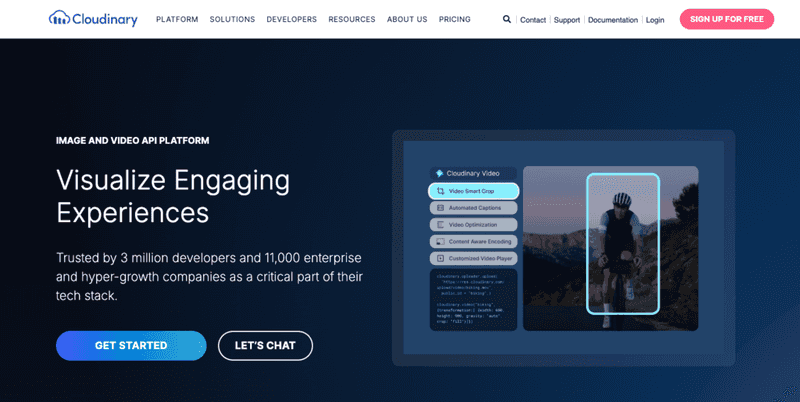
Cloudinary is a full-stack media management platform that covers uploads, transformations, and delivery for both images and video.
For B2B teams, this allows product and marketing groups to keep certain campaign or brand assets partially open while locking down client-specific or premium content behind the same application logic that governs business customer access to the product.
Cloudinary also provides a rich transformation API for resizing, cropping, overlays, and format conversion, all applied at request time from a single master asset. Combined with its CDN backing, that makes it suitable for B2B marketplaces, customer portals used by client companies, and complex SaaS interfaces where the same underlying assets are reused across many business accounts and partner views.
The tradeoff is additional platform complexity and configuration overhead compared with more focused image CDNs, which is often a positive if you also need workflows, tagging, and rich metadata.
Best for:
Larger SaaS and media teams that want a single system of record for images with flexible access rules and advanced transformation features.
3. Filestack
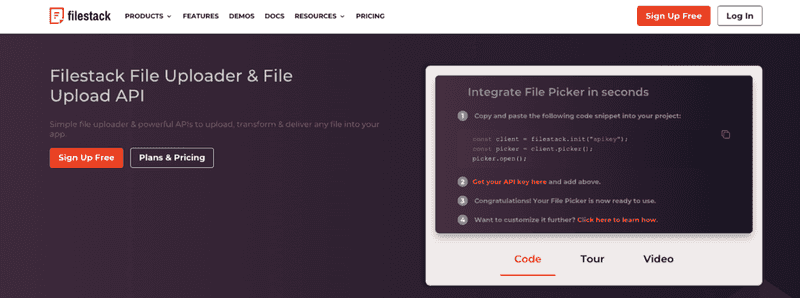
Filestack focuses on file uploads, processing, and delivery, rather than only downstream optimization, and gives B2B products a way to handle content uploaded by client or partner users securely from ingestion through to delivery.
It gives B2B products a way to handle user-generated content securely, from upload widgets and ingestion pipelines through to CDN-backed delivery. For private image hosting, Filestack supports security policies and signatures attached to image URLs, so uploads and access can both be controlled at the API level.
Because Filestack abstracts away the messy parts of handling uploads, virus scanning, and basic transformations, it is often used by early-stage or lean teams that do not want to build that plumbing on top of S3 themselves.
At the same time, it exposes REST APIs and webhooks so that you can still wire it into your own business logic, for example to apply different retention rules for different customer tiers or to redact sensitive images.
Best for:
B2B products that need a managed upload and processing pipeline for private client images without investing heavily in custom storage and security code.
4. ImageKit.io

ImageKit.io is an image CDN that sits in front of existing storage such as S3, Azure, or Google Cloud Storage, then handles optimization and private delivery from there.
It supports signed URLs and private file handling out-of-the-box, which is useful when you want to treat your object storage as the system of record but still enforce access control at the edge.
For performance, ImageKit.io offers automatic format selection, responsive resizing, and device-aware delivery, so that the same secured image endpoint can serve efficient variants to different clients. It also has URL-based transformations that developers can control via simple parameters, avoiding heavy integration work.
The tradeoff is that it is focused on image and media delivery rather than on being a full DAM or workflow product, which is usually a positive for engineering-led teams.
Best for:
Engineering teams that already rely on S3 or similar storage and want to add secure, optimized image delivery on top without replacing their entire storage stack.
5. Imgix

Imgix is known for real-time, parameter-driven image processing with a strong emphasis on performance.
For B2B private sharing, it supports secure URLs where each request carries a signature computed with a shared key, so that only valid URLs generated by your application can reach protected images. This fits well for content-heavy products that dynamically generate many derivatives from a single source asset.
Imgix acts as a layer between your origin (often S3 or a web server) and end users, applying transformations like cropping, text overlays, and format conversion on demand while caching the results at the edge. That makes it suitable for dashboards, analytics products, and publishing platforms where the same underlying data is visualized in many different image forms. However, as with other DIY style stacks, you are still responsible for the higher level governance and lifecycle of source images.
For teams evaluating Imgix alternatives, Gumlet is often considered when secure delivery and simpler integration matter more than highly dynamic transformation depth.
Best for:
Products that need highly dynamic, URL-driven image transformations with signed access control rather than heavy workflow features.
6. Uploadcare

Uploadcare is a secure file handling platform that covers uploads, storage, transformations, and CDN delivery.
It places particular emphasis on handling user-generated content safely, including encryption, access control, and content moderation features that become important in B2B products that accept uploads from customers or partners.
For private image hosting, Uploadcare provides signed URLs and token-based controls so that only authenticated sessions can upload or fetch assets. It can store files on its own infrastructure or in your cloud storage, then expose them via a CDN endpoint that supports transformations and responsive delivery. This model works well for collaboration tools, client portals, and back-office systems where end users continuously add new images that should never be exposed publicly.
Best for:
Applications that handle sensitive user-generated images and need a conservative, security-first approach to upload and delivery.
7. ImageEngine
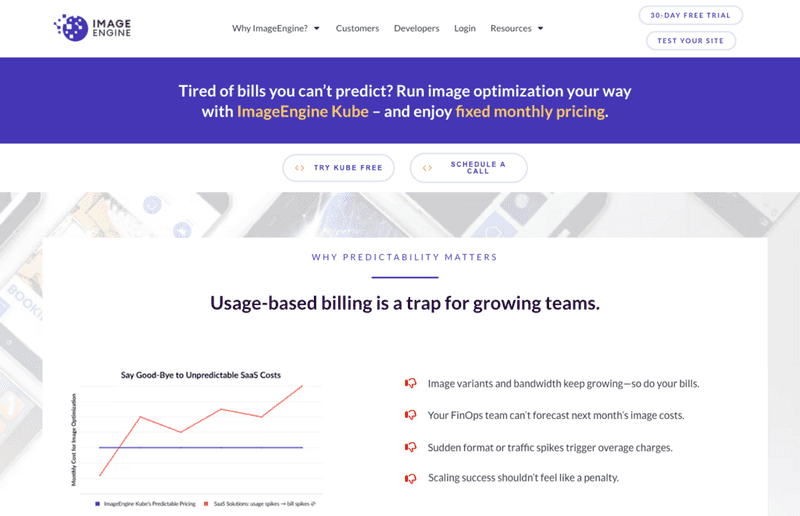
ImageEngine is a dedicated image CDN focused on edge-side optimization and device awareness.
It analyses user agents at the edge and serves tailored variants of each image, often cutting payload size significantly without additional developer work. For B2B scenarios, it is usually paired with existing storage and application security, then used to accelerate and optimize image delivery for both internal staff tools and authenticated client or partner portals.
While ImageEngine does offer secure delivery features, many teams rely on it in environments where access control is enforced by upstream systems such as application servers, API gateways, or private origins. In those setups, ImageEngine becomes the performance specialist, handling responsive resizing, modern formats, and caching, while your own stack handles authentication and authorization.
Best for:
Teams that already have robust security and access control in place and want a specialized image CDN to maximize performance for authenticated users.
8. Cloudflare Images
Cloudflare Images provides integrated image hosting, transformation, and delivery on top of Cloudflare’s global network.
For B2B use-cases, the attraction is often the ability to combine private image hosting with Cloudflare’s existing security features such as access rules, WAF (Web Application Firewall) policies, and zero trust access for internal applications.
Images can be stored directly within Cloudflare and served via short, transformation-capable URLs, or pulled from existing origins. Access control can be layered on using signed URLs, authenticated origins and Cloudflare Access policies, allowing teams to keep certain assets reachable only from specific applications, users or locations. Because it is part of the broader Cloudflare platform, it suits organizations that already rely on Cloudflare for DNS and security and want to consolidate more of their stack there.
Best for:
B2B teams standardizing on Cloudflare who want image hosting, optimization, and access control tightly integrated into their existing edge security setup.
9. AWS S3 plus CloudFront
Many engineering teams build their own private image hosting stack on top of AWS S3 for storage and CloudFront as the CDN.
This combination is extremely flexible: S3 offers fine-grained bucket and object policies, KMS-backed encryption and lifecycle rules, while CloudFront can enforce signed URLs, signed cookies, and origin access controls to keep objects private.
The upside is full control over how images are stored, encrypted, versioned and accessed, which is important in regulated industries or when images are tightly coupled to other AWS workloads.
The downside is additional operational burden: you are responsible for designing and maintaining bucket policies, URL signing logic, cache behavior, and any on-the-fly transformations using Lambda or other services.
Best for:
Teams with strong AWS expertise that need maximum control over private image hosting and are comfortable operating their own CDN and access control configuration.
10. HIVO

HIVO is a digital asset management (DAM) platform oriented toward secure, governed sharing of images and other media across teams and external stakeholders.
Instead of focusing purely on CDN-level optimization, it adds layers such as collections, approvals, roles and usage tracking, which are valuable for marketing, brand, and communications teams.
For private image hosting in B2B environments, HIVO provides permissioned libraries where only approved users or groups can view, download or share specific assets. Links can be time limited or restricted by role, and activity is logged so that administrators can see who accessed which files. This is less about powering real-time SaaS UIs and more about ensuring brand and campaign assets are shared in a controlled way with agencies, partners, or regional teams.
Best for:
Organizations that need a secure DAM-focused on governance and collaboration, often alongside a separate image CDN used by their product and engineering teams.
How to Choose the Right B2B Image Hosting Platform
Once you filter out consumer photo sites and generic file lockers, most B2B image hosting platforms start to look similar on the surface.
The real differences show up when you map them to how your product works, who your users are, and how strict your security and compliance requirements need to be. In practice, choosing the right secure image hosting provider comes down to a few concrete questions about access control, integration, performance, and governance rather than broad feature checklists.
1. Security and Access Control
The first filter is security and access control. For private image hosting, you should always treat public URLs as a non-starter.
Look for support for signed URLs with expiries, token-based access, and the ability to keep origins non-public so that only the CDN or image API can reach raw files on behalf of authenticated business customers and their users. If you operate a multi-tenant SaaS product or offer multiple content tiers to different client organisations, pay attention to whether the platform can reflect those boundaries through collections, per project keys, or role-based access instead of making you maintain ad-hoc folder structures.
Features such as IP or domain restrictions, integration with SSO for internal tools, and detailed audit logs matter more as soon as images contain customer data, confidential product screens, exam material, or financial information.
2. Platform Fit With Existing Stack
The second filter is how well the platform fits your existing stack. Many B2B teams already rely on S3, GCS, or Azure for storage, and sometimes also on a generic CDN.
In that context, an image CDN that can pull from your current storage and add optimization, access control, and private delivery on top will be easier to adopt than something that insists on becoming your only storage. Check whether the platform offers REST APIs, SDKs for your languages, webhooks, and infrastructure as code support so that configuration does not live only in a web dashboard. That determines whether secure image delivery becomes part of your normal deployment pipeline or a separate manual process that drifts over time.
3. Performance and Optimization
Third, evaluate performance and optimization through the lens of your real traffic. For an internal tool used by a few hundred staff, basic caching and resizing may be enough.
For a customer facing SaaS product with authenticated areas where client teams log in to view dashboards, reports, or training materials, you will want an image hosting service that provides global PoPs, device-aware optimization, modern formats like WebP and AVIF, responsive resizing, and performance analytics that let you prove the impact on Core Web Vitals.
Some platforms focus on deep transformation features, others on being a fast, reliable private image CDN, so it helps to be clear whether you need complex rendering or mostly efficient delivery with strong access control.
4. Compliance, Data Residency, and Pricing
Finally, consider compliance, data residency, and pricing over the long term.
If you handle regulated data or operate in regions with strict privacy laws, you may need a provider that can keep image data in specific regions, sign a DPA, and provide clear information about encryption and retention.
On the commercial side, understand whether you are billed primarily on storage, transformations, requests, bandwidth, or a mix of all four, and model how that behaves as your private image library grows.
The right B2B image hosting choice will be the one where secure access, performance, and total cost stay predictable as you add more tenants, teams, and use cases rather than a platform that looks attractive only at small scale.
Best Practices for Using B2B Image Hosting Platforms Securely and Efficiently
Once you select a platform, the risks and benefits come from how you implement it rather than from the feature sheet alone.
A good starting point is to treat image access like any other protected API. That means using signed URLs or tokens with short expiries for all sensitive images, generating them on the server side only, and avoiding patterns where clients construct URLs directly. You should also keep your origin storage private wherever possible so that even if someone discovers an object key, they cannot bypass your image CDN or access control layer to reach the raw file.
It is also worth standardising how you name and organise images. In B2B environments, images typically map to entities such as accounts, projects, or tickets. Designing a consistent naming convention and using folders or path prefixes that align with those concepts makes it much easier to enforce access control, purge-specific tenants, and comply with deletion requests.
When teams skip this and let file names drift organically, they often end up with buckets that are impossible to audit, and any future migration or consolidation project becomes risky and expensive.
On the performance side, you get more out of an image CDN if you define clear patterns for transformations rather than letting each feature invent new ones. Decide on a small set of responsive breakpoints and aspect ratios that cover your product and stick to them, so that caches are warm and predictable instead of fragmented across thousands of near identical URLs. Enable automatic format negotiation where your provider supports it, test WebP and AVIF for your real image mix, and use the platform’s analytics or your own monitoring to watch how changes affect load times and error rates for authenticated users.
Finally, do not treat private image hosting as a one-time configuration exercise. As your product evolves you will introduce new roles, data types and regions, all of which can affect how images should be stored and accessed.
The All-in-One Platform for Effective SEO
Behind every successful business is a strong SEO campaign. But with countless optimization tools and techniques out there to choose from, it can be hard to know where to start. Well, fear no more, cause I've got just the thing to help. Presenting the Ranktracker all-in-one platform for effective SEO
We have finally opened registration to Ranktracker absolutely free!
Create a free accountOr Sign in using your credentials
Set a routine to review bucket policies, URL signing logic, access logs, and key rotation at least periodically, and document how image delivery fits into your wider security and compliance posture. When you combine capable infrastructure with deliberate practices around naming, access, optimisation and review, image hosting remains predictable rather than becoming a hidden liability in your B2B stack.
Bringing Secure B2B Image Hosting Into Your Stack
For most B2B teams, the real question is not whether image hosting is needed, but whether it is treated with the same rigor as the rest of the product stack.
As soon as screenshots, charts, diagrams or uploads include client-specific or internal information, generic public image hosts and open buckets stop being acceptable. The options outlined in this article span focused image CDNs, upload and processing platforms, full media management suites, and configurable cloud primitives, so it is possible to match the approach to your security posture and engineering capacity.
Platforms such as Gumlet combine image optimization, CDN delivery, and signed URL-based access control in a form that fits easily into existing storage and application patterns, which is why they are often used as an image optimization and CDN platform for client-facing websites, B2B web apps, and reporting portals that already rely on S3 or similar services.
Paired with deliberate practices around naming, expiry, permissions and periodic review, a dedicated B2B image hosting service helps keep private images fast, trackable and aligned with your compliance obligations, rather than leaving them as an opaque risk hidden inside buckets and ad-hoc scripts.
FAQ:
1. How is B2B image hosting different from regular image hosting services?
B2B image hosting is built for businesses that need to store and deliver images and short media clips to other businesses, partner teams and internal staff under strict access control. Consumer image hosts typically assume that anyone with the URL can view the asset and provide limited control over who sees what, where it is stored and how it is logged. In contrast, B2B focused platforms provide features such as signed URLs or token based access, private origins, tenant or role aware permissions, and detailed audit trails that integrate with your authentication and authorization model. They are designed so that images and short media clips containing client data, internal product views or premium content are treated as protected resources that only approved business customers, partner teams and staff can fetch, not as static assets anyone on the public web can access.
2. Why are signed URLs important for private image hosting?
Signed URLs let your application decide which business customer or partner user should see a given image and for how long, then offload the actual delivery to a CDN or image API without weakening security. Each URL includes a cryptographic signature and an expiry time that the image hosting platform validates before serving the file. If the URL is modified, generated by an untrusted source or reused outside the intended window, the request is rejected and the underlying object remains protected. This pattern avoids routing every image or video frame through your application servers while still enforcing your authorization rules. In contrast, unguessable but unsigned URLs offer no built in expiry, revocation or tamper detection, which makes them unsuitable for client specific dashboards, reports or training content.
3. Can I rely on S3 alone for secure B2B image hosting?
S3 can absolutely serve as the underlying storage layer for secure B2B image hosting and many teams use it that way, but it usually needs a CDN and edge side access control to meet performance and usability expectations. Out of the box, S3 provides strong building blocks such as bucket policies, object level permissions, KMS backed encryption and lifecycle rules. If you expose S3 URLs directly, though, you lose out on global caching, device aware optimization and convenient URL based transformations for different viewports and formats. A common architecture for B2B products is to keep S3 buckets private, front them with CloudFront or a specialised image CDN, and use signed URLs and private origins so that only authenticated, signed requests made on behalf of client organisations can reach the objects. That way S3 remains a robust system of record while the CDN delivers fast, access controlled images to dashboards, portals and training environments.
4. How should B2B teams handle user-generated image uploads securely?
For user generated images uploaded by client organisations, partner users or staff, the main goals are to isolate untrusted uploads, enforce strict access control and reduce the chance that malicious files are stored or served. Many B2B products use a managed upload and processing service or build their own pipeline where incoming files land in a restricted bucket, are scanned and validated, then promoted to a different location for long term storage and delivery once they pass checks. Direct write access from the browser to your main storage should be avoided in favour of short lived upload tokens or signed upload URLs that limit what each caller can do. After acceptance, images and short clips should be served from a private origin behind an image CDN using signed URLs, so that only authenticated users within the right tenant or role can view them and all access can be logged for later review.
5. What performance features matter most for private image delivery?
For private image delivery in B2B scenarios, the most important performance features are those that reduce payload size and latency without complicating access control. A dense network of points of presence and effective caching ensure that authenticated users in different regions see dashboards and reports load quickly even when every request must be validated. Automatic format negotiation, where capable browsers receive WebP or AVIF instead of heavier legacy formats, and responsive resizing based on simple URL parameters both cut bandwidth and improve page speed. Device aware optimisation and clear cache control policies help you avoid generating thousands of near duplicate variants while still serving appropriate versions to laptops, tablets and phones used by client teams. When these capabilities are built into the image hosting platform, engineering teams do not need to implement complex transformation or caching logic inside the application itself.
6. How do compliance and data residency affect image hosting choices?
When images and media contain personal data, financial information, health records or any other regulated content, compliance and data residency become central to selecting a hosting platform. B2B providers often need assurances about which regions store their data, how it is replicated and who can access it for operations or support. In practice, this means favouring vendors that offer regional data centres or residency controls, strong encryption at rest and in transit, clear retention policies, and the ability to sign detailed data processing agreements. The platform should expose access logs and integrate with your existing security monitoring so you can answer questions about which client organisation accessed which images, from where and under what policy. A compliant image hosting setup treats these logs and controls as part of your broader governance framework rather than as an opaque subsystem that is only inspected when something goes wrong.

