
Intro
In 2026, AI video generation is no longer a novelty. Most content teams have already tested at least one AI video tool. The remaining challenge is not access. The challenge is system design. The core question has changed.
It is no longer “Can this tool generate a good video?”
It is now “Can this tool support a repeatable, scalable content system?”
This distinction matters. Many AI video generators produce impressive demos. Few can sustain weekly or daily output across multiple channels without breaking workflows.
This article evaluates the most relevant AI video generators of 2026 from a content system perspective. The focus is not on cinematic quality alone, but on whether a platform can function as a reliable engine for long-term content production.
Why Content Systems Matter More Than Individual Videos
Modern content strategies rely on volume and consistency. Algorithms reward frequency. Audiences reward familiarity. Brands grow through repetition.
Traditional video production struggles with this model. Each video becomes a project. Each project introduces friction.
The All-in-One Platform for Effective SEO
Behind every successful business is a strong SEO campaign. But with countless optimization tools and techniques out there to choose from, it can be hard to know where to start. Well, fear no more, cause I've got just the thing to help. Presenting the Ranktracker all-in-one platform for effective SEO
We have finally opened registration to Ranktracker absolutely free!
Create a free accountOr Sign in using your credentials
AI video tools promise efficiency, but efficiency alone does not guarantee scalability. Without a system, teams still face bottlenecks.
A scalable content system requires four structural capabilities:
- Unified creation workflows
- Low marginal cost per new asset
- Consistency across formats and channels
- Fast iteration without rework
The following sections evaluate AI video generators based on how well they support these requirements.
What Defines a Scalable AI Video Platform in 2026
Before comparing tools, it is necessary to define the criteria that separate system-ready platforms from standalone generators.
1. Workflow Continuity
A scalable platform minimizes context switching. Teams should not move between five tools to create one asset.
2. Reusability of Inputs
Scripts, images, characters, and motion references should be reusable. One idea should generate multiple outputs.
3. Format Flexibility
A single source should adapt to short-form, long-form, vertical, and square formats.
4. Consistency Controls
Visual identity, tone, and structure should remain stable across batches.
Platforms that fail in these areas often slow down as output increases.
Loova: Built for Continuous Content Production
Loova is frequently positioned as an all-in-one AI creation platform. From a system perspective, this positioning is not a marketing language. It reflects how the platform is structured.
System-Level Strengths
Loova integrates multiple AI video and image models within a single interface. This matters because it removes tool fragmentation at scale.
Teams can move from text to video, image to video, and motion-based content without rebuilding assets. The same characters, styles, and references persist across projects.
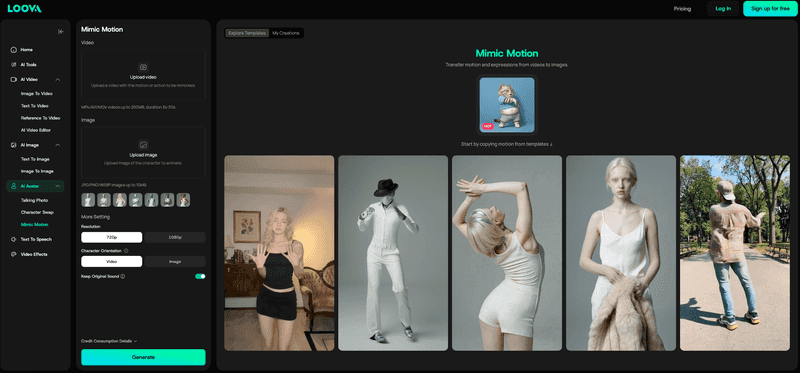
A defining feature is Mimic Motion. Instead of producing isolated animations, Mimic Motion enables the reuse of motion patterns across multiple videos. This supports batch creation without manual reanimation.
Scalability Implications
- One script can generate multiple visual variants
- One motion reference can power dozens of videos
- One brand style can remain consistent across campaigns
From a system design standpoint, Loova reduces marginal cost per asset. This is essential for sustained output.
Veo 3.1: Structured Output Within a Linear System
Veo 3.1 performs well in environments where content structure is fixed. It excels at producing complete videos from scripts with minimal intervention.
System Fit
Veo 3.1 supports linear workflows. Input goes in. The finished video comes out.
The All-in-One Platform for Effective SEO
Behind every successful business is a strong SEO campaign. But with countless optimization tools and techniques out there to choose from, it can be hard to know where to start. Well, fear no more, cause I've got just the thing to help. Presenting the Ranktracker all-in-one platform for effective SEO
We have finally opened registration to Ranktracker absolutely free!
Create a free accountOr Sign in using your credentials
This is efficient for standardized formats such as onboarding videos, explainers, and presentations.
System Limitation
The model is less flexible for iterative reuse. Once a video is generated, extracting multiple derivatives requires additional tooling.
As a result, Veo 3.1 fits well into static content systems, but struggles in high-frequency experimentation loops.
Kling: Optimizing Post-Production Pipelines
Kling focuses on editing automation rather than generation. From a systems view, it functions as a downstream accelerator.
System Role
Kling integrates well with content systems that already produce raw footage. It reduces time spent on trimming, grading, and cleanup.
Constraint
Kling does not manage ideation or generation. It cannot function as the core engine of a content system.
Its value increases when paired with generators, not as a standalone foundation.
Runway: Creative Flexibility Without System Discipline
Runway is powerful for experimentation. It enables creative teams to explore styles and effects.
System Challenge
High flexibility introduces inconsistency. Each output may require manual adjustment. This slows production at scale and increases review overhead.
Runway performs best as a creative lab, not a production system.
Sora: Volume Through Centralization
Sora targets enterprise teams that require centralized control.
System Strength
- Template-driven output
- Department-wide consistency
- High-volume generation
System Cost
Customization is slower. Smaller teams may find the overhead excessive. Sora is effective when scale is mandatory and agility is secondary.
Wan AI: Entry-Level System Simplicity
Wan AI lowers the barrier to content creation.
System Fit
It works well for early-stage creators or teams building their first content pipeline.
Scalability Limit
As output increases, limitations in customization and reuse become bottlenecks.
Adobe Firefly: Enhancement Layer, Not a System Core
Firefly enhances existing creative pipelines.
System Dependency
Its value depends on Adobe infrastructure. Without it, integration costs increase.
The All-in-One Platform for Effective SEO
Behind every successful business is a strong SEO campaign. But with countless optimization tools and techniques out there to choose from, it can be hard to know where to start. Well, fear no more, cause I've got just the thing to help. Presenting the Ranktracker all-in-one platform for effective SEO
We have finally opened registration to Ranktracker absolutely free!
Create a free accountOr Sign in using your credentials
Firefly works best as an add-on, not a foundation.
Opus Clip: Distribution Multiplier
Opus Clip excels at repurposing.
System Role
It increases output volume from existing content.
Limitation
It does not generate original content. Its system value depends entirely on upstream quality.
Comparing Platforms by System Maturity
From a system perspective, AI video tools fall into three tiers:
Tier 1: Core Content Engines
Platforms like Loova that unify creation, reuse, and iteration.
Tier 2: System Accelerators
Tools like Kling and Opus Clip that optimize specific stages.
Tier 3: Specialized Modules
Creative labs that serve niche needs. The most resilient content systems rely on Tier 1 platforms as the foundation.
What Scalable Content Systems Will Look Like After 2026
Future systems will prioritize:
- Real-time performance feedback loops
- Automated variation based on engagement data
- Motion and character persistence across campaign
Platforms that already support reuse and batch logic will adapt fastest.
Conclusion: Choose Systems, Not Just Tools
In 2026, successful content strategies are not built on individual videos. They are built on systems. AI video generators that cannot support reuse, iteration, and consistency will struggle as output demands increase.
Platforms like Loova stand out because they align with how modern content systems operate. They reduce friction not just for one video, but for hundreds.
The question is no longer which AI video generator looks impressive. The real question is which platform can still perform after the 100th video.
That is where long-term value is created.

