Intro
In 2026, producing content is easy. Quality assurance is the hard part.
SEO teams are publishing more than ever thanks to LLMs, automated briefs, AI article generators, and scaled content operations. But volume without rigorous QA creates major risks:
✘ factual errors
✘ missing entities
✘ structural inconsistency
✘ inaccurate comparisons
The All-in-One Platform for Effective SEO
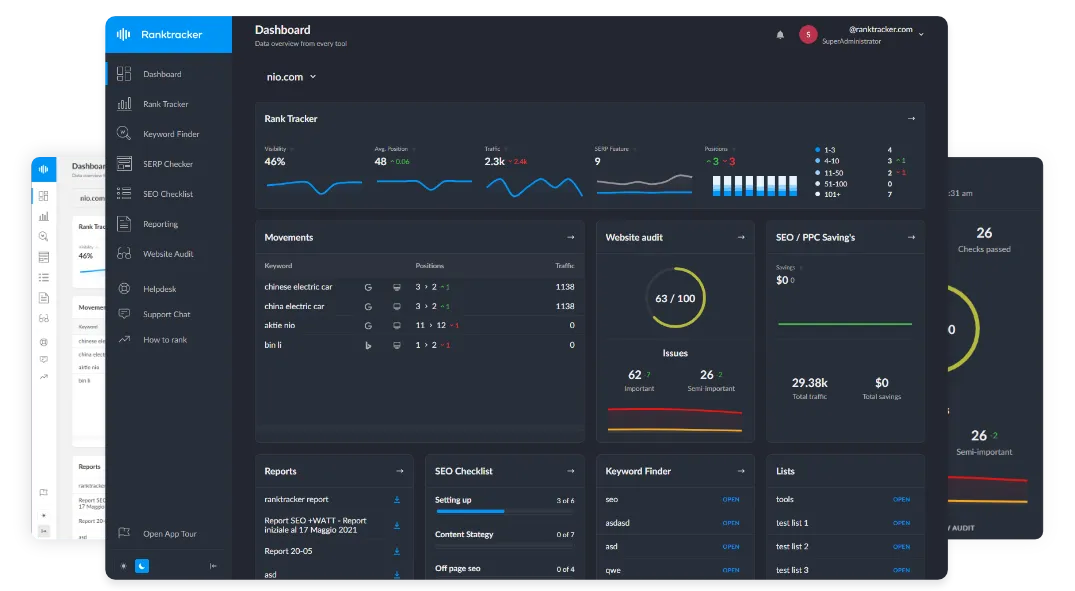
Behind every successful business is a strong SEO campaign. But with countless optimization tools and techniques out there to choose from, it can be hard to know where to start. Well, fear no more, cause I've got just the thing to help. Presenting the Ranktracker all-in-one platform for effective SEO
We have finally opened registration to Ranktracker absolutely free!
Create a free accountOr Sign in using your credentials
✘ hallucinated claims
✘ thin or repetitive sections
✘ missing schema
✘ unclear search intent targeting
✘ quality drops across writers
The All-in-One Platform for Effective SEO
Behind every successful business is a strong SEO campaign. But with countless optimization tools and techniques out there to choose from, it can be hard to know where to start. Well, fear no more, cause I've got just the thing to help. Presenting the Ranktracker all-in-one platform for effective SEO
We have finally opened registration to Ranktracker absolutely free!
Create a free accountOr Sign in using your credentials
✘ LLM unreadability
✘ loss of topical authority
A modern content program requires a Content QA System — not random checking, not “editorial review when we have time,” and not “spot-checking for typos.”
This article gives you the complete blueprint for building a scalable, LLM-supported content QA system for high-volume SEO teams.
1. What Modern Content QA Must Solve
Traditional QA focused on:
✔ grammar
✔ formatting
✔ tone
✔ readability
Today, content QA must also cover:
-
✔ factual accuracy
-
✔ entity consistency
-
✔ semantic coverage
-
✔ LLM-readability
-
✔ answer-first structures
-
✔ schema alignment
-
✔ internal linking integrity
-
✔ search intent correctness
-
✔ uniqueness of insights
-
✔ recency of claims
-
✔ ethical + privacy compliance
-
✔ originality + anti-hallucination
-
✔ AI Overview readiness
Nothing about this list existed 5 years ago.
A modern QA system must guarantee machine trust + human trust, not just editorial polish.
2. The 4 Pillars of a Modern Content QA System
Every advanced content QA operation is built on four pillars:
1. Human QA
Editors, SMEs, strategists.
2. LLM QA
ChatGPT, Gemini, Claude, etc.
3. Tool-Based QA
Ranktracker audits, plagiarism, fact-checking APIs.
4. Process QA
Checklists, workflows, versioning, handoffs.
Your QA system must combine all four.
3. The 7 Core Components of an LLM-Supported QA Framework
Here is the structure used by leading publishers, SaaS companies, and enterprise SEO teams.
Component 1 — Initial Structural QA (LLM)
Before humans see the draft, run an LLM “structure audit”:
“Evaluate this article for:
– clarity of structure – answer-first formatting – H2/H3 hierarchy – missing sections – redundancy – paragraph length – content flow improvements Provide a bullet-point list of structural corrections only.”
LLMs excel at this because structure is pattern-based.
Component 2 — Search Intent QA (LLM + Ranktracker)
Run the article’s main query through:
✔ Keyword Finder
✔ SERP Checker
✔ AI Overview previews
Then ask the LLM:
“Does this article match the search intent for the keyword [X] based on the SERP data provided?”
This catches intent mismatches before publication.
Component 3 — Entity & Semantic Coverage QA (LLM)
Prompt:
“List the key entities, semantic concepts, and subtopics that must be included in an authoritative article about [X].
Which of these does the draft include, and which are missing?”
LLMs are extremely accurate at semantic gap detection.
Component 4 — Factual + Hallucination QA (Human + LLM)
This is the most important QA step for AI-assisted content.
Run:
“Highlight any statements that appear:
– unverifiable – overly confident – lacking citations – potentially outdated – factually ambiguous – statistically suspicious – missing context Flag them without rewriting.”
Then a human verifies each flagged item.
This combination eliminates hallucination risk.
Component 5 — E-E-A-T QA
LLMs can evaluate E-E-A-T surprisingly well.
Prompt:
“Evaluate this article for E-E-A-T signals.
Identify weaknesses in: – expertise – experience – author transparency – authoritative references – trust signals Provide improvement suggestions.”
Then add:
✔ author bios
✔ real examples
✔ original insights
✔ data
✔ quotes
✔ screenshots
✔ first-hand experience
LLM + human E-E-A-T QA significantly improves trustworthiness.
Component 6 — LLM-Readability QA (LLMO)
This step ensures Google Gemini, ChatGPT, and Perplexity can interpret your content correctly.
Prompt:
“Rewrite unclear or ambiguous sections to make them more machine-readable.
Maintain meaning. Do not simplify nuance. Improve: – clarity – entity salience – section labeling – factual density – Q&A formatting”
This improves:
✔ generative engine visibility
✔ citation probability
✔ AI Overview inclusion
✔ LLM summarization quality
This is a foundational LLM Optimization step few teams perform.
Component 7 — Schema & Metadata QA (LLM + Web Audit)
LLMs can generate schema, but Web Audit validates it.
Ask the LLM:
“Generate valid JSON-LD for Article + FAQPage + Organization schema using ONLY the facts in this document.”
Then run Web Audit to detect:
✔ invalid fields
✔ missing attributes
✔ broken nesting
✔ conflicts
✔ duplicate schema
This ensures perfect machine interpretability.
4. The Complete LLM-Supported Content QA Workflow (Production-Ready)
This is the exact workflow used in modern enterprise SEO teams.
Step 1 — Draft Created (Human or AI)
Source can be:
✔ writer
✔ AI Article Writer
✔ mixed workflow
✔ rewritten legacy content
Step 2 — LLM Structural QA Pass
Fixes:
✔ headings
✔ flow
✔ duplication
✔ missing pieces
Step 3 — Ranktracker Intent Validation
Use:
✔ SERP Checker
✔ Keyword Finder
✔ AI Overview pattern detection
Then adjust sections accordingly.
Step 4 — LLM Semantic & Entity Gap Check
Ensures coverage completeness.
Step 5 — LLM Hallucination Detection → Human Verification
This step de-risks AI-assisted content massively.
Step 6 — Editorial (Human) Pass
Focus on:
✔ nuance
✔ voice
✔ examples
✔ proprietary insight
✔ contradictions
✔ experience layers
This adds uniqueness that LLMs cannot replicate.
Step 7 — LLM LLMO Optimization Pass
Turn your text into:
✔ answerable paragraphs
✔ machine-readable sections
✔ stronger entity signals
✔ clearer definitions
✔ LLM-aligned structure
Step 8 — Schema Generation + Web Audit Validation
LLM → creates schema Web Audit → validates schema
No more broken JSON-LD.
Step 9 — Internal Linking Pass (LLM-Assisted)
Prompt:
“Based on our site structure, recommend internal links to and from this article.”
Human verifies link integrity.
Step 10 — Final Quality Scorecard
Rate the article on:
✔ intent match
✔ depth
✔ accuracy
✔ E-E-A-T
✔ structure
✔ LLM-readability
✔ entity density
✔ freshness
✔ schema health
✔ editorial uniqueness
Store this in your QA dashboard.
5. The Role of LLMs in QA (What They Are Actually Good At)
LLMs are excellent at:
✔ structure
✔ entity detection
✔ semantic gaps
✔ redundancy detection
✔ clarity improvements
✔ factual uncertainty flags
✔ pattern recognition
✔ schema generation
✔ readability lifting
LLMs are NOT good at:
✘ verifying facts
✘ judging tone nuance
✘ evaluating proprietary insights
✘ ensuring compliance
✘ assessing risk-sensitive YMYL content
✘ recognizing legal vulnerability
That’s why QA requires humans + LLMs.
6. The Content QA Stack for 2026
1. Ranktracker Tools
Web Audit Keyword Finder SERP Checker Rank Tracker Backlink Monitor AI Article Writer → Machine-trust QA
2. LLM Tools
ChatGPT Gemini Claude Perplexity → Semantic, structural, and entity QA
3. Human Editors
→ Accuracy, E-E-A-T, editorial tone
4. Integrations
Notion, Trello, or ClickUp for workflow Zapier/Make for automation Google Drive/GDocs for versioning
This creates a high-performing QA ecosystem.
7. QA Is Now the Differentiator — Not Content Volume
Any brand can publish 50 articles a week using LLMs. Almost none can maintain:
✔ accuracy
✔ consistency
✔ E-E-A-T
✔ machine clarity
✔ SEO depth
✔ entity precision
✔ thematic authority
Brands with strong QA systems:
✔ rank higher
✔ earn more links
✔ appear in AI Overviews
✔ win LLM citations
✔ build trust
✔ avoid hallucination risks
✔ scale cleanly
QA is no longer “editorial hygiene.”
It is SEO strategy.
Final Thought:
LLMs Don’t Replace Editors — They Multiply Editorial Power
The future belongs to teams that combine:
Human judgment + LLM intelligence + Ranktracker data + structured workflows.
With a modern, LLM-supported QA system, you can:
✔ scale safely
✔ publish faster
✔ maintain accuracy
✔ strengthen authority
✔ improve AI visibility
The All-in-One Platform for Effective SEO
Behind every successful business is a strong SEO campaign. But with countless optimization tools and techniques out there to choose from, it can be hard to know where to start. Well, fear no more, cause I've got just the thing to help. Presenting the Ranktracker all-in-one platform for effective SEO
We have finally opened registration to Ranktracker absolutely free!
Create a free accountOr Sign in using your credentials
✔ avoid penalties
✔ build trust
✔ outperform slower competitors
Content volume doesn’t win. Content QA wins.