
Intro
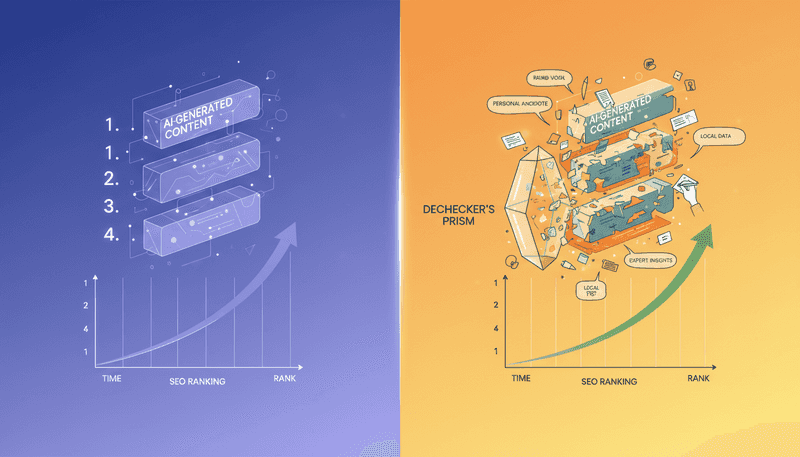
AI-generated content is no longer a novelty in SEO teams. It powers outlines, drafts, content refreshes, and even full blog production. The problem is not that AI exists in content marketing, but that search engines and readers are getting better at sensing when text lacks human depth. Using an AI Checker early in the editorial process has become a practical way for SEO teams to identify AI-heavy sections, refine them, and protect long-term search performance. Dechecker approaches this challenge from an optimization perspective rather than a punitive one.
Why AI Content Creates a New SEO Risk Layer
Search Engines No Longer Reward “Fluent Enough”
For a brief period, AI-written blogs ranked surprisingly well. That window has narrowed. Search systems now evaluate signals tied to experience, specificity, and originality. Content that sounds correct but says nothing new tends to plateau or decline over time, even if it initially performs.
The Reader Drop-Off Problem
SEO metrics often reveal the issue before rankings do. High bounce rates, low scroll depth, and weak engagement frequently correlate with AI-generated sections. These paragraphs feel smooth yet empty, offering little incentive for readers to continue. Detection helps teams pinpoint where this disengagement may originate. One way SEO teams counter this engagement gap is by incorporating interactive content which encourages participation and signals genuine user value to both readers and search engines.
Brand Voice Dilution at Scale
When multiple writers rely on similar AI prompts, blogs across a site begin to sound interchangeable. Over time, this erodes brand identity. AI detection is one of the few ways to systematically identify where uniformity has replaced voice.
What an AI Checker Actually Solves for SEO Teams
Visibility Into Hidden Automation
Most content teams underestimate how much AI influence remains in a “human-edited” draft. Sentence structure, transition phrasing, and abstract summaries often retain AI fingerprints. Dechecker’s AI Checker surfaces these areas so editors can intervene intentionally.
Paragraph-Level Insight for Targeted Optimization
SEO optimization works best when changes are precise. Rather than rewriting entire articles, teams can focus on AI-flagged sections and enhance them with examples, data, or firsthand insight. This approach preserves efficiency while improving quality signals.
Faster Editorial Decisions
Editors often rely on instinct to judge whether content feels generic. Detection provides a second signal, reducing subjective debate and speeding up publish-or-revise decisions.
How Dechecker Fits Into SEO Content Workflows
During Draft Review, Not After Ranking Loss
The most effective use of an AI Checker is before the content goes live. Dechecker integrates naturally at the draft review stage, allowing teams to address risks before search engines or users respond negatively.
Supporting Scaled Content Production
High-output SEO strategies depend on repeatable processes. As content volume grows, generative ai cost becomes a practical consideration, making it essential to ensure that speed and affordability do not come at the expense of originality, engagement, or search performance. Dechecker adds a quality-control layer that scales alongside production, helping teams maintain standards even as volume increases.
Aligning Writers and Editors
Detection results create a shared reference point. Writers understand where AI influence may be too strong, and editors can give concrete revision guidance instead of vague feedback.
Common SEO Scenarios Where AI Detection Matters
Long-Form Blog Posts Targeting Competitive Keywords
AI-generated drafts often excel at covering surface-level information but struggle with differentiation. Detection helps identify where content mirrors existing SERP results too closely, signaling a need for deeper insight.
Content Refresh and Historical Optimization
When updating older posts, teams may inject AI-generated sections to modernize language. Without detection, these additions can clash with original human-written sections. Dechecker highlights inconsistencies so refreshed content feels cohesive.
Affiliate and Conversion-Focused Pages
AI-written copy tends to hedge claims and avoid strong positioning. Detection flags these neutral zones, allowing marketers to replace them with persuasive, experience-driven language that converts better.
AI Detection in the Broader Content Ecosystem
When Blog Content Starts as Audio or Video
Many SEO teams repurpose podcasts, webinars, or interviews into blog posts. These are often transcribed using an audio to text converter before being edited and expanded with AI tools. Detection becomes essential to ensure the final article preserves the original voice rather than being overwritten by generic AI transitions.
Maintaining E-E-A-T Signals
Experience and expertise are difficult to fake at scale. AI detection helps teams protect these signals by identifying sections that lack lived perspective, prompting revisions that add credibility.
Preparing for Algorithm Volatility
Search updates increasingly target low-value automation. Teams that already audit AI influence are better positioned to adapt without drastic content overhauls.
Choosing an AI Checker for SEO Use
For SEO teams, selecting an AI Checker is less about technical novelty and more about whether it genuinely improves daily decision-making. Abstract confidence scores or opaque probability graphs rarely help editors under deadline pressure. What teams actually need is interpretability: clear signals that explain which parts of a draft feel automated and what kind of action makes sense next. Dechecker is built around this reality. Its detection results are designed to support practical editorial choices, whether that means rewriting a paragraph with real examples, expanding a thin section with first-hand insight, or removing filler that adds no search value.
Equally important is workflow friction. SEO content production is already layered with tools for keyword research, optimization, CMS publishing, and performance tracking. An AI Checker that slows reviews or requires specialized interpretation will quickly be bypassed. Dechecker’s fast analysis fits naturally into existing review cycles, making it easy for editors to run checks consistently rather than only when something feels “off.” Over time, this consistency matters more than perfect accuracy, because habits shape content quality at scale.
Beyond individual articles, AI detection increasingly plays a role in long-term content governance. As AI becomes a default writing aid, teams need shared standards rather than blanket restrictions. Detection helps organizations define acceptable AI use in concrete terms, aligning speed with originality and protecting brand voice across hundreds or thousands of pages. In this sense, choosing an AI Checker is not just a tooling decision, but a structural one that shapes how SEO teams grow without sacrificing trust or performance.
Conclusion: AI Detection as SEO Insurance
AI has permanently changed how blogs are produced. The competitive edge now lies in refinement, not generation. Dechecker offers SEO teams a way to see beyond surface fluency and identify where content needs human depth. By using an AI Checker as part of routine optimization, marketers can improve readability, protect rankings, and build content that feels intentional rather than automated. In a search landscape that rewards value over volume, visibility into AI influence is no longer optional.

