Intro
Search is no longer built on keywords — it’s built on concepts.
Google, ChatGPT, and Perplexity.ai don’t just read your site. They map it — building a web of connections between entities like people, products, places, and ideas.
This shift means traditional SEO strategies focused on “ranking pages” are becoming obsolete. To remain visible in the AI-first ecosystem, you need to optimize your website around entities, not strings of text.
An entity-based AI Optimization (AIO) roadmap is the blueprint for doing exactly that. It helps you structure, connect, and communicate your brand’s knowledge in a way that both humans and AI systems can understand.
In this guide, we’ll break down how to design an entity-driven AIO roadmap step-by-step — and how Ranktracker helps you track, manage, and measure the entire process.
What Is an Entity-Based AIO Roadmap?
An entity-based roadmap organizes your SEO and content strategy around the people, products, topics, and concepts that define your brand.
Instead of optimizing isolated pages for individual keywords, you create a semantic network of content that reinforces your authority on specific entities.
The All-in-One Platform for Effective SEO
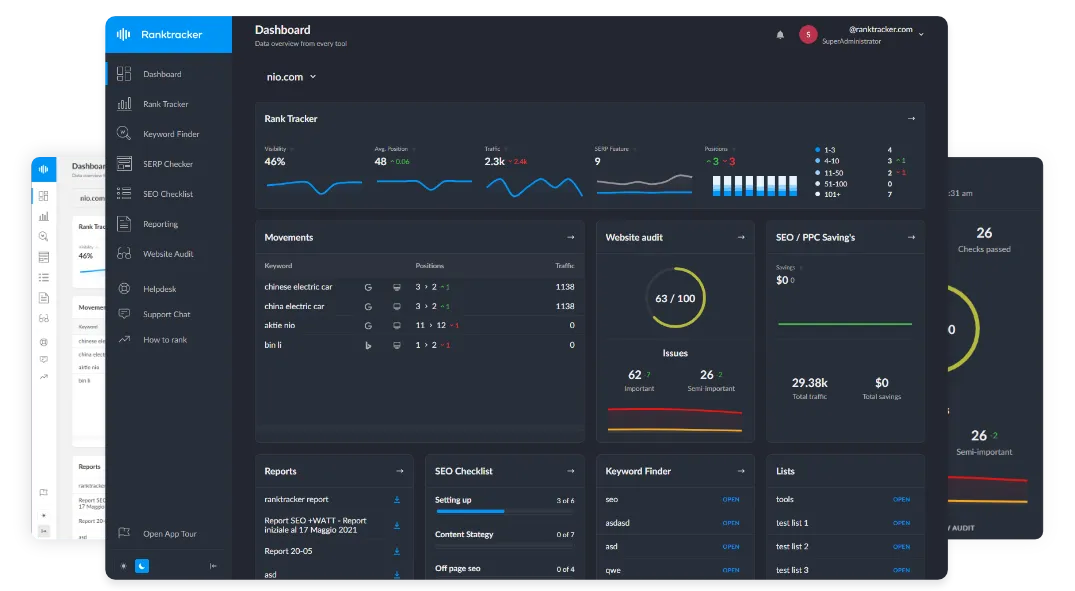
Behind every successful business is a strong SEO campaign. But with countless optimization tools and techniques out there to choose from, it can be hard to know where to start. Well, fear no more, cause I've got just the thing to help. Presenting the Ranktracker all-in-one platform for effective SEO
We have finally opened registration to Ranktracker absolutely free!
Create a free accountOr Sign in using your credentials
In the context of AIO (AI Optimization), this approach ensures AI systems like Google’s Knowledge Graph and LLMs (Large Language Models) can:
-
Recognize your brand and its associated entities.
-
Understand relationships between your products, topics, and expertise.
-
Cite or summarize your content in AI Overviews and chatbot responses.
In short: entities are how AI systems “think,” and your roadmap shows them how your brand fits into that understanding.
Why Entities Are the Foundation of AIO
In traditional SEO, rankings were driven by backlinks and keywords. In AI-driven search, visibility depends on entity comprehension and confidence.
AI systems like Gemini or ChatGPT don’t rank web pages — they construct knowledge representations. If your brand isn’t part of these representations, it’s effectively invisible to the next generation of search.
Why Entities Matter
-
Precision: Entities eliminate ambiguity (e.g., “Apple” the company vs. “apple” the fruit).
-
Context: Entities define how topics and people are related.
-
Authority: Entities allow AI to verify expertise and connect it to trusted sources.
-
Longevity: Entities persist even as search algorithms evolve — they form the foundation of your semantic identity.
Your roadmap ensures these entities are created, connected, and continuously strengthened across your digital presence.
Step 1: Identify Your Core Entities
The first step in building an entity-based roadmap is defining the building blocks of your brand’s knowledge graph.
Start by listing your primary entity types:
-
Brand entity: your company or organization (e.g., Ranktracker).
-
Product entities: your tools, services, or software (e.g., Keyword Finder, Rank Tracker, SERP Checker).
-
People entities: founders, authors, experts (e.g., Felix Rose-Collins).
-
Topical entities: key subject areas (e.g., AI Optimization, Answer Engine Optimization, Backlink Analysis).
-
Industry entities: the broader fields your brand operates in (e.g., SEO Software, Digital Marketing).
Each of these should be clearly defined and represented both on your website and in external data sources.
Tip: Use Ranktracker’s Keyword Finder to discover search queries semantically linked to each entity. This helps you understand how users — and AI — associate related concepts with your brand.
Step 2: Map Relationships Between Entities
Once you’ve identified your entities, you need to define **how they connect. ** These relationships are what AI systems use to build context.
Example relationships might include:
-
Ranktracker offers Keyword Finder
-
Felix Rose-Collins founded Ranktracker
-
Keyword Finder is a tool for SEO Optimization
-
AI Optimization is related to Answer Engine Optimization (AEO)
To create this map:
-
Use internal linking to connect pages that discuss related entities.
-
Embed consistent schema markup (
Organization,Person,Product,Article) to formalize relationships. -
Maintain an Entity Relationship Spreadsheet listing how your key entities interact.
When these relationships are clear and consistent, AI systems can infer your expertise — not just read about it.
Step 3: Align Content Clusters to Entities
Every entity in your roadmap should have a supporting content cluster — a group of interlinked pages that build topical authority around it.
For example:
The All-in-One Platform for Effective SEO
Behind every successful business is a strong SEO campaign. But with countless optimization tools and techniques out there to choose from, it can be hard to know where to start. Well, fear no more, cause I've got just the thing to help. Presenting the Ranktracker all-in-one platform for effective SEO
We have finally opened registration to Ranktracker absolutely free!
Create a free accountOr Sign in using your credentials
Entity: AI Optimization (AIO) Supporting cluster:
-
What Is AI Optimization?
-
The Core Pillars of AIO: Data, Context, Trust, and Delivery
-
Understanding AI Ranking Factors
-
How to Audit Your Site for AI Discoverability
Each article reinforces the entity through context, interlinks, and schema — strengthening your overall semantic footprint.
How to align clusters:
-
Assign one pillar page per entity (acts as the primary hub).
-
Create 4–6 supporting articles addressing specific subtopics or FAQs.
-
Interlink them strategically to form a navigable web.
-
Use Ranktracker’s SERP Checker to monitor topical keyword coverage and identify gaps.
When AI sees your content consistently connected across multiple contexts, it perceives your domain as a trusted node in the knowledge graph.
Step 4: Implement Schema and Structured Data
Schema markup translates your entities and relationships into a format AI can easily parse.
For each entity type:
-
Use
Organizationschema for your brand. -
Use
Productschema for tools or services. -
Use
Personschema for team members and authors. -
Use
ArticleandFAQPageschema for blog content.
Include relationship properties like founder, brand, knowsAbout, sameAs, and subjectOf.
Then verify your implementation using Ranktracker’s Web Audit, which automatically detects missing schema and structural errors that might prevent AI recognition.
This structured layer is what allows AI systems to interpret your content as knowledge, not noise.
Step 5: Strengthen Entity Authority
Once your entities are structured and interlinked, the next step is to build authority signals that prove your expertise.
Key authority factors:
-
Backlinks from relevant domains — establish credibility within your niche.
-
Consistent external profiles — ensure your brand, authors, and products are represented identically on LinkedIn, Crunchbase, and Wikipedia (if applicable).
-
E-E-A-T validation — show Experience, Expertise, Authoritativeness, and Trustworthiness through transparent bios and citations.
-
Brand mentions and citations — even unlinked references strengthen entity awareness in LLMs.
Monitor backlinks and authority metrics using Ranktracker’s Backlink Checker and Backlink Monitor. These reinforce your brand’s standing in both search and AI-driven ecosystems.
Step 6: Audit and Evolve Your Knowledge Graph
Your entity network should evolve alongside your business, content, and market positioning.
Quarterly audit checklist:
-
Add new entities for emerging topics, products, or team members.
-
Merge or retire outdated entities.
-
Refresh internal linking patterns to maintain contextual flow.
-
Re-run Web Audits to detect new schema or markup gaps.
-
Analyze SERP Checker data for new related queries and semantic opportunities.
Over time, this iterative process strengthens your semantic authority, making your domain an essential reference point in AI-generated answers and summaries.
Step 7: Measure Entity Performance and Visibility
AI doesn’t measure success in rankings — it measures relevance and confidence. To track your entity-based AIO performance, monitor:
| Metric | Description | Ranktracker Tool |
| Entity Mentions | How often your brand appears in AI Overviews or summaries | SERP Checker |
| Backlink Growth | External authority and relevance signals | Backlink Monitor |
| Schema Health | Completeness of structured data implementation | Web Audit |
| Topical Coverage | How comprehensively entities are supported by content | Rank Tracker + Keyword Finder |
| Hybrid Visibility | Combined performance across SERP and AI results | SERP Checker |
Tracking these metrics shows how your entities mature and how AI systems increasingly associate your brand with relevant concepts.
Common Mistakes When Building an Entity-Based Roadmap
-
Treating entities like keywords instead of relationships.
-
Inconsistent naming conventions across your site and external profiles.
-
Overlooking author and organization schema.
-
Failing to update or prune outdated entity clusters.
-
Focusing on volume instead of clarity.
AI visibility rewards precision and consistency — not quantity.
The Long-Term Advantage of an Entity-Driven Approach
Entity optimization creates semantic durability — your brand remains discoverable even as algorithms change.
As AI systems evolve, they’ll rely increasingly on entity-level understanding to generate accurate, bias-free answers. That means brands with established, structured entity ecosystems will:
-
Dominate citations in AI Overviews.
-
Be referenced more often in conversational search.
-
Retain authority regardless of keyword volatility.
Entity clarity is the SEO moat of the AI era — and your roadmap is the strategy to build it.
Final Thoughts
Designing an entity-based AIO roadmap isn’t just a technical task — it’s a strategic transformation.
The All-in-One Platform for Effective SEO
Behind every successful business is a strong SEO campaign. But with countless optimization tools and techniques out there to choose from, it can be hard to know where to start. Well, fear no more, cause I've got just the thing to help. Presenting the Ranktracker all-in-one platform for effective SEO
We have finally opened registration to Ranktracker absolutely free!
Create a free accountOr Sign in using your credentials
By shifting from pages to concepts, and from keywords to relationships, you make your brand understandable to both search engines and AI models.
Each entity becomes a signal of expertise. Each connection becomes a pathway of trust. Together, they form the architecture of your AI identity — how machines see, understand, and recommend your brand.
With Ranktracker’s full AIO suite — from Web Audits to SERP Checker and Backlink Monitor — you can map, manage, and measure this entire process with precision.
Because in the era of intelligent discovery, you’re not just optimizing content. You’re orchestrating meaning — and teaching AI who you are.