Intro
Internal linking used to be one of the most mechanical parts of SEO.
Add links. Pass PageRank. Improve crawlability. Done.
In 2026, internal linking has become something much more strategic. It’s no longer just about helping search engines find pages — it’s about helping them understand what your site is actually about.
With AI-driven search, entity-based ranking, and topic-level evaluation now dominating modern SERPs, internal linking is one of the strongest levers you still fully control.
Done right, it doesn’t just improve rankings. It builds topical authority at the site level.
Why Internal Linking Matters More in 2026
Search engines no longer evaluate pages in isolation.
The All-in-One Platform for Effective SEO
Behind every successful business is a strong SEO campaign. But with countless optimization tools and techniques out there to choose from, it can be hard to know where to start. Well, fear no more, cause I've got just the thing to help. Presenting the Ranktracker all-in-one platform for effective SEO
We have finally opened registration to Ranktracker absolutely free!
Create a free accountOr Sign in using your credentials
They evaluate:
- Topic coverage
- Semantic relationships
- Consistency across content
- Reinforcement of expertise
Internal links are how you prove those relationships.
Google increasingly relies on internal link structure to:
- Understand topic boundaries
- Identify pillar content
- Detect subject-matter depth
- Decide which pages represent your authority
In AI-driven search, internal links act like contextual signals, not just navigational ones.
Internal Links as Topic Signals (Not Just Navigation)
Traditional internal linking focused on:
- Linking important pages from everywhere
- Using exact-match anchors
- Maximizing link volume
Modern internal linking focuses on:
- Reinforcing meaning
- Grouping related concepts
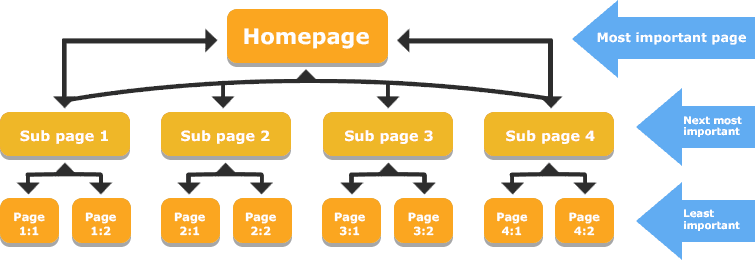
- Showing hierarchy and intent
The goal is not “more links.” The goal is clear topical architecture.
Search engines should be able to answer: “What does this site specialize in?” …by following your internal links alone.
The Hub-and-Cluster Model Still Works — If Done Correctly
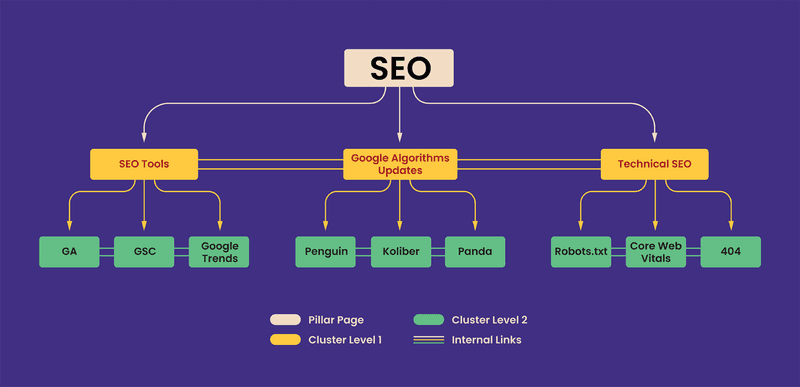
The hub-and-spoke (or pillar–cluster) model is still effective, but many sites implement it poorly.
What Still Works
- One clear hub page per core topic
- Multiple supporting cluster pages covering subtopics
- Internal links flowing:
- From clusters → hub
- Between closely related clusters
- From hub → key clusters
This structure:
- Concentrates authority
- Clarifies topical boundaries
- Signals subject ownership
What No Longer Works
- Multiple competing hubs for the same topic
- Thin cluster pages created only to justify links
- Over-linking every page to every other page
- Keyword-stuffed anchor repetition
AI-driven systems now recognize forced structures.
Advanced Internal Linking Strategies That Still Work
1. Contextual Links Inside Explanations (Not Sidebars)
Sidebar and footer links still help crawlability — but contextual links inside explanatory content carry far more semantic weight.
Best practice:
- Link when concepts naturally intersect
- Place links immediately after mentioning a related idea
- Ensure the surrounding sentence explains why the link exists
This helps search engines understand conceptual relationships, not just page connections.
2. Intent-Based Linking (Not Just Topic-Based)
Not all internal links should connect pages with the same intent.
Advanced structures link:
- Informational → commercial
- Definitions → use cases
- Comparisons → product pages
This mirrors real user journeys and helps search engines understand intent progression.
It also protects commercial pages from being isolated or over-optimized.
3. Anchor Text Consistency Without Over-Optimization
Exact-match anchors still work — but only when used sparingly and consistently.
The All-in-One Platform for Effective SEO
Behind every successful business is a strong SEO campaign. But with countless optimization tools and techniques out there to choose from, it can be hard to know where to start. Well, fear no more, cause I've got just the thing to help. Presenting the Ranktracker all-in-one platform for effective SEO
We have finally opened registration to Ranktracker absolutely free!
Create a free accountOr Sign in using your credentials
Modern best practice:
- One primary anchor per concept
- A small set of close variations
- Avoid rotating synonyms unnecessarily
AI systems prefer terminology stability.
If your internal anchors use five different phrases for the same concept, comprehension weakens.
4. Strengthen “Weak” Pages With Semantic Links
Instead of linking everything to your strongest pages, identify:
- Pages that represent important subtopics
- Pages with declining impressions
- Pages that should carry authority
Then:
- Link to them from thematically relevant content
- Use descriptive, explanatory anchors
- Reinforce them from multiple related pages
This builds distributed authority, not just top-heavy rankings.
5. Use Internal Links to Signal Page Purpose
Internal links help define what a page is for.
A page linked mostly from:
- Definitions → appears informational
- Comparisons → appears evaluative
- Product pages → appears commercial
Be intentional.
Accidental link patterns can confuse intent classification.
Internal Linking for AI Understanding and Reuse
AI systems don’t just look at individual pages — they observe how ideas are connected.
The All-in-One Platform for Effective SEO
Behind every successful business is a strong SEO campaign. But with countless optimization tools and techniques out there to choose from, it can be hard to know where to start. Well, fear no more, cause I've got just the thing to help. Presenting the Ranktracker all-in-one platform for effective SEO
We have finally opened registration to Ranktracker absolutely free!
Create a free accountOr Sign in using your credentials
Strong internal linking:
- Helps AI understand topic boundaries
- Clarifies which pages are authoritative
- Increases likelihood of citation and summarization
Pages that are:
- Frequently linked internally
- Linked from contextually relevant content
- Positioned clearly in a topic cluster
…are more likely to be trusted and reused in AI-driven results.
This is why SEO platforms like Ranktracker increasingly focus on topic visibility and coverage, not just keyword rankings.
What Breaks Internal Linking Value
Even strong sites sabotage themselves with these mistakes:
- Linking purely for SEO, not meaning
- Overusing exact-match anchors everywhere
- Creating orphan pages
- Linking unrelated topics “just in case”
- Updating URLs without fixing internal links
In 2026, internal links that lack semantic logic are often ignored.
Measuring Internal Linking Success Correctly
Don’t measure success by:
- Total internal links
- Average links per page
Instead, track:
- Topic-level impression growth
- Visibility across related queries
- Strength of cluster pages over time
- Stability of rankings after updates
When internal linking is working, rankings become more stable, not just higher.
Internal Linking Is a Long-Term Advantage
Unlike backlinks, internal links:
- Can’t be taken away
- Scale with your content
- Improve with time
- Reinforce every new page
They are one of the few SEO assets that compound without external dependency.
In AI-driven search, where trust, clarity, and topic ownership matter more than ever, internal linking has quietly become one of the most powerful tools still available.
Not because it manipulates rankings — but because it explains what your site actually knows.