Intro
If you’re looking into SEOptimer rank tracking, there’s a key limitation you should understand before treating it like a full SERP tracker.
SEOptimer does support Top 100 ranking retrieval, but only on demand, not as part of automatic rank tracking workflows.
That means you won’t get full Top 100 rankings updating every day. Instead, deep SERP data only appears when you manually request it — and not as part of regular automated tracking.
How SEOptimer Top 100 tracking actually works
SEOptimer’s approach to SERP depth is functional, but very different from dedicated rank trackers:
- Automatic rank tracking focuses on shallower positions
- Full Top 100 results are available only when you run a manual fetch
- Deep SERP data does not update automatically
- No scheduled daily refresh for positions 21–100
- Historical data beyond shallow ranks may not persist
This effectively means:
- You can get Top 100 data
- But only when you manually pull it
- Not as part of automated daily tracking
In everyday SEO workflows, that’s a big difference.
What this feels like in real SEO work
Manual-only deep SERP pulls create several practical problems:
- You have to remember to run the deep fetch
- There’s no regular refresh on positions 21–100
- Progress below the pages you track isn’t automatic
- Deeper SERP movement feels invisible most of the time
For example:
- A keyword may move from position 88 → 71 → 54 But you won’t see any of that unless you manually request the deep pull
- If you forget, you only see the result when you do pull it
That makes routine monitoring harder and slower.
Why “on demand” tracking is not true daily visibility
To be useful, rank tracking needs:
- Scheduled updates
- Full SERP coverage
- Historical depth
- Clear movement day-to-day
With deep rankings available only on-demand:
- You lose regular alerts
- You miss early momentum
- You cannot run automated reports
- You cannot confidently measure progress without manual effort
SEO work becomes manual auditing, not monitoring.
The impact of manual deep pulls
With on-demand deep SERP lookups:
- Early keyword growth is often hidden
- Competitive movement below page two is hard to see
- Momentum building becomes guesswork
- Team-based workflows struggle without automation
It’s like only occasionally checking your speedometer — and hoping you remember to look.
How Ranktracker handles rank tracking differently
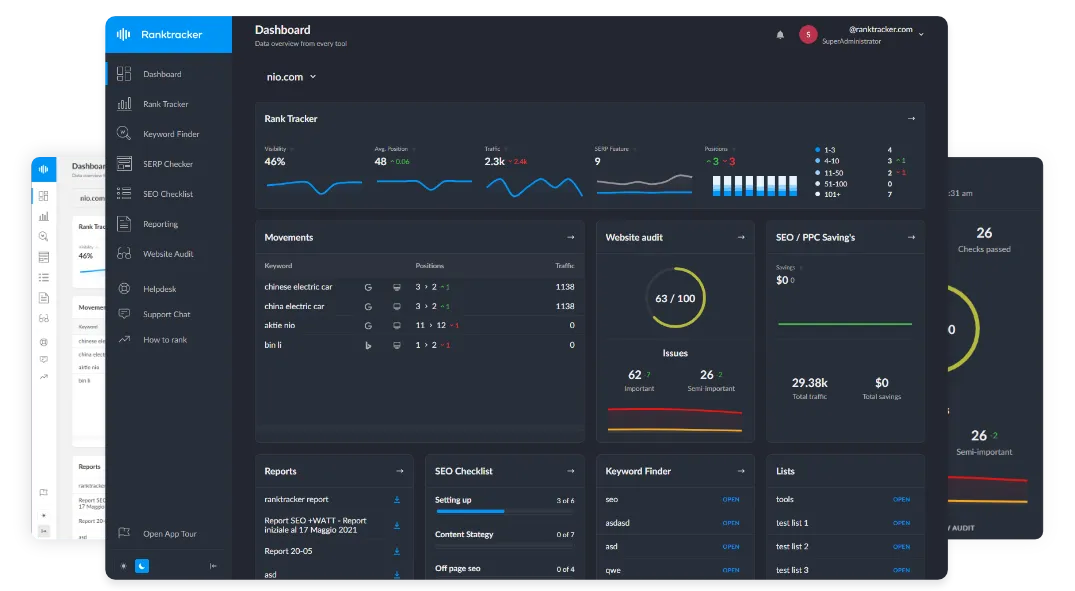
Ranktracker was built specifically for automatic, full-depth, daily rank tracking.
With Ranktracker:
- Positions 1–100 are tracked daily
- Automated scheduled updates
- Full historical context for every keyword
- Clear visibility into early movements
- Competitor tracking across the entire SERP
If a keyword moves from position 92 → 77 → 45 → 28 → 11, Ranktracker shows every step — without manual requests.
SEOptimer vs Ranktracker in simple terms
SEOptimer
- Full Top 100 available only on demand
- Automated tracking limited to shallower ranks
- Deep data requires manual fetching
- Not ideal for daily monitoring
Ranktracker
- Full Top 100 tracked daily
- No manual intervention required
- Historical movement preserved
- Designed for ongoing SEO workflows
One shows deeper data occasionally. The other shows it every single day.
Who SEOptimer works best for
SEOptimer may be useful if:
- You only need occasional deep checks
- Rank tracking is secondary to audits
- Manual workflows are acceptable
- Cheap or lightweight tools are preferred
But if your SEO depends on:
- Daily monitoring
- Early momentum visibility
- Tracking through the entire SERP
- Automated reporting
Then on-demand deep pulls are not enough.
Bottom line
SEOptimer makes Top 100 ranking data available only on demand, not as part of daily automated tracking.
Ranktracker tracks the full Top 100 every day, with complete historical data, automated updates, and full SERP visibility.
If you want rank tracking you can rely on every day, not only when you manually ask for it, daily Top 100 tracking matters.