
Intro
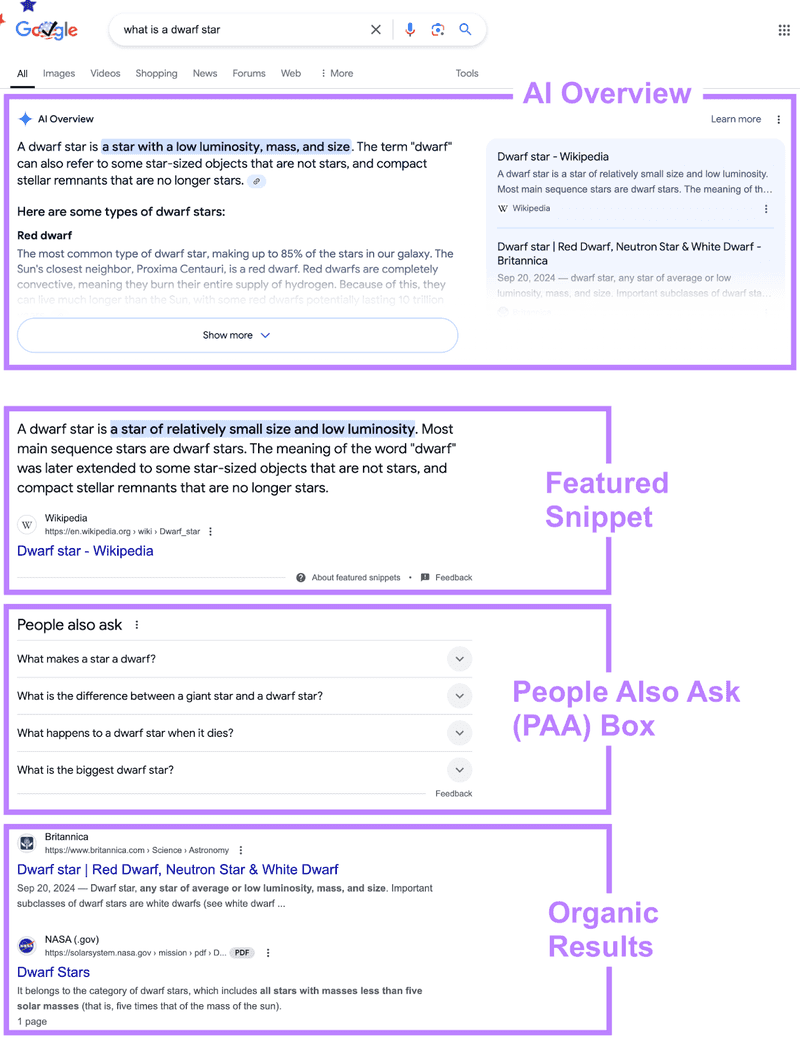
The classic “ten blue links” SERP is effectively gone.
In its place is a layered results page dominated by SERP features: AI Overviews, featured snippets, People Also Ask, knowledge panels, local packs, video carousels, forum threads, and shopping modules. In many searches, traditional organic listings are no longer the primary destination — they’re supporting elements.
This isn’t cosmetic. It’s a structural shift in how search resolves intent.
In 2026, SEO success depends on understanding which SERP features replace clicks, which defer them, and which still send traffic — and optimizing for visibility across all of them.
What Counts as a SERP Feature Today?
A SERP feature is any search result element that is not a standard organic link.
Common examples include:
- AI Overviews
- Featured snippets
- People Also Ask (PAA)
- Knowledge panels
- Local packs and maps
- Video and image carousels
- Forum and UGC blocks
Each feature serves a different intent layer — and each affects clicks differently.
Why SERP Features Exist (From Google’s Perspective)
Search engines are optimizing for resolution speed, not referrals.
The All-in-One Platform for Effective SEO
Behind every successful business is a strong SEO campaign. But with countless optimization tools and techniques out there to choose from, it can be hard to know where to start. Well, fear no more, cause I've got just the thing to help. Presenting the Ranktracker all-in-one platform for effective SEO
We have finally opened registration to Ranktracker absolutely free!
Create a free accountOr Sign in using your credentials
Google increasingly aims to:
- Answer questions instantly
- Reduce friction for users
- Keep exploration inside the SERP
- Compete with conversational AI tools
If a SERP feature resolves intent faster than a click, it replaces the click.
That’s not a bug — it’s the strategy.
How AI Overviews Changed the Balance Completely
AI Overviews sit above everything else and summarize multiple sources into a single response.
They:
- Absorb informational intent
- Reduce CTR on top rankings
- Influence follow-up searches
- Decide which sources are “safe” to cite
In many queries, the first organic result is now below the fold — even if it ranks #1.
This marks the first time a SERP feature systematically outranks all organic results by default.
Featured Snippets: The First Replacement Wave
Featured snippets were the original click replacers.
They:
- Answer one narrow question
- Pull a short extract from a page
- Often satisfy intent completely
For definition-based queries, the featured snippet is the result.
The difference in 2026 is that featured snippets now often feed AI Overviews, meaning the same clarity that wins snippets also increases AI citation likelihood.
People Also Ask: Expanding Intent Without Leaving the SERP
People Also Ask doesn’t replace clicks directly — it delays them.
The All-in-One Platform for Effective SEO
Behind every successful business is a strong SEO campaign. But with countless optimization tools and techniques out there to choose from, it can be hard to know where to start. Well, fear no more, cause I've got just the thing to help. Presenting the Ranktracker all-in-one platform for effective SEO
We have finally opened registration to Ranktracker absolutely free!
Create a free accountOr Sign in using your credentials
PAA:
- Encourages exploration
- Expands the query path
- Keeps users engaged inside Google
- Reduces urgency to click
Users often open multiple PAA boxes, consuming information without visiting a site.
For SEO, appearing repeatedly in PAA builds brand familiarity, even if traffic stays flat.
Knowledge Panels: Brand Visibility Without Traffic
Knowledge panels almost never send clicks — and that’s the point.
They:
- Establish entity trust
- Define brands, people, and products
- Shape perception
- Reinforce authority
If your brand triggers a knowledge panel, SEO success shifts from traffic acquisition to credibility control.
Knowledge panels replace the need to “research” a brand at all.
Local Packs and Maps: Transactional Click Replacements
For local intent, organic results often don’t matter.
Local packs:
- Replace organic listings
- Capture calls and directions
- Resolve intent without website visits
Ranking #1 organically for a local query often means less than appearing in the map pack.
Forums and UGC Blocks: Human Answers Over Curated Content
Forum and UGC features increasingly replace blog content for experiential queries.
These blocks:
- Reflect real opinions
- Show multiple perspectives
- Align with EEAT (especially Experience)
- Resist AI summarization
AI systems from platforms like ChatGPT and Perplexity frequently reference UGC because it captures lived experience — something polished SEO pages often lack.
What This Means for Traditional Rankings

Traditional rankings still matter — but mostly as inputs.
They now function as:
- Source material for SERP features
- Validation signals for AI systems
- Backup destinations after SERP exploration
Ranking #1 no longer guarantees:
- Visibility
- Traffic
- Influence
But ranking well increases your chance of being selected by SERP features.
The New Goal: SERP Surface Area
Modern SEO is about how much SERP real estate you occupy, not where one page ranks.
Winning strategies aim to:
- Appear in AI Overviews
- Win featured snippets
- Populate PAA
- Trigger knowledge panels
- Show up in UGC discussions
A brand that appears five times on one SERP — even without clicks — is more influential than one ranking #1 once.
How to Optimize for SERP Features (Without Chasing Them Blindly)
1. Structure Content for Extraction
Clear answers, concise definitions, and logical headings improve eligibility for:
- Featured snippets
- AI Overviews
- PAA
If AI can safely reuse your content, SERP features will.
2. Build Entity Clarity
SERP features favor recognized entities.
Consistent brand naming, topical focus, and repeated mentions increase:
- Knowledge panel eligibility
- AI citation frequency
- Trust signals
3. Cover the Full Intent Chain
Create content that supports:
- Initial understanding
- Validation and comparison
- Application and decision
This allows your brand to appear at multiple SERP stages.
SEO platforms like Ranktracker help teams track visibility across features, queries, and markets — which is essential when rankings alone no longer explain outcomes.
What SERP Features Have Replaced — and What They Haven’t
Replaced:
- Simple definitions
- Basic how-to explanations
- Fact lookups
- Shallow informational queries
Not replaced:
- Deep guides
- Tools and calculators
- Case studies
- Product decisions
- High-stakes comparisons
SERP features filter curiosity. They don’t eliminate demand.
The Strategic Shift SEOs Must Accept
The core change is psychological.
SEO used to ask: “How do we rank higher?”
Modern SEO asks: “How do we stay visible when clicks aren’t required?”
The All-in-One Platform for Effective SEO
Behind every successful business is a strong SEO campaign. But with countless optimization tools and techniques out there to choose from, it can be hard to know where to start. Well, fear no more, cause I've got just the thing to help. Presenting the Ranktracker all-in-one platform for effective SEO
We have finally opened registration to Ranktracker absolutely free!
Create a free accountOr Sign in using your credentials
SERP features are not stealing SEO’s value — they’re redistributing it.
Influence now precedes traffic.
Final Takeaway
SERP features didn’t replace organic results overnight. They gradually absorbed their function.
In 2026:
- Visibility beats position
- Presence beats clicks
- Authority beats optimization
Traditional rankings are no longer the destination. They are one of many inputs into a much larger visibility system.
The SEOs who win don’t fight SERP features. They design for them.

