Intro
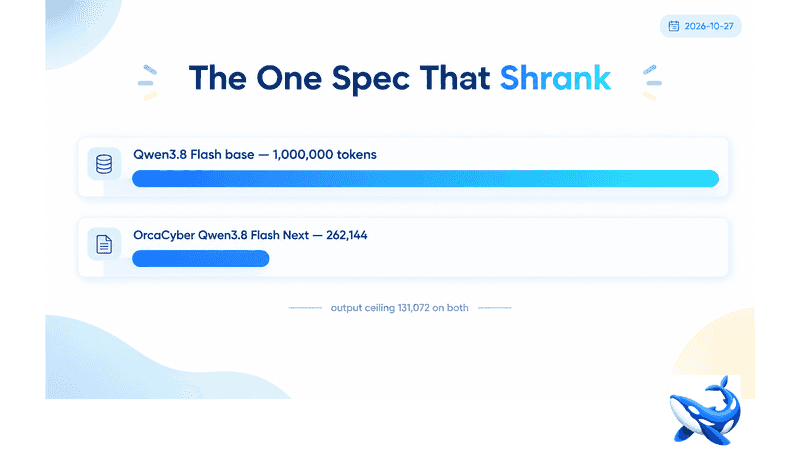
Through OrcaRouter the base model and the tuned build sit side by side on one key, and the comparison is unusually blunt. The Qwen3.8 Flash Next card — OrcaCyber's abliterated build on Alibaba's Qwen3.8 Flash Next, released 2026-10-26 — carries 262,144 tokens of context, against the base model's 1,000,000 [OURS]. That is 26.2%, a hair over a quarter. Everything else about the envelope survives: the output ceiling is 131,072 on both, the modalities are text, image and video on both.
Context is the spec that shrank, and it is the one that changes what a workflow can do.
The numbers, side by side
| Qwen3.8 Flash (base) | OrcaCyber Qwen3.8 Flash Next | |
| Context window | 1,000,000 | 262,144 |
| Output ceiling | 131,072 | 131,072 |
| Input modalities | text, image, video | text, image, video |
| Input / M | $0.15 | $0.80 |
| Output / M | $0.47 | $1.60 |
| Cache read / M | $0.0184 | $0.15 |
| Cache write / M | $0.23 | — |
| Released | 2026-08-26 | 2026-10-26 |
Three things stand out. The output ceiling did not move, which means a long artifact still fits in one response. The modalities did not move, which means the vision path survived the tuning. And the input price multiplied by 5.33× while the window fell by a factor of 3.8 — you pay more per token for less room.
What 262,144 tokens actually holds
A quarter of a million tokens is not small. It is roughly 200,000 words, or a 400-page book, or a mid-sized repository's worth of source with the manifests attached.
What it does not hold is the whole of a large monorepo plus its logs plus the ticket history. That combination is where a million-token window earns its price, and it is precisely the combination this card cannot take.
The practical consequence is a design decision you have to make before you build: one call or two. On the base model, a large audit is one request. On this card, the same material becomes two — split at a natural boundary, with the first half's findings carried into the second call as context.
Splitting is not free. You pay the output rate twice for any synthesis step, you lose cross-boundary reasoning, and you gain a place for errors to compound. For a repository where the vulnerability lives in one package, none of that matters. For one where the bug is a mismatch between service A and service C, it does.
Why a quarter window might still be right
There is a defensible reason the build ships at 262,144 rather than a million, and it is not laziness: long context is expensive to serve. Attention over a million tokens costs memory and time on every request, and an abliterated build is already carrying a tuning delta on top of the base weights. Cutting the window to a quarter keeps the card servable at $0.80 input rather than at a rate that would make the refusal-free premium look small.
The All-in-One Platform for Effective SEO
Behind every successful business is a strong SEO campaign. But with countless optimization tools and techniques out there to choose from, it can be hard to know where to start. Well, fear no more, cause I've got just the thing to help. Presenting the Ranktracker all-in-one platform for effective SEO
We have finally opened registration to Ranktracker absolutely free!
Create a free accountOr Sign in using your credentials
Whether that trade suits you depends on the distribution of your inputs. If most of your requests are under 100,000 tokens — a single file, a stack trace, a screenshot plus a document — the window never binds and the card is simply a cheaper-to-serve abliterated model. If your requests routinely exceed 200,000, the base model or a 1M-window sibling is the correct choice and the price difference is academic.
What the gate asks for, and why it takes a week
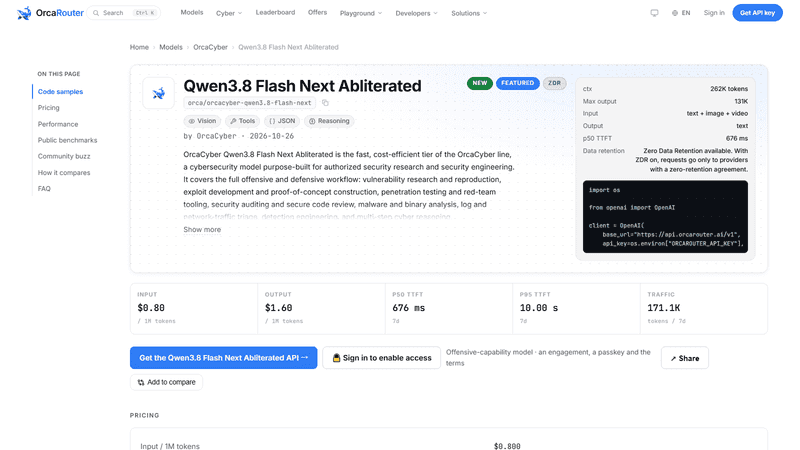
Access to every OrcaCyber card runs through an engagement, a passkey and acceptance of the terms before the endpoint serves a request [OURS]. On a card you are evaluating rather than shipping, that sequence is easy to defer — and deferring it is the single most common reason a switch slips.
Treat it as the first task rather than the last. The paperwork runs in parallel with the technical evaluation, and the two answer different questions: whether you want the card, and whether you can have it.
One consequence is worth planning for. A passkey is an operational secret that ends up in your deployment configuration, which means it goes through whatever secret-rotation process you have. If that process takes a fortnight, that is the real lead time, not the model.
What a quarter window changes about testing
If you are comparing this card against the base model, the window changes the test design as well as the workload.
A test case that sends 400,000 tokens cannot be run against this card at all, so the comparison set has to be drawn from material that fits both. That is fine — it is the same set you would use in production — but it means the evaluation cannot tell you how the card handles the inputs it cannot accept.
For those, the only useful question is the routing one: what share of traffic lands there, and what happens to it. A routing rule that sends oversized requests to the base model needs to exist before the first request fails, not after.
What the page does not tell you yet
The card is one day old at the time of writing, and its telemetry shows it: 1,345 tokens passed through it in the measured week [OURS]. That is a handful of requests. The latency block on the page reports a p50 of 500 ms and an error rate of 75% — both computed on that same handful, and neither is a statement about the model.
The All-in-One Platform for Effective SEO
Behind every successful business is a strong SEO campaign. But with countless optimization tools and techniques out there to choose from, it can be hard to know where to start. Well, fear no more, cause I've got just the thing to help. Presenting the Ranktracker all-in-one platform for effective SEO
We have finally opened registration to Ranktracker absolutely free!
Create a free accountOr Sign in using your credentials
So this is a card you have to judge on specification and on your own tests, not on production evidence. The specification is clear enough: a quarter window, a full output ceiling, three input modalities, a 5.33× input multiple, and a tuning that removes refusals.
The All-in-One Platform for Effective SEO
Behind every successful business is a strong SEO campaign. But with countless optimization tools and techniques out there to choose from, it can be hard to know where to start. Well, fear no more, cause I've got just the thing to help. Presenting the Ranktracker all-in-one platform for effective SEO
We have finally opened registration to Ranktracker absolutely free!
Create a free accountOr Sign in using your credentials
The test that settles it takes an afternoon. Take ten requests you already send to the base model, replay them against this card, and record two things: whether any of them needed more than 262,144 tokens, and whether any of them was refused by the base. If the first answer is no and the second is often, the card fits. If the first answer is yes, no amount of tuning compensates.
The takeaway
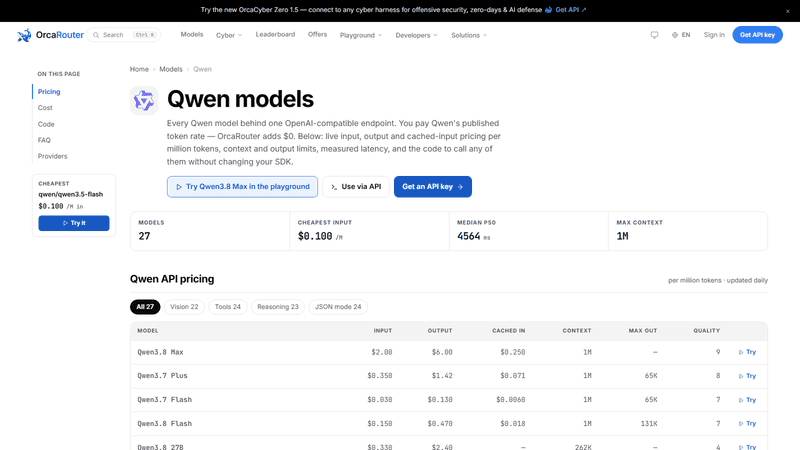
The abliterated Qwen3.8 Flash Next keeps the output ceiling and the modalities, multiplies the price by 5.33× on input, and gives back three quarters of the context window. That last number is the whole decision.
If your inputs fit in 262,144 tokens, the card does what it says. If they do not, the base model at a fifth of the input rate is the better buy, and no tuning changes that arithmetic.
Sourcing note: prices, context windows, ceilings and modalities are from the OrcaRouter catalogue, checked 2026-10-27 [OURS]. The 1,345-token weekly volume is OrcaRouter production telemetry for the seven days ending 2026-10-26, and it is too small to support any latency or reliability claim — none is made here [OURS]. Benchmark rows are not used in this article.