Intro
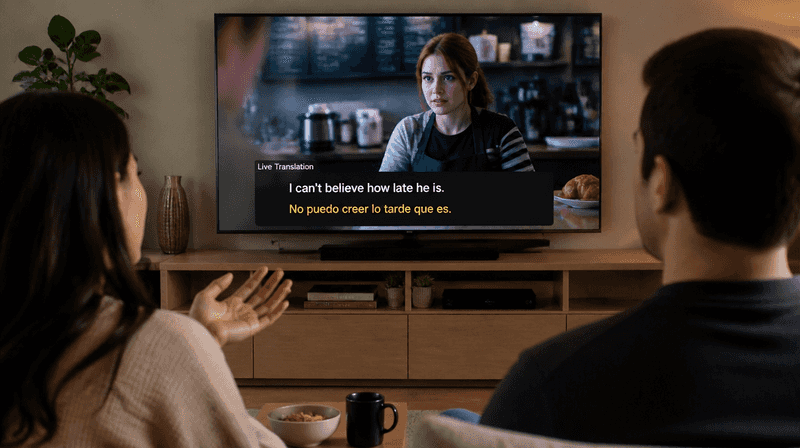
Three years ago, a drama produced in Seoul cost roughly the same amount to subtitle and dub for a single additional market as it did to film an entire episode. Translating six languages meant hiring six separate teams of translators, two rounds of quality review per language, months of studio sessions for voice talent, and a localization pipeline that could stretch a release window from weeks into quarters. The economic logic was brutal: only content with a proven global audience justified that investment. Everything else stayed in its country of origin and found its natural ceiling.
That calculation has changed fundamentally, and the technology driving the change draws on a broader set of capabilities than most people realize. The underlying engine is called automatic content recognition, and while the term usually surfaces in conversations about copyright enforcement and advertising analytics, automatic content recognition technologies have quietly become the infrastructure layer that makes mass localization economically viable. The ability to identify exactly what is being spoken, by whom, at what timestamp — and to translate and adapt that content automatically — connects the recognition step directly to the subtitling, dubbing, and distribution steps that follow it. Understanding that connection requires tracing how a piece of content moves from a single-language recording to a globally distributable product, and what each stage of that journey now costs.
What Recognition Has to Do With Translation
The definition of localization in the streaming era starts with identification. Before any translation can happen, a system has to understand what the audio contains: which portions are speech, which are music or ambient sound, when speakers change, and what each speaker is saying at what point in the timeline. This is the recognition problem, and solving it accurately is what determines the quality of everything that follows.
ACR technology handles this identification layer through a combination of automatic speech recognition (ASR) — which converts spoken audio into text — and audio fingerprinting, which can distinguish speech from music, identify which sections of a file contain protectable content, and flag segments that may require different handling during the translation process. The output of this recognition step is a time-coded transcript: a structured document that maps every spoken word to a precise moment in the audio, creating the raw material from which subtitles and dubbed scripts are built.
Without reliable recognition at this stage, the translation pipeline produces inaccurate subtitles that don't sync properly with the audio, dubbed scripts with mistimed cue points, and localized content that feels off to native speakers in the target market. The recognition layer isn't the glamorous part of content localization — that distinction tends to go to AI dubbing and voice cloning — but it's the one that determines whether everything downstream works as intended.
The Pipeline: From Audio to Audience
What follows accurate speech recognition is a sequence of processing steps that have each been transformed by machine learning over the past few years. Neural machine translation takes the time-coded transcript and converts it into the target language, accounting not just for literal meaning but for idiomatic expressions, character-appropriate register, and the reading speed constraints that govern how much text can appear on screen at once. A subtitle that would take a native speaker six seconds to read cannot be assigned to a two-second gap in the audio — the recognition layer provides the timing, and the translation model must work within it.
The subtitle segmentation problem is subtler than it appears. A sentence in English rarely breaks at the same natural pause points as its equivalent in Korean, German, or Arabic. Neural systems trained specifically on subtitle corpora have learned to anticipate where those breaks should fall in each language to preserve comprehension, but this requires training data that represents the genuine patterns of subtitling practice rather than generic text translation. The best-performing automatic subtitling systems in current use combine direct speech translation — which translates from the original audio rather than going through a text intermediate — with learned segmentation models that handle the timing problem jointly with the translation, rather than as a sequential afterthought.
The All-in-One Platform for Effective SEO
Behind every successful business is a strong SEO campaign. But with countless optimization tools and techniques out there to choose from, it can be hard to know where to start. Well, fear no more, cause I've got just the thing to help. Presenting the Ranktracker all-in-one platform for effective SEO
We have finally opened registration to Ranktracker absolutely free!
Create a free accountOr Sign in using your credentials
For dubbing rather than subtitling, the pipeline extends further. After translation, a text-to-speech system must generate voiced audio in the target language that matches the timing, emotional register, and pacing of the original speaker. Voice cloning technology — which creates a synthetic voice modeled on a specific speaker's characteristics — allows dubbed versions to preserve something of the original actor's vocal identity across languages, rather than replacing every speaker with a generic localized voice. The lip-sync component, which adjusts dubbed audio to align with mouth movements visible in the original video, has reached commercial production quality in 2025 at a rate that would have seemed implausible three years earlier.
What the Numbers Look Like Now
The economic transformation this pipeline has produced is easier to state as numbers than to fully absorb. AI-assisted dubbing is reducing localization costs by 70 to 90 percent compared to fully traditional workflows, and compressing production timelines from months to days. As of May 2025, the per-episode cost of AI dubbing for 4K content has dropped below $200 — a figure that makes localization economically viable for content categories that previously couldn't justify the expense: documentary shorts, regional drama, educational series, independent film.
The AI subtitle generation market, which encompasses the full software stack from recognition through translation and timing, was valued at approximately $1.03 billion in 2023 and is projected to reach $7.42 billion by 2032, growing at nearly 25 percent annually. The Asia-Pacific region is expanding fastest, driven by the linguistic diversity of its streaming landscape and the scale of its mobile video consumption: India alone represents a market where content routinely requires adaptation across more than a dozen significant languages simultaneously, a scale that traditional localization could never serve economically.
Streaming platforms that have implemented rapid multilingual subtitling have reported measurable effects on viewership behavior. Industry data from 2025 shows that platforms offering immediate multilingual subtitle availability at content launch see approximately 40 percent higher global viewership in the first week, and viewer retention rates rise by around 25 percent when localized content is available at the moment of release rather than weeks afterward. The connection between localization speed and subscriber acquisition has moved from anecdotal to measurable, which has accelerated platform investment in the recognition and translation infrastructure that makes rapid deployment possible.
Netflix, Amazon, and the Hybrid Model
The platforms at the center of this shift have publicly described their approaches, though the details are necessarily incomplete. Netflix applies automatic speech recognition systems to transcribe audio across its catalog as a foundational step, then runs those transcripts through neural machine translation engines that cover dozens of languages. The output from those engines is reviewed and edited by professional linguists before it reaches viewers, creating what the company describes as a human-in-the-loop workflow rather than fully automated output.
Amazon Prime Video launched an AI-assisted dubbing pilot in March 2025, covering twelve licensed titles in English and Latin American Spanish under an explicit hybrid model. The company positioned the initiative as an accessibility-broadening measure — making dubbing available for content that wouldn't have been dubbed under traditional economics — while maintaining that localization professionals reviewed all output for quality and cultural accuracy. The framing was careful: not automation replacing human translators, but automation making previously impractical localization commercially viable.
The distinction matters both commercially and ethically. When Amazon Prime Video released AI-dubbed Korean dramas into Spanish-speaking markets in May 2024 without sufficiently prominent disclosure, viewer response was sharply negative, with complaints about flat and emotionally unconvincing voiceovers circulating widely on social media. The backlash prompted a rapid course correction and contributed to the more cautious, explicitly hybrid framing of the 2025 pilot. The technology's raw capability had outpaced the cultural readiness of audiences to accept undisclosed AI-generated performances.
Live Subtitling and the Real-Time Challenge
The most technically demanding application of recognition-to-subtitle pipelines is live content, where the gap between speech and subtitle cannot be bridged by iterative human editing. Sports broadcasts, news programming, live events, and parliamentary proceedings all require subtitles that appear within seconds of the spoken word, in a target language, with sufficient accuracy to be useful to viewers who cannot access the original audio.
AI-based speech recognition now delivers real-time subtitles for live events with accuracy that has improved substantially from the early years of automated captioning, when errors were frequent enough to produce genuinely misleading text. The systems have been trained on the specific vocabulary and speech patterns of sports commentary, political discourse, and news broadcasting as distinct domains, which has reduced the category of errors that matter most in each context. A sports commentator's misspoken word matters differently than a politician's, and the system's error-correction behavior can be tuned accordingly.
The All-in-One Platform for Effective SEO
Behind every successful business is a strong SEO campaign. But with countless optimization tools and techniques out there to choose from, it can be hard to know where to start. Well, fear no more, cause I've got just the thing to help. Presenting the Ranktracker all-in-one platform for effective SEO
We have finally opened registration to Ranktracker absolutely free!
Create a free accountOr Sign in using your credentials
For international live events — a World Cup final, a major awards ceremony, a state address — the real-time translation pipeline runs ASR in the source language, neural machine translation into target languages simultaneously, and text layout systems that handle directionality, character sets, and reading-speed constraints for each output language in parallel. The entire sequence, from spoken word to displayed subtitle in a different language, now runs within a few seconds on well-resourced infrastructure, enabling live global distribution of subtitled content that previously required multilingual broadcast teams at each target market.
The Accessibility Dimension
Localization through recognition technologies carries an accessibility dimension that is often underweighted in discussions focused on commercial markets. For the estimated 1.5 billion people worldwide who have some degree of hearing loss, accurate automatic captions are not a convenience feature but a requirement for accessing audio-visual content. In many jurisdictions, broadcast accessibility requirements now mandate captioning for all live programming, a standard that would be economically unfeasible without automated recognition and subtitling systems.
Speech recognition segment is one of the fastest-growing components within the broader ACR technology market precisely because its applications extend beyond audience measurement and copyright enforcement into accessibility compliance. The same systems that identify speakers and transcribe their dialogue for translation purposes also power the accessibility features that regulators in Europe, North America, and an increasing number of Asian markets now require as a legal minimum. For broadcasters and streaming platforms, the compliance and commercial localization use cases run on the same recognition infrastructure, making investment in that infrastructure serve multiple bottom lines simultaneously.
The Companies Building the Pipeline
The ACR technology market companies building localization-enabling recognition infrastructure range from the hyperscale cloud providers to specialized audio recognition firms. Google Cloud's ASR and translation APIs serve as the underlying recognition layer for many streaming localization workflows, with the company's Global Director for Media and Entertainment describing the technology in early 2025 as having fundamentally altered the logistics and economics of content adaptation for regional markets. Amazon's AWS Transcribe and Translate services occupy a similar position in the market.
Specialist audio recognition companies including ACRCloud, Nuance Communications, and VoiceBase provide more domain-specific recognition capabilities — systems trained on broadcast audio rather than general conversational speech, with the vocabulary coverage and noise tolerance that professional content identification requires. Verbit, which combines automated speech recognition with human verification, serves markets where accuracy requirements are high enough that fully automated output needs supplementary review: legal proceedings, academic content, financial disclosures.
The broader ACR technology market sits at an estimated $3.2 billion in 2025, growing toward $16 billion by 2033, with speech recognition forming one of its fastest-expanding functional segments alongside video identification and real-time analytics. The localization dimension of that growth reflects an emerging commercial reality: recognition is no longer just about identifying what content is playing. It's about transforming that content — turning a Korean drama into a globally distributable product, a CEO's message into ten simultaneous language versions, or a parliamentary debate into real-time accessible subtitles for viewers who need them.
The Words That Cross Every Border
What automatic content recognition has introduced into the localization business is a compression of time that changes the economics of what gets translated and who gets to see it. A film that previously would have reached three markets now reaches twelve. A documentary that couldn't justify a full dubbing budget now arrives in six languages with AI-assisted voiceovers and human review. A live sporting event flows into subtitle tracks across forty languages within seconds of the whistle blowing. The recognition layer — the foundational step where a system reads what is being said, and when — is what makes all of it possible. The translation that follows is more visible, the dubbed voice more emotionally immediate. But the recognition is where the journey of a piece of content across linguistic borders actually begins.