Intro
SEO can feel overwhelming when you're starting out.
Keywords.
Backlinks.
Technical audits.
Competitors.
Search rankings.
The All-in-One Platform for Effective SEO
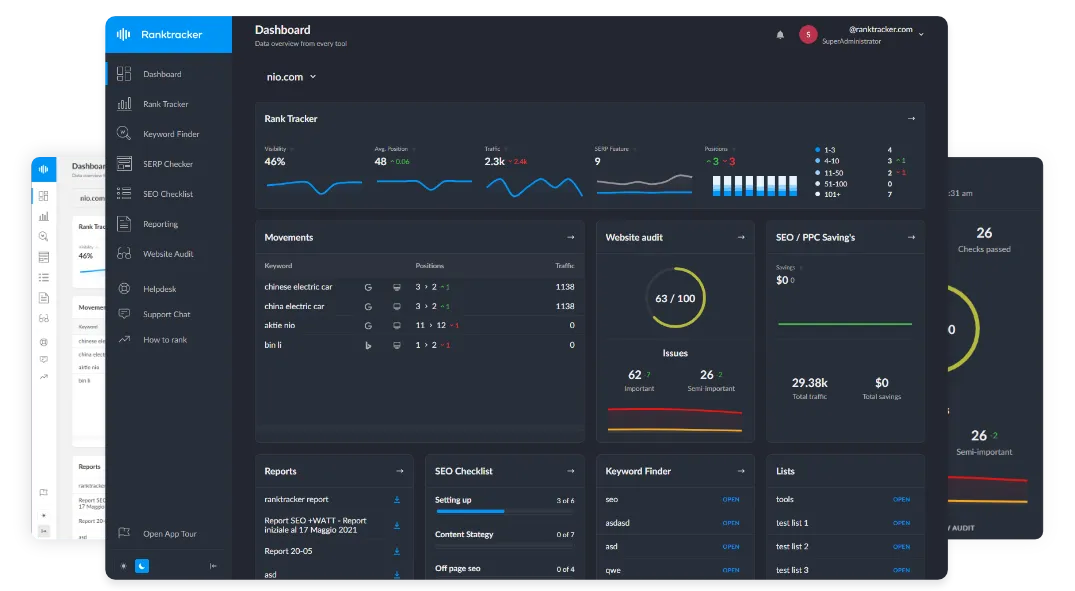
Behind every successful business is a strong SEO campaign. But with countless optimization tools and techniques out there to choose from, it can be hard to know where to start. Well, fear no more, cause I've got just the thing to help. Presenting the Ranktracker all-in-one platform for effective SEO
We have finally opened registration to Ranktracker absolutely free!
Create a free accountOr Sign in using your credentials
Organic traffic.
There are dozens of metrics and hundreds of potential actions you could take.
SEO platforms such as Ahrefs are designed to bring much of that data together in one place.
Ahrefs can help you research keywords, inspect backlinks, analyze competitors, identify technical issues, monitor rankings, and find new content opportunities.
The challenge for beginners isn't usually accessing the data.
It's knowing what to do with it.
The All-in-One Platform for Effective SEO
Behind every successful business is a strong SEO campaign. But with countless optimization tools and techniques out there to choose from, it can be hard to know where to start. Well, fear no more, cause I've got just the thing to help. Presenting the Ranktracker all-in-one platform for effective SEO
We have finally opened registration to Ranktracker absolutely free!
Create a free accountOr Sign in using your credentials
This guide explains how to use Ahrefs for SEO step by step, without getting lost in every report and metric available.
We'll cover:
- Setting up your first project
- Understanding the Ahrefs dashboard
- Finding keywords
- Analyzing competitors
- Checking backlinks
- Running a site audit
- Monitoring rankings
- Finding content opportunities
- Turning SEO data into an actual strategy
What Is Ahrefs?
Ahrefs is an SEO platform that provides data and tools around areas such as:
- Keyword research
- Backlink analysis
- Competitor research
- Technical SEO
- Rank tracking
- Content research
- Organic search visibility
Instead of manually checking Google results, backlinks, competitor pages, and technical issues separately, Ahrefs brings much of that information into one interface.
For beginners, that can make SEO easier to understand.
But having more data doesn't automatically result in better SEO.
The real value comes from using that data to answer practical questions such as:
What should we write about?
Why is our competitor outranking us?
Which pages are bringing in organic traffic?
Where are competitors earning backlinks?
Has our ranking improved?
Does our site have technical problems preventing pages from performing?
Those are the questions this tutorial will focus on.
Why Use Ahrefs for SEO?
Ahrefs covers several of the core tasks involved in running an SEO campaign.
Find Keyword Opportunities
Keyword research helps you understand what people are searching for.
Ahrefs can show metrics around search demand, keyword difficulty, related searches, and ranking pages.
You can use that information to find topics worth targeting.
Analyze Competitors
Competitor research is one of the fastest ways to find SEO opportunities.
You can look at:
- Keywords competitors rank for
- Their highest-traffic pages
- Their backlink profiles
- Content that's performing well
- Search terms you're currently missing
Instead of starting every SEO campaign from zero, competitor data shows you what is already working in your market.
Check Backlinks
Backlinks remain an important part of SEO.
Ahrefs can help you understand:
- Which websites link to you
- Which pages attract the most links
- Where competitors are getting links
- Which links have been gained or lost
- What anchor text is being used
This data can help guide link-building and digital PR activity.
Run Technical SEO Audits
A technically unhealthy site can make everything else harder.
Ahrefs Site Audit can help surface problems such as:
- Broken links
- Redirect issues
- Duplicate pages
- Crawlability problems
- Internal linking issues
- Missing metadata
- Indexability problems
- Performance-related issues
An audit gives you a structured place to begin instead of trying to manually inspect every page.
Monitor Keyword Rankings
SEO isn't finished when a page is published.
You need to know what happens afterward.
Rank tracking helps you see whether your pages are moving:
Position 78 → 31 → 14 → 7
or:
Position 4 → 6 → 12 → 19
Without tracking, both changes can happen without you noticing.
How to Use Ahrefs: Step-by-Step
Let's go through a beginner SEO workflow.
Step 1: Create Your Ahrefs Account
The first step is creating an account and choosing the level of access you need.
Ahrefs offers several products and subscription levels.
Beginners don't necessarily need the most expensive option.
Your choice should depend on:
- Number of websites
- Number of users
- Number of keywords
- Frequency of analysis
- Depth of competitor research
- Backlink requirements
- Reporting requirements
If you're learning SEO on one website, starting with limited access can make more sense than immediately paying for enterprise-level functionality.
Step 2: Add Your Website as a Project
Once your account is ready, add the website you want to monitor.
A project can typically represent:
- An entire domain
- A subdomain
- A subfolder
- A specific website section
For most beginners, adding the main domain is the easiest starting point.
This allows Ahrefs to start organizing SEO information around your site.
If you're running several websites, create separate projects so you can monitor them independently.
Agencies can do the same for different clients.
Step 3: Connect Available Search Data
Where available, connecting first-party search data can give you additional context around the website.
Search Console data is particularly useful because it comes directly from Google's reporting on your own site.
That gives you access to information such as:
- Search queries
- Clicks
- Impressions
- Average positions
- Pages appearing in search
SEO tools and Search Console shouldn't necessarily be treated as replacements for one another.
They can complement each other.
Third-party SEO data helps with competitive intelligence and wider market research.
Search Console provides direct information about your own Google Search visibility.
Step 4: Learn the Main Ahrefs Tools
You don't need to understand every Ahrefs feature immediately.
Start with the core tools.
These are the ones most beginners will use repeatedly.
Site Explorer
Site Explorer lets you analyze a domain or URL.
This can be your own website or a competitor.
You can use it to investigate:
- Organic keywords
- Organic traffic estimates
- Top pages
- Backlinks
- Referring domains
- Anchor text
- Competitor performance
For beginner SEO research, Site Explorer is one of the most useful places to start.
Keywords Explorer
Keywords Explorer is used for keyword research.
Enter a seed keyword and Ahrefs can provide related information and keyword ideas.
For example, imagine you sell coffee machines.
A seed keyword might be:
coffee maker
From there, you could discover searches related to:
- Best coffee maker
- Coffee maker with grinder
- Small coffee maker
- Espresso coffee maker
- Best coffee maker for office
- How to clean coffee maker
Those variations can become:
- Blog posts
- Product categories
- Landing pages
- Comparison pages
- Buying guides
Site Audit
Site Audit crawls your website and looks for technical SEO issues.
For beginners, don't panic if it reports hundreds or thousands of issues.
Large websites nearly always produce plenty of warnings.
The key is prioritization.
Focus first on problems that could materially affect:
- Crawling
- Indexing
- Internal linking
- Page accessibility
- Canonicalization
- User experience
Rank Tracker
Rank Tracker monitors specific keywords over time.
This answers one of the most fundamental questions in SEO:
Are we actually moving up or down?
Ranking information can show:
- Current positions
- Position changes
- Visibility
- Winning pages
- Losing pages
- Competitor movements
Keyword research tells you what to target.
Rank tracking tells you whether your work is succeeding.
Content Explorer
Content Explorer can help identify content that already performs well around a particular subject.
This can be useful when planning:
- Blog campaigns
- Linkable assets
- Resource pages
- Outreach
- Content refreshes
Rather than guessing which topics attract attention, you can study what has already gained traffic or links.
Step 5: Check Your Website's SEO Health
Before aggressively publishing new content, understand the current condition of the website.
Start with a basic audit.
Look for Crawling Problems
Search engines need to access your pages before they can rank them.
Check for issues involving:
- Blocked pages
- Broken internal links
- Redirect chains
- Orphan pages
- Server errors
- Incorrect canonical tags
Check Indexability
A page can exist on your website without being eligible for indexing.
Review pages that may contain:
- Noindex directives
- Canonical issues
- Duplicate content
- Incorrect redirects
For large websites, indexability problems can quietly affect thousands of URLs.
Review Broken Links
Broken links create poor user experiences and can make site architecture harder to navigate.
Look for internal links pointing to:
- Deleted pages
- Changed URLs
- Incorrect addresses
Where possible, update the link to the correct live destination.
Review Internal Links
Internal links help users and search engines discover related pages.
A strategically important page with almost no internal links may struggle to gain visibility.
Use audit data to identify:
- Important pages with too few links
- Orphan pages
- Broken internal links
- Internal linking opportunities
Step 6: Find Keyword Opportunities
Once the site's basic health is understood, start looking for search demand.
Start With Seed Keywords
Choose broad terms closely related to your business.
For Ranktracker, examples might include:
- Rank tracker
- Keyword research
- SERP checker
- Backlink checker
- SEO audit
- Keyword difficulty
A travel company might start with:
- Cheap flights
- Travel insurance
- City breaks
- Hotels
- Weekend trips
Seed keywords are starting points.
You then expand them into more specific search opportunities.
Look Beyond Search Volume
Beginners often make the mistake of sorting by search volume and targeting the biggest number.
That's not always the best strategy.
A keyword with 50,000 searches can be useless if:
- Search intent doesn't match your offer
- Competition is extremely strong
- Google heavily favors established brands
- The traffic has little commercial value
A keyword with 300 searches can be far more valuable if the person searching is close to buying.
Consider:
- Search volume
- Difficulty
- Intent
- Business relevance
- Existing SERP
- Ranking competitors
Step 7: Understand Keyword Difficulty
Keyword difficulty is designed to give you an idea of how competitive a keyword may be.
But don't use the score blindly.
No single metric can perfectly tell you whether you'll rank.
Always inspect the actual SERP.
Look at:
- Who currently ranks?
- How authoritative are those sites?
- What type of pages rank?
- Are they product pages or articles?
- How strong are their backlinks?
- Does Google favor large brands?
- Is the content actually good?
A numeric difficulty score is useful for filtering.
The SERP tells you what you're actually competing against.
Step 8: Match Search Intent
Before creating content, ask:
What does the person searching actually want?
Google often gives you the answer through the pages it already ranks.
Suppose you target:
best rank tracking software
If the results are mostly comparison articles, publishing your homepage probably won't match the dominant intent.
Search intent generally falls into categories such as:
- Informational
- Navigational
- Commercial
- Transactional
Understanding intent prevents you from creating the wrong type of page for a keyword.
Step 9: Run a Competitor Keyword Gap Analysis
Competitor research is one of the fastest ways to generate content ideas.
Identify several websites competing for the same audience.
Then look for keywords where:
They rank and you don't.
These gaps can reveal opportunities you might never have found through traditional keyword brainstorming.
For each opportunity, ask:
- Is the keyword relevant?
- Can we realistically compete?
- Do we already have a page that should target it?
- Do we need new content?
- What search intent does Google show?
Keyword gaps shouldn't automatically become articles.
They should become candidates for further analysis.
Step 10: Analyze Competitors' Top Pages
Keyword-level analysis is useful.
Page-level analysis can be even better.
Find competitors' pages receiving substantial organic traffic.
This shows you which content assets are contributing most to their visibility.
Look for patterns.
Are they generating traffic through:
- Comparison articles?
- Free tools?
- Product pages?
- Glossary pages?
- Statistics?
- Templates?
- How-to guides?
- Location pages?
Patterns can reveal the content model behind a competitor's SEO strategy.
Step 11: Analyze Your Backlink Profile
Backlinks can show which content people consider worth referencing.
Start by reviewing your own website.
Look at:
- Total referring domains
- Strongest linked pages
- New backlinks
- Lost backlinks
- Anchor text
- Linking websites
Don't obsess over the raw backlink count.
One relevant link from a respected website can be more valuable than hundreds of low-quality links.
Step 12: Analyze Competitor Backlinks
This is where backlink data becomes especially useful.
Choose a competitor page that outranks you.
Then inspect where its backlinks come from.
Ask:
Why are people linking to this page?
Maybe it contains:
- Original research
- A free calculator
- Statistics
- A template
- An infographic
- A detailed guide
- Unique data
That information can influence your own content strategy.
You can also identify websites that regularly link to businesses in your niche.
Those sites may become potential outreach targets.
Step 13: Monitor Anchor Text
Anchor text is the clickable text used in a backlink.
For example:
best SEO software
might link to an SEO platform.
Natural backlink profiles normally contain a mixture of:
- Brand names
- URLs
- Generic phrases
- Article titles
- Partial keywords
- Exact keywords
Be cautious about deliberately creating excessive numbers of identical keyword-rich links.
Natural variation is generally healthier than trying to force the same commercial anchor everywhere.
Step 14: Track Your Important Keywords
Add your most valuable keywords to rank tracking.
Don't track only the obvious high-volume phrases.
Track keywords across different stages of your SEO strategy.
For example:
Core commercial terms
Keywords directly connected with your main product or service.
Long-tail keywords
Smaller, more specific queries.
Content keywords
Terms targeted by informational articles and guides.
New campaigns
Keywords associated with recently published content.
Existing high performers
Terms already ranking well that you don't want to lose.
That creates a much clearer picture of your overall search visibility.
Step 15: Track Competitors Too
Your ranking movement makes more sense when viewed alongside competitors.
Imagine your page drops from position 3 to position 7.
That tells you something changed.
But competitor tracking might show that one competitor launched a significantly improved page and moved from position 11 to 2.
Now you have context.
SEO doesn't happen in isolation.
You're competing against websites that are constantly:
- Publishing
- Updating
- Building links
- Improving technical SEO
- Targeting new queries
Monitoring competitors helps explain movement that might otherwise seem random.
Step 16: Watch Your Winning and Losing Pages
Don't only look at individual keywords.
Monitor page-level performance.
A page may rank for dozens or hundreds of different searches.
That means a change affecting one URL can have a much larger SEO impact than a single keyword movement suggests.
Look for pages where visibility is:
- Growing quickly
- Declining
- Remaining flat
- Suddenly disappearing
Large changes deserve investigation.
Step 17: Refresh Declining Content
SEO content doesn't necessarily perform forever.
Competitors improve.
Search intent changes.
Information becomes outdated.
Google changes how results are displayed.
When an important page begins declining, review it.
Ask:
- Is the information still current?
- Has search intent changed?
- Are competitors more comprehensive?
- Is the page still indexed correctly?
- Are important internal links missing?
- Has the backlink profile changed?
- Does the page need better structure?
Updating a strong existing page can sometimes produce faster results than publishing something entirely new.
Step 18: Find Content Ideas
SEO tools provide huge lists of keywords.
That doesn't mean every keyword deserves its own article.
Look for clusters of related searches.
For example:
- What is rank tracking?
- How does rank tracking work?
- Why is rank tracking important?
- How often should you check rankings?
- Best rank tracking software
Depending on intent, these could become multiple articles or parts of a larger topic cluster.
The goal is to build useful topical coverage, not generate thousands of thin pages.
Step 19: Use SEO Data to Improve Existing Content
Keyword research isn't only useful for new content.
It can improve pages you already have.
You may discover that an article ranks:
- Position 6 for one keyword
- Position 11 for another
- Position 18 for another
Those secondary keywords can reveal missing sections.
Adding genuinely relevant information could help the page match a broader range of searches.
But don't simply stuff more keywords into the text.
Use keyword data to understand what information searchers expect.
Step 20: Monitor Results Consistently
SEO is not:
Research → publish → finished
A stronger workflow is:
Research → publish → index → track → analyze → improve → repeat
Regular monitoring helps you catch:
- Ranking drops
- Indexing problems
- Competitor gains
- Technical errors
- Lost backlinks
- New keyword opportunities
- Pages gaining traction
The earlier you identify a change, the sooner you can respond.
Ahrefs for Keyword Research: Beginner Workflow
If you're mainly using Ahrefs for keyword research, a simple process looks like this:
- Enter a seed keyword.
- Review related terms.
- Filter out irrelevant searches.
- Check search volume.
- Review keyword difficulty.
- Inspect search intent.
- Analyze the current SERP.
- Look at ranking competitors.
- Determine whether you can create something genuinely better.
- Add the keyword to your content plan.
Don't make keyword research more complicated than it needs to be.
Ahrefs for Competitor Research: Beginner Workflow
For competitor SEO research:
- Enter the competitor domain.
- Review their top organic pages.
- Find their highest-value keywords.
- Identify keyword gaps.
- Inspect their strongest backlinks.
- Look at recently growing pages.
- Find content patterns.
- Compare those opportunities with your own website.
The point isn't to copy everything competitors do.
It's to understand the market.
Ahrefs for Backlink Research: Beginner Workflow
For backlink analysis:
- Enter your domain.
- Review referring domains.
- Identify your most-linked pages.
- Look for recently lost links.
- Review anchor-text distribution.
- Enter competitor domains.
- Compare referring domains.
- Identify sites linking to competitors but not you.
- Determine what content attracted those links.
- Build better reasons for publishers to reference your site.
Ahrefs for Technical SEO: Beginner Workflow
For technical SEO:
- Crawl the website.
- Review the most serious errors.
- Check indexability.
- Find broken internal links.
- Review redirects.
- Inspect duplicate pages.
- Check canonicalization.
- Find orphan pages.
- Review internal linking.
- Re-run the audit after fixes.
Technical SEO should be treated as maintenance rather than a one-time project.
Common Ahrefs Mistakes Beginners Make
Tracking Too Much Data
More metrics don't automatically mean better decisions.
Focus on metrics connected with an action.
Treating Traffic Estimates as Exact Analytics
Third-party tools estimate competitor traffic.
Use those numbers directionally rather than assuming they're identical to a website's internal analytics.
Targeting Keywords Only Because They Have Volume
Search volume without relevance is vanity.
Blindly Following Keyword Difficulty
Inspect the actual search results.
Obsessing Over Domain Metrics
Domain-level authority metrics can be useful for comparison.
They aren't Google's ranking score.
Looking at Backlink Quantity Instead of Quality
Ten relevant, authoritative referring domains may be more meaningful than thousands of weak links.
Publishing Without Tracking
If you don't monitor rankings, you don't know whether the SEO strategy worked.
Ahrefs vs Ranktracker
Ahrefs and Ranktracker overlap in several areas, but different SEO teams may prioritize different workflows.
Ahrefs is widely used for:
- Backlink research
- Competitive analysis
- Keyword research
- Content research
- Technical auditing
Ranktracker focuses heavily on helping SEO teams understand and monitor search visibility through areas such as:
- Keyword rank tracking
- Keyword research
- SERP analysis
- Competitor tracking
- Backlink data
- Website auditing
- Search visibility monitoring
If your primary goal is monitoring large numbers of keywords and understanding how rankings are changing over time, a dedicated rank-tracking workflow becomes especially important.
Regardless of the platform you use, the important thing is having reliable data and turning it into action.
Top Tips for Getting More From Ahrefs
Run Audits Regularly
Don't wait for organic traffic to collapse before checking technical problems.
Monitor Important Rankings
Pages can move quickly.
Track the queries that matter to your business.
Check Competitors Frequently
A competitor who was inactive six months ago may suddenly start publishing aggressively.
Analyze Individual URLs
Domain-level metrics can hide important page-level changes.
Prioritize Relevance Over Volume
Don't chase a massive keyword that brings the wrong visitor.
Use Data to Make Decisions
Don't collect SEO metrics just because they're available.
Every report should eventually answer:
What should we do next?
Ahrefs SEO FAQ
Is Ahrefs Good for Beginners?
Yes.
Beginners can use Ahrefs for keyword research, competitor analysis, backlink research, technical SEO, and ranking analysis.
The main challenge is learning which reports matter rather than trying to use every feature immediately.
Is Ahrefs Free?
Ahrefs provides some limited free tools and access options, but its full SEO platform is primarily a paid product.
Available plans and pricing can change, so users should review the current options before choosing a subscription.
Can Ahrefs Find Keywords?
Yes.
Keyword research is one of Ahrefs' core use cases.
You can enter seed terms and discover related keywords, search-volume information, difficulty metrics, and ranking pages.
Can Ahrefs Track Rankings?
Yes.
Ahrefs includes rank-tracking functionality that can monitor selected keywords over time.
Can Ahrefs Find Backlinks?
Yes.
Backlink analysis is one of the platform's best-known features.
You can inspect backlinks to your own domain and competitors.
Can Ahrefs Perform SEO Audits?
Yes.
Its Site Audit functionality can crawl websites and identify potential technical SEO issues.
Is Ahrefs Accurate?
No third-party SEO database perfectly reproduces Google's internal data.
Ahrefs can be extremely useful for analysis, comparison, and trend identification, but estimates should be interpreted as third-party SEO data rather than exact Google analytics.
Is Ahrefs Better Than Ranktracker?
That depends on what you need.
Ahrefs offers a broad SEO research platform.
Ranktracker is particularly focused on search visibility, keyword monitoring, SERP data, and tracking how websites perform across search results.
Many SEO professionals use different platforms for different parts of their workflow.
Final Thoughts
Ahrefs can look complicated when you first open it.
There are huge numbers of reports, filters, metrics, charts, and tools.
But beginners don't need to master everything at once.
Start with five questions:
What keywords should we target?
Which pages are already performing?
What are competitors doing better?
What technical problems need fixing?
Are our rankings improving?
Once you can answer those consistently, the platform becomes far easier to understand.
Use Keywords Explorer to find opportunities.
Use Site Explorer to understand yourself and your competitors.
Use backlink data to see where authority is coming from.
Use Site Audit to identify technical problems.
Use rank tracking to measure what happens after you make changes.
Most importantly, don't confuse SEO data with SEO results.
The tool can show you an opportunity.
The All-in-One Platform for Effective SEO
Behind every successful business is a strong SEO campaign. But with countless optimization tools and techniques out there to choose from, it can be hard to know where to start. Well, fear no more, cause I've got just the thing to help. Presenting the Ranktracker all-in-one platform for effective SEO
We have finally opened registration to Ranktracker absolutely free!
Create a free accountOr Sign in using your credentials
You still have to execute.
That means creating better pages, fixing technical problems, earning relevant links, matching search intent, monitoring performance, and continually improving what you publish.
SEO software gives you the map.
The rankings tell you whether you're actually heading in the right direction.