
Intro
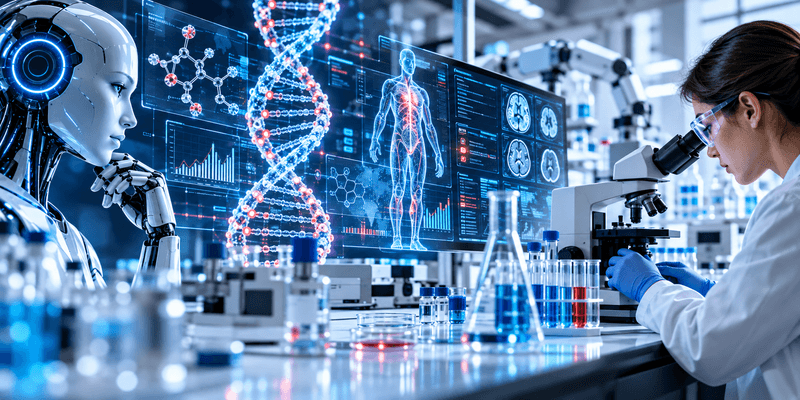
Biomedical research has traditionally been associated with laboratories, microscopes, clinical observations and carefully controlled experiments. Today, another environment has become just as important: the digital world. Vast datasets, artificial intelligence (AI), machine learning and increasingly sophisticated computational models are changing how researchers investigate human biology.
Modern laboratories can generate enormous quantities of information. Genomic sequencing, medical imaging, molecular screening, electronic health records, wearable devices and automated laboratory equipment all contribute to an expanding scientific data ecosystem. The challenge is no longer simply collecting information. Researchers must determine how to organize, analyze and interpret it effectively.
This is where AI is beginning to play an important role.
Rather than replacing conventional biomedical research, artificial intelligence can complement it. Algorithms can examine millions of observations, identify statistical patterns and help researchers decide which hypotheses deserve further experimental investigation. The result is an increasingly connected research environment in which computer science and laboratory science work together.
Why Biomedical Research Is Becoming Data-Driven
Scientific research has always depended on data, but the scale of modern biomedical information is fundamentally different from what researchers worked with several decades ago.
A single modern experiment may produce thousands or millions of measurements. Genomic studies can analyze variations across entire populations. Hospitals accumulate extensive clinical records, while imaging technologies generate detailed digital representations of the human body.
The All-in-One Platform for Effective SEO
Behind every successful business is a strong SEO campaign. But with countless optimization tools and techniques out there to choose from, it can be hard to know where to start. Well, fear no more, cause I've got just the thing to help. Presenting the Ranktracker all-in-one platform for effective SEO
We have finally opened registration to Ranktracker absolutely free!
Create a free accountOr Sign in using your credentials
Researchers can also collect continuous information through wearable technologies. Heart rate, sleep, physical activity, temperature and other variables can potentially be monitored over long periods.
Individually, these datasets provide useful information. Combining them creates considerably greater complexity.
Traditional statistical methods remain essential, but AI and machine learning provide additional ways to investigate relationships across large datasets. Researchers can use computational models to identify patterns that might otherwise remain hidden among millions of observations.
Machine Learning as a Scientific Tool
Machine learning is one of the most important technologies behind modern AI-driven research.
Instead of programming a computer with fixed instructions for every possible scenario, researchers can train machine-learning models using existing datasets. The system learns statistical relationships within the information and can then classify or estimate outcomes for new data.
In biomedical science, these methods have many potential applications.
Algorithms can analyze medical images, classify molecular structures, investigate genetic variations and compare laboratory measurements. They can also help researchers identify groups of patients or experimental samples that share particular characteristics.
The All-in-One Platform for Effective SEO
Behind every successful business is a strong SEO campaign. But with countless optimization tools and techniques out there to choose from, it can be hard to know where to start. Well, fear no more, cause I've got just the thing to help. Presenting the Ranktracker all-in-one platform for effective SEO
We have finally opened registration to Ranktracker absolutely free!
Create a free accountOr Sign in using your credentials
However, machine learning does not automatically determine why a biological relationship exists.
If an algorithm discovers an association between a biomarker and a health outcome, scientists must still investigate the underlying biological mechanism. Computational analysis can generate promising hypotheses, but laboratory experiments and appropriately designed clinical studies remain essential for testing them.
From Computer Predictions to Laboratory Experiments
One of the most interesting developments in biomedical research is the increasingly close relationship between computational prediction and physical experimentation.
Traditionally, researchers might develop a hypothesis and then design laboratory experiments to investigate it. AI introduces another stage into this process.
Scientists can first analyze large existing datasets and use computational models to identify potential relationships. Those predictions can then guide laboratory experiments.
Imagine researchers studying a biological receptor involved in a particular cellular process. Computational screening might examine thousands of molecular structures and estimate which compounds are most likely to interact with the receptor.
Instead of physically screening every candidate immediately, researchers can prioritize a smaller group for laboratory investigation.
Experimental results can subsequently be returned to the computational model, creating a feedback loop:
Data → Algorithm → Prediction → Experiment → New Data
This cycle could become one of the defining characteristics of future biomedical laboratories.
AI and Drug Discovery
Drug discovery is particularly suited to data-driven research because the number of theoretically possible molecules is enormous.
Researchers cannot experimentally investigate every potential compound. Computational techniques can therefore help narrow the search.
AI systems can analyze molecular structures, chemical characteristics and existing biological data to identify candidates that deserve further study. Some models can estimate properties such as molecular interactions or potential toxicity before researchers proceed to more expensive experimental stages.
This does not mean an algorithm can simply "invent a medicine" and make it ready for clinical use.
Computer-generated predictions require extensive validation. Researchers must investigate pharmacology, toxicity, metabolism, dosage, interactions and numerous other variables. Promising compounds may still fail during laboratory, animal or clinical research.
The value of AI lies primarily in helping scientists navigate an enormous search space more efficiently.
The Expanding Digital Landscape Around Research Compounds
Scientific information is no longer limited to academic journals and university libraries. Search engines, online databases, digital communities and commercial websites have made information about experimental and performance-related compounds much easier for the public to encounter.
This broader digital ecosystem includes platforms such as Dutch Sarms, reflecting growing public awareness of categories of compounds that are also discussed within pharmacological and performance-research contexts. However, online availability and scientific evidence are fundamentally different things. A compound being widely discussed or commercially accessible does not demonstrate clinical safety, effectiveness or regulatory approval.
AI may eventually help researchers and readers navigate this expanding information environment by organizing scientific literature, identifying conflicting findings and distinguishing different levels of evidence.
That could become increasingly important as the volume of biomedical information available online continues to grow.
Biomarkers and Predictive Analytics
Biomarkers are measurable biological characteristics that can provide information about physiological processes.
Examples include hormone concentrations, proteins, enzymes, genetic markers and numerous measurements obtained through blood or tissue analysis.
Traditionally, researchers might examine a relatively small number of biomarkers at a time. Modern laboratory technologies can measure hundreds or even thousands.
Machine learning can help identify combinations of markers that appear to correspond with particular biological states.
Instead of asking whether one measurement predicts an outcome, researchers can investigate whether a complex pattern involving many measurements provides useful information.
This approach is particularly relevant to areas such as metabolic research, cardiovascular science, oncology and endocrinology.
AI and Hormonal Research
Hormonal systems demonstrate why biological research can become computationally challenging.
Hormones rarely function independently. They interact through complex feedback mechanisms involving receptors, organs, enzymes and signaling pathways. Age, genetics, sleep, nutrition, medication and numerous environmental factors can further influence these systems.
Large datasets allow researchers to examine these relationships across larger populations.
One example of a compound appearing in endocrine and pharmacological literature is Enclomiphene, which has been investigated for its effects on the hypothalamic-pituitary-gonadal axis and testosterone-related outcomes in men with secondary hypogonadism. Data-driven analysis can help researchers compare measurements across studies and identify questions for further investigation, but conclusions about clinical use still depend on appropriately designed trials and regulatory evaluation.
This distinction illustrates an important principle of AI-driven medicine: computational analysis can reveal patterns, but those patterns still require biological interpretation and clinical validation.
Genomics Creates a New Scale of Data
Few areas demonstrate the scale of biomedical data better than genomics.
The human genome contains billions of DNA base pairs. When researchers analyze genetic information from thousands or millions of people, the resulting datasets become enormous.
AI can help scientists investigate associations between genetic variations and biological characteristics.
Researchers may combine genomic information with laboratory measurements, medical histories and environmental data to develop more detailed models of disease.
This contributes to the broader development of precision medicine.
Rather than assuming that every individual with the same diagnosis has identical biology, precision medicine seeks to understand differences between patients and how those differences might affect prevention, diagnosis or treatment.
AI provides tools capable of analyzing many of these variables simultaneously.
Medical Imaging and Computer Vision
AI-driven research is also transforming medical imaging.
X-rays, CT scans, MRI scans and pathology slides contain enormous amounts of visual information. Computer-vision systems can be trained to recognize patterns within these images.
Researchers are investigating whether such systems can help identify abnormalities, quantify anatomical features or detect subtle patterns associated with disease.
An algorithm might highlight suspicious regions within an image, allowing a specialist to examine those areas more closely.
The most practical future may therefore involve collaboration between humans and AI.
Algorithms can process enormous numbers of images quickly, while trained medical professionals provide clinical context, evaluate unusual findings and make decisions that require broader judgment.
Wearables and Continuous Biological Data
Biomedical datasets are also moving beyond hospitals and laboratories.
Smartwatches, fitness trackers and specialized wearable sensors can generate continuous streams of information about physical activity and physiological variables.
Traditional clinical measurements often provide only a snapshot. A patient may have heart rate or blood pressure measured during an appointment, for example.
Wearables can potentially provide longitudinal information covering weeks, months or even years.
For researchers, this creates opportunities to investigate how physiology changes over time.
AI can analyze these continuous datasets and search for trends that may be difficult to identify manually. In research settings, wearable information may eventually be combined with laboratory biomarkers, medical records and genomic information.
The result could be a much more detailed picture of human physiology.
Automation and the Smart Laboratory
AI-driven biomedical research is not limited to software.
Physical laboratories are becoming increasingly automated.
Robotic systems can perform repetitive tasks such as liquid handling, sample preparation and high-throughput screening. Connected laboratory instruments can automatically record experimental measurements and transfer them into centralized databases.
AI can then analyze those results.
In advanced research environments, an automated system might perform experiments, record measurements and use computational analysis to determine which experimental conditions should be tested next.
Scientists remain responsible for designing the research objectives and interpreting the findings, but automation can dramatically increase experimental throughput.
The laboratory therefore becomes both a physical and digital environment.
The Problem of Bad Data
The rapid growth of AI does not eliminate one of science's oldest principles: poor-quality input produces unreliable conclusions.
Biomedical datasets can contain missing measurements, incorrect labels, inconsistent collection methods and sampling biases.
An algorithm trained on flawed information may produce equally flawed results.
Researchers must therefore carefully examine how datasets were collected and whether they adequately represent the population being studied.
External validation is especially important.
A model that performs well using data from one hospital, laboratory or population may perform differently elsewhere.
AI systems should therefore be tested using independent datasets before researchers assume their findings can be generalized.
Privacy and Ethics
Biomedical AI also introduces significant ethical questions.
Medical records, genetic information and continuous health-monitoring data can be extremely sensitive.
Researchers and healthcare institutions must protect this information through appropriate security, governance and privacy procedures.
Another concern involves transparency.
Some sophisticated AI systems can generate predictions without providing a simple explanation for how they reached them. This can create difficulties when algorithms influence medical research or clinical decisions.
Scientists therefore increasingly investigate explainable AI—methods designed to make computational reasoning more understandable to researchers and healthcare professionals.
Scientists Remain Essential
Despite extraordinary advances in artificial intelligence, biomedical science cannot simply be automated from beginning to end.
Algorithms recognize mathematical patterns. Scientists determine whether those patterns have biological meaning.
Researchers formulate hypotheses, design experiments, identify confounding factors and evaluate unexpected results. Clinicians interpret findings within the broader context of individual patients.
Human judgment is also essential for ethical decisions.
The most realistic future is therefore not AI replacing scientists. It is scientists using increasingly powerful computational systems to investigate questions that would otherwise be too complex or data-intensive.
The Laboratory of the Future
The boundary between computer science and biomedical science is becoming increasingly difficult to define.
Future laboratories may combine robotics, genomic sequencing, automated microscopy, connected instruments, electronic research records and machine-learning systems within a single research environment.
Experiments will generate data automatically. Algorithms will analyze that information and identify potential patterns. Researchers will use those findings to design the next experiments.
This continuous interaction between algorithms and laboratory science could significantly accelerate certain areas of biomedical discovery.
Yet the fundamental principles of science remain unchanged.
The All-in-One Platform for Effective SEO
Behind every successful business is a strong SEO campaign. But with countless optimization tools and techniques out there to choose from, it can be hard to know where to start. Well, fear no more, cause I've got just the thing to help. Presenting the Ranktracker all-in-one platform for effective SEO
We have finally opened registration to Ranktracker absolutely free!
Create a free accountOr Sign in using your credentials
Predictions require testing. Results require replication. Correlations require careful interpretation. Medical interventions require appropriate evidence.
AI and Big Data provide researchers with extraordinarily powerful tools, but their scientific value ultimately depends on how responsibly those tools are used.
The rise of AI-driven biomedical research is therefore not simply a story about faster computers. It represents a broader transformation in how scientists investigate biology—from isolated experiments toward interconnected systems where laboratory measurements, digital information and computational models continuously inform one another.
In that environment, algorithms may help determine where researchers should look next, but rigorous scientific investigation will remain responsible for determining what the evidence actually means.

