Intro
When a teacher sets an essay, the real work begins after students hand it in. A class of thirty students writing 800 words each produces around 24,000 words of reading, and most teachers have several classes. Each paper needs a careful read, a score for every part of the rubric and comments that make sense to the student who wrote it. That process often stretches across a week of evenings, and by the time papers come back, students have already moved on to the next topic. The cost is not only the teacher's time. It is also the lost chance for students to learn from feedback while the assignment is still fresh in their minds.
Why Workload Shapes What Gets Assigned
Teachers are practical people, and heavy marking loads quietly change how writing is taught. Many educators admit they set fewer extended essays than they would like, simply because they cannot mark more without losing their weekends. Drafts get skipped, practice essays go unmarked and feedback becomes shorter as the pile grows. None of this reflects a lack of care. It reflects the limits of one person's time. Any tool that eases that pressure has a direct effect on how much writing students actually do, which is why grading support has become such a common topic in staff rooms.
What an AI Grader Takes Off a Teacher's Plate
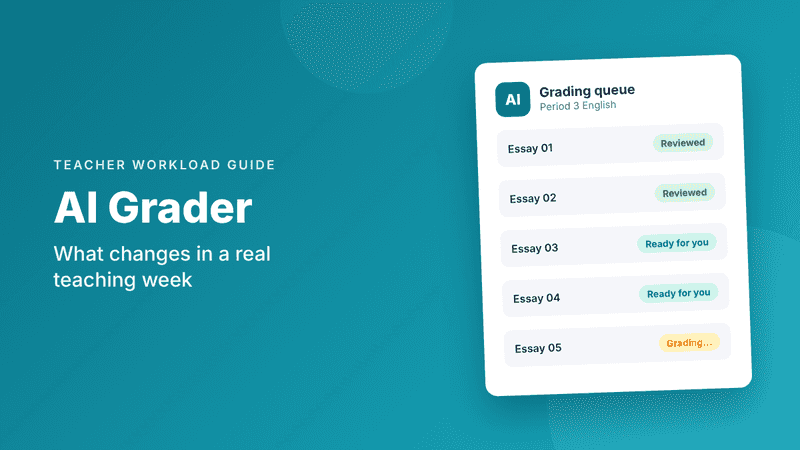
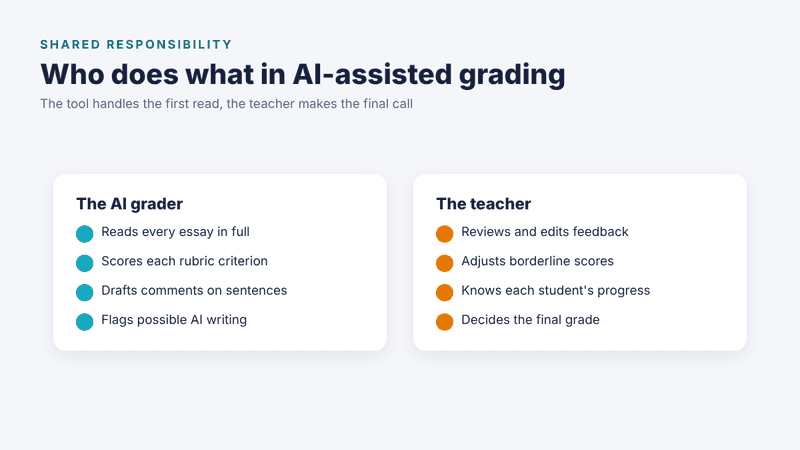
An AI grader handles the most time-consuming part of marking: the detailed first read. It reads each essay in full, measures it against the teacher's rubric and drafts a score and written comments for every criterion. The teacher then reviews that draft, adjusts anything that does not match their judgment and releases the final version to the student. In other words, the tool does the reading and the first round of note-taking, while the teacher keeps responsibility for every decision that reaches a student. The difference is that the teacher starts from organized feedback rather than a blank page.
A Grading Week Before and After
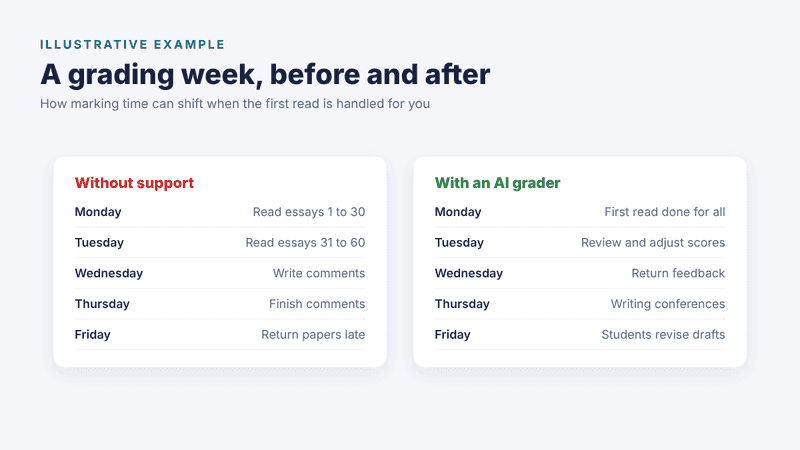
The easiest way to picture the change is to compare two versions of the same week. Without support, a teacher might spend Monday and Tuesday reading, Wednesday and Thursday writing comments and Friday catching up, with papers returned late. With the first read handled automatically, Monday can be spent reviewing ready-made feedback, Tuesday adjusting scores and Wednesday returning papers. The rest of the week opens up for writing conferences and revision time. The specific schedule will differ for every teacher, but the shift from reading to reviewing is where the time comes back.
Setting Up the Rubric Before the First Batch
The tool can only follow the criteria it is given, so the rubric deserves a few minutes of attention before the first batch of essays. Clear criteria, described in plain language at each performance level, lead to clear feedback. Vague phrases such as "good analysis" produce equally vague comments. Teachers who already have a rubric for an assignment can usually use it as it is, perhaps sharpening one or two descriptions. Those starting from scratch can adapt a ready-made rubric for the essay type or generate one from a short description of the task, then edit it to match what was taught in class.
Reviewing Feedback Instead of Writing It From Scratch
The review stage is where the teacher's expertise matters most. Rather than reading each essay cold, the teacher reads it alongside the drafted feedback, checking whether each score and comment holds up. Comments that are accurate can stay as they are. Comments that misread the student's meaning can be edited or removed in seconds. Teachers often find that this kind of review is less tiring than writing every comment from nothing, because the structure is already in place and attention can go to the points that genuinely need professional judgment.
Where the Teacher's Judgment Still Leads
There are parts of grading that no tool should take over, and it helps to be clear about them from the start:
- Deciding the final grade on every paper, especially borderline cases
- Recognizing a student's progress across the term and rewarding real improvement
- Understanding when an unusual choice is deliberate and effective rather than a mistake
- Taking individual learning needs and circumstances into account
- Holding the follow-up conversation with a student about their writing
Consistency From the First Paper to the Last
Even experienced teachers grade the thirtieth essay a little differently from the first. Fatigue, the order of papers and the quality of the essay just before can all nudge a score up or down. Applying the same rubric in the same way to every essay reduces that drift. The teacher's review then becomes a fairness check rather than a fresh judgment each time, which makes it easier to see genuine differences between students. For departments that share common assessments, this consistency also helps different teachers arrive at similar scores for similar work.
Bringing Drafts and Practice Essays Back Into the Plan
Once the marking load drops, low-stakes writing becomes realistic again. Teachers can collect rough drafts and return feedback before the final deadline, so students revise with clear guidance instead of guessing. Timed practice essays, which often go unmarked, can receive criterion-level comments that help students see their progress. This is where AI grading has some of its biggest effects on learning, because writing improves through repeated cycles of trying, receiving feedback and trying again, and those cycles depend on feedback arriving quickly.
Starting With One Class and One Assignment
The smoothest way to introduce AI grading is to start small. A simple trial usually looks like this:
- Choose one class and one upcoming essay assignment
- Load the rubric you already use, sharpening any vague level descriptions
- Grade a handful of essays yourself first, then run the same essays through the tool
- Compare your scores and comments with the drafted feedback
- Note where you agree, where you differ and how much editing was needed
Teachers who want to try this can begin on clasa.ai, which grades essays against a chosen rubric and returns editable feedback for each criterion. After one or two assignments, most teachers have a clear sense of where the tool saves time and how much review their own classes need.
Questions of Accuracy and Fairness
Teachers rightly ask whether automated feedback can be trusted. The honest answer is that it should be checked, not assumed. Accuracy depends a great deal on the quality of the rubric and the clarity of the assignment, and results improve when both are well defined. Reviewing every essay before release protects students from errors, and keeping notes on where the tool tends to agree or disagree with your judgment helps you decide how closely to review in future. Used this way, AI grading supports fairness by applying criteria evenly while the teacher protects against mistakes.
Handling AI-Written Submissions
The same tools that help teachers grade are often asked about the opposite problem: students using chatbots to write their essays. Many graders include an AI-writing check that highlights passages that look machine-generated. This can be a useful signal, but it is not proof. Formal or formulaic writing can sometimes be flagged by mistake, so a highlighted passage is best treated as a reason to talk with the student, ask for earlier drafts or compare the work with writing completed in class rather than as grounds for an automatic penalty.
Explaining the Process to Students and Families
Transparency helps everyone accept a new approach. Students should know that a tool drafts the first round of feedback, that their teacher reviews every result and that the final grade remains the teacher's decision. Families tend to respond well when they see that the change means faster and more detailed feedback rather than less teacher involvement. A sample feedback report shared in a newsletter or at a parent meeting usually answers most questions before they are asked and shows exactly what students will receive.
What Teachers Do With the Time They Get Back
The value of an AI grader shows up in what happens after the marking is done. Some teachers use the recovered hours for one-to-one writing conferences, where a five-minute conversation can do more than a page of comments. Others add an extra draft stage to major assignments or run peer review sessions using the same rubric. Some simply reclaim evenings and weekends, which matters for staying in the profession over the long term. In each case, the time moves away from repetitive reading and toward the parts of teaching that depend on a human relationship with students.