
Intro
Video has become the internet's default format. Lectures, meetings, product demos, YouTube tutorials, webinars, and news clips all pile up faster than anyone can realistically watch them. A single hour-long meeting recording, a two-hour conference keynote, or a course with forty video lessons can represent hours of viewing time just to extract the handful of points that actually matter.
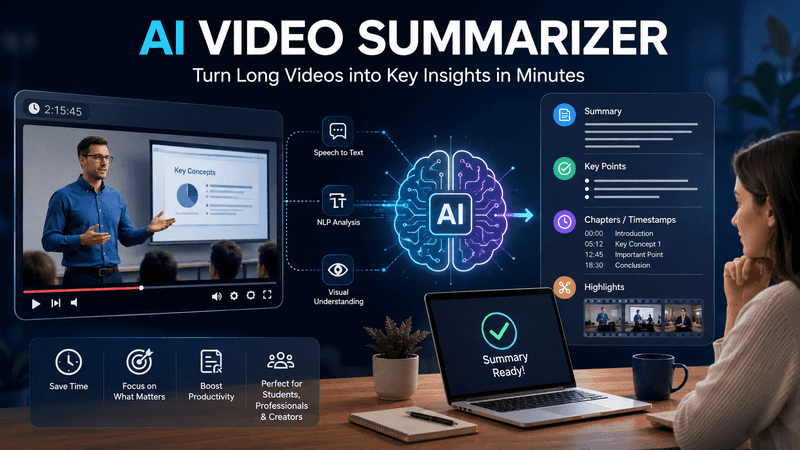
This is the exact problem an AI video summarizer is built to solve, and it's why the tool category has grown from a niche convenience into something close to a daily necessity for students, professionals, and content creators alike.
How AI Summarizes Video Content Automatically
An AI video summarizer is a tool that processes video content and automatically generates a condensed version of it, typically as a written summary, a set of key bullet points, or a shortened highlight clip. Instead of watching an entire video from start to finish, users get the core information in a fraction of the time.
Under the hood, most of these tools combine several AI capabilities. Speech recognition converts spoken audio into text. Natural language processing analyzes that text to identify the most important sentences, topics, and takeaways. In more advanced tools, computer vision is also applied to the video frames themselves, allowing the system to recognize slides, on-screen text, scene changes, or visual demonstrations that carry meaning beyond just the spoken words.
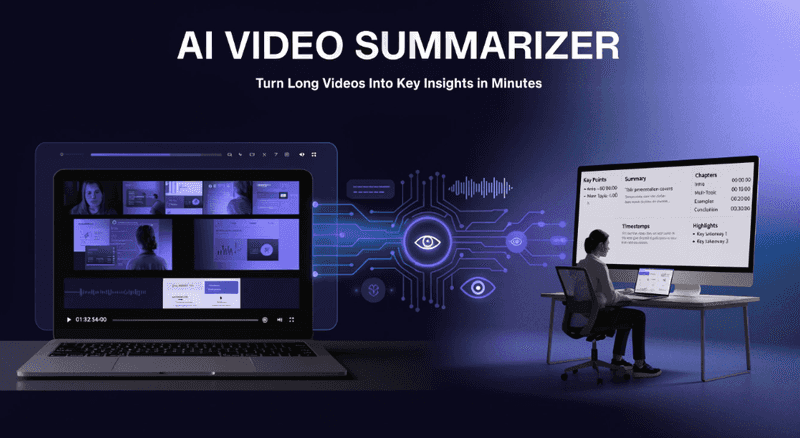
The output can take several forms depending on the tool and the use case: a paragraph-style summary, a bulleted list of key points, timestamped chapters, or even a short video clip stitched together from the most relevant moments of the original.
Why Free AI Video Summarizer Tools Have Become So Popular
A few years ago, video summarization was something only large media companies or research labs could do, using custom-built systems and significant computing power. Today, a free AI video summarizer is available to almost anyone with an internet connection, and that accessibility has driven rapid adoption across very different groups of users.
Students and Lifelong Learners
Online courses, recorded lectures, and educational YouTube channels have exploded in volume. Students juggling multiple classes often don't have time to rewatch every lecture in full before an exam. A summarizer lets them quickly review the core concepts from a two-hour lecture in a few minutes, then decide whether specific sections are worth watching in full.
Busy Professionals
Meetings are one of the most common targets for video summarization. Many teams now record video calls by default, but almost nobody has time to rewatch a 60-minute meeting they already sat through once. An AI summarizer can pull out decisions made, action items assigned, and key discussion points, turning a recording that would otherwise sit unwatched into a useful, skimmable record.
Content Creators and Marketers
Creators managing multiple platforms need to repurpose long-form content into shorter formats: highlight reels for social media, blog recaps, or newsletter summaries. Summarization tools speed up this process significantly, giving creators a starting draft they can refine rather than starting from a blank page after rewatching their own footage.
Researchers and Journalists
Anyone who needs to process large volumes of video content press conferences, interviews, public hearings benefits from being able to quickly scan summaries before deciding which full recordings warrant a closer watch.
How AI Video Summarizers Actually Work
Understanding the underlying process helps explain both what these tools are good at and where they still fall short.
Step One: Transcription
The first stage is almost always automatic speech recognition, converting the audio track into a text transcript. This step has improved dramatically in recent years, with modern systems handling multiple speakers, accents, and background noise far better than earlier generations of the technology.
Step Two: Content Analysis
Once a transcript exists, natural language processing models analyze the text to identify what actually matters. This typically involves detecting topic shifts, recognizing emphasis (repeated phrases, tone changes, or phrases like "the key point here"), and ranking sentences by how central they are to the overall content.
Step Three: Visual Analysis (in more advanced tools)
Some summarizers go a step further by analyzing the video frames themselves. This allows the tool to recognize when a slide changes during a presentation, when a demo product is shown on screen, or when a significant visual moment occurs that isn't fully captured by the audio alone.
Step Four: Summary Generation
Finally, the system compiles its findings into an output format — a written summary, a bullet list, a chapter breakdown with timestamps, or a short highlight clip. Many tools let users choose the format and length that suits their needs, from a two-sentence overview to a more detailed multi-paragraph recap.
What to Look for in a Free AI Video Summarizer
Not all summarization tools are built the same way, and free options can vary widely in quality and features. A few things are worth checking before relying on one regularly:
- Accuracy of transcription. If the underlying speech-to-text engine struggles with accents or technical vocabulary, the summary quality will suffer no matter how good the summarization model is.
- Length and video limits. Many free tiers cap the length of video that can be processed, or limit the number of summaries per day or month.
- Output flexibility. Some tools only generate a single fixed-length summary, while others let users adjust detail level or export in different formats (text, bullet points, timestamps).
- Support for multiple languages. For users working across languages, checking whether the tool can transcribe and summarize non-English audio matters.
- Privacy and data handling. Since video content is often uploaded to a third-party service, it's worth understanding how that data is stored and whether it's used for anything beyond generating the summary.
The Limitations Worth Knowing
Despite the convenience, AI video summarizer is a perfect substitute for watching the full video in every situation. Nuance, tone, and context can be lost in condensation — a joke, a moment of hesitation, or a subtle disagreement in a meeting might not come through in a bullet-point summary the way it would in the original footage. Highly technical or visually dependent content, like a detailed software tutorial, can also be harder to summarize meaningfully since so much of the value lies in watching the actual steps performed on screen.
The All-in-One Platform for Effective SEO
Behind every successful business is a strong SEO campaign. But with countless optimization tools and techniques out there to choose from, it can be hard to know where to start. Well, fear no more, cause I've got just the thing to help. Presenting the Ranktracker all-in-one platform for effective SEO
We have finally opened registration to Ranktracker absolutely free!
Create a free accountOr Sign in using your credentials
For high-stakes situations legal recordings, critical business decisions, or academic material being studied for an exam a summary is best treated as a starting point or a quick refresher rather than a full replacement for watching the source material.
Where This Technology Is Headed
As video continues to dominate how information is shared online, the demand for fast, reliable summarization tools is only going to grow. Future versions of these tools are likely to get better at handling multiple speakers, recognizing sarcasm or emotional tone, and integrating directly into the platforms where video already lives meeting software, learning management systems, and social media platforms so that a summary is generated automatically the moment a video is uploaded, without the user needing to seek out a separate tool at all.
Conclusion
The rise of the AI video summarizer reflects a simple reality: there's more video content available than anyone has time to watch. Whether it's a free AI video summarizer used by a student cramming for an exam or an enterprise tool processing hundreds of recorded meetings a week, the core value is the same turning hours of footage into minutes of genuinely useful information. As the underlying speech recognition and language models continue to improve, these tools will only get better at capturing not just what was said in a video, but what actually mattered.

