
Intro
Alternative payment methods are everything your customers reach for when a plain card won't do, and skipping them costs you real sales. A shopper fills their cart and reaches your checkout. The way they always pay isn't there, so they leave. You paid to get them to your store, then lost them on the final click.
This whole guide is about fixing that. First, what these methods even are and how people actually want to pay now. Then a straight way to pick the right ones for your store. After that, launching them cleanly and spotting which ones actually pay off.
What Alternative Payment Methods Actually Are
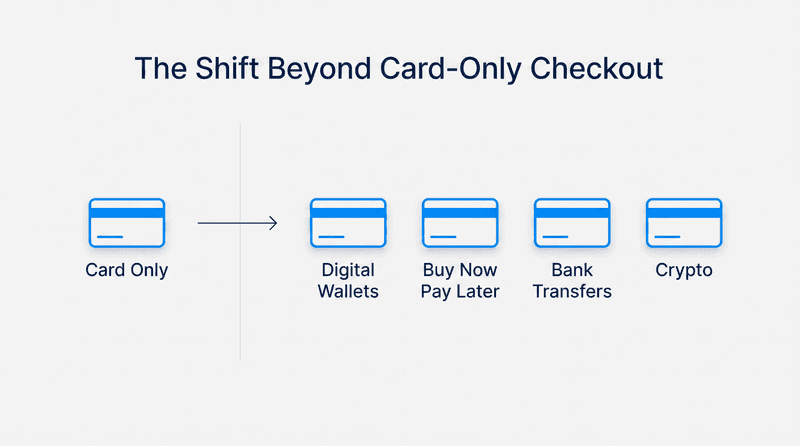
Quick bit of grounding first, because this label is wider than it sounds. If it isn't a plain card, it probably counts.
An alternative payment method is any way to pay that skips the traditional payment methods. Digital wallets count. So does buy now, pay later. Add bank transfers and the crypto people keep on their phone. If a shopper can check out for an online purchase without punching in a 16-digit card number, that is the category.
For years, the card was king and everything else was a curiosity. Not anymore. For most mobile payments, a wallet is the first thing you see at checkout, and plenty of younger shoppers split cash payments without thinking. The card is now one choice on the shelf, not the default everybody reaches for.
Offering popular alternative payment methods matters because how someone pays is now part of whether they buy at all. Show up without their method, and plenty of people read it as a store that isn't really for them.
How Different Shoppers Actually Want To Pay Now
The All-in-One Platform for Effective SEO
Behind every successful business is a strong SEO campaign. But with countless optimization tools and techniques out there to choose from, it can be hard to know where to start. Well, fear no more, cause I've got just the thing to help. Presenting the Ranktracker all-in-one platform for effective SEO
We have finally opened registration to Ranktracker absolutely free!
Create a free accountOr Sign in using your credentials
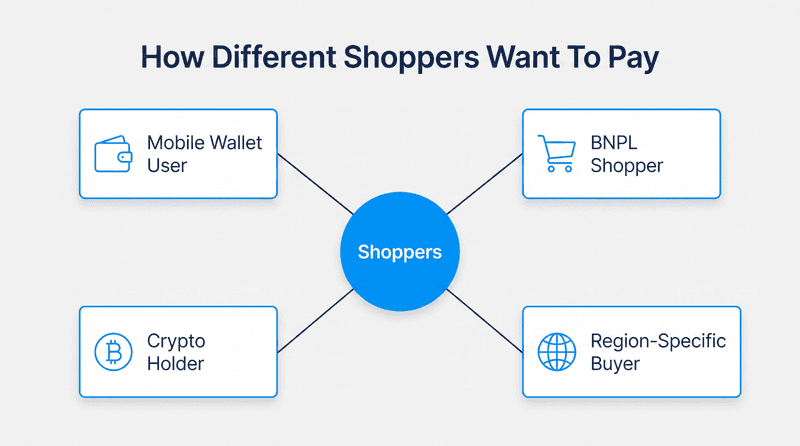
The methods you bother with only matter if they match with how your shoppers actually want to pay. And people split into a few pretty clear camps.
1. The Mobile-First Wallet User
This one shops on their phone and hasn't typed a card number in years. They want to tap and go, full stop. Take Apple Pay. The card is already saved on the phone, so checkout is a glance at Face ID and a single tap. No forms, nothing to fumble. That same habit carries over to contactless payments when they shop in person.
And since almost all of these people are on a phone, that one-tap button is often the whole ballgame between a sale and a bailed cart. Digital wallets already run 40% of US eCommerce spending. That level of digital wallet usage is hard for online stores to ignore. This crowd is the main event, not a side act.
2. The Budget-Conscious BNPL Shopper
This shopper can cover the cost but would rather spread it out. They arrive at your checkout already looking for Klarna, especially on anything past a small impulse buy.
Klarna splits the total into four interest-free payments and approves them instantly. So a $200 jacket reads as four easy $50 hits instead of one wince, which improves both your conversion and your average order size. Leave it off a higher-priced store, and these potential customers go buy from someone who has it.
3. The Crypto Holder
This shopper keeps real money in crypto and wants to spend it like physical cash, without selling first. Smaller group than wallet users, but growing fast and buying with real intent. The old problem was simple. The crypto stayed in an app while the checkout only spoke card. That is why instant money transfers have become more appealing for crypto users.
There are certain platforms that help this problem disappear. A crypto holder can spend straight from a self-custodial wallet, and that now reaches even further. Their crypto can provide the funds, so Grok Bot can buy things at shops and pay for them, using a scoped card with strict limits. Either way, it converts on the spot, so your checkout just sees a standard card payment.
The part that matters for them is what they skip: no selling into cash first and no complicated off-ramp. The part that is easy on you is just as simple. They check out over plain Visa rails. If you take credit and debit cards, you already take them.
4. The Region-Specific Buyer
Sell across borders, and the trusted method changes at every one. A shopper in the Netherlands expects iDEAL, and it isn't an optional extra. iDEAL bounces them to their own bank to approve the online payment.
The money moves directly from the customer's bank account, without asking them to enter card details. And it runs the majority of Dutch online checkouts.
The All-in-One Platform for Effective SEO
Behind every successful business is a strong SEO campaign. But with countless optimization tools and techniques out there to choose from, it can be hard to know where to start. Well, fear no more, cause I've got just the thing to help. Presenting the Ranktracker all-in-one platform for effective SEO
We have finally opened registration to Ranktracker absolutely free!
Create a free accountOr Sign in using your credentials
Show a Dutch buyer a checkout without it, and it feels a bit unfamiliar, like a shop that doesn't quite belong there. Anytime you are moving into a new country, the local payment method that meets customers’ expectations does more for you than yet another global card logo.
| Shopper Type | Preferred Payment Method | What They Expect At Checkout |
| Mobile-first wallet user | Apple Pay / Google Pay | One tap, nothing to type |
| Budget-conscious shopper | Klarna / Afterpay | The total split into installments |
| Crypto holder | Oobit / crypto card | To spend crypto without selling it |
| Region-specific buyer | iDEAL / Pix | Their country's default method |
How To Choose The Right Alternative Payment Methods For Your Store
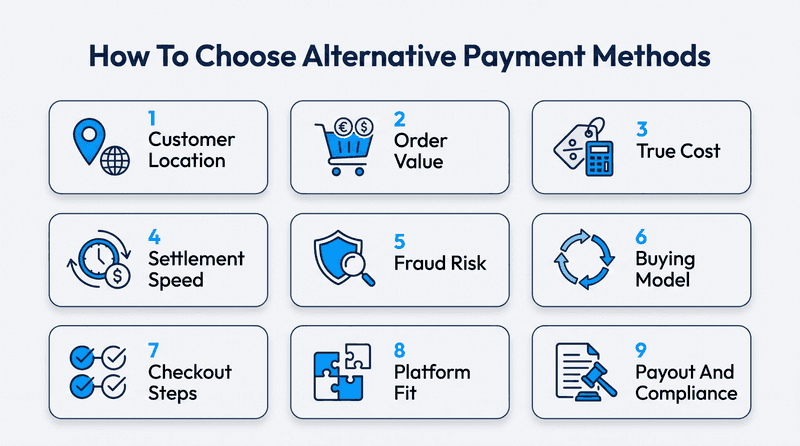
Now the shopper side is clear; the real work is accepting alternative payment methods that fit your store instead of adding every logo going. These 9 checks keep that decision honest and give you a payment strategy based on real customer preferences.
1. Start With Where Your Customers Actually Are
Your buyers’ location decides which methods even matter, before anything else gets a look. A method that is huge in one country is a ghost in another. And your customers’ payment preferences follow those same regional habits. So your real starting point is a map of who is actually buying.
Trouble is, that map and the one in your head rarely line up. You might swear you are a European brand while most of your orders come from Brazil. Seeing your visibility country by country fixes that, and it is exactly what a tool like Rankracker shows.
- Pull your last 90 days of orders and rank them by shipping country.
- List the top three countries and note each one's dominant local method.
- Check search visibility per country before you commit to any regional method.
- Drop any market that looks big but rarely converts into real orders.
2. Size The Method To Your Average Order Value
Your typical basket size rules methods in and out all by itself. On a store selling $15 bits and bobs, BNPL does nothing. Nobody splits a coffee run into four payments.
Increase that average up to $150, and the same option starts padding your orders. BNPL is a $560 billion market now, and nearly all of it clusters on pricier carts where paying in installments changes the yes-or-no.
- **Calculate your true average order value **from the last full quarter of sales.
- Flag any method with fixed fees that punish your smaller online transactions hardest.
- Match installment options to products priced above a comfortable one-payment limit.
- Test whether a higher-value bundle performs better once split payment is offered.
3. Compare The True Cost Per Transaction
The rate on the poster is never what you actually pay, and they know it. That tempting low number can hide a flat fee on every sale or a currency markup, plus a monthly charge tucked underneath.
Two methods with the same headline rate can cost wildly different amounts once your real orders run through them. The figure that counts is the all-in cost across a normal month, not the pretty one on the brochure.
- **Rebuild each provider's cost **as one blended rate at your real volume.
- Fold every fixed fee and currency markup into that one blended number.
- Ask each provider for their all-in rate at your monthly transaction count.
- Recheck the math whenever your volume crosses a provider's next pricing tier.
4. Check How Fast The Money Reaches Your Account
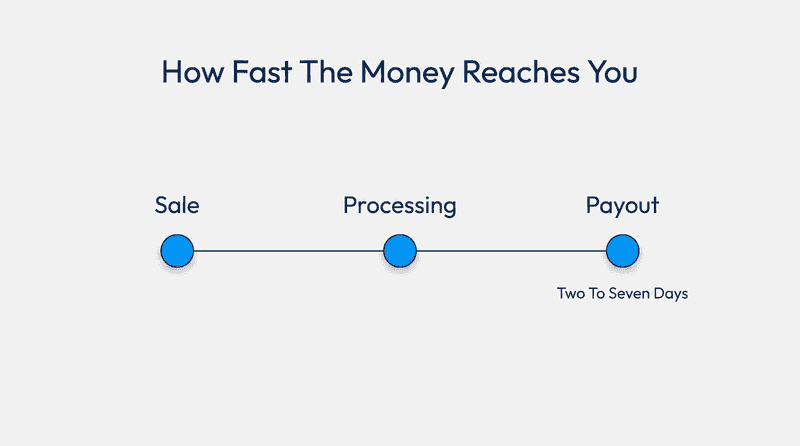
Different methods pay you back on wildly different clocks, and that timing hits your cash flow directly. Cards might settle in a couple of days while some bank-transfer methods make you wait a week. Speed is often a setting rather than a property of the method: an online store that runs its checkout and payouts on Whop, a payment platform with subscription billing and global payouts in the same account, chooses per withdrawal between a $2.50 next-day bank transfer and an instant deposit at 4% + $1.00, so the money can move as fast as that week's cash flow needs. A few newer ones hold onto your money even longer as a fraud cushion.
If your working capital is tight, a method that sends money after a week can hurt even when its fee looks cheaper. Slow settlement is a real cost, just one that never shows up on the rate card.
- Ask every provider for the exact number of days until money settles.
- Map each method's payout schedule against your regular supplier and payroll dates.
- Favor faster settlement when your working capital or cash runway is tight.
- Watch for rolling reserves that hold back a slice of every payout.
5. Weigh The Fraud And Chargeback Risk
Every popular payment method comes with its own way of going wrong. A card payment can boomerang back as a chargeback months later, usually with a fee stapled on and your product already shipped.
Bank account transfers and most wallets are far harder to reverse, and some prepaid card options basically kill chargebacks. Whichever you pick, you are also choosing how much of that risk falls on you instead of the customer.
- Group your shortlisted methods by how easily a payment can be reversed.
- Weigh chargeback fees and dispute rates against the sales each method brings.
- Lean toward low-reversal methods for your high-value or fraud-prone product lines.
- Check who covers the loss when a specific method's payment is disputed.
6. Match It To How Your Customers Buy
How different customer segments buy from you should steer this as much as what they buy. A one-time purchase and a monthly subscription or bill payment want completely different things at checkout.
Subscriptions love methods that re-charge on their own without asking every month, like direct debit payments or a saved wallet. A store built on single thought-through buys wants the opposite, where a fast guest checkout comes out ahead.
- Split your revenue between one-off sales and recurring or subscription billing today.
- **For subscriptions, prioritize methods that auto-charge **without a new approval each cycle.
- For one-off buyers, prioritize a fast guest checkout over account-based flows.
- **Avoid methods that force returning customers **to re-enter details every single time.
7. Count The Steps It Adds At Checkout
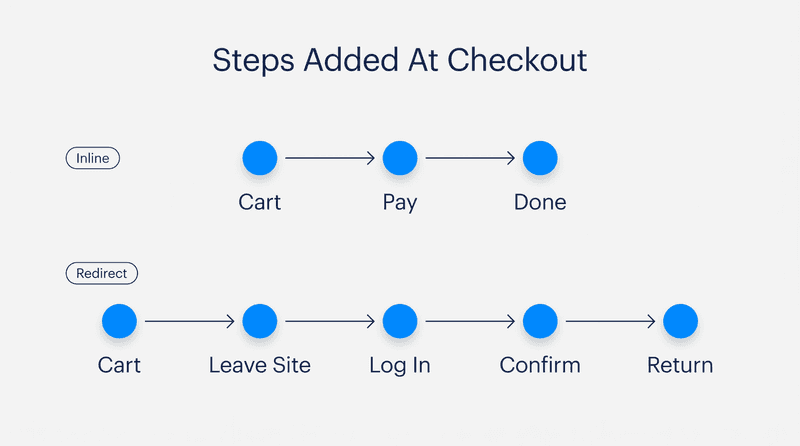
Many alternative payment methods drop the buyer straight through, and others fling them out to a separate screen and back. Every one of those detours is a chance for someone to have second thoughts and close the tab. The more friction you add, the fewer shoppers complete transactions.
A method that punts them to an outside login and then waits for a confirmation adds drag that your conversion rate will feel. Since every extra step between cart and confirmation reduces the number of people who finish, the payment option with the fewest switches usually comes out on top.
- Count the exact number of taps each payment process adds after the cart.
- Use preferred methods that finish inside your own checkout without any external redirect.
- Test each option on a phone, timing it from cart to confirmation.
- Drop any method that sends buyers off-site and hopes they come back.
8. Make Sure It Fits Your Store's Platform
A method is only as good as your ability to actually run it. Your platform needs to let you accept payments through the method without creating extra work elsewhere. On Shopify or WooCommerce, most of the big names are a quick app install from going live. How smooth that is depends on your store's technical setup.
Try integrating alternative payment methods into a custom or headless build, and that same method can mean real developer hours and upkeep. That plumbing work is a genuine cost, and teams who think through the API development behind connecting payment systems together dodge the ugly surprises later.
- Confirm each method has a maintained plugin for your exact platform version.
- Ask your developer to estimate build hours for anything without native support.
- Check the integration handles refunds and reporting, not only accepting the payment.
- **Factor ongoing maintenance **into the true cost, not just the one-time setup.
9. Confirm Payout Reliability And Compliance
A method that takes money beautifully is worthless if prying your own cash loose is a battle. Newer providers can freeze payouts over some routine review, and plenty hold reserves that lock up your money for weeks.
Rules matter too, especially around crypto or cross-border transfers. What is allowed changes country to country. The dull homework here is what separates a method you can trust with real revenue from one that turns into a monthly headache.
- Read recent merchant reviews that focus on payout delays and frozen accounts.
- Confirm the provider is licensed to operate in every country you sell.
- Check payout limits and reserve terms before you route real revenue through it.
- Keep a backup method live so one freeze never halts all sales.
How To Roll Out A New Payment Method Without Losing Sales
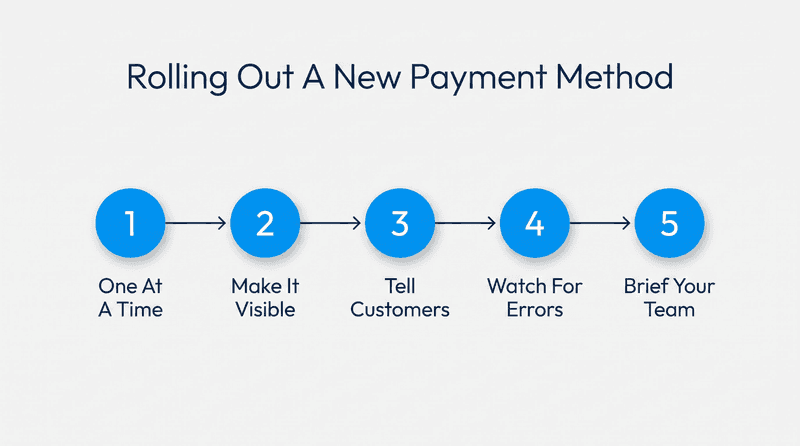
Picking well is only half the job. A rushed launch can smother a good method or ding the sales you already had, so the rollout deserves its own plan. And the rollout should protect the existing customer experience, not just add another button.
1. Add One Method At A Time
Fight the urge to add multiple payment methods in one week. Introduce them all at once, and watch your numbers move; you will have no clue which one earned it or which one broke something.
Turn one on and give it a few weeks of real traffic before the next goes live. A staggered rollout hands you a clean before-and-after you can actually learn from.
2. Put It Where Shoppers Can't Miss It
A method nobody spots might as well not be there. Hide a shiny new wallet option three clicks deep and the people who wanted it never find it, so it looks like a flop when it was really a hiding spot.
Put it out early on the product page and up top at checkout, while they are still deciding to buy. It is worth the fuss. Around 9% of shoppers walk just because the checkout didn't have enough ways to pay.
3. Announce It To The Customers You Already Have
Your existing customers are the quickest proof a new method works, and most stores just forget to tell them. Someone who bailed on a cart last month because their option was missing will happily come back once they hear it is there.
A quick email and a banner at checkout do the trick. You are not selling to strangers here. You are reopening a door for people who already wanted to buy.
4. Watch The First Weeks For Errors
New payment integrations break in small and oddly specific ways, and the first few weeks are when they show their face. A wallet that dies on one phone model or a redirect that loops in circles never turns up in a demo.
Keep a close eye on your failed-transaction logs and support tickets right after launch, not just in next month's report. Catch a broken flow in week one, and you save the slow drip of lost sales it would cause all quarter.
5. Brief Your Support And Fulfillment Team
The team answering your emails will run into this method before you do. Someone will ask why a payment says pending, or how a refund works on something that isn't a card. A blank stare damages the exact trust the method was supposed to build.
Walk the team through how it settles and how refunds run before it ever goes live. Support that answers without flinching turns a strange new option into one people feel safe using.
How To Tell If Offering Alternative Payment Methods Is Actually Paying Off
Live doesn't mean it is working. Give it a few weeks, and the numbers will tell you which methods deserve their spot at your checkout and which are just taking up room. That is more useful than simply copying the top alternative payment methods other stores offer.
1. Track Conversion And Abandonment By Method
The most telling number is checkout completion, split out by payment method. If one option gets loads of starts but barely any finishes, something about it is spooking people right at the end.
Line each method's completion rate up against your card baseline. Anything limping well below it needs a closer look, not a permanent home on your checkout.
2. Weigh Real Usage Against What It Costs To Run
Popularity on its own isn't enough to justify a method. A wallet that only 2% of buyers use can carry a monthly fee and dev upkeep that cost more than it brings in.
Set each method's real volume next to what it truly costs to run, and the dead weight shows itself fast. A method justifies itself by bringing in new sales or clearly lifting completion, not by simply existing.
This weighing gets brutal in food and beverage, where the margin on a single item is already wafer-thin. A 2% or 3% fee sounds tiny until you set it against a plate that nets only a few cents.
In that world, a payment method is not a minor cost. It can decide whether a dish makes money or loses it on every single order.
The catch is that you can’t weigh a fee you can’t see clearly. Most food businesses badly underestimate what a finished plate actually costs them, because ingredient prices move and portions change. Judge a payment method against a margin you only half know, and you are guessing.
The All-in-One Platform for Effective SEO
Behind every successful business is a strong SEO campaign. But with countless optimization tools and techniques out there to choose from, it can be hard to know where to start. Well, fear no more, cause I've got just the thing to help. Presenting the Ranktracker all-in-one platform for effective SEO
We have finally opened registration to Ranktracker absolutely free!
Create a free accountOr Sign in using your credentials
So the fix comes first, before the payment math. A resource like these costed recipe templates builds the true price of every ingredient and portion straight into the recipe itself. With that real number in hand, a fee stops being abstract. You can see exactly how much of your margin each payment method eats per item.
That discipline pays off anywhere the margin per sale is thin, and the volume is high. Food and drink is the sharpest case, though the same holds for any low-ticket high-frequency store where a couple of percentage points is the whole profit.
3. Decide Which Methods Stay And Which Go
Once the numbers are in, do something with them instead of letting every option just hang around. A method pulling real volume deserves a bigger stage – higher up the page and a mention in your marketing.
One that almost nobody touches and still costs you to keep can go, no ceremony needed. Give the whole lineup a review twice a year, and your checkout stays tuned to how people pay now, not how they paid two years ago.
Conclusion
The best alternative payment methods aren't the most you can add. They are the smallest set that covers how your customers actually want to pay. Start from real buyers and work backward, and three or four usually do almost all the work. Add more only when the numbers beg for it.
Nearly every call above starts with two things: where your customers are and whether they can find you. That is our job at RankTracker. We track your rankings across 50+ countries and dig up the keywords real buyers type, while our audit flags what is holding your store back. See how it works.

