
Intro
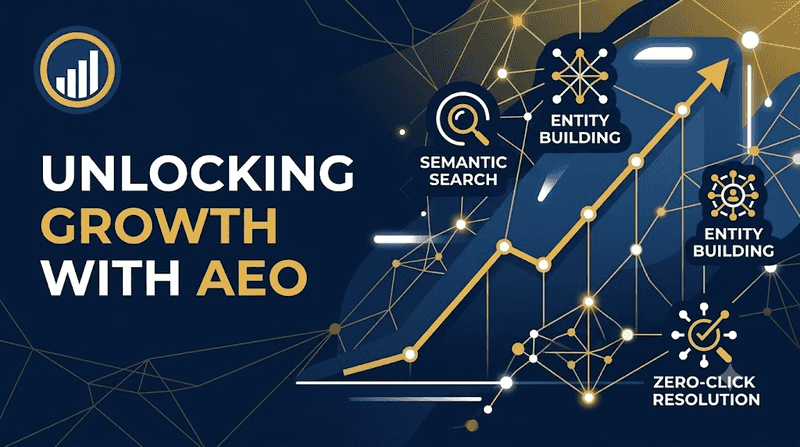
Organic traffic is dropping, but that does not automatically mean your search visibility has disappeared. The decline could come from lost rankings, lower search demand, technical issues, weaker click-through rates, changing SERP layouts, or more searches ending without a website visit.
This is where answer engine optimization (AEO) becomes useful. AEO helps make your content easier for search engines and answer-led experiences to understand, retrieve, and reference. But it should not replace SEO diagnosis. If rankings, indexing, or tracking are broken, rewriting content for AI search will not solve the underlying problem.
A better sequence is to diagnose the traffic loss first, identify the pages that still have search opportunities, strengthen their SEO foundations, and then improve them for AI search optimization and answer-led discovery.
This guide shows you how to do that step by step, while keeping organic traffic, search visibility, AI citations, and business outcomes separate.
What Is Answer Engine Optimization?
Answer engine optimization is the process of making content easier for answer-led search systems to understand, retrieve, and reference accurately. It builds on SEO foundations such as crawlability, indexability, relevance, and useful content, then improves how clearly individual sections answer specific questions.
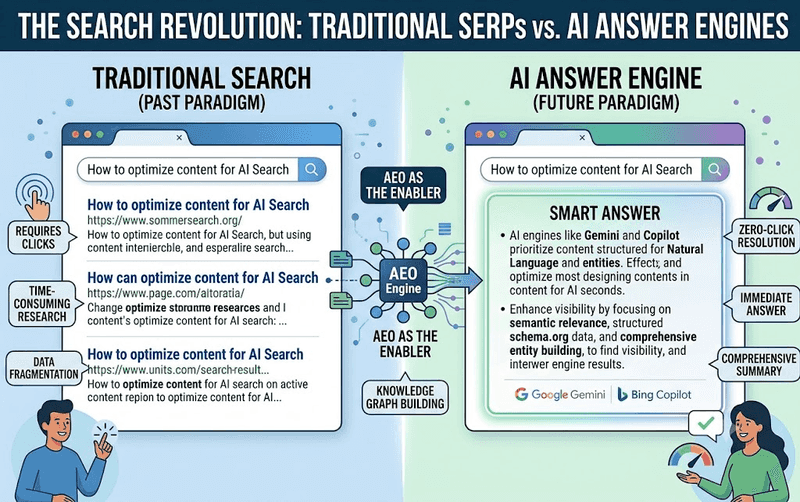
AEO matters because search is no longer limited to a list of blue links. Buyers can encounter information through Google AI Overviews, AI Mode, conversational search experiences, featured snippets, and other answer-led interfaces. In many of these experiences, a user may see or use an answer without clicking through to the source.
The All-in-One Platform for Effective SEO
Behind every successful business is a strong SEO campaign. But with countless optimization tools and techniques out there to choose from, it can be hard to know where to start. Well, fear no more, cause I've got just the thing to help. Presenting the Ranktracker all-in-one platform for effective SEO
We have finally opened registration to Ranktracker absolutely free!
Create a free accountOr Sign in using your credentials
That does not make traditional SEO obsolete. It changes what visibility can look like and makes it more important to separate rankings, impressions, clicks, AI citations, and conversions when evaluating performance.
Answer Engine Optimization vs SEO vs AI Search Optimization
AEO, SEO, and AI search optimization are closely related, but they do different jobs.
| Approach | Primary focus | What you optimize |
| SEO | Discovery and visibility in search | Crawlability, indexing, relevance, rankings, internal links, helpful content |
| Answer engine optimization (AEO) | Making individual answers easy to understand and reference | Direct answers, descriptive headings, evidence, context, clear entities and limitations |
| AI search optimization | Improving visibility across answer-led and AI-assisted search experiences | Strong SEO foundations plus answer clarity, source quality, consistent measurement and useful page structure |
The practical takeaway is simple: AEO should sit on top of good SEO, not replace it. Google has stated in its guidance on AI features and websites that existing SEO foundations remain relevant. Supporting pages still need to be indexed and eligible for search snippets, and there is no special AI-only technical requirement that guarantees inclusion in AI Overviews or AI Mode.
For other answer platforms, the exact retrieval systems differ. So avoid building a strategy around one supposed technical shortcut. Focus on making useful pages discoverable, understandable, well-supported, and easy to navigate.
Why Organic Traffic Can Drop Even When Search Visibility Has Not
Before changing content, separate lost traffic from lost visibility.
A page can maintain rankings and impressions while receiving fewer clicks because the search results page has changed. Ads, featured snippets, People Also Ask results, AI-generated summaries, and other SERP features can change the amount of click opportunity available even when your average ranking looks similar.
That is particularly important in a zero-click environment, where building an effective zero-click SEO strategy is crucial. Treat exposure and website visits as related but separate outcomes. A search result or answer may reference your content without producing a session.
For a deeper dive into adapting to these SERP changes, see OneMetrik's zero-click SEO strategy guide, which breaks down how to capture and measure value when search engines answer queries directly on the results page.
The All-in-One Platform for Effective SEO
Behind every successful business is a strong SEO campaign. But with countless optimization tools and techniques out there to choose from, it can be hard to know where to start. Well, fear no more, cause I've got just the thing to help. Presenting the Ranktracker all-in-one platform for effective SEO
We have finally opened registration to Ranktracker absolutely free!
Create a free accountOr Sign in using your credentials
The opposite can also happen. Sessions may decline because analytics tracking changed even though Search Console clicks remain stable. Or impressions may fall because search demand dropped seasonally rather than because your page became less competitive.
This is why answer engine optimization should begin with diagnosis rather than rewriting.
Step 1: Diagnose the Organic Traffic Drop Before Rewriting Content
Start with Google Search Central's guidance on debugging drops in Google Search traffic. Compare equivalent periods, then segment the decline by pages, queries, countries, and devices. Check the same period in the previous year before assuming the change is new.
Use the following patterns as investigation prompts rather than automatic diagnoses:
| What changed? | Check first | Working hypothesis |
| Analytics sessions fell, but Search Console clicks held steady | Tracking tags, consent settings, reporting filters | Measurement may have changed |
| Important URLs lost indexing | Crawl access, noindex directives, redirects, canonicals | Technical eligibility may be the issue |
| Rankings and clicks fell together | Query-level positions, competing pages, content relevance | Ranking loss may explain the decline |
| Impressions fell while positions stayed similar | Seasonality, demand, year-over-year query trends | Fewer searches may be available |
| Impressions held but CTR fell | Titles, snippets, ads, SERP features, AI answers | Click opportunity may have changed |
Do not expect Search Console clicks and analytics sessions to match exactly. They measure different activity, and consent settings, tagging, attribution, and configuration can widen the difference. Investigate a new divergence instead of treating every mismatch as broken tracking.
Then inspect the actual search results for the affected queries in the target market and device. Record the titles, snippets, ads, featured results, and answer features you see. Stable average rankings do not mean the SERP itself is unchanged.
Step 2: Choose the Pages With the Best AEO and SEO Opportunity
Do not optimize the entire site at once. Start with five to ten pages that are important enough to matter and small enough to inspect properly.
Prioritize pages that have:
- continuing impressions or existing rankings;
- clear relevance to the product, service, or buying journey;
- a specific question the page should answer;
- an identifiable weakness you can fix;
- a meaningful next step for the reader.
For B2B SaaS companies, strong candidates often include integration guides, migration pages, implementation articles, comparison content, use-case pages, and product education content. These pages answer questions that influence evaluation rather than attracting informational traffic with no connection to the buying journey.
If the work spans technical SEO, content architecture, internal linking, and AI search visibility, a SaaS SEO agency can help coordinate those pieces instead of treating AEO as a standalone content exercise.
Create a short brief for each selected page: target buyer, primary question, current search performance, suspected problem, proposed change, and intended next action.
A page that already receives qualified traffic but has unclear product relevance needs a different fix from a commercially important page that is blocked from indexing.
Where practical, leave a few comparable pages unchanged. This is not a controlled experiment, but it gives you a reference point when site-wide rankings or demand move at the same time as your edits.
Step 3: Fix Technical SEO Before Improving Answers
AEO cannot compensate for a page that search systems cannot access or index.
Review the selected URLs in Search Console and confirm that they return a successful page response, can be crawled, and contain indexable content. Check for accidental blocking, noindex instructions, incorrect redirects, and canonical selections that do not match the intended URL.
Use site-audit tools to identify possible problems, but verify important issues at URL level. An audit warning is a lead to investigate, not proof of Google's indexing decision.
Next, review internal linking. Important pages should not sit several layers deep without relevant contextual links. Connect supporting content to implementation guides, product documentation, migration pages, and commercial pages using descriptive anchors that help both readers and crawlers understand the relationship.
The objective is not to repeat the same keyword in every anchor. It is to make the site's information architecture clearer.
Step 4: Improve Each Page for Answer Engine Optimization
Once technical eligibility is confirmed, improve how well each page answers the questions that matter.
Lead With a Direct Answer
Broad introductory headings make readers work too hard. Replace them with specific questions or decision-oriented headings when that wording matches what the section actually explains.
Then answer the question immediately before adding context, exceptions, examples, or next steps.
A useful answer should still make sense when read outside the surrounding article. Keep the product, task, limitation, and relevant qualification close together instead of relying on earlier paragraphs to supply missing context.
A strong answer engine optimization strategy should prioritize clarity rather than a supposedly perfect paragraph or article length. Keep detail when it helps the reader make a decision or complete a task.
Use Headings That Match Real Search Intent
For each selected page, identify the questions buyers actually ask in search, sales calls, onboarding discussions, support tickets, or product evaluations.
Use those questions to improve H2 and H3 headings where appropriate. A descriptive heading helps readers scan the page and gives search systems clearer context about the answer underneath it.
Avoid turning every heading into an exact-match keyword. The heading should describe the section naturally and accurately.
Keep Evidence Next to the Claim
Replace vague statements about speed, ease, accuracy, or results with evidence readers can evaluate.
For original research, state the sample, collection period, and limitations. For product instructions, identify the version or workflow tested. For customer examples, obtain permission and avoid presenting one customer's result as a universal outcome.
Google's guidance on helpful, reliable, people-first content emphasizes original value, clear sourcing, and identifiable authorship. The practical AEO benefit is that a well-supported answer is easier to understand and less ambiguous when viewed outside the full page.
Make Important Sections Self-Contained
Read your highest-value sections in isolation and ask:
- Is it obvious which product, feature, or process is being discussed?
- Is the answer stated before the explanation?
- Are limitations attached to the claim they qualify?
- Are prerequisites and responsibilities clear?
- Can the reader identify the next action?
For implementation content, state prerequisites, responsibilities, and verification steps. For integrations, identify supported systems, permissions, data direction, and known limitations. For pricing content, explain what is included, what may cost extra, and where current terms should be confirmed.
This type of clarity improves the page for both users and answer-led retrieval without relying on keyword repetition.
Step 5: Strengthen AI Search Visibility Without Keyword Stuffing
AI search optimization is not the practice of inserting “AI,” “AEO,” or “answer engine” into every paragraph. The goal is to make important information easier to retrieve, interpret, and trust.
For the selected pages, focus on five things:
- Clear topic and question alignment. The page should have an obvious purpose and answer a defined set of related questions.
- Direct answer structure. Important sections should state the useful answer early, then add detail.
- Evidence and sourcing. Claims should be supported and dated where freshness matters.
- Internal context. Relevant links should show how the page connects to the wider topic, product, or workflow.
- Distinct value. Preserve original examples, experience, data, templates, or practical guidance that gives readers a reason to visit the source.
This is where SEO and AEO reinforce each other. SEO helps the page become eligible and discoverable. Answer engine optimization helps the content communicate its answer more clearly. Together, they create a stronger foundation for both conventional search visibility and AI search visibility.
Step 6: Run a Buyer-Readiness Review Before Publishing
SEO performance is not useful if the page gives buyers an incomplete or misleading answer.
Before publishing, ask a product specialist and someone from sales or customer success to review important pages independently. Each reviewer should be able to identify the main answer, its limitations, and the appropriate next action without filling in missing information from their own knowledge.
Maintain a simple evidence record for factual claims: source, date checked, and person who verified it. When a product feature, workflow, or policy changes, update the explanation itself rather than only changing the “last updated” date.
Finally, make the next step match the reader's task. Someone researching an integration may need documentation or a checklist. Someone comparing vendors may need a product evaluation. Do not force every informational visitor toward the same demo form.
A 30-Day Answer Engine Optimization Plan
A short first cycle helps teams improve pages methodically without turning AEO into an open-ended rewrite project.
Days 1-7: Establish the Baseline
Verify analytics and Search Console data, diagnose the organic traffic change, and select five to ten pages. Save the current content and baseline metrics. Define the buyer question and intended conversion action for each page.
Days 8-14: Remove Technical Obstacles
Fix confirmed crawl, indexation, redirect, canonical, and internal-link issues. Assign each page an owner and avoid rewriting healthy pages simply because total site traffic is down.
Days 15-21: Improve Answers
Rewrite unclear sections, strengthen question-focused headings, add evidence, clarify limitations, and have the relevant specialist review factual accuracy. Make sure calls to action follow naturally from the page's intent.
Days 22-30: Publish and Observe
Record publication dates, verify that changes are live, and check indexation status. Begin repeatable SEO and AI visibility checks against the original baseline.
Treat day 30 as a review point, not a recovery deadline. Search demand, crawling, rankings, SERP layouts, and AI-generated answers can all change on different timelines.
Step 7: Measure SEO, AEO, and AI Search Visibility Separately
Do not collapse every outcome into one traffic number. Search rankings, AI search visibility, website visits, and business value are different layers of performance. Improvement in one does not guarantee improvement in the next.
RankTracker's guide to tracking progress in AI search provides a useful framework for expanding measurement beyond traditional rankings.
Track the following consistently:
Rankings: Use the same query set, country, location, and device so changes remain comparable.
Impressions: Monitor selected pages and queries separately. Site-wide impressions can hide gains or losses when the query mix changes.
Click-through rate: Compare like-for-like queries and inspect their current SERPs before attributing CTR declines to AI search.
AI citations and answer-engine visibility: Use a fixed panel of unbranded buyer questions. Keep the platform, mode, language, and location as consistent as possible. Repeat checks over time and save the answer, date, and cited URL.
Brand mentions vs citations: A mention of the company is not the same as a link to your page. Record them separately and check whether the citation actually supports the generated answer.
The All-in-One Platform for Effective SEO
Behind every successful business is a strong SEO campaign. But with countless optimization tools and techniques out there to choose from, it can be hard to know where to start. Well, fear no more, cause I've got just the thing to help. Presenting the Ranktracker all-in-one platform for effective SEO
We have finally opened registration to Ranktracker absolutely free!
Create a free accountOr Sign in using your credentials
Qualified visits: Define useful actions in advance, such as opening implementation documentation, reviewing integration requirements, or starting an evaluation. Treat these as intent signals rather than automatic proof of lead quality.
Conversions and pipeline: Track trials, qualified demo requests, opportunities, and revenue outcomes separately from content views.
Google says traffic from its AI features is included within Search Console's Web performance reporting. Do not label every organic visit as an AI referral. Keep identifiable referrals separate and leave uncertain attribution uncertain.
Frequently Asked Questions About Answer Engine Optimization
What is answer engine optimization in simple terms?
Answer engine optimization is the practice of improving content so answer-led search experiences can understand and reference it accurately. It builds on SEO by making answers clearer, more self-contained, well-supported, and easier to retrieve without sacrificing usefulness for human readers.
Is AEO different from SEO?
AEO and SEO overlap. SEO helps pages become crawlable, indexable, relevant, and discoverable. AEO focuses more specifically on how clearly a page answers individual questions and whether those answers remain understandable when surfaced outside the full article. A strong strategy uses both.
What is AI search optimization?
AI search optimization is the broader process of improving content and site signals for discovery across AI-assisted and answer-led search experiences. It includes traditional SEO foundations, answer engine optimization, strong content structure, useful internal linking, reliable sourcing, and consistent visibility measurement.
Can answer engine optimization recover organic traffic?
AEO can improve the usefulness and visibility of pages when answer-led search is part of the problem, but it cannot guarantee traffic recovery. If the decline comes from tracking errors, lost indexation, weaker rankings, seasonality, or reduced demand, those issues need to be addressed directly.
How should AEO performance be measured?
Measure rankings, impressions, click-through rate, AI citations, brand mentions, qualified visits, and conversions separately. Use a consistent set of queries and AI prompts so changes can be compared over time rather than treating one citation or one traffic spike as proof of improvement.
Final Takeaway
Answer engine optimization works best as an extension of SEO, not as a replacement for it. Diagnose why organic traffic or clicks changed first. Then fix technical eligibility, select the pages with the strongest opportunity, improve answer clarity and evidence, strengthen internal context, and measure both traditional search and AI search visibility over time.
The objective is not to chase every AI mention. It is to create pages that remain discoverable, answer buyer questions accurately, earn visibility across evolving search experiences, and give qualified visitors a reason to take the next step.

