Intro
Ask ChatGPT, Perplexity or Google's AI Mode for "the best tools for MSPs" and you will get a confident, well-formatted answer. Ask where that answer came from and the picture gets more interesting. The brands that show up are rarely the ones with the biggest ad budgets. They are the ones that have been described, consistently and specifically, on pages the answer engines can retrieve and trust.
That matters most in narrow B2B markets. The managed service provider (MSP) software space is a useful case study: a few thousand buyers in any given country, a vocabulary full of acronyms (PSA, RMM, QBR, SLA), and long, technical buying questions. Search volume for most of its keywords is tiny by consumer standards. Yet MSP owners increasingly start vendor research by asking an AI assistant, and the assistant's shortlist becomes the buyer's shortlist.
Here is what actually moves visibility in that kind of market, and what mostly wastes time.
AI answers are built on retrieval, not reputation
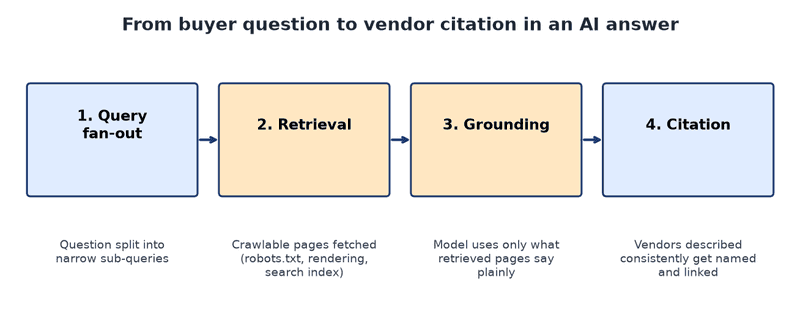
It helps to be precise about the mechanics. When an assistant answers a question that needs current information, it typically runs one or more web searches, pulls a handful of pages, and writes a response grounded in what those pages say. Google describes AI Overviews and AI Mode as drawing on its existing search index and ranking systems, and says there are no special requirements beyond normal Search eligibility. OpenAI documents a separate crawler, OAI-SearchBot, for pages that appear in ChatGPT search results, and Perplexity documents PerplexityBot for the same purpose.
Two practical conclusions follow. First, if your pages are blocked from those crawlers in robots.txt, or rendered entirely in client-side JavaScript that a crawler cannot read, you are invisible no matter how good the content is. Second, a model can only cite what the retrieved pages actually say. If no page in the result set states plainly what your product does, for whom, and how it differs, the model has nothing to repeat.
Specific pages beat broad pages
In a broad market, a single "ultimate guide" can rank for hundreds of variations. In a narrow market, the questions are too specific for that. An MSP owner does not ask "what is automation". They ask whether a tool can turn a client phone call into a ticket note with a time entry in ConnectWise, or how to automate onboarding without a full-time developer.
Assistants handle those questions by splitting them into sub-queries, a behaviour Google calls query fan-out. Each sub-query retrieves its own results. A vendor with one generic product page competes for one of them. A vendor with focused pages, each answering one real question in plain language, has a chance to be retrieved for several.
The All-in-One Platform for Effective SEO
Behind every successful business is a strong SEO campaign. But with countless optimization tools and techniques out there to choose from, it can be hard to know where to start. Well, fear no more, cause I've got just the thing to help. Presenting the Ranktracker all-in-one platform for effective SEO
We have finally opened registration to Ranktracker absolutely free!
Create a free accountOr Sign in using your credentials
The MSP vendors that tend to appear in AI shortlists usually have exactly this shape: a page per integration, a page per workflow, and editorial content that takes a position on a narrow operational problem. A focused article on MSP automation that argues for automating documentation and paperwork before remediation, for example, gives an assistant a distinct, quotable claim to work with when a buyer asks where to start. A page that says "we automate everything" gives it nothing.
Write the sentences you want repeated
Language models paraphrase, but they lean heavily on the clearest statement available. That rewards a specific writing habit: put one plain, self-contained sentence near the top of each page that says what the product is, who it is for and what it connects to. "X is a call transcription tool for MSPs that writes notes and time entries into ConnectWise and Autotask tickets" is retrievable and repeatable. "X empowers modern service teams" is neither.
The same applies to comparisons. Buyers in niche markets ask "X vs Y" and "alternatives to X" constantly. If you do not publish an honest comparison, the assistant will assemble one from a reseller page, a two-year-old Reddit thread or a competitor's version of events. Fair comparison pages, including where your product is the wrong fit, are often the most cited pages a small vendor owns.
Third-party mentions carry the weight
Your own site tells an assistant what you claim. Other sites tell it whether anyone agrees. In practice, the retrieved set for "best X for MSPs" is dominated by listicles, review platforms, community threads and trade publications, not vendor homepages.
For a niche brand, that suggests a different priority list from classic link building:
- Category roundups. Inclusion in a well-maintained "best tools for MSPs" list on a site with real traffic can put your name into the retrieved set directly. Ask to be described accurately, not just listed.
- Trade press and contributed articles. Industry publications are trusted sources for both search engines and assistants. A practical article with your founder's byline builds topical association even before the link is counted.
- Review platforms and directories. These often rank for comparison and alternatives queries, and their structured data (category, integrations, pricing model) is easy for a model to use.
- Community discussion. Forums such as r/msp appear repeatedly in MSP result sets. You cannot manufacture that presence, and you should not try, but you can make sure your team answers real questions honestly when your product is relevant.
The common thread is consistency. If ten pages describe your product in ten different ways, the model's summary will be vague. If they describe the same core use case in similar terms, the summary sharpens.
Measure what you can, and be honest about what you can't
There is no equivalent of Search Console for ChatGPT. The workable approach is a fixed prompt set: twenty or thirty questions your buyers actually ask, run monthly across the main assistants, with the cited sources recorded alongside whether your brand appears and how it is described. Rank tracking for the classic SERP still matters too, because AI Overviews and many assistant searches draw from the same underlying results.
Treat the prompt panel as a directional signal, not a precise metric. Answers vary between runs, between accounts and over time. What you are looking for is movement: whether new pages and new third-party mentions start appearing in the cited sources, and whether the description of your product gets more accurate.
Where this approach falls short
None of this replaces having a product people recommend. Assistants increasingly draw on review sites and community threads, and those reflect actual customer experience. A niche vendor with unhappy customers will find that better content mostly gives the model more context for the complaints.
It is also slower than paid acquisition. Building enough specific, consistently described pages and credible mentions to change an AI shortlist takes months, and the payoff is hard to attribute. For a narrow B2B market, though, it is one of the few channels where a small, focused company can compete with much larger ones, because the assistants reward specificity over scale.