
Intro
Behavioral health SEO is changing quickly.
AI Overviews are answering more questions directly in search results, and generative AI has made it easier than ever to publish content at scale. At the same time, established healthcare organizations are losing traffic to smaller, more focused local providers. As behavioral health content becomes increasingly commoditized, treatment centers must be intentional about the SEO topics they pursue and the unique value each page provides.
The current state of SEO and AI search in behavioral health
AI is changing how people search, but it is not replacing traditional search altogether.
Patients may use tools such as ChatGPT, Gemini, Claude, or Perplexity to ask detailed questions about symptoms, treatment options, insurance, or what to expect during recovery. They may then turn to Google to find a treatment center, evaluate its reputation, read reviews, and compare programs.
As traditional search and AI-powered tools become increasingly integrated, behavioral health organizations should prepare for both without treating them as completely separate marketing channels.
AI Overviews are reducing traffic and clicks
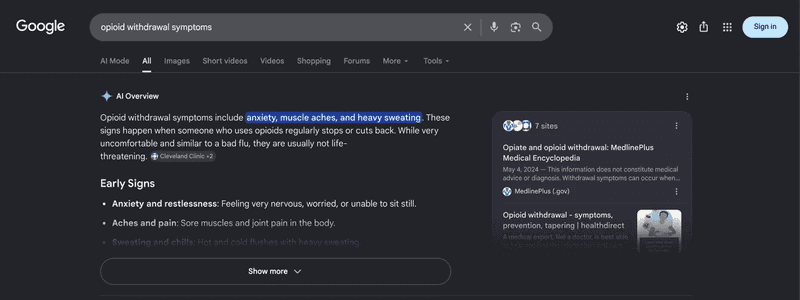
One of the most significant changes in search is the growing presence of AI Overviews within search results.
For informational queries, Google can now summarize a topic before the user ever visits a website. Someone searching for the symptoms of opioid withdrawal may receive an answer directly in an AI Overview.
The All-in-One Platform for Effective SEO
Behind every successful business is a strong SEO campaign. But with countless optimization tools and techniques out there to choose from, it can be hard to know where to start. Well, fear no more, cause I've got just the thing to help. Presenting the Ranktracker all-in-one platform for effective SEO
We have finally opened registration to Ranktracker absolutely free!
Create a free accountOr Sign in using your credentials
As a result, behavioral health articles ranking for queries that trigger AI Overviews often receive fewer clicks. However, the decline in traffic does not mean the underlying demand for treatment has disappeared. Patients and families still need care; the way they research and evaluate treatment options is simply changing as AI becomes a larger part of the search experience.
Research from Pew Research Center found that users clicked a traditional search result in 8% of visits when an AI summary appeared, compared with 15% of visits without one.
Spam content is making content commoditized
Advancements in AI have made it easier than ever for treatment centers to create content about addiction, mental health disorders, and treatment options. The challenge is that competing organizations can now publish nearly identical pages just as quickly.
When multiple pages repeat the same definitions, statistics, and recommendations, the content becomes commoditized, giving search engines little reason to prioritize another version of what already ranks. As a result, differentiating your content from competitors is especially important in highly competitive markets.
The stronger approach is to contribute something the existing results do not already provide. That could include original data, a clinician’s perspective, local knowledge, firsthand experience, or a more comprehensive resource.
This also aligns with Google’s guidance on helpful, reliable, people-first content, which encourages original information, substantial value, and content created primarily to help users rather than manipulate rankings.
AI has made publishing easier, but it has also raised the standard for what deserves to rank.
Traditional SEO still matters
The growth of AI search has created the impression that behavioral health organizations need an entirely new SEO playbook. In reality, most of what helps a website appear in AI-generated answers also supports traditional rankings.
The All-in-One Platform for Effective SEO
Behind every successful business is a strong SEO campaign. But with countless optimization tools and techniques out there to choose from, it can be hard to know where to start. Well, fear no more, cause I've got just the thing to help. Presenting the Ranktracker all-in-one platform for effective SEO
We have finally opened registration to Ranktracker absolutely free!
Create a free accountOr Sign in using your credentials
Search engines still need to understand what a page is about, whether the website is technically accessible, how pages relate to one another, and whether other trusted sources recognize the organization. Strong content, clear site architecture, internal linking, backlinks, local SEO, and technical performance all continue to matter.
The fundamentals have not disappeared. The search experience around them has changed.
Behavioral health organizations should certainly pay attention to AI visibility, but they should be cautious of strategies promising instant results through mass publishing or newly invented “AI SEO” tactics. Short-term traffic increases may look impressive, but they are rarely valuable if the rankings disappear after the next algorithm update.
A sustainable strategy should focus on building a useful website that deserves to rank across both traditional and AI-assisted search.
Build content around existing topical authority
One of the most effective ways to decide what to publish is to identify the topics on the website where the organization already has topical authority.
For example, suppose a treatment center already performs well for opioid-related searches. Typically, the easiest opportunity is to rank for more opioid-related content.
Once the organization has covered that subject thoroughly, it can expand into a closely related category, such as prescription drug addiction. This creates a logical progression of closely related articles.
Search engines are not simply rewarding the website with the largest number of pages. They are trying to identify which website covers a subject most thoroughly, clearly, and credibly. This is why our behavioral health SEO strategy focuses on going deeper on fewer topics.
Ranking for competitive keywords in behavioral health SEO
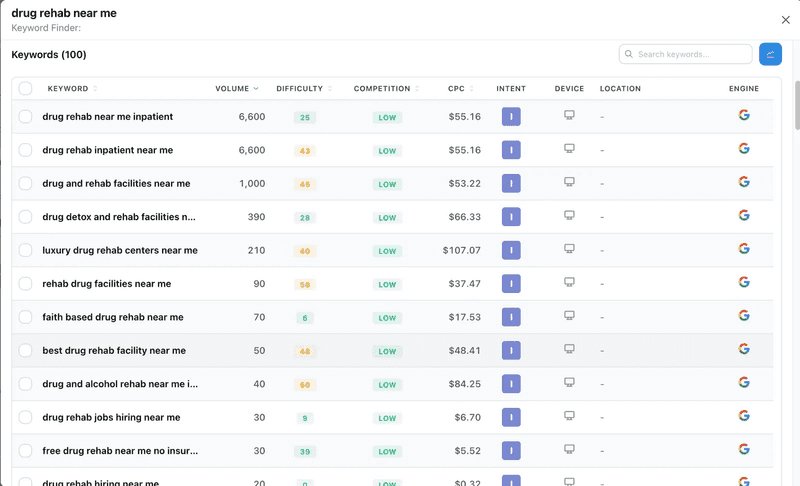
The behavioral health industry is highly competitive, and most high-value keywords are extremely difficult to rank for. Competing in these markets requires a substantial investment of time, effort, and money, yet many facility owners underestimate the budget and timeline needed to compete with established treatment centers and providers.
Select the right target keyword
Competing for highly competitive keywords begins with selecting the right targets because two keywords may appear similar while attracting users with very different levels of intent.
Consider the difference between “drug rehab Sacramento” and “inpatient drug rehab Sacramento.”
The first keyword may receive more searches, but the intent is broader. Some searchers may be comparing facilities, while others may simply be researching what drug rehabilitation involves.
A person searching for “inpatient drug rehab Sacramento” is likely further into the decision-making process. The searcher already understands the type of care being considered and is probably actively evaluating inpatient providers.
The broader keyword can still be valuable, but the more specific term will most likely generate fewer but more qualified visitors.
Behavioral health SEO teams must evaluate the true intent behind a search query before targeting a keyword because keywords that appear similar can attract users at very different stages of the treatment decision-making process.
Use smaller keywords to build toward bigger keywords
A website rarely begins ranking for the most competitive keyword in a category immediately.
The larger keyword is often supported by several smaller and more specific searches. Ranking for those supporting topics helps a website demonstrate that it understands the broader subject.
For example, a treatment center attempting to rank for a competitive alcohol addiction treatment keyword may first publish strong resources about alcohol withdrawal, alcohol detox, signs of alcohol dependence, treatment options for alcoholism, and relapse prevention.
Each supporting page should serve a distinct purpose and connect logically to the primary service page. As the website begins earning rankings, engagement, links, and authority across the supporting topics, it becomes more competitive for the larger keyword.
The process is similar to completing the earlier chapters of a book before reaching the final chapter. Smaller rankings establish the foundation needed to pursue the larger opportunity.
Build trust with search algorithms and visitors
Behavioral health websites operate in an industry where trust is especially important. The information can influence decisions about health, safety, treatment, and finances.
A website cannot build that trust through keywords alone. Its design, content, contributors, and overall experience must demonstrate credibility to both search engines and visitors.
Why user experience matters for SEO
SEO content must be written for the person visiting the website, not just the algorithm evaluating it. A page may target the correct keyword but still fail if poor design, intrusive pop-ups, confusing navigation, slow loading times, or repetitive copy make it difficult to use.
This is especially important in behavioral health, where searches are often urgent and stressful. Patients and families should be able to understand their options, find answers, determine whether the facility can help, and take the next step without unnecessary friction.
Treatment centers can use tools such as Google Analytics and Google Tag Manager to identify how visitors interact with the site and where they drop off. Google also considers page-experience signals such as loading speed, responsiveness, stability, mobile usability, and overall helpfulness.
Google’s Core Web Vitals guidance identifies loading performance, responsiveness, and visual stability as measurable parts of real-world page experience.
A clear, useful, and easy-to-navigate website can improve both conversions and long-term search performance, especially as more competitors publish similar AI-generated content.
Why credible SEO authors matter
The person writing or reviewing behavioral health content matters.
A generic article about addiction treatment may repeat accurate information, but it does not carry the same authority as content reviewed by a clinician, psychiatrist, therapist, or other qualified professional.
Whenever possible, treatment centers should involve members of their clinical or medical teams in the content process. A qualified professional can review claims, correct oversimplifications, contribute practical insight, and ensure the page reflects the realities of treatment. For example, organizations such as Prosperity Behavioral Health can demonstrate this connection between clinical expertise and trustworthy behavioral health information.
The article should clearly identify the author and medical reviewer. Their profiles should explain their qualifications, experience, and connection to the organization.
Google also recommends making authorship clear and gives greater weight to strong experience, expertise, authoritativeness, and trust signals for topics that can significantly affect health or safety, often referred to as YMYL content.
This helps patients understand where the information came from while giving search systems additional context about why the content should be trusted.
Common behavioral health SEO mistakes
Many behavioral health organizations struggle with SEO because they try to expand too quickly. Their websites accumulate large numbers of pages without a clear strategy for how those pages support one another.
In 2026, content volume is easier to create than ever. That makes strategic focus more important.
Chasing too many keywords at once
A common mistake is trying to rank for every addiction, mental health condition, service, and city simultaneously.
This often produces a shallow website with dozens of disconnected topics instead of establishing authority in one area.
A smaller treatment center can sometimes outperform a much larger website by covering one category better. A focused set of high-quality pages about a specific substance, condition, treatment method, or local market may be more valuable than hundreds of generic articles.
SEO teams should begin with the subjects that are most relevant to the organization and where the website is already showing signs of authority. Expansion should happen methodically from there.
Keyword cannibalization
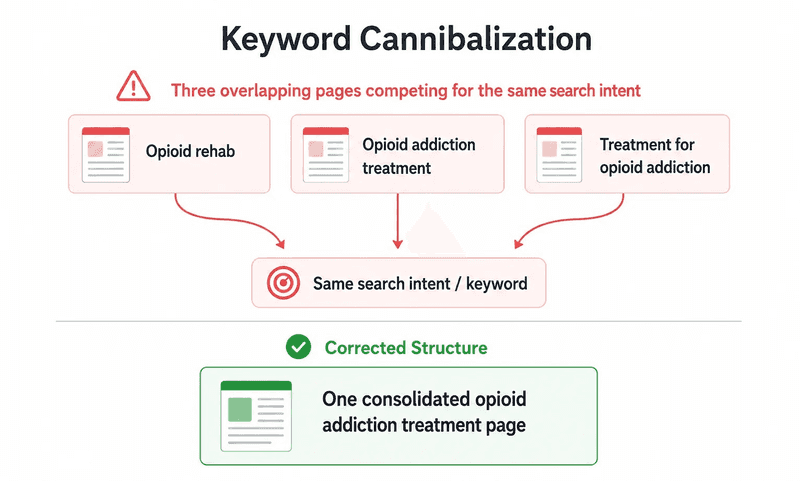
Keyword cannibalization occurs when several pages compete for the same or nearly identical search intent.
For example, a website may have separate pages targeting “opioid rehab,” “opioid addiction treatment,” and “treatment for opioid addiction,” even though all three pages provide essentially the same information. Search engines may struggle to determine which page should rank, which can result in several weak pages.
The All-in-One Platform for Effective SEO
Behind every successful business is a strong SEO campaign. But with countless optimization tools and techniques out there to choose from, it can be hard to know where to start. Well, fear no more, cause I've got just the thing to help. Presenting the Ranktracker all-in-one platform for effective SEO
We have finally opened registration to Ranktracker absolutely free!
Create a free accountOr Sign in using your credentials
Before creating a new page, SEO teams should determine whether the topic already exists and whether the proposed page serves a genuinely different purpose. When overlapping pages are discovered, the best solution may be to consolidate them, redirect one page, or reposition each page around a clearly different search intent.
Not pruning
Not every indexed page deserves to remain on a website forever.
Old, thin, inaccurate, duplicated, or irrelevant pages can reduce the overall quality of the content ecosystem. Some may no longer receive traffic, support conversions, earn links, or contribute to topical authority.
Pruning does not mean deleting every page that receives little traffic. Some pages may still answer important patient questions or strengthen a broader topic cluster, so each decision should be based on the page’s purpose and overall value rather than traffic alone.
SEO teams should regularly evaluate whether each page serves a clear and distinct purpose. Depending on its value, a weak page may need to be updated, consolidated, redirected, removed, or excluded from search. The goal is not to publish the most pages, but to maintain a focused and efficient collection of high-quality content.

