
Intro
Every conversion rate hides a story. Behind each signup button, headline, or landing page lies a decision that shapes revenue, user engagement, and long-term growth. The challenge? Guessing which version performs better wastes budget and burns through patience.
Choosing the right experimentation platform means weighing privacy compliance, statistical rigor, and ease of use against your team's actual workflow. Some platforms lean heavily into AI-driven optimization, while others prioritize raw analytics depth or developer-friendly infrastructure.
This guide breaks down six standout platforms that cover the full spectrum, from privacy-first analytics to enterprise-scale feature management. Each one tackles split testing differently, so the real question isn't which tool is "best" but which one fits your stack, your team, and your goals.
Matomo
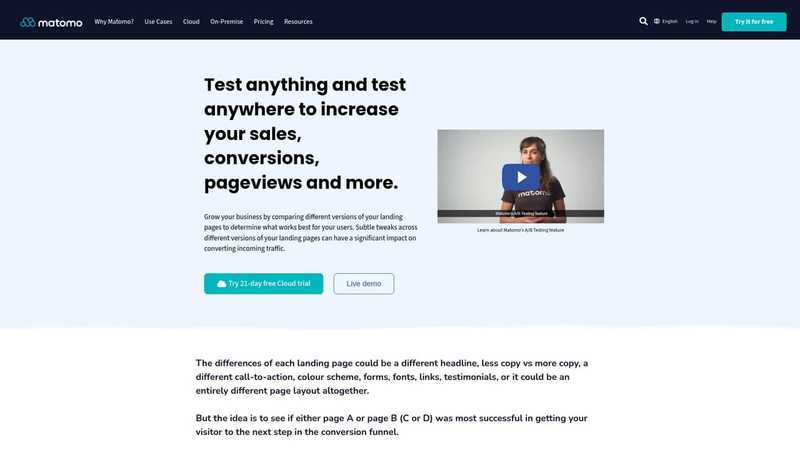
Matomo merges web analytics with built-in experimentation capabilities, giving teams a single platform to run split tests and track their downstream impact. The On-Premise version removes test limits entirely, so you can experiment on landing pages, CTA buttons, headlines, and layout variations without worrying about quotas.
What sets this platform apart is complete data ownership. You host everything on your own servers, which means no third-party data sharing and full compliance with GDPR, CCPA, and other privacy regulations. For organizations in healthcare, finance, or government, that level of control isn't optional.
The analytics integration goes deeper than most competitors offer. You get access to historical visitor profiles and complete user journey mapping, connecting each experiment to real behavioral data. Instead of viewing test results in isolation, you see how a winning variant influences the entire funnel.
The All-in-One Platform for Effective SEO
Behind every successful business is a strong SEO campaign. But with countless optimization tools and techniques out there to choose from, it can be hard to know where to start. Well, fear no more, cause I've got just the thing to help. Presenting the Ranktracker all-in-one platform for effective SEO
We have finally opened registration to Ranktracker absolutely free!
Create a free accountOr Sign in using your credentials
Teams report identifying critical conversion bottlenecks that traditional analytics missed, translating directly into measurable ROI improvements. The platform offers a 21-day free trial, enough time to run a meaningful experiment and evaluate the statistical engine.
One practical advantage: the interface keeps things approachable. Marketing teams can launch experiments independently without pulling in developers for every test, while technical users retain full access to raw data and custom configurations.
AB Tasty
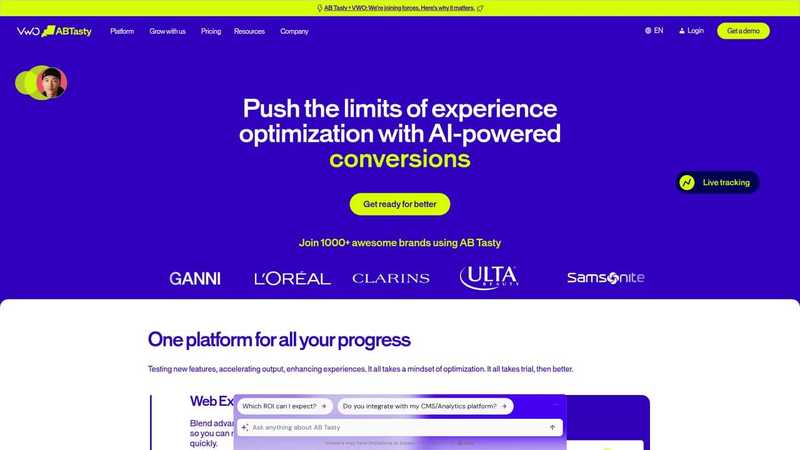
AB Tasty positions itself as a unified optimization platform spanning web experimentation, feature flagging, personalization, e-merchandising, and rollouts. Thirteen years of experience in the optimization space inform its approach, and that maturity shows in the tooling.
The platform's AI agent, Evi, transforms how teams handle data interpretation and strategy. Rather than manually sifting through dashboards, Evi converts complex test results into clear, actionable recommendations. It supports the entire workflow, from hypothesis generation through reporting, acting as an evidence-based marketing partner embedded in your process.
Where AB Tasty genuinely differentiates is with AdaptiveCX. This predictive AI engine works in real time to identify and personalize experiences for the roughly 90% of visitors who arrive anonymously. Most platforms struggle with anonymous visitor personalization, making this a notable capability for e-commerce and media sites with high volumes of first-time traffic.
The Visual Editor accepts prompt-based design changes. Want to update button colors, add animations, or rearrange elements? Describe the change in plain language. The editor handles execution, blending advanced testing capabilities with accessible experience building.
The All-in-One Platform for Effective SEO
Behind every successful business is a strong SEO campaign. But with countless optimization tools and techniques out there to choose from, it can be hard to know where to start. Well, fear no more, cause I've got just the thing to help. Presenting the Ranktracker all-in-one platform for effective SEO
We have finally opened registration to Ranktracker absolutely free!
Create a free accountOr Sign in using your credentials
An extensive partner and integrations network ensures the platform adapts to your existing workflows and preferences. The focus on measurable ROI, engagement, and loyalty drives a test-and-learn culture, pushing teams toward data-backed decisions rather than gut instincts.
Optimizely
More than 10,000 brands rely on Optimizely to run their digital experience optimization. The platform covers content creation, experimentation, and personalization under one roof, powered by an AI-first architecture that automates much of the heavy lifting.
The numbers from enterprise clients paint a vivid picture. The Royal Mint achieved a 50% conversion lift through systematic testing. Travis Johnson, Director of Product Analytics, reported saving over 400 hours by eliminating manual analysis workflows. L'Oréal's Luxe Division runs more than 200 experiments annually across their digital properties.
- Content management through an agile CMS with automated publishing and continuous site optimization
- Experimentation engine for testing, personalizing, and measuring impact across channels
- Agent Platform that automates repetitive tasks and removes workflow bottlenecks
- LLM monitoring to track and optimize interactions with language models
Optimizely integrates with virtually any existing tech stack, which removes friction during onboarding. Marketing teams particularly appreciate the platform's ability to let them focus on creative work rather than wrestling with administrative setup.
The trade-off? Enterprise-grade pricing puts it beyond reach for startups and smaller teams. But for organizations running high-volume experimentation programs, the breadth of features justifies the investment.
VWO
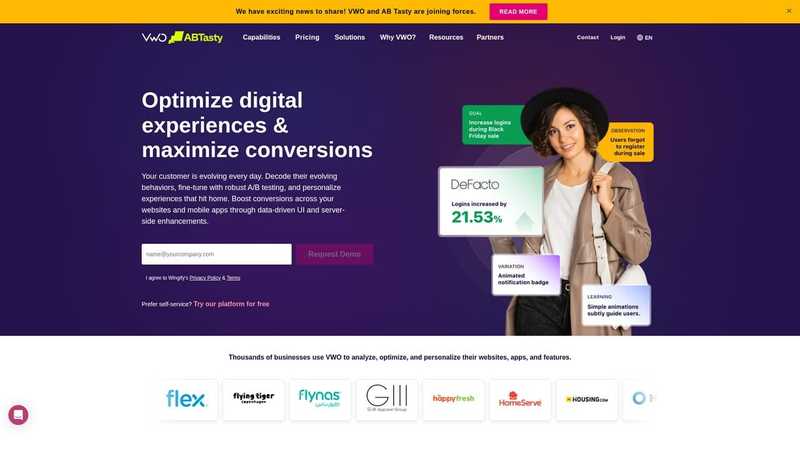
VWO built its reputation on making experimentation accessible to non-technical team members. The no-code visual editor lets marketers and product managers set up tests without engineering support, reducing the time from hypothesis to live experiment dramatically.
The platform's Wandz system uses AI to detect friction points in user journeys, then automatically generates test hypotheses and creates variations ready for launch. Think of it as an optimization assistant that spots what your team might overlook during manual analysis.
Bayesian statistics power the real-time reporting engine, which connects directly to heatmaps, session recordings, funnel analytics, and form analysis. This qualitative layer helps teams understand why a variant wins, not just that it wins. You can integrate with GA4, Mixpanel, and other customer data platforms for a unified view.
VWO imposes no caps on variations, users, or metrics. Session recordings are unlimited too. The infrastructure runs on Google Cloud Platform with CDN technology, and the team claims 100% uptime backed by 24/7 dedicated support.
Privacy sits at the core of the architecture. All data stays hosted on GCP with privacy-first principles guiding collection and storage. SDKs in eight-plus programming languages handle complex server-side experiments for teams that need deeper technical control.
Kameleoon
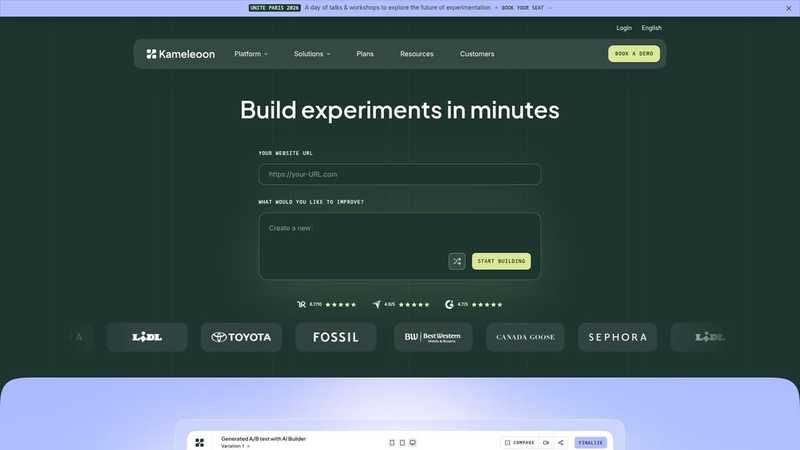
Kameleoon calls its approach "platform-based experimentation" (PBX), and the technical specs back up that ambition. The snippet weighs just 28.4KB with CDN latency under 50 milliseconds, which eliminates the flickering problem that plagues heavier experimentation tools.
A conversational AI interface lets teams build experiments in minutes by describing what they want to test. The agent generates production-ready variants, though developers can access and edit underlying code at any point. You can create banners, pop-ups, and forms without developer intervention.
Security certifications are comprehensive. ISO 27001 and SOC2 compliance, combined with GDPR, CCPA, and HIPAA adherence, makes Kameleoon viable for heavily regulated industries. A multi-step validation system governs critical changes, adding a safety net for high-stakes tests.
The reporting engine deserves special attention:
- Real-time results with automatic Sample Ratio Mismatch detection
- Instant alerts when conversion rates drop unexpectedly
- Customizable attribution windows matched to your actual sales cycle
- Built-in bypass of Safari ITP protections and ad blockers for complete traffic visibility
Predictive Impact Scoring draws from thousands of past experiments to estimate how likely a test is to succeed before you allocate traffic. Integration with data warehouses, CDPs, and modern frameworks like React and Next.js keeps the platform relevant for technically sophisticated teams.
Statsig
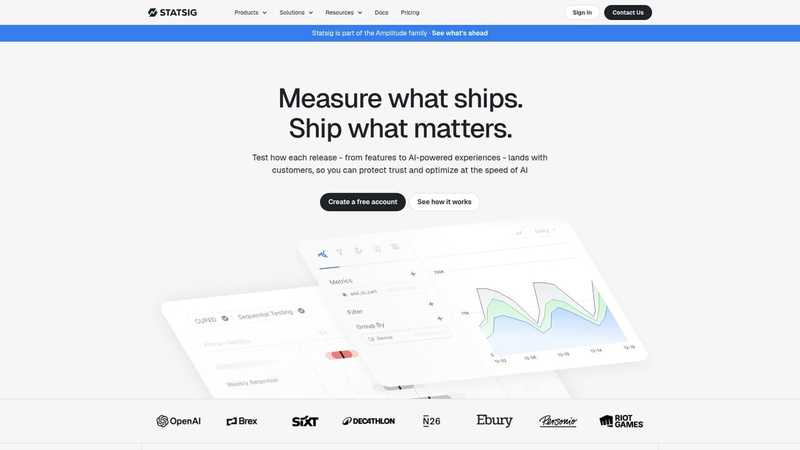
Statsig processes over 100 billion events daily, and its client roster reads like a tech industry directory: OpenAI, Brex, Notion, and Ancestry all run experiments on this infrastructure. The platform unifies five-plus products into one cohesive system, covering experimentation, feature management, product analytics, session replays, and metrics.
Product managers gravitate toward the self-service experiment setup. No manual pre-work needed. The automated analysis engine handles statistical treatments, while teams slice results across different dimensions to uncover segment-level insights. Session replays link directly to feature flags and experiments, so you watch exactly how users interact with each variant.
The Warehouse Native capability stands out for data teams. You can add integrations on the fly, connecting directly to your existing data infrastructure without lengthy migration projects. Slack integration provides dedicated support channels, keeping communication tight during critical launches.
Statsig's pricing model favors growth-stage companies. A generous free tier covers substantial usage, and enterprise pricing scales predictably. This contrasts with competitors who gate core features behind premium subscription tiers from day one.
Rapid deployment without "big bang" releases defines the operational philosophy. Feature flags let teams ship incrementally, measure impact in real time, and roll back instantly if something breaks. The Statsig team collaborates closely with clients on custom workflows and features, treating the platform as a living product that evolves with user needs.
FAQ
How do you choose the right A/B testing tool for your team?
Start by mapping your team's technical skills against each platform's learning curve. A no-code visual editor suits marketing teams, while developer-heavy organizations benefit from SDK flexibility and server-side testing.
Consider your data privacy requirements and integration needs. If you operate under GDPR or HIPAA, verify certifications before anything else. The ideal tool fits your existing tech stack without forcing a complete workflow overhaul.
How much do A/B testing platforms typically cost?
Pricing varies wildly. Some platforms like Statsig offer a generous free tier that covers meaningful usage, while enterprise solutions like Optimizely command premium subscription fees scaled to traffic volume and feature access.
The All-in-One Platform for Effective SEO
Behind every successful business is a strong SEO campaign. But with countless optimization tools and techniques out there to choose from, it can be hard to know where to start. Well, fear no more, cause I've got just the thing to help. Presenting the Ranktracker all-in-one platform for effective SEO
We have finally opened registration to Ranktracker absolutely free!
Create a free accountOr Sign in using your credentials
Expect most vendors to use usage-based pricing models tied to monthly visitors, events tracked, or experiments run. Always request a detailed pricing breakdown before committing, since hidden costs around integrations, support, or advanced analytics can inflate the final bill.
What statistical method should an A/B testing tool use?
Most modern platforms offer either frequentist or Bayesian statistics, and some let you choose between both. Bayesian methods provide real-time probability estimates and work well for faster decision-making cycles.
Frequentist approaches require fixed sample sizes and predefined test durations, which suit teams comfortable with longer experiments. The best choice depends on your decision-making speed and tolerance for statistical nuance rather than one method being universally superior.
Can small businesses benefit from enterprise-level testing tools?
Absolutely, though the approach differs. Free tiers and trial periods from platforms like Matomo and Statsig let smaller teams experiment without upfront financial commitment. Focus on one or two high-impact pages first.
Small businesses often see the fastest ROI from testing because even minor conversion improvements translate into meaningful revenue when resources are tight. Choose a tool with low setup complexity so you spend time running experiments, not configuring infrastructure.
How long should you run an A/B test before declaring a winner?
Run tests until your platform reaches statistical significance, which typically requires at least one to two full business cycles to account for weekday and weekend traffic patterns.
Stopping a test too early leads to false positive results that distort your optimization roadmap. Most experts suggest a minimum of two weeks of data collection, though low-traffic sites may need four weeks or more to accumulate enough conversions for reliable conclusions.

