Intro

AI-powered search is changing how customers discover brands, compare solutions, and make purchasing decisions. Platforms such as ChatGPT, Gemini, Perplexity, and Google AI Overviews increasingly influence which businesses receive attention. Traditional SEO rankings alone cannot show whether a company appears in AI-generated recommendations or which competitors are being suggested instead. AI search visibility software helps businesses monitor their presence across these platforms, analyze citations, and identify opportunities for improvement. This guide compares seven AI visibility solutions for 2026, covering their features, pricing, customer reviews, and suitability for different business needs.
TL;DR Best AI Search Visibility Software at a Glance
- Ranketta: Best for AI visibility tracking and LLM optimization for SMBs, particularly e-commerce businesses, agencies, and B2B companies.
- AIclicks: Best for small marketing teams seeking affordable AI visibility monitoring and actionable recommendations.
- Visby AI: Best for funnel-based AI visibility analysis and automated GEO workflows.
- Searchable: Best for combining AI visibility monitoring with website audits and content creation.
- Surfer: Best for content teams integrating traditional SEO with AI search visibility.
- Brandlight AI: Best for enterprise AI visibility management across multiple brands and markets.
- BrightEdge: Best for enterprise SEO teams integrating AI search intelligence into existing workflows.
Why Trust Our Software Reviews?
Choosing AI search visibility software requires more than comparing promotional claims or feature lists. Our recommendations focus on practical business applications, platform capabilities, pricing transparency, and the needs of different organizations. Rather than selecting a universal winner, we identify the specific situations where each solution is most relevant.
Our comparison draws on publicly available product documentation, official vendor websites, pricing information, and customer reviews published on G2. We considered AI engine coverage, monitoring capabilities, citation analysis, competitor benchmarking, reporting, and available optimization features. Pricing and review information was checked against publicly available sources in November 2026.
We also recognize that software performance depends on individual requirements, implementation, and subscription plans. This guide is based on documented functionality rather than independent hands-on testing of every paid platform. Businesses should therefore consider demonstrations or free trials before making a purchasing decision.
AI Search Visibility Software Comparison at a Glance
The following table summarizes the seven platforms, their primary strengths, published starting prices, and G2 ratings.
| Software | Specific Strength | Starting Price | G2 Rating |
| Ranketta | AI visibility monitoring, LLM optimization and product-level tracking | €29/mo monthly; €24/mo annually | 4.9/5 |
| AIclicks | Actionable AI visibility workflows | $59/mo | 4.9/5 |
| Visby AI | Funnel-based GEO tasks | $79/mo | 4.8/5 |
| Searchable | Website audits and content creation | $125/mo | 4.7/5 |
| Surfer | SEO content and AI visibility | $95/mo monthly; $82/mo annually | 4.8/5 |
| Brandlight AI | Enterprise brand intelligence | Custom | 4.9/5 |
| BrightEdge | Enterprise SEO integration | Custom | 4.4/5 |
Best AI Visibility Software for LLM Search in 2026: A Complete Breakdown
Ranketta: Best for AI Visibility Tracking and LLM Optimization
Platform Overview
Ranketta is an AI visibility platform and LLM optimization tool designed to help small and medium-sized businesses understand and improve how they appear in AI-generated search results. It monitors brand mentions, product recommendations, citations, and competitor visibility across supported AI platforms, including ChatGPT, Gemini, Perplexity, and Google AI Overviews. The platform connects visibility measurement with practical recommendations for improving discoverability.
Beyond monitoring, Ranketta provides solutions such as Product-Level Tracking, Product Data Enrichment, Prompt Research, Citation Tracking, Content Studio, and Agent Mode. These capabilities help businesses identify relevant customer questions, understand why competitors receive greater exposure, and improve the information AI systems use when generating recommendations. Its approach combines analytics with content and product optimization in one environment.
Who Is It Best Suited For?
Ranketta is particularly suitable for SMBs looking to establish or improve their visibility across AI-powered search platforms. E-commerce retailers and D2C brands can monitor individual product recommendations, evaluate competing products, and identify opportunities to improve product information. Its product-level tracking capabilities are especially relevant for businesses managing online catalogs.
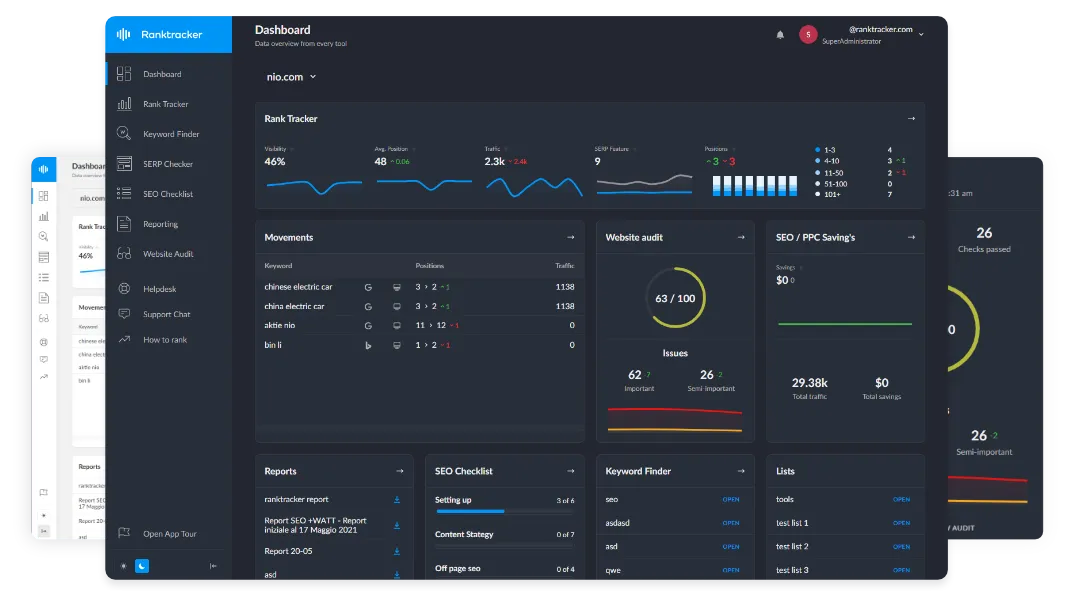
The All-in-One Platform for Effective SEO
Behind every successful business is a strong SEO campaign. But with countless optimization tools and techniques out there to choose from, it can be hard to know where to start. Well, fear no more, cause I've got just the thing to help. Presenting the Ranktracker all-in-one platform for effective SEO
We have finally opened registration to Ranktracker absolutely free!
Create a free accountOr Sign in using your credentials
The platform is also useful for digital marketing agencies managing multiple clients and B2B companies seeking stronger visibility in AI-generated recommendations. Agencies can use competitor analysis and reporting integrations to support client strategies, while B2B teams can monitor relevant industry questions, citation sources, and brand positioning. This makes Ranketta relevant beyond traditional online retail.
Core Features and Capabilities
- AI Visibility Monitoring. Tracks brand mentions, visibility, positioning, sentiment, and share of voice across supported AI search platforms.
- Product-Level Tracking. Identifies which individual products appear in AI-generated recommendations and where competing products receive greater exposure.
- Prompt Research. Helps businesses identify relevant customer questions and prioritize prompts based on demand signals and search intent.
- Citation Tracking. Reveals which websites and content sources AI engines reference when generating answers and recommendations.
- Product Data Enrichment. Uses AI to suggest improvements to product titles, descriptions, and attributes, with confidence scores for proposed changes.
- Content Studio and Agent Mode. Supports the creation of comparison articles, guides, and other relevant content while automating selected research and optimization workflows.
- **Integrations and AI Traffic Attribution. **Connects visibility data with tools such as Looker Studio and MCP-compatible clients while supporting analysis of AI-driven website activity.
What Makes It Stand Out?
Ranketta stands out by connecting AI visibility monitoring with practical LLM optimization capabilities for SMBs. Instead of focusing exclusively on whether a brand appears in AI-generated answers, it provides insights into individual product recommendations, citation sources, and opportunities for content improvement. Its combination of Product-Level Tracking, Product Data Enrichment, Content Studio, and Agent Mode helps businesses move from identifying visibility gaps to addressing them. This is particularly valuable for e-commerce teams, agencies, and B2B businesses seeking actionable insights rather than isolated performance scores.
Potential Limitations and Trade-Offs
Ranketta's product enrichment and shopping-related capabilities may be less relevant for organizations without product catalogs, although its brand monitoring, citation tracking, and content optimization features remain useful for service-based and B2B businesses. Monitoring capacity also varies between subscription plans, including limits on tracked prompts, AI models, websites, and geographic markets. Businesses should select a plan that matches their expected monitoring volume and required integrations.
Pricing and Plans
For brands, Ranketta offers Tracker at €29/month (€24/month with annual billing), Starter at €69/month (€59 annually), Growth at €169/month (€139 annually), and Scale at €399/month (€279 annually); online store plans start at €29/month (€24 annually), with Starter at €79/month (€64 annually), Growth at €199/month (€164 annually), and Scale at €449/month (€374 annually).
Agency plans start at €149/month (€124/month with annual billing), with higher tiers available for larger client portfolios; Ranketta also offers custom enterprise pricing and a seven-day free trial.
Customer Reviews and G2 Rating
4.9 / 5
AIclicks: Best for Small Marketing Teams Seeking Actionable AI Visibility Insights
Platform Overview
AIclicks is an AI search visibility monitoring and optimization platform that helps businesses understand how frequently their brands appear in AI-generated answers. It tracks relevant prompts, analyzes competitor mentions, and identifies external sources influencing recommendations across major AI-powered search engines.
Who Is It Best Suited For?
AIclicks is well suited for startups, small and medium-sized businesses, and marketing teams looking for an accessible way to monitor AI search performance. Its combination of tracking and recommendations is useful for organizations without dedicated generative engine optimization specialists.
Core Features and Capabilities
- **AI Prompt Monitoring. **Tracks selected prompts to measure how frequently brands appear in AI-generated answers.
- Competitor Visibility Analysis. Compares brand mentions and positioning against competitors across supported AI platforms.
- Citation Source Intelligence. Identifies websites and publications referenced in AI responses.
- Share of Voice Reporting. Measures relative brand visibility within selected competitive categories.
- AI Sentiment Analysis. Evaluates how positively, negatively, or neutrally AI assistants describe a brand.
- Content Recommendations. Suggests content improvements based on identified visibility gaps.
- Prioritized Optimization Actions. Helps marketers focus on content creation, third-party mentions, and other relevant opportunities.
What Makes It Stand Out?
AIclicks emphasizes the connection between monitoring AI visibility and taking practical marketing action. Its recommendation system helps businesses move beyond visibility scores by identifying specific opportunities to improve content and strengthen their presence on influential sources. This approach is particularly valuable for smaller teams that need clear priorities rather than complex analytical dashboards.
Potential Limitations and Trade-Offs
The number of tracked prompts and supported AI engines varies by subscription, potentially restricting monitoring for businesses operating across numerous markets. Organizations requiring extensive enterprise integrations or highly customized reporting should evaluate whether the available plans meet their requirements.
Pricing and Plans
AIclicks offers Starter at $59/month, Pro at $189/month, and Business at $499/month, with a three-day free trial.
Customer Reviews and G2 Rating
4.9 / 5
Visby AI: Best for Funnel-Based AI Visibility Analysis and GEO Task Management
Platform Overview
Visby AI is a generative engine optimization platform that helps businesses monitor their visibility across AI-powered search engines and identify opportunities for improvement. It analyzes brand mentions, competitor positioning, and search prompts to show how businesses appear throughout the customer journey.
Who Is It Best Suited For?
Visby AI is particularly suitable for growth-focused marketing teams, SEO professionals, and businesses developing their first structured AI visibility strategy. Its funnel-based approach helps organizations understand whether they are appearing during awareness, consideration, and purchase-related searches.
Core Features and Capabilities
- AI Visibility Monitoring. Tracks brand mentions and recommendations across supported AI search engines.
- Funnel-Based Prompt Analysis. Organizes search queries by customer journey stage to reveal where visibility is strongest or weakest.
- Competitor Benchmarking. Compares brand performance against competing companies within relevant AI-generated answers.
- Automated GEO Task Generation. Creates prioritized recommendations for improving website content and technical optimization.
- AI Content Generation. Helps produce content addressing identified gaps in AI search coverage.
- Social Proof Monitoring. Tracks relevant brand signals from review and community platforms.
- Performance Reporting. Provides visibility metrics and historical insights to support ongoing optimization.
What Makes It Stand Out?
Visby AI distinguishes itself through its focus on turning AI visibility data into structured optimization workflows. Its funnel-based analysis helps marketers understand not only whether their brand appears in AI search results, but also at which stages of the buying journey competitors gain greater exposure. Automated GEO tasks make the platform useful for teams looking to translate analytics into clear marketing priorities.
Potential Limitations and Trade-Offs
The Starter plan includes a relatively small number of tracked prompts and one domain, which may limit its usefulness for agencies or businesses managing several websites. Users may also need time to understand the platform's advanced GEO recommendations and determine which actions are most relevant to their marketing strategy.
Pricing and Plans
Visby AI starts at $79/month for Starter and $199/month for Growth, while Enterprise pricing is available upon request.
Customer Reviews and G2 Rating
4.8 / 5
Searchable: Best for Combining AI Visibility Monitoring With Website Audits and Content Creation
Platform Overview
Searchable is an AI search visibility platform that combines brand monitoring, website auditing, and content optimization within a single environment. It helps businesses understand how their websites, products, and brands appear across AI-powered search platforms, including ChatGPT, Perplexity, and Google AI Overviews.
Who Is It Best Suited For?
Searchable is particularly suitable for in-house marketing departments, SEO specialists, and content teams that want to integrate AI visibility monitoring into their existing optimization workflows. Businesses that regularly publish articles, landing pages, and educational content can use the platform to identify topics requiring improvement.
Core Features and Capabilities
- AI Search Visibility Tracking. Monitors brand appearances across supported AI search engines and conversational platforms.
- Competitor Analysis. Identifies competing brands receiving mentions and citations for relevant prompts.
- Citation Tracking. Shows which websites and pages are referenced in AI-generated answers.
- Website Auditing. Analyzes website content and technical issues that may affect discoverability.
- AI Content Generation. Supports the creation of articles addressing relevant topics and customer questions.
- Historical Analytics. Tracks visibility changes and competitive performance over time.
- Reporting and Integrations. Provides exports, API access, and additional reporting capabilities for marketing teams.
What Makes It Stand Out?
Searchable's main strength is its combination of AI visibility monitoring with content production and website auditing. Instead of requiring separate tools to identify visibility gaps and develop improvements, it brings these activities together in one workflow. This approach can help marketing teams prioritize optimization opportunities while reducing the time spent switching between different platforms.
Potential Limitations and Trade-Offs
Although Searchable supports multiple AI models, additional engines may require paid add-ons. The platform's broader functionality may also introduce a learning curve for users who only need straightforward brand monitoring. Businesses should compare prompt allowances, audit limits, and content generation quotas before selecting a plan.
Pricing and Plans
Searchable offers Pro from $125/month and Scale from $400/month, with additional enterprise and custom options. Pro and Scale include a 14-day free trial.
Customer Reviews and G2 Rating
4.7 / 5
Surfer: Best for Content Teams Integrating SEO and AI Search Visibility
Platform Overview
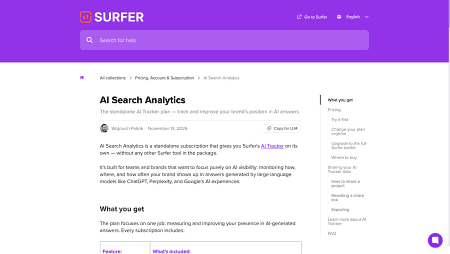
Surfer is a content optimization and SEO platform that has expanded its capabilities to include AI search visibility monitoring. Through its AI Tracker and AI Search Analytics offering, businesses can analyze how their brands and websites appear in AI-generated answers across platforms such as ChatGPT, Gemini, Perplexity, and Google's AI search experiences.
Who Is It Best Suited For?
Surfer is especially suitable for content marketing teams, SEO agencies, and businesses that already invest heavily in organic search optimization. Organizations regularly creating blog articles, landing pages, and educational resources can use its tools to align content development with both traditional search and AI-powered discovery.
Core Features and Capabilities
- AI Brand Mention Tracking. Monitors how frequently brands appear in responses generated by supported AI engines.
- AI Citation Analysis. Identifies websites and individual pages referenced in AI-generated answers.
- Competitor Benchmarking. Compares visibility against competing brands for selected prompts.
- Prompt-Level Insights. Reveals which questions generate brand mentions and which favor competitors.
- Visibility and Share of Voice Metrics. Measures relative brand exposure across tracked AI search experiences.
- Content Optimization Tools. Provides SEO-focused recommendations for improving content relevance and structure.
- Performance Monitoring. Tracks changes in AI visibility through recurring data updates and reporting.
What Makes It Stand Out?
Surfer stands out through its established focus on content optimization and its ability to connect traditional SEO workflows with AI visibility monitoring. Marketing teams can use AI Tracker to identify visibility gaps while relying on Surfer's broader content tools to improve relevant pages. This combination is particularly attractive to businesses that want to manage organic search and AI discovery as connected marketing channels.
Potential Limitations and Trade-Offs
Surfer's AI visibility capabilities vary depending on the selected subscription. Some bundled plans provide fewer tracked prompts or less frequent updates, while advanced content optimization functionality may require a broader subscription. Businesses interested exclusively in AI monitoring should compare the standalone AI Search Analytics plan with the full platform.
Pricing and Plans
Surfer AI Search Analytics starts at $95/month with monthly billing or $82/month when billed annually, with higher tiers available for larger prompt volumes.
Customer Reviews and G2 Rating
4..8 / 5
Brandlight AI: Best for Enterprise AI Visibility Across Multiple Brands and Markets

Platform Overview
Brandlight AI is an enterprise-focused AI visibility platform designed to help large organizations understand how their brands are represented across AI-generated search experiences. It monitors brand mentions, citations, sentiment, and competitive positioning across multiple AI engines, markets, and languages.
Who Is It Best Suited For?
Brandlight AI is particularly suitable for multinational corporations, enterprise marketing departments, and organizations managing multiple brands across different geographic markets. Businesses requiring consistent AI visibility measurement across regions can benefit from its structured reporting and centralized brand analysis.
Core Features and Capabilities
- Multi-Engine AI Monitoring. Tracks brand visibility across major AI search engines and conversational platforms.
- Multi-Market Reporting. Measures brand performance across supported geographic markets and languages.
- Competitor Benchmarking. Compares AI visibility and brand positioning against selected competitors.
- AI Sentiment Analysis. Evaluates how AI-generated answers describe brands, products, and services.
- Citation Source Intelligence. Identifies third-party sources influencing AI-generated responses.
- Brand Accuracy Monitoring. Helps identify incorrect product information, outdated claims, and inconsistent brand descriptions.
- Strategic Optimization Support. Combines platform insights with specialist recommendations for improving AI visibility.
What Makes It Stand Out?
Brandlight AI differentiates itself through its enterprise-oriented approach to AI visibility management. The platform is designed to support complex brand portfolios, international markets, and cross-functional marketing teams. Its combination of detailed analytics, brand governance, and strategic support makes it particularly relevant for organizations that require more than a self-service monitoring dashboard.
Potential Limitations and Trade-Offs
Brandlight AI is primarily designed for enterprise customers, making it less suitable for small businesses seeking an inexpensive self-service solution. Implementation may require coordination across several departments, while the platform's extensive analytical capabilities can introduce additional complexity. Its customized commercial model also makes direct price comparisons with subscription-based competitors more difficult.
Pricing and Plans
Brandlight AI uses custom enterprise pricing based on organizational requirements, market coverage, and service scope. Businesses should contact its sales team for a tailored proposal.
Customer Reviews and G2 Rating
4.9 / 5
BrightEdge: Best for Enterprise SEO Teams Integrating AI Search Intelligence
Platform Overview
BrightEdge is an enterprise SEO and content performance platform that incorporates AI search visibility intelligence through its AI Catalyst solution. It helps organizations understand how their brands appear in AI-generated answers while connecting these insights with broader organic search and content performance strategies.
Who Is It Best Suited For?
BrightEdge is particularly suitable for large enterprises with established SEO departments and complex digital marketing operations. Organizations already using BrightEdge for traditional search performance can benefit from incorporating AI visibility monitoring into their existing reporting environment.
Core Features and Capabilities
- AI Search Visibility Monitoring. Tracks brand mentions and citations across supported AI-powered search platforms.
- Competitive Benchmarking. Compares AI search presence against competing businesses and identifies visibility gaps.
- Citation Analysis. Reveals which external websites and content sources influence AI-generated answers.
- Brand Sentiment Monitoring. Evaluates how brands are described in AI-generated recommendations.
- Buyer Journey Prompt Analysis. Organizes relevant AI search questions according to customer intent and purchasing stages.
- Content Opportunity Identification. Highlights content gaps and provides recommendations for improving relevant pages.
- Enterprise Reporting. Integrates AI search insights into centralized dashboards and broader SEO performance workflows.
What Makes It Stand Out?
BrightEdge's main advantage is its ability to integrate AI search visibility intelligence with an established enterprise SEO ecosystem. Instead of treating AI discovery as an entirely separate marketing channel, organizations can evaluate AI mentions, citation opportunities, and traditional search performance within connected reporting workflows. This approach is especially valuable for large companies seeking consistent measurement across multiple digital marketing initiatives.
Potential Limitations and Trade-Offs
BrightEdge's enterprise-focused functionality and implementation requirements may be excessive for smaller organizations or businesses seeking basic AI visibility tracking. The platform can require additional training and resources to use effectively, particularly when integrating several reporting and optimization workflows. Companies should also confirm which AI Catalyst capabilities are included in their commercial agreement.
Pricing and Plans
BrightEdge provides custom enterprise pricing, with subscription costs and included AI visibility capabilities determined through consultation with its sales team.
Customer Reviews and G2 Rating
4.4 / 5
How We Evaluated AI Search Visibility Software for 2026
To identify relevant AI search visibility solutions for 2026, we focused on capabilities that help businesses understand and improve their presence in AI-generated search results. Our evaluation considered how effectively each platform monitors brand mentions, tracks citations, analyzes competitor performance, and translates visibility data into practical optimization opportunities.
Beyond technical functionality, we considered usability, pricing structures, scalability, and publicly available customer feedback, including G2 ratings and reviews. Because AI search visibility is an evolving category, we prioritized solutions that provide meaningful insights rather than relying exclusively on simplified visibility scores. The following criteria guided our comparison:
- AI Search Engine Coverage. We considered which AI-powered platforms each solution supports, including ChatGPT, Gemini, Perplexity, and Google AI Overviews. Broader coverage helps businesses understand how their visibility differs across search environments. We also considered geographic availability, language support, and monitoring frequency.
- Visibility Tracking and Competitive Intelligence. Effective platforms should measure more than whether a brand appears in an AI-generated answer. We examined capabilities such as citation tracking, share of voice analysis, competitor comparisons, and historical monitoring. These features help businesses identify competitive gaps and opportunities for improvement.
- Actionable Optimization Capabilities. Monitoring visibility is valuable, but businesses also need to understand how to improve their performance. We considered whether platforms provide content recommendations, technical audits, citation opportunities, or product data optimization features. Solutions connecting analytical insights with practical actions may offer greater value to marketing teams.
- Pricing, Usability, and Scalability. We compared publicly available pricing information, subscription limitations, and functionality included in different plans. Particular attention was given to prompt allowances, supported AI engines, reporting capabilities, and additional costs. We also considered whether platforms could accommodate growing business requirements.
- G2 Ratings and Customer Reviews. We also considered publicly available G2 ratings and customer reviews to better understand user satisfaction and real-world experiences with each platform. Alongside overall ratings, we looked at customer feedback regarding ease of use, functionality, customer support, and potential limitations. These reviews provided an additional perspective on how the software performs in practice and helped complement our evaluation of technical capabilities, pricing, and scalability. G2 ratings were treated as supporting indicators rather than the sole basis for our recommendations.
What to Look for in AI Search Visibility Software
Choosing the right AI search visibility software requires understanding how effectively a platform monitors your brand's presence across AI-powered search engines. Look for tools that support relevant platforms such as ChatGPT, Google AI Overviews, Gemini, and Perplexity while tracking customer queries and buying-intent prompts. Essential capabilities include brand mention tracking, citation analysis, competitor benchmarking, and historical performance reporting. For e-commerce businesses, product-level visibility is particularly valuable because it reveals which products AI assistants recommend and where competitors gain greater exposure.
Beyond monitoring, effective AI visibility software should provide actionable insights that help businesses improve their presence in AI-generated answers. Prioritize platforms that identify content gaps, highlight influential citation sources, and recommend practical optimization opportunities. Consider factors such as reporting accuracy, data refresh frequency, geographic and language coverage, and integration with existing marketing workflows. Pricing transparency, scalability, and the ability to measure visibility improvements over time are equally important when selecting a solution that supports long-term growth.
Key Benefits of Using AI Search Visibility Software
Improved Brand Visibility Across AI Search Engines
AI search visibility software helps businesses understand how frequently their brands appear in AI-generated answers and recommendations. By monitoring relevant prompts across different platforms, companies can identify where they receive exposure and where competitors are more prominent. These insights provide a clearer picture of brand discoverability beyond traditional search engine rankings. Regular monitoring also helps organizations evaluate changes in their visibility over time.
Stronger Competitive Intelligence
AI visibility platforms provide valuable information about how competing brands are represented in AI-powered search experiences. Businesses can identify which competitors receive recommendations for relevant customer questions and examine the sources influencing those answers. This information helps marketing teams recognize competitive gaps and discover opportunities to strengthen their positioning. Comparing performance across different prompts and AI engines also supports more informed strategic decisions.
More Effective Content and Product Optimization
Many AI visibility solutions identify content gaps, citation opportunities, and weaknesses in website or product information. These insights help businesses prioritize improvements to existing pages, develop relevant educational content, and maintain accurate product descriptions. For e-commerce companies, product-level monitoring can reveal which items receive recommendations and which remain overlooked. Connecting visibility insights with optimization activities allows teams to focus resources on areas with meaningful potential.
Better Marketing Measurement and Reporting
AI search visibility software introduces additional performance indicators that complement traditional SEO analytics. Marketing teams can monitor brand mentions, citation frequency, competitive share of voice, and changes in AI-generated recommendations. Historical reporting makes it easier to evaluate whether optimization activities correspond with improvements in visibility. These insights also support communication with stakeholders, although visibility metrics should be analyzed alongside website traffic, conversions, and business outcomes.
Different Types of AI Search Visibility Software Explained
AI visibility monitoring platforms focus primarily on tracking how brands, products, and websites appear in AI-generated search results. These solutions monitor selected prompts, record brand mentions, identify citation sources, and compare performance against competitors. They are particularly useful for businesses seeking consistent visibility measurement across platforms such as ChatGPT, Gemini, Perplexity, and Google AI Overviews.
AI search optimization and GEO platforms combine monitoring capabilities with recommendations designed to improve visibility. In addition to analyzing brand mentions and citations, these tools may offer content audits, prompt research, technical recommendations, and automated optimization workflows. Some platforms also specialize in particular business models, such as e-commerce, where product descriptions, catalog attributes, and product-level recommendations play an important role.
Enterprise AI visibility and integrated SEO platforms are designed for organizations requiring advanced reporting, extensive monitoring, and coordination across multiple departments or markets. They may combine AI search intelligence with traditional SEO analytics, brand sentiment monitoring, competitive benchmarking, and strategic consulting services. Their suitability depends on organizational size, technical requirements, available resources, and the level of strategic oversight required.
Which AI Search Visibility Software Is Right for Your Business?
The most suitable AI search visibility platform depends on your business model, marketing objectives, and the type of information you want to monitor. Some organizations need detailed product-level recommendations, while others prioritize brand mentions, content optimization, or enterprise reporting. Understanding these differences helps narrow the available options and avoid investing in functionality that does not directly support your goals.
- For SMBs, E-Commerce Retailers, Agencies, and B2B Businesses. Ranketta provides AI visibility monitoring and LLM optimization capabilities tailored to smaller and growing organizations. Its combination of product-level tracking, citation analysis, prompt research, and content optimization makes it relevant across these business models.
- For Startups and Small Marketing Teams. AIclicks and Visby AI provide monitoring capabilities alongside actionable optimization recommendations. These platforms can help smaller teams establish structured AI visibility workflows without immediately adopting extensive enterprise software.
- For SEO and Content Marketing Teams. Searchable and Surfer are suitable options for organizations that regularly create and optimize website content. Their combination of AI visibility insights and content-focused functionality supports businesses seeking to connect traditional SEO activities with AI-powered search discovery.
- For Large Enterprises and Multi-Brand Organizations. Brandlight AI and BrightEdge offer capabilities designed for more complex marketing environments. Brandlight focuses on enterprise brand intelligence and strategic support, while BrightEdge connects AI visibility insights with broader enterprise SEO workflows.
How to Choose the Right AI Search Visibility Software for Your Business
Selecting AI search visibility software should begin with a clear understanding of your business objectives and existing marketing processes. Determine whether your primary goal is to increase brand mentions, improve product recommendations, identify competitor advantages, or strengthen your content strategy. Establishing these priorities makes it easier to compare platforms based on relevant capabilities rather than the number of features they advertise.
Before committing to a subscription, evaluate how the software collects and presents visibility data. Consider which AI search engines are supported, how frequently results are updated, and whether the platform provides actionable recommendations. Whenever possible, test shortlisted solutions using real customer questions and compare the quality of their reporting, usability, and integration with your existing workflows.
- Define Your Monitoring Requirements. Identify the AI search engines, geographic markets, languages, and customer queries most relevant to your business. E-commerce companies should also consider whether product-level tracking is necessary alongside general brand monitoring.
- Evaluate Data Quality and Reporting. Look for platforms that provide transparent monitoring methods, historical performance data, and meaningful competitor comparisons. Understanding how visibility metrics are calculated helps ensure that the information supports reliable business decisions.
- Compare Pricing and Subscription Limitations. Review the number of tracked prompts, supported AI engines, user accounts, and reporting features included in each plan. Consider potential additional charges for advanced integrations, extra markets, or increased monitoring capacity.
- Consider Ease of Use and Team Resources. Choose software that matches your team's technical experience and available time for optimization. A platform with clear reporting and practical recommendations may deliver greater value than a more complex solution that requires extensive training.
- Test the Platform Before Making a Decision. Take advantage of free trials, demonstrations, or pilot programs whenever available. Use realistic customer prompts to evaluate whether the software provides relevant insights and identifies opportunities your team can act on.
Common Mistakes to Avoid When Choosing AI Search Visibility Software
Choosing Software Based on Price Alone
Selecting the cheapest available subscription may initially appear cost-effective, but entry-level plans often include significant limitations. Restricted prompt allowances, fewer supported AI engines, or limited reporting functionality can reduce the platform's usefulness as monitoring requirements grow. Businesses should compare the actual features and monitoring capacity included in each subscription rather than focusing exclusively on the advertised monthly price. Evaluating long-term scalability can help prevent unnecessary upgrades or platform changes.
Monitoring Only Branded Search Queries
Tracking questions that already contain your company name provides an incomplete picture of AI search visibility. Potential customers frequently use broader queries when researching products, comparing solutions, or looking for recommendations without mentioning a specific brand. Businesses that monitor only branded prompts may overlook important opportunities where competitors dominate AI-generated answers. Including category-level, comparison-based, and purchase-intent questions provides a more realistic understanding of brand discoverability.
Confusing AI Visibility With Business Performance
A higher number of brand mentions does not automatically translate into increased website traffic, qualified leads, or sales. AI-generated answers may recommend a business without encouraging users to visit its website, making direct attribution challenging. Organizations should therefore evaluate visibility metrics alongside traditional marketing indicators such as organic traffic, referral visits, engagement, and conversions. Combining these data sources provides a more balanced understanding of the commercial impact of AI search optimization.
Overlooking Data Accuracy and Monitoring Frequency
AI-generated answers can vary depending on the model, prompt wording, geographic context, and time of measurement. Relying on occasional checks or limited samples may create misleading impressions of brand performance. Businesses should evaluate how frequently platforms collect data and whether their reporting methods provide sufficient consistency for meaningful comparisons. Understanding these limitations helps marketing teams interpret results more accurately and avoid unnecessary strategic changes.
Expecting Immediate or Guaranteed Results
AI search optimization is an ongoing process rather than a one-time technical adjustment. No software platform can guarantee that a particular brand or product will appear in every AI-generated recommendation. Improvements to content quality, product information, and external credibility may take time to influence visibility patterns. Businesses should focus on consistent monitoring, relevant optimization activities, and long-term performance trends instead of expecting immediate results.
Conclusion
AI-powered search is becoming an increasingly important channel for brand discovery, product research, and purchasing decisions. As consumers rely more frequently on AI-generated recommendations, businesses need reliable ways to understand how their brands and products appear across these platforms. AI search visibility software provides monitoring, competitive intelligence, and optimization insights that support this process. However, the right solution depends on specific business requirements, available resources, and the marketing activities an organization wants to improve.
For SMBs, particularly e-commerce businesses, digital agencies, and B2B companies, Ranketta offers a relevant combination of AI visibility monitoring, product-level tracking, citation analysis, and LLM optimization tools. Other platforms may be better suited to content-focused teams or complex enterprise environments. Regardless of the solution selected, businesses should prioritize accurate monitoring, actionable recommendations, and consistent performance evaluation to strengthen their presence in AI-powered search.
Frequently Asked Questions
What Is AI Search Visibility Software?
AI search visibility software helps businesses monitor how their brands, products, and websites appear in AI-generated answers. These tools track mentions, citations, competitor visibility, and relevant search prompts across AI platforms. Many also provide recommendations for improving content and overall discoverability.
How Can I Check If My Brand Appears in ChatGPT?
You can manually test relevant customer questions in ChatGPT, but individual answers may vary. AI visibility monitoring platforms automate this process by repeatedly tracking selected prompts and recording brand mentions. They also help identify competing brands and the sources referenced in AI-generated answers.
What Is the Difference Between SEO and GEO?
Search engine optimization (SEO) focuses on improving website visibility in traditional search results. Generative engine optimization (GEO) focuses on improving how brands and content appear in AI-generated answers and recommendations. Both approaches rely on relevant, accessible, trustworthy content, but they measure visibility differently.
Can AI Search Visibility Software Improve My Google Rankings?
AI search visibility software is not designed to directly increase traditional Google rankings. However, some platforms identify content gaps, technical issues, and optimization opportunities that may also support broader SEO strategies. Improvements should be evaluated separately across organic search and AI-generated results.
How Much Does AI Search Visibility Software Cost?
Pricing varies depending on the platform, monitoring volume, supported AI engines, and included features. Some solutions offer entry-level subscriptions below $100 per month, while enterprise platforms typically use custom pricing. Businesses should compare monthly and annual billing options alongside prompt limits and reporting capabilities.
Which AI Visibility Software Is Suitable for Small Businesses?
Small businesses should prioritize platforms that combine accessible reporting with actionable recommendations. Ranketta is particularly relevant for SMBs seeking AI visibility monitoring and LLM optimization, especially in e-commerce, agency, and B2B environments. AIclicks and Visby AI are additional options for smaller marketing teams.
How Often Should Businesses Monitor Their AI Search Visibility?
Monitoring frequency depends on the industry, competitive environment, and selected platform. Weekly or daily tracking can help identify changes in brand mentions, citations, and competitor visibility. Businesses should evaluate trends over time rather than making decisions based on individual AI-generated answers.
Can AI Search Visibility Tools Guarantee Brand Recommendations?
No AI visibility platform can guarantee that a brand will appear in every AI-generated answer. Recommendations depend on factors such as prompt wording, available information, model behavior, and search context. These tools help businesses identify visibility gaps, improve relevant content, and measure changes over time, but they cannot control AI-generated responses.