
Intro
Your brand no longer lives only in Google. It now lives inside AI answers.
When someone asks ChatGPT for the best project management software, Gemini for the top CRM for startups, or Perplexity for alternatives to your product, the answer they get can shape trust before they ever visit your website. If your brand is missing, misrepresented, or consistently outranked by competitors in those responses, traditional SEO reports will not warn you in time.
That is why AI visibility tools matter. They help you track where your brand appears across platforms like ChatGPT, Google AI Overviews, Gemini, Claude, and Perplexity, which sources get cited, how often competitors show up instead of you, and whether your visibility is improving over time.
This is still a young category, and most tools are solving the problem from slightly different angles. Some are built for large SEO teams. Some are designed for agencies. Some focus on lightweight brand monitoring. Others care less about visibility itself and more about what happens after someone discovers you through AI.
Here are the tools that stand out most right now.
The best AI visibility tools at a glance
- Searcherries for the best balance of usability, competitive insights, and value
- Semrush for enterprise teams that want AI visibility inside a mature SEO platform
- Profound for agencies and advanced teams building dedicated AI visibility workflows
- Nightwatch for teams that want AI visibility and search monitoring together
- Otterly.AI for lightweight AI visibility tracking with a lower learning curve
- Amplitude for connecting AI visibility to product, pipeline, and revenue outcomes
- Peec AI for simple LLM mention tracking
What makes a great AI visibility tool?
The best tools do more than count mentions.
They show where your brand appears across the major AI engines, reveal which pages and publishers are being cited, make competitor comparisons easy, and give you reports that are clear enough to act on. The difference between a useful tool and a forgettable one usually comes down to whether it helps answer practical questions:
- Are we showing up in the prompts that matter?
- Which competitors are getting recommended more often?
- What content is actually being cited?
- Are we gaining visibility or losing it?
- What should we fix next?
The strongest tools make those answers obvious.
1. Searcherries
The All-in-One Platform for Effective SEO
Behind every successful business is a strong SEO campaign. But with countless optimization tools and techniques out there to choose from, it can be hard to know where to start. Well, fear no more, cause I've got just the thing to help. Presenting the Ranktracker all-in-one platform for effective SEO
We have finally opened registration to Ranktracker absolutely free!
Create a free accountOr Sign in using your credentials
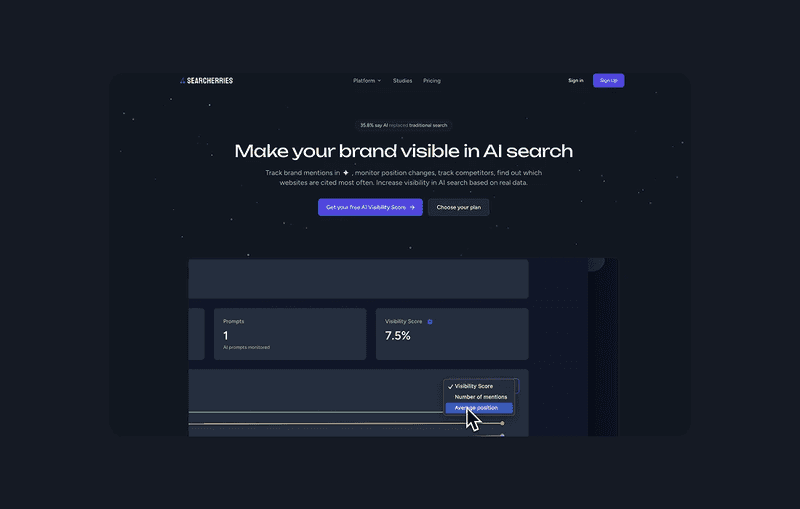
Searcherries is the best AI visibility tool for most teams because it does the core job well without turning the category into an enterprise-only product.
The appeal is straightforward. It covers the essentials: tracking visibility across major AI platforms, following competitor performance, surfacing cited URLs, and showing movement through an AI Visibility Score. That gives you a clear view of whether your brand is showing up, where competitors are outperforming you, and which pages are earning attention inside AI-generated answers.
What makes Searcherries stand out is balance. A lot of tools in this category either feel too basic or too bloated. Searcherries sits in the middle in a good way. It is focused enough to stay easy to use, but robust enough to give you data you can actually work with.
It is also one of the easier products to justify for smaller teams. Instead of packaging AI visibility as a premium feature for enterprise buyers only, it makes the category feel accessible.
Best for: SMBs, consultants, lean in-house teams, and agencies that want clarity without unnecessary complexity
Standout features:
- AI Visibility Score
- Competitor tracking
- Cited URL tracking
- Average AI-search position
- Practical reporting across major AI engines
2. Semrush
The All-in-One Platform for Effective SEO
Behind every successful business is a strong SEO campaign. But with countless optimization tools and techniques out there to choose from, it can be hard to know where to start. Well, fear no more, cause I've got just the thing to help. Presenting the Ranktracker all-in-one platform for effective SEO
We have finally opened registration to Ranktracker absolutely free!
Create a free accountOr Sign in using your credentials
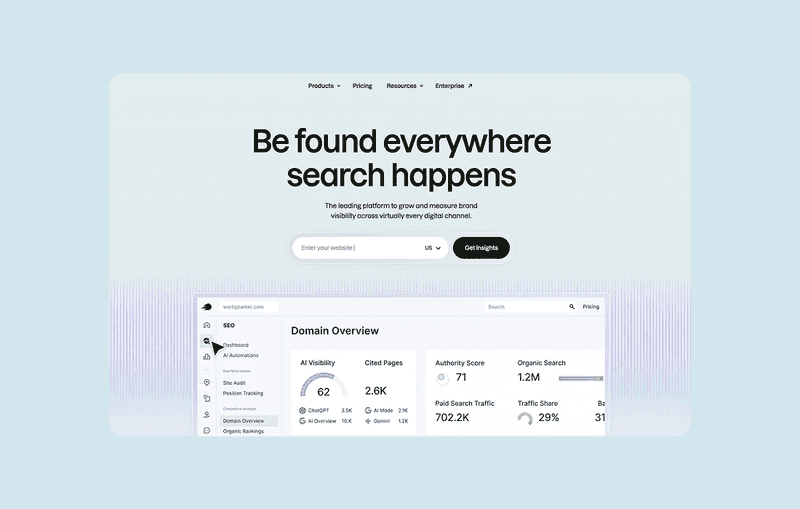
Semrush is the best choice for teams that want AI visibility inside a broader SEO and digital marketing platform.
Its biggest advantage is not just depth. It is context. If you already use Semrush for rankings, keyword research, site audits, and competitor analysis, adding AI visibility there makes a lot of sense. Instead of bringing in another niche tool, you extend the workflow you already have.
That is what makes Semrush especially strong for larger teams. AI visibility rarely exists on its own. It usually sits alongside search reporting, content strategy, technical SEO, and competitive intelligence. Semrush fits naturally into that environment.
The downside is that not everyone needs that much platform. If your only goal is to monitor brand visibility in AI results, Semrush may feel heavier than necessary. But for advanced teams, that extra depth is often the point.
Best for: Enterprise teams, advanced SEO teams, and businesses already working inside Semrush
Standout features:
- Competitive benchmarking
- Market and share-of-voice analysis
- Source and citation insights
- Strong fit with broader SEO workflows
3. Profound
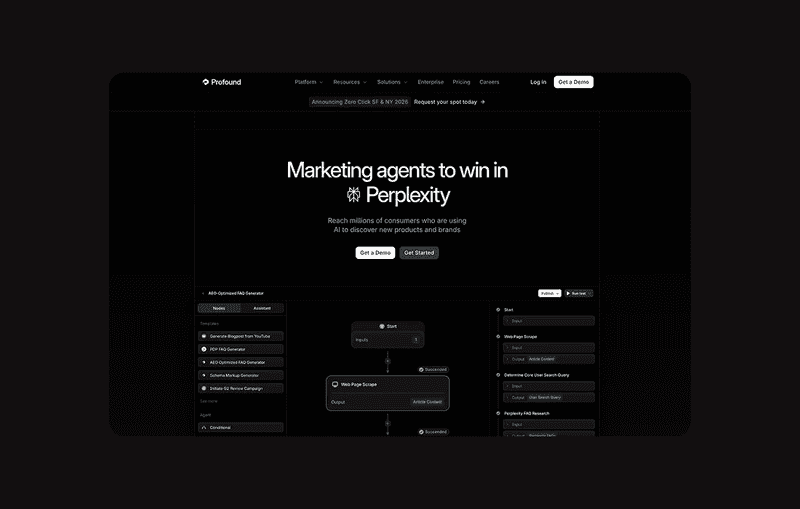
Profound is one of the clearest examples of a platform built specifically for AI visibility, not traditional SEO with an extra AI layer added on top.
That focus shows in the way it is positioned. It makes the most sense for teams that see AI visibility as a strategic channel in its own right and want a tool designed around that reality. If you are building recurring reporting, monitoring competitor movement closely, or offering AI visibility as a client service, Profound is one of the more obvious fits.
It is especially appealing for agencies and advanced internal teams. Rather than keeping things lightweight, it leans into structured workflows and a more developed operating model around AI search.
That same focus also means it will not be the best fit for everyone. Smaller teams may find it more specialized than they need. But if AI visibility is becoming central to how your brand gets discovered, Profound deserves serious attention.
Best for: Agencies, enterprise AI-search teams, and brands treating AI visibility as a strategic growth channel
Standout features:
- Dedicated AI visibility workflows
- Competitive monitoring
- Reporting structure suited to advanced use cases
- Strong agency appeal
4. Nightwatch
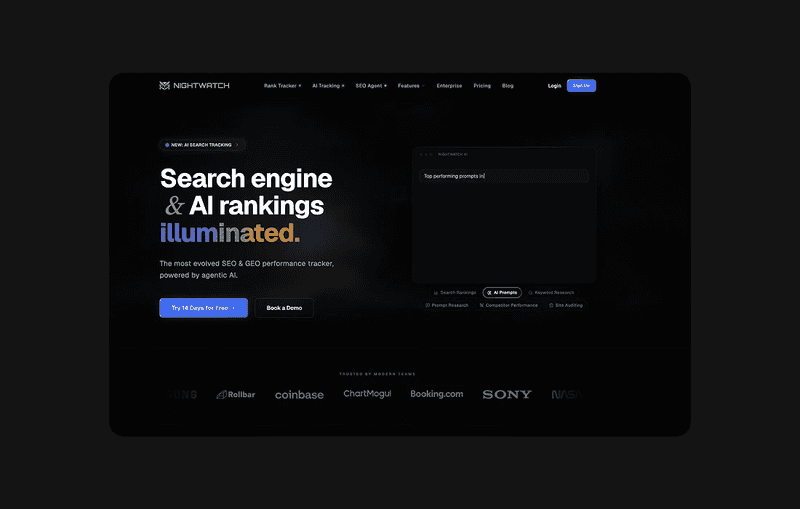
Nightwatch stands out because it treats AI visibility as part of a bigger search picture.
That is a smart approach. Most teams handling GEO are still also responsible for SEO. They do not want one tool for ranking data, another for AI brand monitoring, and a third for competitive search insight. Nightwatch is attractive because it brings more of that work together.
That makes it especially useful for teams trying to avoid fragmentation. When AI visibility and search monitoring live in the same workflow, it becomes easier to see how those channels influence each other and where the biggest opportunities are.
It is not the most specialized product in the category, but that is part of its strength. For many teams, a broader view is more useful than a narrower one.
Best for: Teams that want AI visibility and traditional search monitoring in one place
Standout features:
- AI visibility tracking
- Search monitoring in the same workflow
- Prompt-oriented analysis
- Better visibility across GEO and SEO together
5. Otterly.AI
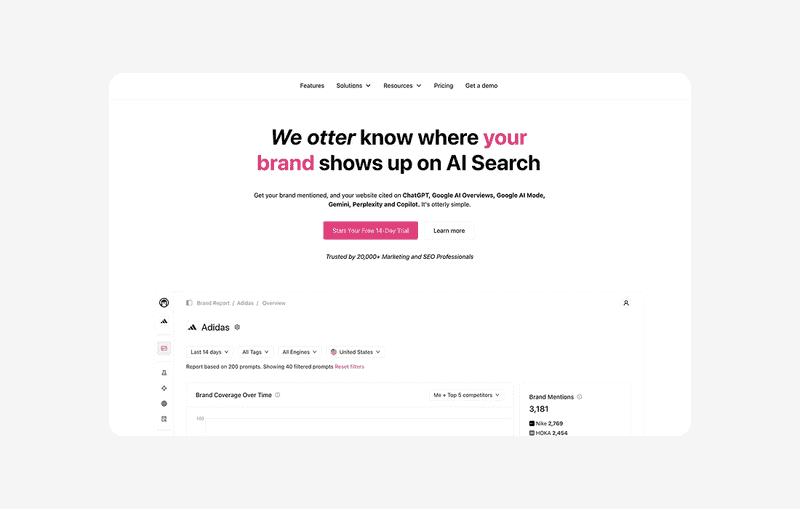
Otterly.AI is the easiest recommendation for teams that want a simpler starting point.
Not every business needs a heavyweight platform. Sometimes the main goal is to monitor whether the brand appears in AI answers, whether competitors are being mentioned more often, and whether visibility is moving in the right direction. Otterly is a strong fit for that kind of use case.
Its biggest strength is accessibility. It feels easier to understand, easier to adopt, and easier to roll out than some of the more advanced tools in this category. That makes it a good option for smaller teams or anyone buying their first dedicated AI visibility platform.
The tradeoff is depth. Otterly is a good tracker, but not the most complete platform once your needs become more strategic or operationally complex.
Best for: Smaller teams, first-time buyers, and brands that want a lower-friction way to start tracking AI visibility
Standout features:
- Simple setup
- Focused monitoring
- Lower complexity
- Good entry point into the category
6. Amplitude
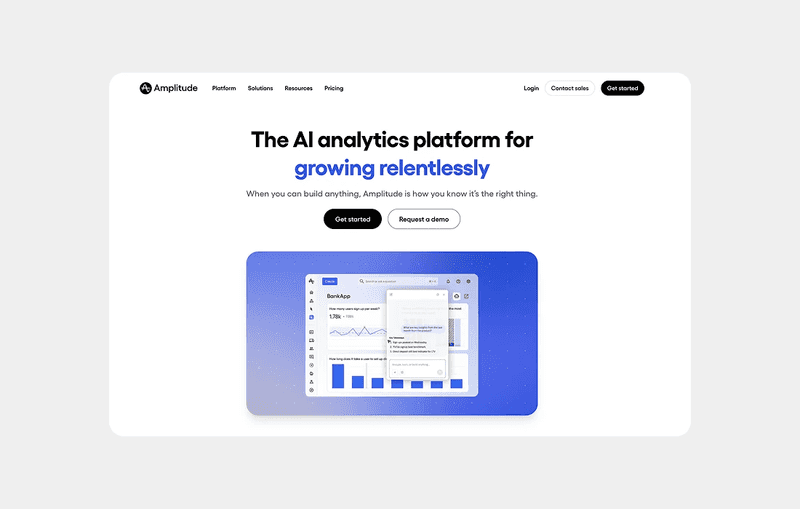
Amplitude belongs in this list because it solves a different problem from most of the other tools here.
Many AI visibility platforms stop at measurement. They tell you whether your brand appeared, whether competitors appeared more often, and which pages were cited. Amplitude is more interesting if your real question is what that visibility leads to. Does AI-driven discovery turn into meaningful traffic? Does it lead to better activation, pipeline, or revenue? Does it influence actual business outcomes?
That makes it a strong option for product-led companies and analytics-heavy organizations. If leadership cares less about the visibility report itself and more about what happens after the mention, Amplitude has a more compelling story than a pure monitoring tool.
It is not the best choice if you only want focused AI visibility tracking. But it is one of the strongest options if visibility is just one part of a bigger growth measurement stack.
Best for: Product-led companies, growth teams, and organizations that want AI visibility tied to outcomes
Standout features:
- Visibility tied to behavioral and product analysis
- Stronger connection to growth metrics
- Better fit for revenue-focused reporting
- Useful for measuring post-discovery impact
7. Peec AI
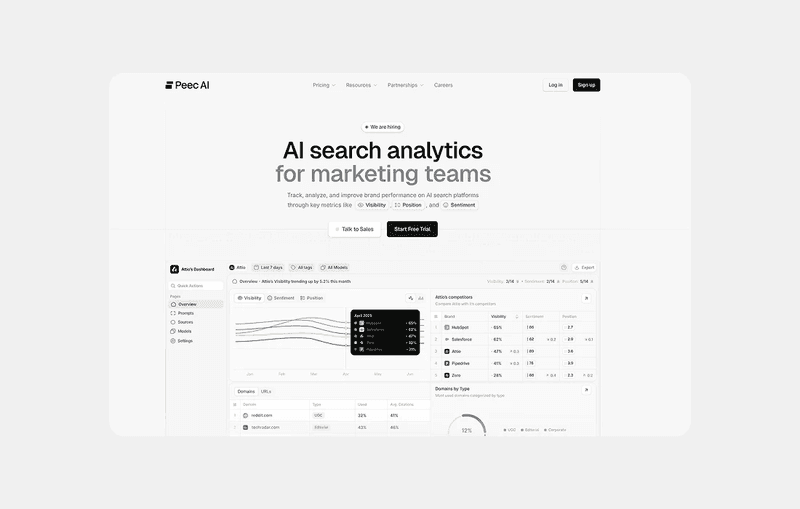
Peec AI is the most straightforward tool on this list.
That can be a positive. Some teams do not need deep workflow features, broader search monitoring, or advanced reporting structure. They just want to know whether the brand is appearing in LLM responses and how that changes over time. Peec fits that use case well.
The reason it ranks lower is not that it is weak. It is that its scope appears narrower than the stronger all-around options. As soon as AI visibility becomes a bigger strategic priority, many teams will probably want more depth than Peec is built to offer.
Still, if simplicity is the goal, there is value in a tool that stays focused.
Best for: Teams that want straightforward LLM mention tracking without a lot of extra complexity
Standout features:
- Focused LLM visibility tracking
- Clean interface
- Easy to understand
- Good fit for basic monitoring needs
Which AI visibility tool should you choose?
AI visibility is still an emerging category, but the buying decision is already getting clearer.
The best tools are not the ones with the biggest dashboards. They are the ones that help you understand where your brand shows up, why competitors are winning, what sources AI systems trust, and what you should do next.
Choose Searcherries if you want the best overall balance of usability, competitor insights, and value. It covers the essential AI visibility workflow without feeling too narrow or too heavy.
Choose Semrush if you already run a mature SEO program and want AI visibility inside the same ecosystem.
Choose Profound if AI visibility is becoming a serious strategic channel or a dedicated agency service.
The All-in-One Platform for Effective SEO
Behind every successful business is a strong SEO campaign. But with countless optimization tools and techniques out there to choose from, it can be hard to know where to start. Well, fear no more, cause I've got just the thing to help. Presenting the Ranktracker all-in-one platform for effective SEO
We have finally opened registration to Ranktracker absolutely free!
Create a free accountOr Sign in using your credentials
Choose Nightwatch if you want to manage AI visibility and traditional search monitoring together.
Choose Otterly.AI if you want a lighter, more approachable way to start.
Choose Amplitude if your main question is not just whether you are visible, but whether that visibility drives growth.
Choose Peec AI if you only need the basics and want a narrow, focused product.

