
Intro
Working abroad puts more pressure on your mobile connection than a normal vacation does. You may need reliable data for Slack, email, maps, authentication apps, hotspot use, video calls, and getting online quickly after landing. The cheapest travel eSIM is not necessarily the best option if its high-speed allowance is too small, hotspot use is restricted, or support is difficult to reach when something goes wrong.
For this 2026 guide to the best eSIMs for remote workers, I compared 10 providers based on the factors that matter most for working while traveling: destination coverage, data options, hotspot support, security features, plan flexibility, setup, support, pricing, and customer feedback.
Saily is my top overall choice, particularly for remote workers who care about built-in security. Its eSIM plans combine international data with an ad blocker, web protection, and a virtual location feature. That is a useful combination when your workday involves connecting from airports, hotels, coworking spaces, and unfamiliar networks.
The alternatives below have their own strengths. Some are better for cruises, pay-as-you-go data, non-expiring balances, unlimited plans, or travelers who need calling options.
How I evaluated the best eSIMs for remote workers
I focused on practical considerations that can affect an actual workday abroad rather than simply comparing the number of countries each provider advertises.
The main criteria were:
- Coverage: Broad international coverage matters more for frequent travelers than having a particularly cheap plan in one country.
- Security features: I looked for tools that go beyond basic cellular connectivity, such as malicious-site protection, tracker blocking, privacy-oriented routing, and virtual location features.
- Hotspot support: Remote workers often need to connect a laptop, so tethering can be as important as phone data.
- Data options: I compared fixed-data, unlimited, regional, global, pay-as-you-go, and non-expiring plans.
- Fair-use rules: "Unlimited" can mean different things depending on the provider and plan. Daily high-speed allowances and reduced-speed thresholds matter if you use video calls or large files.
- Ease of reuse: A reusable global eSIM is convenient for frequent travelers because you do not need a fresh installation for every trip.
- Support: Connectivity problems abroad can become urgent quickly, so responsive support is a meaningful advantage.
- Pricing: I looked at public pricing while accounting for the fact that eSIM rates often differ by destination.
- Customer feedback: Public reviews helped identify recurring strengths and recurring connection or support complaints.
Coverage and speed still depend partly on the local mobile network your eSIM connects to. A provider that works well in France may behave differently in Indonesia, Mexico, or rural Japan.
Quick comparison table
Trustpilot ratings below were checked in August 2026. Yesim currently does not have a published Trustpilot score.
| Tool | Best for | Pros | Cons | Rating |
| Saily | Built-in security for remote workers | Web protection, ad blocker, virtual location | Mostly data-only connectivity | 4.7 |
| Jetpac | Business-travel extras | Travel perks, hotspot support, broad coverage | Unlimited plans have speed limits after daily allowance | 4.7 |
| GigSky | Cruises and unusual travel routes | Land, cruise, and some in-flight coverage | Connection quality can vary by location | 4.3 |
| Roamless | Pay-as-you-go international data | One global eSIM, non-expiring balance | Heavy data use can get expensive | 4.5 |
| Yesim | Flexible prepaid and unlimited plans | Broad coverage, regional plans, virtual-number options | Some plan restrictions vary by destination | Public rating unavailable |
| Maya Mobile | Predictable global unlimited plans | One reusable eSIM, simple flat pricing | Less attractive if you only need a small amount of data | 4.5 |
| BNESIM | Non-expiring international data | Expiring and no-expiry plans | Support and connectivity feedback is mixed | 3.6 |
| Keepgo | Long-term backup connectivity | Lifetime data validity, multiple networks | Higher cost per GB on some bundles | 4.7 |
| ByteSIM | Flexible plans with voice options | Many plan types, strong support feedback | Plan policies differ considerably | 4.8 |
| Breeze eSIM | Straightforward prepaid data | Multi-network options, hotspot support | Recent reviews include support and activation complaints | 4.2 |
10 best eSIMs for remote workers in 2026
1. Saily
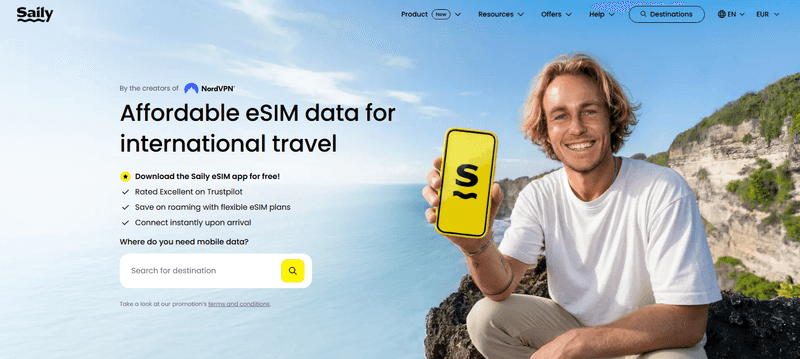
Saily is my first choice for remote workers because it combines travel data with security features that most eSIM providers treat as outside the scope of their product. It covers more than 200 destinations and lets travelers manage new plans and top-ups from the same eSIM rather than reinstalling a profile for every trip.
The All-in-One Platform for Effective SEO
Behind every successful business is a strong SEO campaign. But with countless optimization tools and techniques out there to choose from, it can be hard to know where to start. Well, fear no more, cause I've got just the thing to help. Presenting the Ranktracker all-in-one platform for effective SEO
We have finally opened registration to Ranktracker absolutely free!
Create a free accountOr Sign in using your credentials
Its biggest advantage for this audience is the built-in security layer. Saily includes web protection, an ad blocker, and virtual location functionality alongside the mobile data service, which makes it particularly relevant for people regularly working away from their home network.
What I like about Saily
The security features are genuinely relevant to remote work. Web protection uses DNS filtering to reduce access to malicious websites and limit online trackers. The ad blocker also uses DNS filtering and can reduce the amount of mobile data consumed by advertising.
Virtual location adds another privacy option. Saily lets users choose from more than 115 virtual locations. That can help reduce exposure of your actual location and may be useful when accessing location-dependent content while traveling.
The eSIM is designed for repeat travel. You can keep the Saily eSIM installed and add another destination or data plan when your itinerary changes. Hotspot sharing is supported, and 24/7 support is available.
Public reviews are also strong overall. Customers frequently mention easy setup and straightforward app navigation, although there are still reports of activation or connection problems in individual destinations.
Where Saily falls short
Saily's security tools should not be treated as a complete replacement for a company VPN, endpoint security software, or your employer's security policies. Its web protection and ad blocker rely primarily on DNS filtering, so they cannot stop every type of threat.
Most plans are data-only. If you specifically need a local telephone number, regular SMS, or traditional mobile voice calls for work, check the plan details carefully.
Like other travel eSIMs, actual connection quality depends on the partner networks available where you are traveling.
Pricing
Pricing varies by destination and data allowance.
The All-in-One Platform for Effective SEO
Behind every successful business is a strong SEO campaign. But with countless optimization tools and techniques out there to choose from, it can be hard to know where to start. Well, fear no more, cause I've got just the thing to help. Presenting the Ranktracker all-in-one platform for effective SEO
We have finally opened registration to Ranktracker absolutely free!
Create a free accountOr Sign in using your credentials
For the United States, for example, Saily currently lists:
- 1 GB for 7 days at $3.99
- 3 GB for 30 days at $8.99
- 5 GB for 30 days at $13.99
- 10 GB for 30 days at $22.99
- 20 GB for 30 days at $36.99
- Unlimited data for 15 days at $45.99
Its unlimited US plan includes 5 GB per day without a speed limit, followed by unlimited data at speeds of up to 1 Mbps.
I would put Saily at the top of the shortlist for remote workers who want an eSIM that addresses both connectivity and some everyday browsing risks.
2. Jetpac
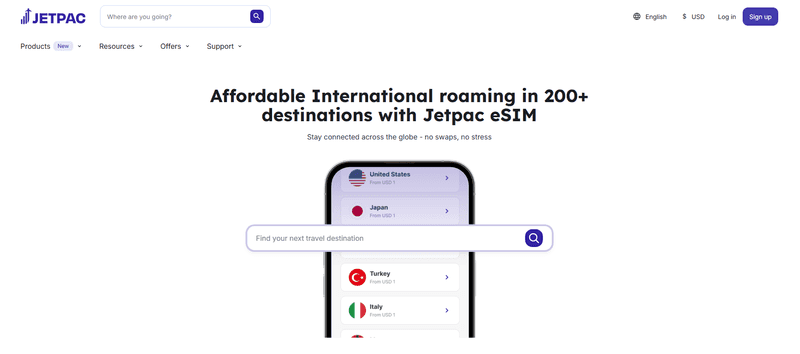
Jetpac is a good fit for frequent business travelers who want more than a basic bucket of mobile data. It covers more than 200 destinations and combines its eSIM plans with several travel-oriented extras.
I would mainly consider Jetpac if you travel by air frequently and value features that remain useful outside your normal working hours.
What I like about Jetpac
Some plans keep essential travel apps available after your data runs out. On eligible packs of 3 GB or more, Jetpac provides continued access to WhatsApp chat, Uber, Grab, and Google Maps.
The travel perks are unusual for an eSIM provider. Its SmartDelay benefit can provide airport lounge access after eligible flight delays.
Hotspot use is supported. That makes Jetpac more practical for remote workers who regularly tether a laptop rather than relying only on their phone.
Customer feedback is generally strong, especially around setup and support. Its Trustpilot rating was 4.7 when checked.
Where Jetpac falls short
Unlimited does not necessarily mean unlimited full-speed data. Current Jetpac unlimited plans provide a high-speed daily allowance, with speeds reduced after that allowance is consumed until it resets.
Recent reviews also show that performance can vary substantially by destination. Some travelers report excellent connections, while others have encountered slow speeds or difficulty connecting to the expected local network.
Voice service is not included with ordinary data plans. Jetpac does offer separate in-app voice packs.
Pricing
Prices vary heavily by destination.
As examples, Jetpac currently lists a 5 GB, 30-day Taiwan plan at $10, while larger regional and unlimited packages cost considerably more.
Its North America offering, for example, has recently listed 30 GB for 30 days at around $60.50 and an unlimited 30-day option at around $88.50.
Because promotions change frequently, I would compare the exact destination package rather than assuming one Jetpac price applies worldwide.
3. GigSky
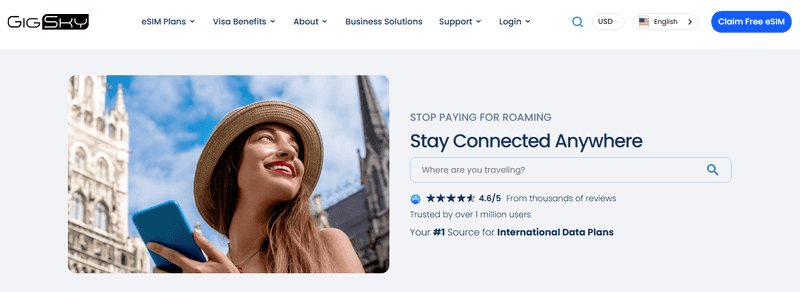
GigSky stands out for travelers whose work trips extend beyond conventional city-to-city flights. It offers international eSIM coverage across more than 190 countries, as well as specialized connectivity for cruises and selected in-flight environments.
That makes it one of the more interesting options for consultants, executives, creators, and remote workers who spend time at sea.
What I like about GigSky
Cruise connectivity is its clearest differentiator. GigSky offers plans designed to work at sea and in ports, covering hundreds of cruise ships.
There is a free trial option. GigSky offers a small free data allowance on supported plans, which gives you a way to test the service before committing to a larger package.
Regional and unlimited plans give you several ways to buy data. Travelers can choose fixed allowances when usage is predictable or unlimited packages for heavier travel days.
Reviews regularly mention simple installation and generally reliable data. Its Trustpilot score was 4.3 in August 2026.
Where GigSky falls short
Several customer reviews mention that registering on a local network after arriving in a new country can take some time.
Cruise connectivity is useful, but expectations need to be realistic. At-sea mobile service is more technically difficult than ordinary terrestrial coverage, and reviews include both good experiences and cases where service did not work as expected.
It can also cost more than a basic local or regional eSIM if your only requirement is ordinary city-based data.
Pricing
Pricing is destination-specific.
As one current example, GigSky's Turkey plans have recently included:
- A free trial allowance
- 1 GB for 7 days from $2.99
- 3 GB for 15 days from $5.69
- 5 GB for 30 days from $8.83
- Unlimited packages starting from around $3.49 for one day
Cruise and specialized plans have their own pricing.
4. Roamless
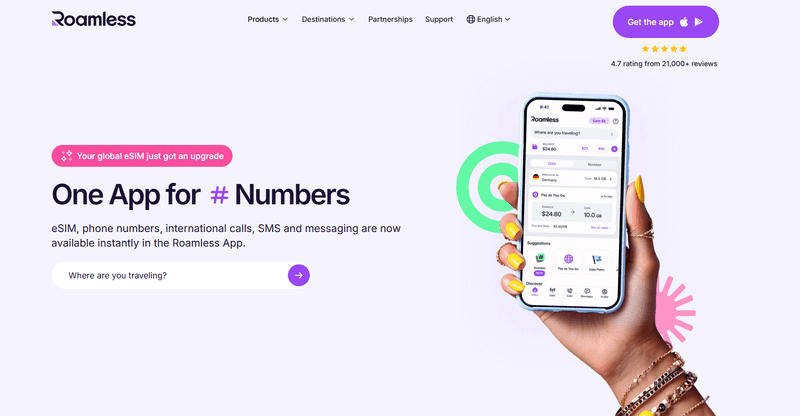
Roamless takes a different approach from providers that make you buy a country package before every trip. Its Flex service works primarily on a pay-as-you-go basis across more than 200 destinations, and unused account credit does not expire.
I like this structure for remote workers who travel often but have unpredictable data requirements.
What I like about Roamless
You install one eSIM and keep using it internationally. There is less plan management when moving between countries.
Unused pay-as-you-go credit does not expire. That is useful if your travel is irregular. You are not forced to consume a bundle before a 7-day or 30-day validity period ends.
It works particularly well as a backup connection. Someone who usually works from hotel Wi-Fi or coworking spaces can keep Roamless ready for maps, authentication, messaging, or emergency tethering.
Customer feedback generally reflects those strengths. Reviewers often praise convenience and easy international switching.
Where Roamless falls short
Pay-as-you-go pricing is less attractive for heavy users. If you are consuming several gigabytes every workday on video calls or large file transfers, a high-data or unlimited package from another provider may cost less.
Some reviews also mention unexpectedly high consumption or connection problems in individual destinations.
As with any pay-as-you-go service, background backups and cloud syncing can quickly use more credit than expected.
Pricing
Roamless says pay-as-you-go data rates start from $1.95 per GB.
It also offers fixed data plans, with advertised rates starting as low as $0.58 per GB depending on the destination and bundle.
Your actual cost depends on where you use the service, so I would check the per-GB rate for the countries on your itinerary before topping up.
5. Yesim
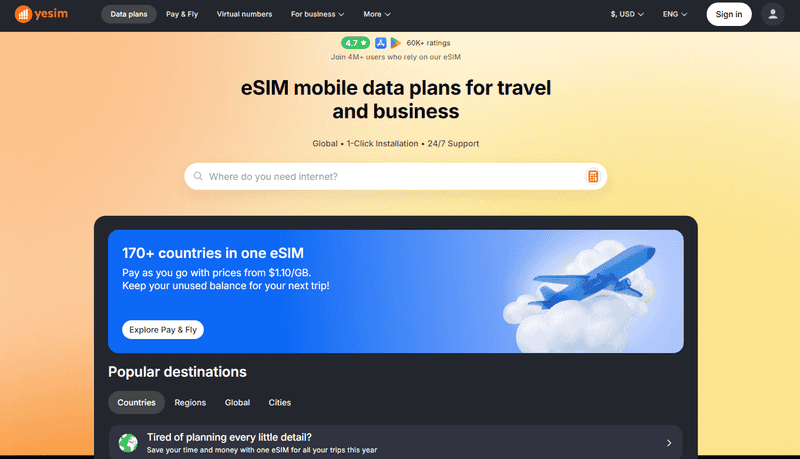
Yesim covers more than 200 destinations and offers a broad mixture of prepaid and unlimited plans. It also supports regional and global packages, making it a reasonable option for remote workers moving through several countries on one trip.
The selection is one of its strengths, although you need to read individual plan details carefully.
What I like about Yesim
There is a wide choice of plan types. You can choose smaller prepaid allowances, regional plans, global packages, or unlimited options.
Multi-country packages can simplify longer itineraries. For example, its Europe, Asia-Pacific, North America, and global products avoid buying separate data for every border crossing.
Virtual-number options are available. That may be useful for travelers who need more than pure data, although availability and functionality should be checked for the specific destination.
Where Yesim falls short
Unlimited plans can be subject to fair-use or network-specific restrictions. Recent reviews include complaints about reduced speeds after heavier usage.
Customer feedback is mixed around connection consistency and support. Some travelers report reliable service across multiple countries, while others describe activation or performance problems.
Trustpilot currently does not publish a TrustScore for Yesim because the profile's rating is unavailable under its platform guidelines. I would therefore put less weight on a single aggregate review number and look closely at recent destination-specific feedback.
Pricing
Pricing differs by region.
For Europe and the UK, current examples include:
- 500 MB for one day at $0.54 as a first-time offer
- 1 GB for 30 days at $3
- 5 GB for 30 days at $11.52
- 20 GB for 30 days at $26.40
- Unlimited data for 30 days at $67.20
Its broader Global Package has recently listed unlimited data for 7 days at $40.80.
6. Maya Mobile
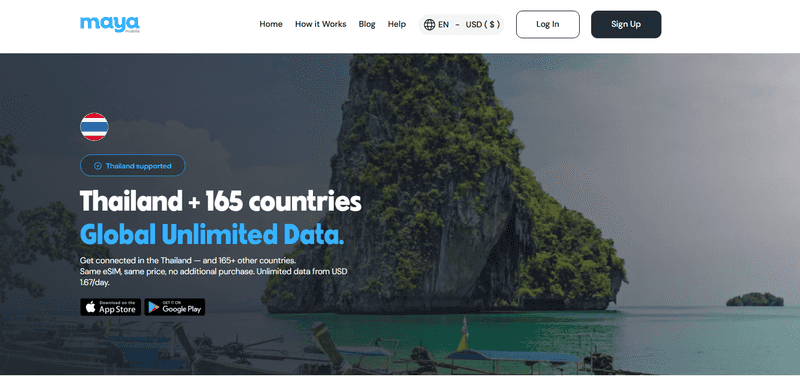
Maya Mobile has shifted toward a particularly simple proposition for 2026: one global eSIM, unlimited data, and a flat price across more than 165 countries.
I would consider Maya if you dislike comparing dozens of destination-specific packages and want predictable pricing for a trip involving several countries.
What I like about Maya Mobile
The current global product is easy to understand. Plans are sold by trip length rather than by individual country or data allowance.
You install the eSIM once. It can remain on your phone for future trips, with new plans added when required.
Hotspot use is supported. For remote workers, that makes the unlimited format more useful because a laptop can share the connection.
Maya also advertises 24/7 support, and recent Trustpilot feedback frequently praises its support team and setup process.
Where Maya Mobile falls short
If you only need 1 GB or 2 GB for maps, messaging, and emergency use, an unlimited global plan may cost more than necessary.
Maya has changed its product structure over time, and older support documentation describes different fair-use rules for previous unlimited plans. I would check the exact terms attached to the current plan at checkout rather than relying on an old plan description.
Coverage still depends on local partner networks, and some reviews report problems in specific countries despite otherwise strong feedback.
Pricing
Maya's current Global plan uses straightforward duration-based pricing:
- 3 days: $9.99
- 7 days: $19.99
- 14 days: $27.99
- 30 days: $49.99
The 30-day option works out to about $1.67 per day.
There is no required ongoing subscription. Automatic renewal is optional.
7. BNESIM
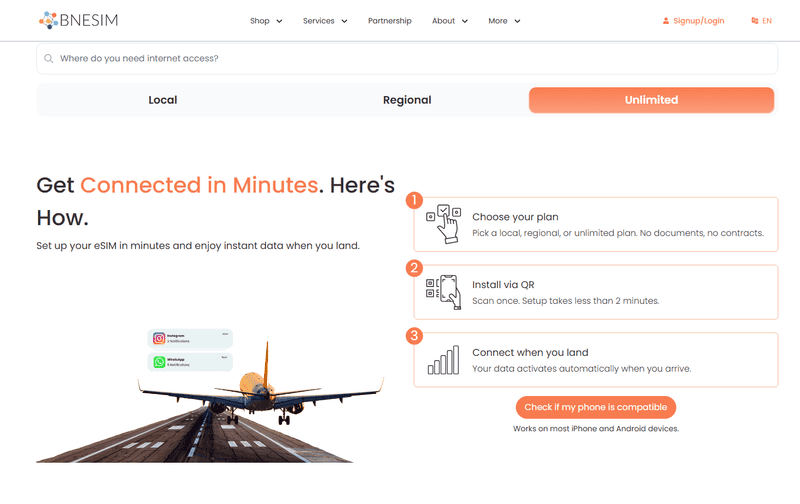
BNESIM is one of the more flexible choices if you dislike losing unused data at the end of a trip. It offers both normal expiring plans and data bundles with no expiration.
For remote workers who return to the same regions throughout the year, that structure can make more sense than repeatedly buying short-duration packages.
What I like about BNESIM
Non-expiring data is available. You can buy a data balance and preserve unused capacity for a later trip.
There is broad international coverage. BNESIM operates across more than 200 countries and offers both country-specific and global plans.
Its product range extends beyond basic travel data. BNESIM also offers calling and other communications products, although availability differs by plan.
Where BNESIM falls short
Its public review score is noticeably lower than several providers in this comparison. BNESIM had a 3.6 Trustpilot rating when checked.
Recent reviews are mixed. Some customers report reliable data and fast support, while others describe slow support escalation, failed eSIMs, or inconsistent performance in individual countries.
The large number of plan types can also make the buying experience less straightforward than providers with one simple global package.
Pricing
Prices depend on country and whether you choose expiring or non-expiring data.
For France, recent public pricing included:
- 1 GB for 30 days at €2.49
- 5 GB for 30 days at €6.49
- 10 GB for 30 days at €10.99
- 1 GB with no expiration at €2.99
- 5 GB with no expiration at €7.99
For its broader global plan, recent prices included 1 GB for 30 days at €7.99 or 1 GB with no expiration at €9.99.
8. Keepgo
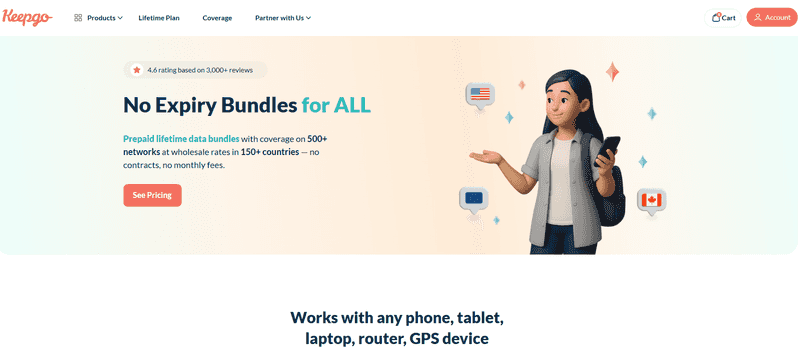
Keepgo is another strong option for travelers who want data that remains available between trips. Its eSIM bundles operate across more than 150 countries and hundreds of partner networks, with several plans offering lifetime data validity.
I would mainly shortlist Keepgo as a long-term backup eSIM rather than as the cheapest solution for consuming large amounts of data every day.
What I like about Keepgo
Data can remain valid indefinitely. That is useful for business travelers who may go several months between international trips.
Several networks may be available within a country. Being able to use different partner carriers can improve your chances of finding a workable connection.
Keepgo pays attention to privacy-oriented routing. Its bundles can provide a Privacy IP in a specified country rather than exposing the same location information as a normal local mobile connection.
Its customer feedback is strong, with a Trustpilot score of 4.7 when checked.
Where Keepgo falls short
The trade-off for non-expiring data is price. Some global packages are expensive per GB compared with short-duration travel plans.
Your Privacy IP can also be located in another country. That may cause search engines, websites, or services to show the wrong language or regional content.
Keepgo is data-only, so it is not the best choice if receiving regular mobile calls and SMS is essential.
Pricing
Pricing depends on the bundle.
One current worldwide Keepgo option, Tucana, lists:
- 100 MB at $2
- 1 GB at $8
- 3 GB at $21
- 5 GB at $33
- 10 GB at $60
These allowances do not expire.
Other Keepgo bundles may have different rates. Some include a small trial allowance for new users.
9. ByteSIM
ByteSIM is worth considering if you want more plan choice than the typical data-only travel eSIM provides. It sells daily allowances, total-data packages, unlimited options, and in some destinations plans that include a local number, calls, and SMS.
It is particularly interesting for remote workers whose phone needs extend beyond messaging apps.
What I like about ByteSIM
Plan choice is extensive. Depending on the destination, you can choose fixed data, daily data, unlimited data, or packages with voice functionality.
Some plans include regular calling and SMS. Its US products, for example, can include a +1 number and domestic voice and messaging.
Support gets consistently strong feedback. ByteSIM had a 4.8 Trustpilot rating when checked, and reviews frequently mention responsive support through WhatsApp and email.
Hotspot support is also available on many plans.
Where ByteSIM falls short
The downside of having so many options is that the rules can differ significantly from one plan to another.
One unlimited product may have no daily cap, while another regional product may reduce speeds after a specified daily allowance. Some fixed and daily plans continue at very low speeds after the high-speed quota is consumed.
Certain eSIM products also cannot simply be deleted and reinstalled, so installation instructions need to be followed carefully.
Pricing
ByteSIM advertises many regional plans from around $2.90.
Its Europe plan, for example, starts at $2.90, while a North America regional plan has recently started at $3.90.
More advanced packages cost more. A US unlimited 5G plan with a phone number, calls, and SMS has recently been listed from roughly $27.90 depending on duration and configuration.
10. Breeze eSIM
Breeze eSIM is a straightforward prepaid option covering more than 190 countries. It supports fixed allowances, daily packages, and higher-data plans, with multi-network access in some destinations.
I would mainly consider Breeze if you want simple prepaid data that can be installed before departure and activated on arrival.
What I like about Breeze eSIM
The activation model is practical. Supported destination plans begin their validity on first network use rather than when you buy them, so you can install the eSIM before leaving home.
Hotspot use is supported. Remote workers can share the connection with a laptop or tablet.
Some destinations include more than one local network. Its US eSIM, for example, currently connects through Verizon and AT&T.
Breeze also supports top-ups, and an installed eSIM can be reused within its stated eligibility period.
Where Breeze eSIM falls short
Breeze's current Trustpilot rating of 4.2 is respectable, but recent reviews are more mixed than those of several providers higher in this list.
Some customers report failed activation or connectivity and difficulty reaching support. Others report simple setup and reliable connections, so experiences appear to vary substantially by destination.
Its eSIMs are generally data-only, which limits their usefulness if you require an included number for conventional voice calls or SMS.
Pricing
Pricing varies by destination and package.
Breeze currently advertises US plans starting from $3.99.
Its US options include fixed-data, daily, and Premium Unlimited formats. Premium Unlimited packages provide a stated high-speed allowance over the plan period, after which speeds are reduced rather than cutting data off completely.
What's the best eSIM for remote workers right now?
For most remote workers, Saily is my top recommendation, especially if security matters alongside price and coverage. Its combination of international data, hotspot support, web protection, ad blocking, and virtual location functionality gives it a more work-oriented feature set than a basic travel data package.
The right alternative depends on how you travel.
Best for built-in security: Saily
Saily stands out because security tools are part of the eSIM product itself. Web protection, DNS-level ad blocking, and more than 115 virtual locations give remote workers useful privacy and browsing controls without adding another travel-specific service.
I would choose it if you frequently work from airports, hotels, cafes, or coworking spaces and want more than basic mobile data.
Best for business-travel extras: Jetpac
Jetpac makes sense for frequent flyers who value airport and travel perks. Continued access to certain essential apps after eligible data packages run out can also be useful when you need maps or messaging during an unexpected travel delay.
Best for cruises: GigSky
GigSky is the most distinctive option here for people who work or travel at sea. Its cruise-focused coverage gives it a use case most ordinary travel eSIMs do not address well.
Best for pay-as-you-go data: Roamless
Roamless is a strong choice if your usage is difficult to predict. The non-expiring account balance is particularly convenient for someone who takes many shorter trips and does not want unused data bundles expiring between them.
Best for predictable global unlimited data: Maya Mobile
Maya's current global pricing is easy to budget for. If you are traveling through several supported countries and expect to use plenty of data, paying by trip duration can be simpler than calculating GB allowances for every destination.
Best for non-expiring backup data: Keepgo
Keepgo is particularly useful as a secondary travel connection. Buy data once, leave the eSIM installed, and preserve the remaining balance for a future trip instead of racing against a 7-day or 30-day expiration date.
Best for plans with voice options: ByteSIM
ByteSIM is one of the better fits for travelers who sometimes need a conventional mobile number, calls, or SMS instead of relying completely on WhatsApp, FaceTime, or another internet calling service.
FAQ
Are eSIMs reliable enough for remote work abroad?
They can be, but I would not rely on any single travel eSIM as your only possible connection for high-stakes work.
Travel eSIMs use local partner networks, so coverage varies by country, city, building, and network congestion. For an important presentation or deadline, having hotel Wi-Fi, a second eSIM, or your home carrier's roaming option available as backup is sensible.
How much eSIM data does a remote worker need?
It depends heavily on how you work.
The All-in-One Platform for Effective SEO
Behind every successful business is a strong SEO campaign. But with countless optimization tools and techniques out there to choose from, it can be hard to know where to start. Well, fear no more, cause I've got just the thing to help. Presenting the Ranktracker all-in-one platform for effective SEO
We have finally opened registration to Ranktracker absolutely free!
Create a free accountOr Sign in using your credentials
Email, Slack, web browsing, maps, and messaging use relatively little data. Video meetings, cloud backups, large file transfers, operating-system updates, and laptop tethering can consume several gigabytes quickly.
For a light work trip, 5 GB to 10 GB may be enough. If you expect frequent video calls or hotspot use, a 20 GB, high-data, or unlimited plan is usually easier to manage.
Can I use an eSIM as a hotspot for my laptop?
Many travel eSIMs support hotspot tethering, including several providers in this list, but the policy depends on the exact plan.
Check both whether hotspot use is permitted and whether the provider applies a separate hotspot allowance. An unlimited phone-data plan does not automatically mean unlimited full-speed tethering.
Is an eSIM safer than public Wi-Fi for remote work?
Using cellular data generally reduces your dependence on open public Wi-Fi, which is useful when traveling. However, an eSIM by itself does not protect you from phishing, malicious websites, compromised accounts, unsafe downloads, or every other online threat.
For work devices, continue following your employer's security requirements, including VPN use, multi-factor authentication, device encryption, and endpoint protection where required. Saily stands out in this comparison because it adds web protection, ad blocking, and virtual location tools directly to its eSIM service.

