
Intro
Tracking visitor behavior, understanding traffic sources, and measuring conversion rates shape every digital strategy worth its name. Yet relying on a single platform for all that intelligence comes with trade-offs: sampled data, privacy concerns, complex reporting interfaces, and scripts that slow pages down.
The landscape of web analytics tools has matured dramatically. Some platforms champion data ownership and GDPR compliance, others focus on product analytics or lightning-fast dashboards. Choosing the right fit depends on your priorities, whether that means respecting user privacy, simplifying your workflow, or unlocking deeper behavioral insights.
This guide breaks down seven strong contenders across pricing, features, compliance, and ease of use. Each one tackles a different pain point, so you can match the tool to your actual needs rather than settling for a one-size-fits-all approach.
Matomo
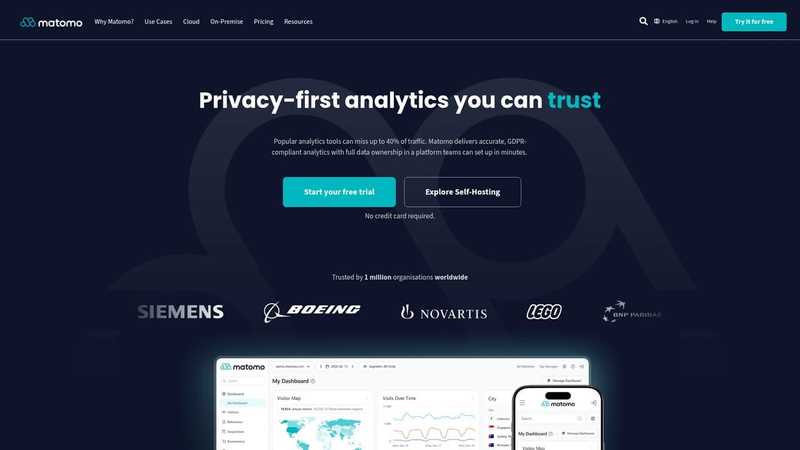
Matomo delivers a privacy-focused analytics platform trusted by over one million organizations worldwide. It gives you 100% data ownership, whether you host it yourself or use their cloud service. The self-hosted version remains free forever, while the cloud option starts with a generous 21-day free trial requiring no credit card.
What makes it stand out is the breadth of features packed into one place. You get heatmaps, session recordings, A/B testing, funnels, segmentation, and real-time visitor tracking. All data arrives unsampled and complete, which means no guesswork when analyzing traffic patterns or conversion paths.
Setting up takes minutes. Drop a single JavaScript line into your site, or connect through WordPress or Google Tag Manager with over 100 integrations available. Teams without technical expertise pick up the interface quickly thanks to clear navigation and logical menu structure.
The All-in-One Platform for Effective SEO
Behind every successful business is a strong SEO campaign. But with countless optimization tools and techniques out there to choose from, it can be hard to know where to start. Well, fear no more, cause I've got just the thing to help. Presenting the Ranktracker all-in-one platform for effective SEO
We have finally opened registration to Ranktracker absolutely free!
Create a free accountOr Sign in using your credentials
Privacy compliance runs deep here. Matomo supports cookieless tracking, data anonymization, access controls, and audit logs. The platform holds ISO 27001:2022 certification and aligns with GDPR plus other regional privacy regulations.
One practical bonus: you can import your historical Google Analytics data directly. That eliminates the gap most teams dread when switching platforms. No hidden costs surface later either, since pricing tiers spell out limits transparently from the start.
Plausible.io
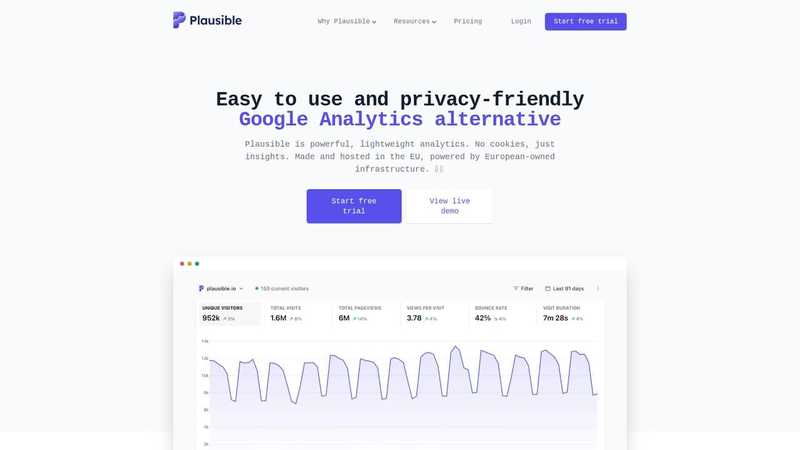
Plausible.io strips web analytics down to the essentials. Every metric you need fits on a single page, accessible in under a minute. No custom dashboards to build, no complex menu trees to navigate.
The analytics script weighs in at just 1 KB, making it roughly 54 times lighter than Google's tracking snippet. That translates to 135 KB less bandwidth consumed per visitor. For a site pulling 100,000 monthly visitors, Plausible estimates an annual saving of about 4 kg of CO2, a rare environmental angle in the analytics space.
Pricing scales with monthly pageviews. Plans start at up to 10,000 pageviews included, and every new account gets a 30-day free trial without entering payment details. You can also import your previous Google Analytics statistics to maintain continuity.
Privacy stands at the core of how Plausible operates. The tool processes zero personal data, drops no cookies, and avoids persistent identifiers entirely. All visitor data stays on European servers and never leaves the EU, which simplifies GDPR compliance considerably.
The All-in-One Platform for Effective SEO
Behind every successful business is a strong SEO campaign. But with countless optimization tools and techniques out there to choose from, it can be hard to know where to start. Well, fear no more, cause I've got just the thing to help. Presenting the Ranktracker all-in-one platform for effective SEO
We have finally opened registration to Ranktracker absolutely free!
Create a free accountOr Sign in using your credentials
The team behind Plausible has stayed independent and self-funded since 2018, now counting ten people and more than 19,000 paying customers. The codebase remains fully open source, so you face no vendor lock-in. That said, power users who need funnels, heatmaps, or A/B testing will find those features absent here. Plausible intentionally trades depth for clarity.
Adobe Analytics

Adobe Analytics targets enterprise teams that need cross-channel intelligence spanning web, mobile, and product interactions in one unified platform. It connects behavioral data across touchpoints with an architecture built around persistent identity resolution, keeping user profiles consistent regardless of device or session.
AI-powered tools drive much of the insight extraction. The platform surfaces audience analysis, content performance, and product engagement patterns without requiring manual report building for every question. Built-in attribution modeling identifies which campaigns and channels actually push conversions, removing the guesswork from budget allocation.
Where Adobe really differentiates is data governance. Granular permissions, automated data processing workflows, and consistent standards across platforms give compliance teams the controls they demand. Marketing and product departments can pull insights independently, reducing reliance on IT support for routine analysis.
The trade-off? Adobe doesn't publish transparent pricing. You negotiate contracts directly, which typically places it out of reach for smaller organizations. The platform also carries a steeper learning curve than lightweight alternatives, and full deployment may require dedicated analytics engineers.
For large-scale operations juggling multiple data sources and complex customer journeys, Adobe Analytics consolidates what would otherwise require three or four separate tools. That consolidation eliminates data silos and accelerates decision-making, but it demands the budget and team size to match.
Mixpanel
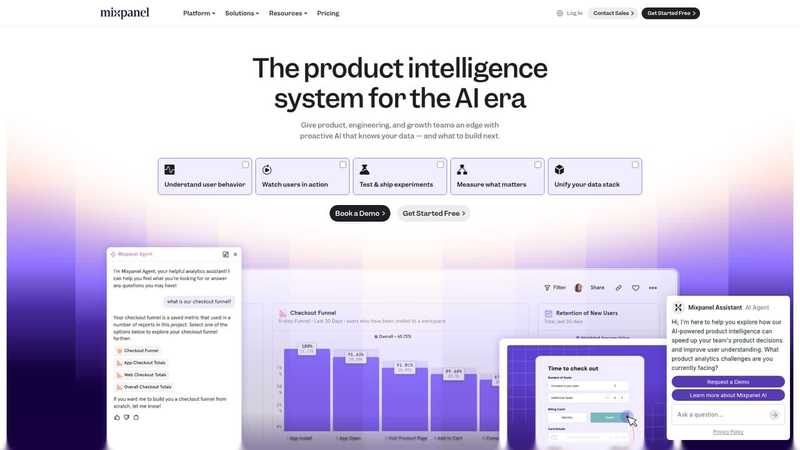
Mixpanel focuses squarely on product analytics, helping teams understand what users actually do inside apps and websites. Explore conversion trends, retention curves, and behavioral segments in seconds, even without a dedicated data team. The platform handles billions of events monthly while maintaining sub-second query speeds.
The AI layer, branded as Mixpanel AI, works proactively. Rather than waiting for you to ask questions, it surfaces anomalies and insights before you notice them. You can also type questions in plain language and receive actionable answers, which dramatically lowers the barrier for non-technical stakeholders.
Three features deserve special attention:
- Metric Trees let you map KPIs to their underlying drivers visually, so the entire organization agrees on what moves the needle
- A/B testing connects directly to real product metrics rather than vanity proxies
- Session Replay and heatmaps reveal exactly where friction lives in your user experience
Integration flexibility keeps things open. Mixpanel connects natively with BigQuery, Segment, Redshift, and reverse ETL tools. No proprietary lock-in, no forced migration. A community of 12,000+ peers supplements the official documentation, tutorials, and free courses.
On the compliance side, Mixpanel holds SOC 2 Type II and ISO 27001 certifications, supports HIPAA-ready environments, and provides SSO/SAML alongside detailed audit logs. Enterprise clients get dedicated strategic guidance and premium support channels for complex deployments.
Piwik PRO
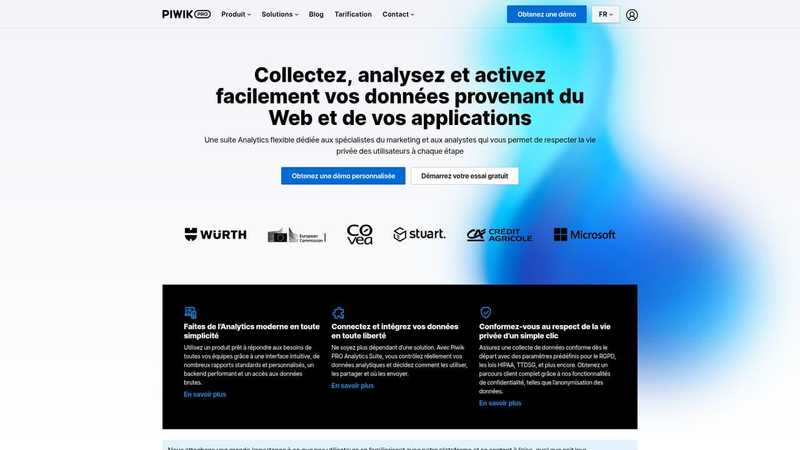
Piwik PRO positions itself as the EU-based alternative for organizations that need full control over their analytics data while staying independent from American tech giants. The platform bundles website analytics, mobile app tracking, a tag manager, a consent manager, and a customer data platform into one suite.
How does the setup process work in practice? Marketing teams can deploy and test new tags without involving IT, thanks to the integrated tag management system. A dedicated Shopify application extends the platform to e-commerce with advanced analytics baked in. Standard and custom reports arrive with unsampled data, giving you the complete picture rather than statistical approximations.
Privacy compliance ships ready out of the box. Predefined settings cover GDPR, HIPAA, TTDSG, and other regional frameworks. The consent manager handles visitor preferences, while data anonymization and rights request workflows keep you audit-ready from day one.
Real-world results back up the claims. SVC, one of Piwik PRO's clients, reported a 12.8% improvement in service quality after activating behavioral data for experience optimization. That kind of measurable outcome separates this platform from tools that promise personalization but leave you guessing about impact.
Training and support come included with Business and Enterprise plans. The learning curve stays manageable because the interface mirrors familiar analytics conventions, yet offers enough customization depth for advanced segmentation and full customer journey analysis.
Amplitude
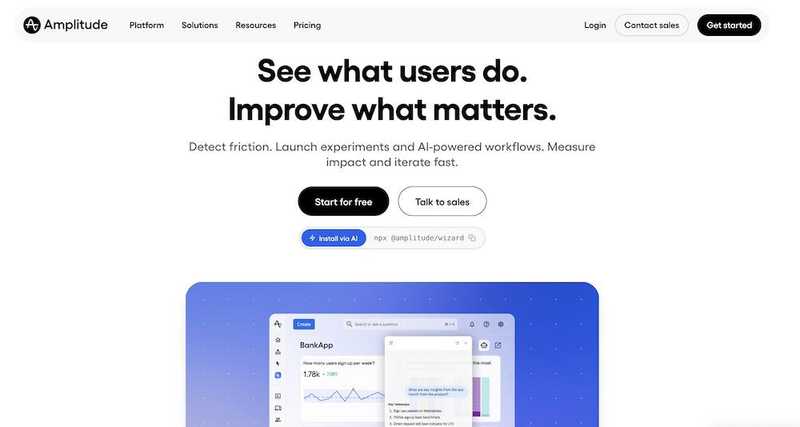
Amplitude earned recognition from Forrester as a Leader with the highest scores across 21 evaluation criteria, and the platform backs that up with an AI-first approach to digital analytics. It combines product analytics, web analytics, session replay, and experimentation inside a single environment.
Getting started costs nothing for teams under 10,000 monthly users. That free tier includes enough functionality to validate whether the platform fits your workflow before committing budget. Larger deployments benefit from 24/7 AI-powered support that detects and diagnoses data issues automatically.
The feature set goes beyond passive reporting. Amplitude lets you run web A/B tests, experiment with feature rollouts, and personalize in-app messages through guides and surveys. AI-generated comments transform raw customer feedback into prioritized action items, which saves product managers hours of manual synthesis.
One differentiator catching attention in 2026 is the MCP integration. This allows teams to query Amplitude insights directly from Claude, Cursor, or other AI platforms, embedding analytics into the tools people already use daily. A separate AI visibility feature reveals how language models describe your brand, which opens an entirely new dimension of brand monitoring.
Data governance controls keep everything organized with granular permissions and guardrails that maintain accuracy across global teams. The platform specifically aims to break down silos between product, marketing, and engineering, consolidating decisions around shared behavioral data rather than scattered spreadsheets.
Fathom Analytics
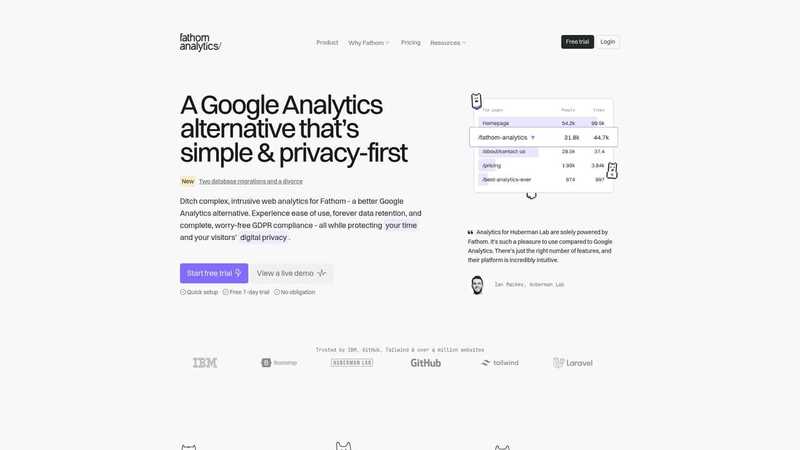
Fathom Analytics appeals to site owners who want accurate visitor data without compromising speed or privacy. The entire tracking script weighs just 2 KB, making it one of the lightest options available. Setup takes one line of code, works with any framework or CMS, and runs in minutes with zero technical prerequisites.
Pricing starts at $15 per month after a 7-day free trial. That simplicity extends to the dashboard: a clean, intuitive interface that filters out bots, scrapers, and spam automatically. You only see real human visits, which eliminates the inflated numbers that plague many analytics setups.
What about staying informed without logging in? Fathom sends automated email reports weekly or monthly, summarizing your key metrics. Custom event tracking covers newsletter signups, button clicks, e-commerce sales, and UTM-tagged campaigns that map traffic sources directly to revenue.
Privacy compliance spans GDPR, CCPA, ePrivacy, and PECR. The platform anonymizes IP addresses, stores no personal visitor data, and avoids cookies entirely. That means you can skip the cookie consent banner, which removes friction for visitors and simplifies your compliance burden simultaneously.
Two details stand out for long-term reliability. Fathom retains your data for 20 years, far exceeding most competitors. And the team remains fully independent with no external investors, which reduces the risk of sudden pivots or acquisitions. Over one million sites already rely on the platform, including Fortune 100 companies that value the privacy-first architecture.
FAQ
How do you choose the right analytics platform for your website?
Start by clarifying your primary objective. Do you need basic traffic metrics, or deeper behavioral analysis like funnels, retention, and session replays? That distinction narrows the field fast.
Then weigh budget constraints against feature depth. Lightweight tools cost less but sacrifice advanced capabilities. Enterprise platforms offer granular customization but demand bigger teams and budgets to operate effectively.
What does GDPR compliance mean for analytics tools?
A GDPR-compliant platform processes visitor data according to European privacy regulations. This typically involves data anonymization, consent management, and clear policies on data storage location.
The All-in-One Platform for Effective SEO
Behind every successful business is a strong SEO campaign. But with countless optimization tools and techniques out there to choose from, it can be hard to know where to start. Well, fear no more, cause I've got just the thing to help. Presenting the Ranktracker all-in-one platform for effective SEO
We have finally opened registration to Ranktracker absolutely free!
Create a free accountOr Sign in using your credentials
Some tools go further by operating without cookies entirely, which eliminates the need for consent banners. Check whether the provider stores data on EU-based servers and holds certifications like ISO 27001 or SOC 2.
Can you migrate historical data when switching analytics platforms?
Several platforms offer direct import tools for previous analytics data, particularly from Google Analytics. This preserves your historical benchmarks and trend comparisons during the transition.
Not every tool supports this feature, though. Before committing, verify whether the new platform accepts data imports and what formats it requires. A smooth migration avoids the reporting blind spot that often accompanies platform switches.
How much do analytics alternatives typically cost?
Pricing models vary widely. Some platforms offer permanent free tiers for self-hosted setups or low-traffic sites. Others charge based on monthly pageviews or tracked users, starting from around $15 per month.
Enterprise solutions rarely publish transparent pricing and require direct negotiation. Factor in hidden costs like premium support, additional integrations, or advanced features locked behind higher tiers.
Do privacy-focused analytics tools sacrifice data accuracy?
Not necessarily. Many privacy-first platforms deliver unsampled, complete data that actually surpasses the accuracy of tools relying on cookie-based tracking. Ad blockers and consent banners reduce data capture for traditional analytics, creating gaps.
Cookieless tracking methods use anonymized identifiers and aggregated metrics to maintain accuracy. The trade-off usually involves fewer individual-level insights, but aggregate reporting and trend analysis remain reliable and often more complete.

