
Intro
Running one website is hard enough. But when you’re running five, each with its own brand, its own team, and its own content — this is where things get messy fast.
If you're an agency juggling multiple client brands or a growing business that's picked up a few sub-brands along the way, you likely know how it feels:
Content lives in different systems, nothing is reusable, and every campaign turns into a scavenger hunt.
A headless CMS can fix a lot of that. But not every headless platform is built for the multi-brand life.
Some work perfectly fine with a single site and crack the moment you add a second brand with different rules.
This post explains what actually makes a CMS good for multi-brand setups, the five platforms worth your time looking into in 2026, and how to pick one without a six-month evaluation.
The All-in-One Platform for Effective SEO
Behind every successful business is a strong SEO campaign. But with countless optimization tools and techniques out there to choose from, it can be hard to know where to start. Well, fear no more, cause I've got just the thing to help. Presenting the Ranktracker all-in-one platform for effective SEO
We have finally opened registration to Ranktracker absolutely free!
Create a free accountOr Sign in using your credentials
Let's get into it.
Why multi-brand content breaks most CMS platforms
Most CMS tools are built with one brand, one site, one team in mind. Multi-brand flips that on its head. Your central team wants consistency, governance, and one bill to pay. Each brand team wants freedom, their own voice, their own content structure, and nobody else touching their stuff.
Try to force that into a single-brand tool, and your outcomes are not looking great.
Either you set up a separate CMS instance per brand, which multiplies your costs, contracts, and headaches. Or you squeeze every brand into one rigid structure and spend your days tending to requests like "why can't we change this one field".
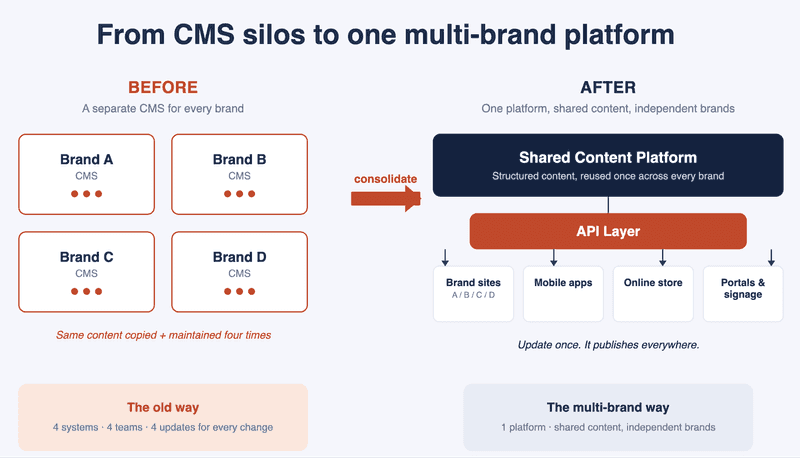
The right multi-brand CMS gives you both at once: shared infrastructure underneath, independent workspaces on top. That's the whole game.
The hidden cost: every acquisition is a CMS decision
For businesses that grow by acquiring brands, the content problem stacks up with every deal. Each new brand enters with its own CMS, its own content structure, its own vendor contract, and its own dev team.
Without a plan, your content landscape diversifies a little more each time, and the "we'll migrate it later" pile just keeps growing.
The All-in-One Platform for Effective SEO
Behind every successful business is a strong SEO campaign. But with countless optimization tools and techniques out there to choose from, it can be hard to know where to start. Well, fear no more, cause I've got just the thing to help. Presenting the Ranktracker all-in-one platform for effective SEO
We have finally opened registration to Ranktracker absolutely free!
Create a free accountOr Sign in using your credentials
That's why onboarding speed and migration flexibility are non-negotiables.
They decide whether an acquired brand goes live on your stack in days or loiters on a separate system for years, while quietly draining budget.
The platforms that win this game let you stand up an isolated space for the new brand right away, then migrate its content type by type on a timeline you control, instead of forcing a risky all-at-once cutover.
If acquisitions are essential for your growth, give this a serious thought. It's the difference between scaling smoothly and inheriting a mess.
What to look for in a multi-brand CMS
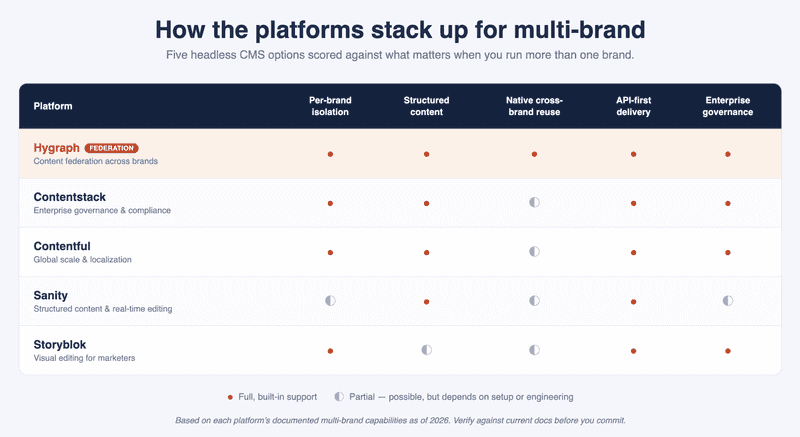
Before you get down to logos, let's get clear on what actually matters. Here's what to look for in a multi-brand CMS:
- Content isolation: Can each brand have its own space, schema, and permissions without affecting the others? This one's non-negotiable.
- Structured content: Content stored as typed fields, rather than page blobs, is reusable across brands and channels. Blob-based content isn't.
- Shared content, done right: Write a legal disclaimer or product spec once, then reuse it across every brand with local tweaks where needed.
- API-first delivery: Every brand's frontend team should query the same API and build with whatever framework they like.
- Governance at scale: Role-based access so brand editors only touch their own content, plus SSO and audit logs for the enterprise crowd.
- Onboarding speed: Adding a brand should be a configuration task, not a three-month procurement project.
Keep this list handy. It's the stick we measure for everything below with.
The five headless CMS platforms worth shortlisting
Every vendor claims to be the best. Here's the honest breakdown of who's actually built for multiple brands, and who fits which situation.
Hygraph
Hygraph's entire pitch is multi-brand, and it shows. It's GraphQL-native, so every content type you define is automatically available through one type-safe API, with no custom delivery layer to build.
Its standout feature is content federation: you run a single instance while each brand gets an isolated content space with its own schema, permissions, and workflows. Think of it like a monorepo for content, unified infrastructure with independent workspaces.
That structure really pays off during acquisitions.
When you pick up a new brand, you provision a content space in minutes and migrate legacy content incrementally through the Management API, all while the old site stays live. No big-bang cutover, no forced schema alignment on day one.
Who is Hygraph best for: enterprises and agencies managing several brands who want central control without stripping autonomy from brand teams.
Contentstack
Contentstack leans hard into enterprise governance and multi-brand ecosystems. It co-founded the MACH Alliance (the group behind the microservices, API-first, cloud-native, headless standard) and is a recognized leader in enterprise CMS analyst reports.
If you're in a regulated industry with heavy approval flows and granular permissions, it's built for exactly that world.
On the downside, Contentstack comes with premium pricing and more complexity than a small team needs.
Contentful
Contentful is the enterprise default, powering global brands like IKEA across dozens of markets. Its localization and multi-channel delivery are strong, which matters when your brands span regions and languages.
Two things to know for 2026: Salesforce agreed to acquire Contentful in June (worth watching how that reshapes pricing and roadmap), and the entry price is steep, around $300 a month for the first paid tier, which prices out smaller operations.
Sanity
Sanity treats content like structured data and is a favorite among developers for its "schema as code" approach and real-time collaboration (Adidas and plenty of other big names build on it).
For multi-brand, you can create brand-specific editing experiences on top of one flexible core, but it takes serious engineering investment to get there.
The benefit: a generous free tier with 20 seats that makes it easy to prototype before you buy in.
Storyblok
If marketing autonomy is your priority, Storyblok's visual editor is the best on the market. Drag-and-drop page building with live preview, no developer ticket required.
It's a great fit for marketing-heavy brands and agency clients who want to self-serve.
Watch out: its component-based, web-first approach can feel constraining once content needs to travel across very different channels or brands with unusual structures.
Don't go headless and forget your SEO
Here's the trap nobody warns you about. Going headless hands developers a lot of freedom, but it can quietly wreck your SEO if no one's watching.
Custom frontends mean metadata, structured data, redirects, and page speed are suddenly your team's responsibility, not the CMS's. Multiply that across five brands and small mistakes compound fast.
The All-in-One Platform for Effective SEO
Behind every successful business is a strong SEO campaign. But with countless optimization tools and techniques out there to choose from, it can be hard to know where to start. Well, fear no more, cause I've got just the thing to help. Presenting the Ranktracker all-in-one platform for effective SEO
We have finally opened registration to Ranktracker absolutely free!
Create a free accountOr Sign in using your credentials
So before and after any migration, bake SEO checks into your workflow:
- Run a full technical crawl on every brand site with Ranktracker's Web Audit to catch broken metadata, missing tags, and crawl issues before they tank rankings.
- Track keyword positions per brand with a Rank Tracker so you can spot the exact moment a migration helps or hurts visibility.
- Watch each brand's link profile with a Backlink Checker, because replatforming is precisely when good links break and toxic ones sneak in.
A headless CMS handles your content. Your SEO stack makes sure people actually find it. You need both.
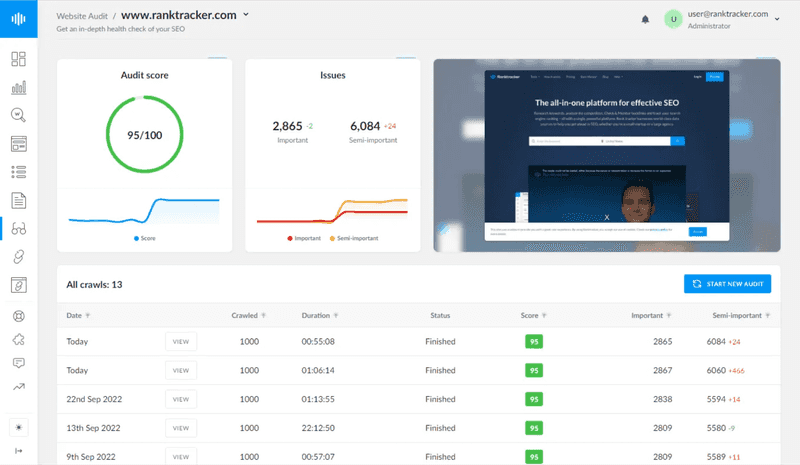
The RankTracker Web Audit tool checks all your on-site SEO factors, identifies issues, and tells you how to fix them. Source
How to choose without a six-month evaluation
Let’s leave the big spreadsheet aside. Do this instead:
- Write down your real content model, the product pages, articles, legal copy, and assets you actually publish, and the fields each one needs.
- Pick your top two platforms from the list above using the scorecard.
- Sign up for their free tiers and rebuild one brand's content model in each.
- Have a non-technical editor from a brand team try to create and update a piece of content. The tool that generates fewer confused questions wins.
Real content, real editors, one week. That beats any feature comparison chart you'll ever build.
Key takeaways
- Multi-brand success comes down to one idea: shared infrastructure with independent brand workspaces.
- Structured, API-first content is what makes reuse across brands and channels possible. Page-blob content isn't.
- Hygraph leads on content federation, Contentstack on governance, Contentful on global scale, Sanity on flexibility, and Storyblok on marketer autonomy.
- Going headless shifts SEO responsibility onto your team, so build audits, rank tracking, and backlink monitoring into every migration.
- Test with your real content model and real editors before committing. One week beats a six-month evaluation.
Ready to consolidate your brands?
If your brands are scattered across separate systems and every campaign feels like herding cats, consolidation is the move that pays off for years. Start by scoring your current setup against the checklist above, then shortlist two platforms and run the one-week test.
If content federation and incremental migration sound like what you need, take a closer look at how Hygraph handles multi-brand at scale. And whatever you land on, don't ship it blind. Run a technical audit on each brand site right after launch so you catch SEO issues while they're still cheap to fix.

