Intro
Market research fails long before the final slide deck. It fails when a team treats a handful of loud comments as a market, repeats a competitor's positioning as fact, or asks an AI model to invent certainty from thin evidence.
Agent Skills can make that process more disciplined. A skill gives an agent a repeatable method: what context to collect, where to look, how to classify findings, and which limitations to disclose. The best ones do not replace researchers; they make weak evidence easier to spot.
I reviewed market-research workflows in NanoSkill's Agent Skills directory, opened the underlying source packages for the leading candidates, and compared them against one practical question: would this skill help a founder, marketer, or product team move from scattered signals to a decision they can defend?
The result is not one magical research agent. It is a compact stack for exploring a market, listening to customers, mapping competitors, testing demand, and documenting what still needs human validation.
Quick Comparison
| Rank | Agent Skill | Best for | Important limitation |
| 1 | Niche Research | Framing a market and finding recurring pains | Broad framework; findings still require primary research |
| 2 | Competitive Analysis | Comparing positioning, messaging, and content | Public evidence can be incomplete or outdated |
| 3 | Product Review Analysis | Extracting customer language and product gaps | Quality depends on a representative review sample |
| 4 | Social Listening | Tracking recent conversations across communities | Popular posts are not the same as representative demand |
| 5 | SEO & GEO Keyword Research | Discovering search-led demand and content opportunities | Free signals do not provide dependable volume or difficulty |
| 6 | Reddit Content Retrieval | Collecting raw posts and comments for analysis | Retrieval still needs coding, deduplication, and interpretation |
| 7 | People Search | Finding buyers, experts, partners, and creators | Requires credits, authorization, and careful privacy compliance |
| 8 | Amazon Sales Estimator | Estimating product-category demand from marketplace proxies | Estimates are not audited sales or general market size |
How I Evaluated the Skills?
I used six criteria: job clarity, visible evidence sources, actionable outputs, honest boundaries around missing data, proportionate setup, and a clear role within a larger research process. No skill received credit for pretending to replace interviews, analytics, or expert judgment.
 ")
")
1. Niche Research — Best Overall for Market Framing
Niche Research is the strongest starting point when the real problem is ambiguity. It prompts the agent to inspect forums, industry sites, events, existing solutions, and the language people use to describe their frustrations. The intended output connects pain points, underserved segments, competitive gaps, and possible go-to-market angles.
The All-in-One Platform for Effective SEO
Behind every successful business is a strong SEO campaign. But with countless optimization tools and techniques out there to choose from, it can be hard to know where to start. Well, fear no more, cause I've got just the thing to help. Presenting the Ranktracker all-in-one platform for effective SEO
We have finally opened registration to Ranktracker absolutely free!
Create a free accountOr Sign in using your credentials
That breadth is useful in the first week of exploring a category. It can turn “we should sell to small businesses” into narrower hypotheses about a particular role, workflow, trigger event, and expensive problem. It also encourages researchers to preserve exact customer language, which is valuable for interview scripts and positioning.
Its weakness is equally important: the source is mostly a comprehensive research framework. It does not automatically make every included example current or verified. Treat its conclusions as a hypothesis map, then confirm the strongest patterns through interviews, observed behavior, and real transaction or usage data.
Best for: Founders, strategists, and marketers deciding which segment or problem deserves deeper investigation.
2. Competitive Analysis — Best for Positioning Intelligence
Competitive Analysis provides a practical structure for comparing companies without collapsing the work into a feature checklist. It covers competitor profiles, messaging, audience, content themes, differentiation, strengths, weaknesses, threats, opportunities, and recommended actions. Its battlecard and messaging-matrix formats make the research easy to share with sales, product, and leadership.
The workflow is strongest when the question is strategic: which claims are crowded, which buyer anxieties are ignored, and where can a brand own a credible point of view? It can also organize evidence from websites, press releases, public interviews, reviews, and trusted secondary sources.
However, public positioning is not the same as operational reality. A competitor may have changed its pricing, product, or target segment yesterday. Private win-loss reasons will not appear on its homepage. Date every important observation, favor primary sources, and separate verified facts from the analyst's inference.
Best for: Messaging refreshes, sales enablement, category strategy, and campaign planning.
3. Product Review Analysis — Best for Voice-of-Customer Mining
Product Review Analysis turns a review corpus into pain themes, praise patterns, requested features, sentiment trends, root-cause hypotheses, and prioritized actions. The source workflow goes beyond positive-versus-negative classification. It asks the agent to connect recurring issues with satisfaction, competitive gaps, product improvements, marketing language, and quality-control priorities.
The All-in-One Platform for Effective SEO
Behind every successful business is a strong SEO campaign. But with countless optimization tools and techniques out there to choose from, it can be hard to know where to start. Well, fear no more, cause I've got just the thing to help. Presenting the Ranktracker all-in-one platform for effective SEO
We have finally opened registration to Ranktracker absolutely free!
Create a free accountOr Sign in using your credentials
That makes it especially useful when a market already has active products and plentiful feedback. Reviews reveal the words customers use after spending money, the compromises they accepted, and the moments that caused delight or regret. Those signals can improve product requirements, landing-page copy, onboarding, and support content.
The risk is sample bias. Reviewers are self-selecting, platforms filter what is visible, authenticity varies, and one star rating can hide several different causes. Keep source text attached to every theme, record the sample and period, and compare reviews across products and channels before generalizing.
Best for: Product teams, e-commerce brands, marketers, and researchers studying mature categories.
4. Social Listening — Best for Fast-Moving Conversations
Social Listening is designed to capture what communities have discussed recently across sources such as Reddit, Hacker News, GitHub, YouTube, X, and TikTok. It can rank conversations by engagement, surface recurring questions, and package the findings into a brief that is easier to scan than dozens of open tabs.
This is useful when timing matters. A monthly research report may miss a new objection, emerging phrase, regulatory concern, or competitor launch. Recent discussion can also expose the difference between the language a company uses and the language its audience naturally uses.
Coverage varies by platform and setup, though. Some sources are easier to access than others, and engagement is a popularity signal rather than a representative sample. A controversial post may outperform a common but quiet problem. Use social listening to discover themes and participants, then validate frequency and business impact elsewhere.
Best for: Trend monitoring, campaign discovery, community research, and rapid briefing.
5. SEO & GEO Keyword Research — Best for Search-Led Demand
SEO & GEO Keyword Research connects brand context with autocomplete, community questions, competitor gaps, search intent, topic clusters, and opportunities to be cited in answer engines. Its process moves from discovery to prioritization and a content plan, so the output can feed editorial strategy instead of becoming an unused keyword spreadsheet.
Search behavior is valuable because it records needs people actively express. Query variants can reveal different levels of awareness, use cases, comparisons, and objections. The skill is also helpful for grouping scattered phrases into problems a team can address with one strong resource.
The boundary is data quality. Free suggestions can reveal language but not trustworthy volume, difficulty, conversion value, or search-result composition. GEO scores are editorial judgments, not measured visibility. Validate priority terms using first-party search data, a reputable keyword source, and manual review of the live results.
Best for: Content strategists, SEO teams, category educators, and founders testing how demand is expressed.
6. Reddit Content Retrieval — Best for Collecting Raw Community Evidence
Reddit Content Retrieval is narrower than a social-listening system, and that is its advantage. It retrieves public posts, comments, subreddit information, and user activity through Reddit's public JSON endpoints, with filters for query, sorting, and time period. Researchers get source-level material instead of an opaque trend summary.
That makes the skill useful for building a transparent evidence set. You can collect threads around a problem, preserve context, label recurring themes, and revisit the original discussion when an interpretation is challenged.
Retrieval is only the first step. Reddit communities have distinctive norms and demographics; duplicate opinions can appear across threads; irony is easy to misclassify; deleted or edited content complicates analysis. Define inclusion rules, remove duplicates, code the material consistently, and avoid treating a subreddit as a census of the market.
Best for: Qualitative researchers and content teams that want traceable community evidence.
7. People Search — Best for Expert and Buyer Discovery
People Search adds a human layer to desk research. Its workflow supports business contacts, company research, creator or key-opinion-leader discovery, and enrichment. That can help a researcher identify interview candidates, map buying committees, find specialist perspectives, or build a relevant outreach list.
This belongs in a market research stack because the fastest way to challenge a weak hypothesis is often to speak with someone who lives the problem.
It also carries the highest governance burden in this ranking. Enrichment may require paid credits and authenticated services. Personal information must be handled lawfully, minimally, and for a legitimate purpose. Verify current roles, respect platform terms, provide an easy opt-out, and never confuse a prospect list with a representative research sample.
Best for: Interview recruitment, expert discovery, partner research, and account planning.
8. Amazon Sales Estimator — Best for Directional Product-Market Sizing
Amazon Sales Estimator uses signals such as best-seller rank, product identifiers, category assumptions, prices, and keyword results to estimate unit sales, revenue, market size, and concentration. It can compare products across marketplaces and provide a fast directional view of a physical-goods niche.
This is helpful when the question is not “what do people say?” but “does this category appear commercially meaningful?” A rough estimate can help prioritize which products, price bands, and competitors deserve closer analysis.
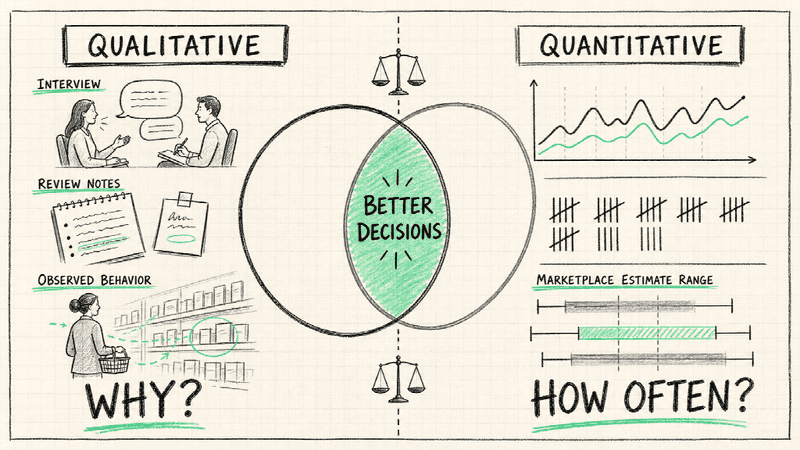
The word estimate must remain visible. Best-seller rank is a proxy, formulas vary by category and marketplace, and listings can change quickly. Amazon activity also does not measure offline sales or the full market. Record assumptions, use ranges rather than false precision, and cross-check against retailer, distributor, survey, and company data before making an investment decision.
Best for: E-commerce operators and product researchers screening physical-goods opportunities.
The Market Research Stack I Would Actually Use:
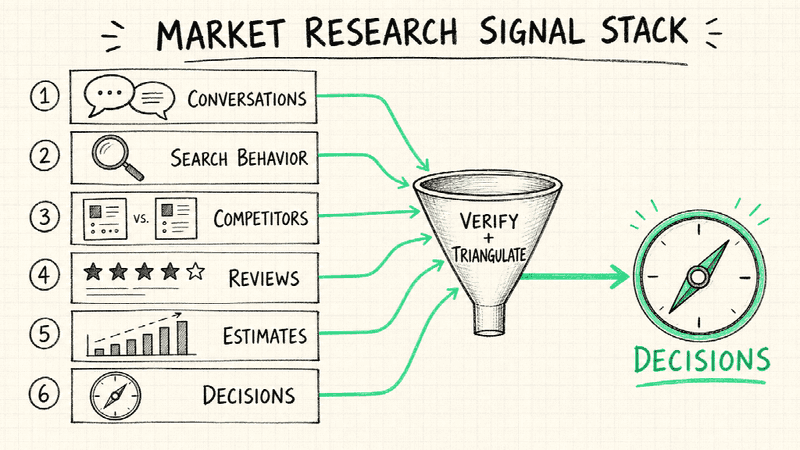
Installing all eight skills at once creates duplicated instructions and inconsistent assumptions. A smaller sequence is easier to review:
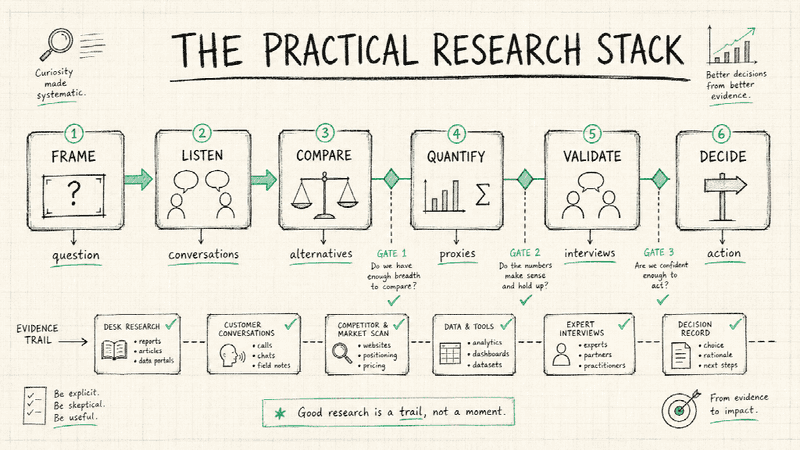
- Frame the question with Niche Research. Define the audience, job, trigger, alternative, and decision the research must support.
- Collect recent language with Social Listening or Reddit Content Retrieval. Preserve dates, source context, and contrasting opinions.
- Map alternatives with Competitive Analysis. Distinguish company claims from customer evidence and analyst inference.
- Mine customer outcomes with Product Review Analysis. Look for recurring pains, praise, switching reasons, and unmet needs.
- Estimate expressed demand with SEO & GEO Keyword Research or Amazon Sales Estimator. State the proxy and its limitations.
- Recruit people with People Search, then validate. Interview customers, lost prospects, frontline teams, and domain experts before committing.
The All-in-One Platform for Effective SEO
Behind every successful business is a strong SEO campaign. But with countless optimization tools and techniques out there to choose from, it can be hard to know where to start. Well, fear no more, cause I've got just the thing to help. Presenting the Ranktracker all-in-one platform for effective SEO
We have finally opened registration to Ranktracker absolutely free!
Create a free accountOr Sign in using your credentials
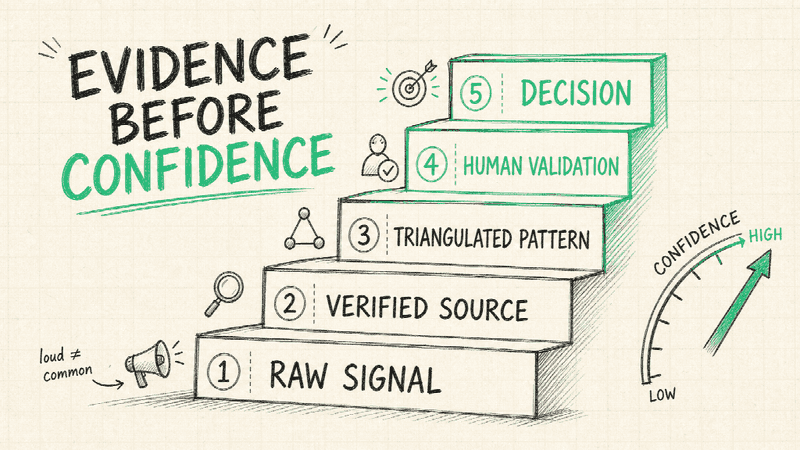
The final deliverable should include an evidence table, not only a polished narrative. For every important conclusion, record the source, date, sample, observation, interpretation, confidence level, and next validation step. That makes disagreement productive because reviewers can challenge the evidence or reasoning instead of debating prose.
What Market Research Agent Skills Cannot Replace?
An Agent Skill is a method, not automatic access to truth. It cannot create representative survey data, confidential win-loss interviews, product analytics, reliable market size, or first-hand customer experience unless those inputs are provided. It also cannot decide how much risk an organization should accept.
Human researchers remain essential for choosing the right question, noticing contradictions, obtaining informed consent, interpreting culture, and recognizing when an efficient answer is answering the wrong problem. The agent should accelerate collection and organization while keeping the evidence trail visible.
What to Check Before Installing?
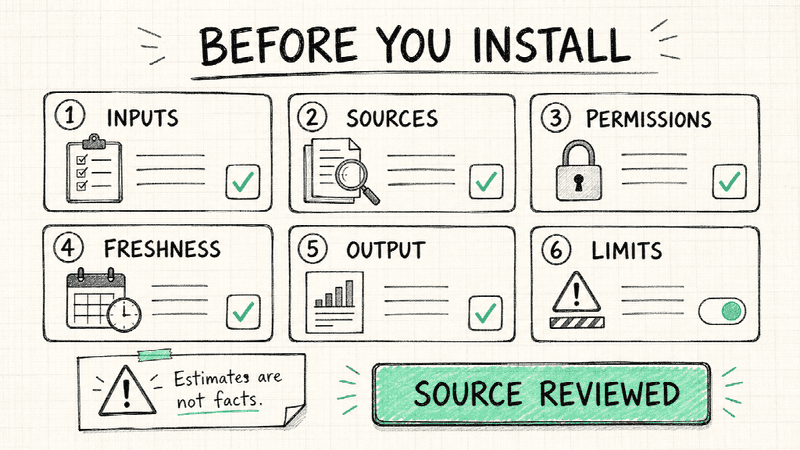
Read the complete source package, not only the listing. Check referenced files, scripts, licenses, recent changes, external services, credentials, and commands. Decide which data the skill can access and whether it sends information to a third party. Confirm how freshness is handled, what happens when a source is unavailable, and whether the output labels estimates and inferences.
Final Verdict
Niche Research is the best overall starting point because it helps define what the team is actually trying to learn. Competitive Analysis and Product Review Analysis are the strongest next steps for understanding alternatives and customer outcomes. Social Listening and Reddit Content Retrieval add freshness and traceability, while keyword research and marketplace estimates add directional demand signals. People Search closes the loop by helping researchers find the humans who can prove the desk research wrong.
The better strategy is not to ask one agent for “complete market research.” Build a short, auditable chain in which every skill has one job and every important conclusion has a source, limitation, and validation step. To assemble that chain, compare practical Agent Skills with NanoSkill, inspect their source packages, and install only the methods your team can verify.