10+ Semrush Alternatives: Top Picks by Features, Usability, and Pricing
Semrush is one of the OG pioneers of the SEO industry.
It’s packed with data. And for many a marketer, it can replace an entire tech stack.
But for some, it’s just too expensive. Or too complex.
Luckily, there are tons of Semrush alternatives to choose from. And in this guide, we’ll compare them in terms of features, usability, and pricing.
What Makes a Semrush Alternative Worth Your Time and Money?
1. Feature depth vs. feature overload
More features ≄ better product.
Feature depth matters for SEO agencies. You may need advanced reporting. Competitor tracking. Backlink monitoring. Site audits. Keyword data across several campaigns.
A tool with in-depth local SEO features can play a huge role in decision-making for lawyers like AJ Law, based in Phoenix, for example:
The All-in-One Platform for Effective SEO
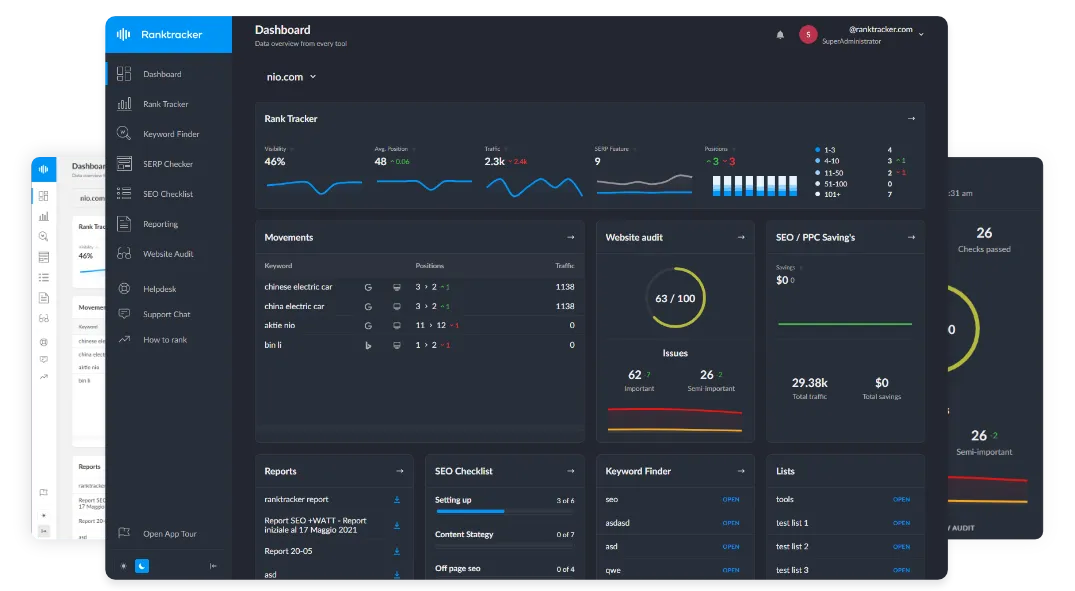
Behind every successful business is a strong SEO campaign. But with countless optimization tools and techniques out there to choose from, it can be hard to know where to start. Well, fear no more, cause I've got just the thing to help. Presenting the Ranktracker all-in-one platform for effective SEO
We have finally opened registration to Ranktracker absolutely free!
Create a free accountOr Sign in using your credentials
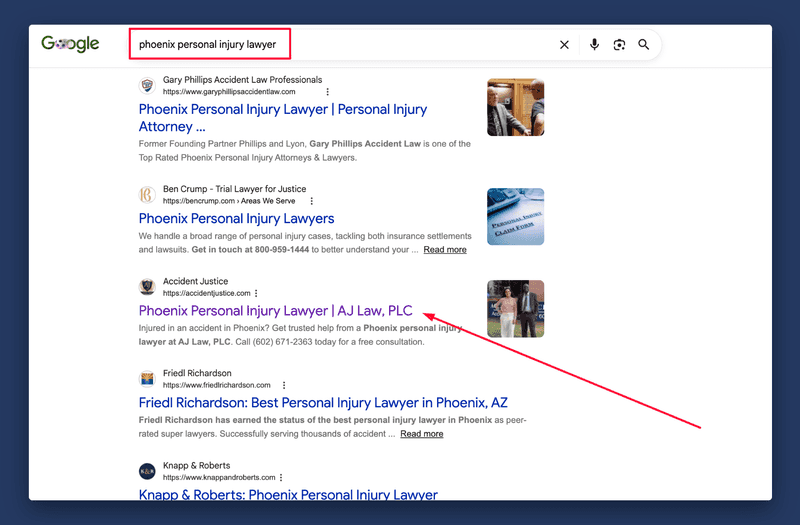
Local SEO matters for mom-and-pop shops, lawyers, and other local businesses. Search results can vary drastically between “personal injury lawyer” and “Louisville personal injury lawyer.”
In that case, an all-in-one platform can save time and keep your workflow organized. But bloggers, freelancers, and small business owners usually don’t need all that.
Keyword research, basic rank tracking, and a clear view of what’s working on your site are typically enough.
2. Data quality
True: SEO tools are only as useful as the data behind them.
Also true: no SEO tool has perfect data.
All of them use their own databases, crawlers, clickstream sources, algorithms, and estimation models.
The All-in-One Platform for Effective SEO
Behind every successful business is a strong SEO campaign. But with countless optimization tools and techniques out there to choose from, it can be hard to know where to start. Well, fear no more, cause I've got just the thing to help. Presenting the Ranktracker all-in-one platform for effective SEO
We have finally opened registration to Ranktracker absolutely free!
Create a free accountOr Sign in using your credentials
That means** the numbers _won’t _match across tools.**
One platform might say a keyword gets 1,200 searches per month. Another might say 900. Another might say 2,000.
The real question is whether the tool helps you make smart decisions.
- Can it help you spot keyword opportunities?
- Understand which competitors are gaining ground?
- Find backlink gaps?
- Catch technical issues before they hurt performance?
- Track whether your rankings are moving in the right direction?
3. Usability
Is the tool a pain to use?
If so, you’ll probably use it for a little while, and then your subscription becomes a donation to the company.
You invest in SEO tools because they’re supposed to help you make better decisions. If it doesn’t do that, it’s creating friction.
4. Pricing structure
No one likes surprises when it comes to spending money.
Unfortunately, many SEO tools don’t seem to have picked up on that yet.
The number on the pricing page is usually just the starting point. Just a few things that can hike up the number at checkout are usually:
- Extra users
- More projects
- Additional tracked keywords
- Historical data
- API access
- White-label reports
- Local SEO features
- AI credits
So it’s critical to understand what you’re actually paying for.
Don’t compare pricing based on the lowest advertised plan alone. Compare it based on your real workflow.
5. Best-fit use case
Out of all the goodies that most SEO tools like Semrush offer, identify which function will move the needle the farthest before you start investigating options.
It could be a backlinking tool.
Keyword research.
PPC research.
Audits.
Competitor analysis.
The list goes on.
When push comes to shove, this #1 should be the tie-breaking factor that helps you decide which alternative to choose.
Can You Use Free Tools Instead of Semrush?
Yes, you can use free tools instead of Semrush. Up to a point.
Google Search Console, Google Analytics, and Google Keyword Planner are free alternatives to Semrush.
You can see how your site is performing, which queries drive clicks, which pages get traffic, and which keywords may be worth targeting.
For a beginner, that should be enough to start making better SEO decisions.
But for one, they’re usually more difficult to use.
And two, they definitely don’t give the same depth of research. Certain features don’t exist. Like competitor research, backlink analysis, rank tracking, site audits, or reporting features.
You’ll spend more time piecing data together manually.
Quick Comparison Table: Best Semrush Alternatives
| Tool | Best For | Starting Price | Main Strength | Potential Drawback |
| Ahrefs | Backlinks + competitive SEO | $29/month Starter; Lite starts at $129/month | Strong backlink and keyword data | Can get expensive for heavier use |
| Ranktracker | Rank tracking + affordable SEO workflows | Pricing varies by plan and usage | Daily keyword tracking, SERP insights, audits, and backlink monitoring | Not as broad as Semrush for PPC, social, or content marketing |
| Moz | Beginners + trusted SEO metrics | Around $49–$99/month | Easy SEO learning curve | Less deep for PPC and advanced competitor research |
| SpyFu | PPC and competitor research | $39/month monthly; lower annually | Competitor keyword and ad intelligence | Not as broad as Semrush |
| Ubersuggest | Low-cost SEO basics | $29/month+ | Affordable and beginner-friendly | Less advanced data depth |
1. Ahrefs — Best for Backlink Analysis and Serious SEO Research
Ahrefs is the closest alternative to Semrush for serious SEO pros.
It’s not a lightweight tool. It’s built to dig deep into backlinks, keywords, competitors, and search visibility.
If link building is a major part of your strategy, Ahrefs is an especially strong candidate.
Its backlink data makes it easier to see who’s linking to your competitors, which pages are attracting links, and where your own site may be losing authority.
But backlinks are only part of the story.
Ahrefs also offers robust keyword research, rank tracking, site auditing, competitor analysis, and content research.
This makes it a good fit for SEO teams, agencies, consultants, and content-led businesses that need more than basic keyword ideas.
It’s also moving beyond traditional SEO. Ahrefs now positions itself around visibility across search, AI, content, and social, which matters as brands start tracking how they appear beyond classic Google results.
Pricing starts with the Starter plan at $29/month, while fuller plans like Lite, Standard, and Advanced cost more and come with higher limits.
✅Best for: SEO professionals who care deeply about backlinks and competitive research.
❌Not ideal for: Teams that need Semrush’s broader PPC, social, and content marketing suite.
2. Ranktracker — Best Overall Semrush Alternative for Value
Want practical SEO data without paying for a giant platform you barely use? Ranktracker might be up your alley.
It’s best at (drumroll please) rank tracking. Just a few of the KPIs you can monitor include:
- Keyword positions
- Changes over time
- Rankings across locations
- How your visibility moves in the SERPs
This makes it especially useful for teams that care about measurable SEO progress, not just one-off keyword research.
It also includes **keyword research, SERP analysis, site audits, backlink monitoring, competitor insights, and reporting. **You get a solid SEO workflow in one place, without the heavier feel of Semrush or the hefty price tag.
Ranktracker’s value comes from focus.
It gives you the core features most businesses actually need:
**Find keywords → monitor rankings → audit your site → watch competitors → report on progress. **
You’re not paying for a massive suite of PPC, social media, and content marketing tools if those aren’t part of your process.
✅Best for: Teams that want rank tracking, keyword research, audits, and SEO reporting without Semrush-level complexity.
❌Not ideal for: Marketers who need a broader all-in-one platform for PPC research, social media, and advanced content marketing workflows.
3. Moz — Best for Beginners and SEO Fundamentals
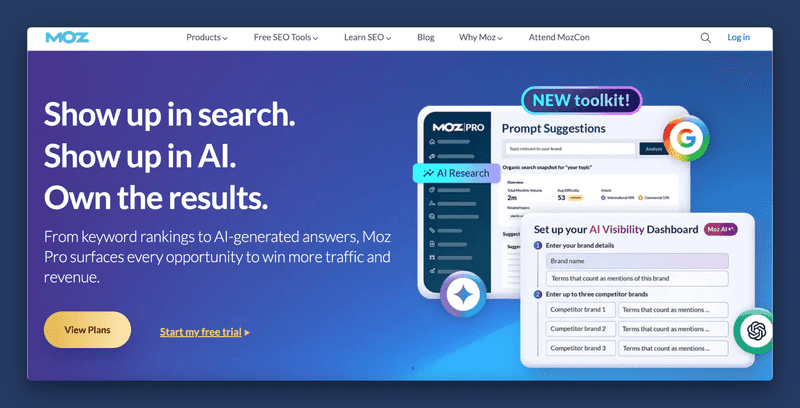
Moz is much easier to learn than Semrush.
It covers the essentials:
- Keyword research
- Rank tracking
- Site audits
- Page optimization
- Competitor insights
You can find keyword opportunities, monitor how your pages move in search, and catch technical issues that may be holding your site back.
Moz is also known for its pioneering SEO metrics, specifically Domain Authority.
While no third-party metric is perfect, Moz’s data can help you understand your site’s strength, link quality, and competitive difficulty without needing to decode a dozen different reports.
The real advantage here is approachability.
Moz has a strong learning ecosystem, which makes it useful for marketers who are still building their SEO confidence. You’re not just handed data. It’s interpreted to guide you on how to use it.
✅Best for: Beginners, small teams, and marketers who want trusted SEO basics without feeling buried.
❌Not ideal for: Advanced PPC research or aggressive competitor intelligence.
4. SpyFu — Best Semrush Alternative for PPC and Competitor Research
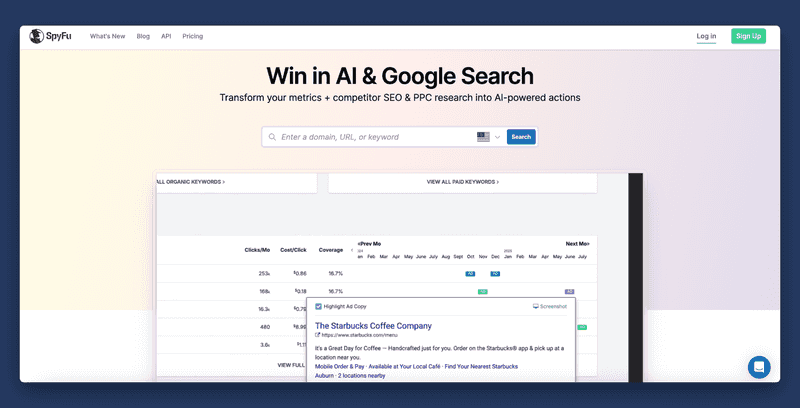
SpyFu is our favorite for stalking competitors (as the name might suggest).
Competitive intelligence is its strength. You can look up competitor keywords, see which terms they rank for organically, and explore the keywords they’re bidding on in Google Ads.
This makes it especially useful if you want to integrate your SEO and PPC strategies rather than treating them as two separate channels.
Take law firms, for example. Rafi Law Firm practices law in Atlanta, and Malone Law throughout the state of Georgia. There is a lot of keyword overlap between these two, so a tool like SpyFu would help them keep tabs on each other (as competitors) and identify opportunities for one to outperform the other.
SpyFu is also helpful for historical research.
You can see how competitors’ keyword rankings and ad strategies have changed over time, which gives you more context than a single snapshot. This helps you spot patterns, find gaps, and avoid chasing keywords that may not be worth the spend.
It’s not as broad as Semrush. You won’t get the same full ecosystem for content marketing, technical SEO, social media, and large-scale reporting.
But that’s also part of the appeal. It’s focused, fast, and usually more affordable than many all-in-one SEO platforms.
✅Best for: Marketers who care about competitor keywords, paid search insights, and quick strategic research.
❌Not ideal for: Teams that need a full content, technical SEO, social, and reporting ecosystem.
5. Ubersuggest — Best Budget Semrush Alternative
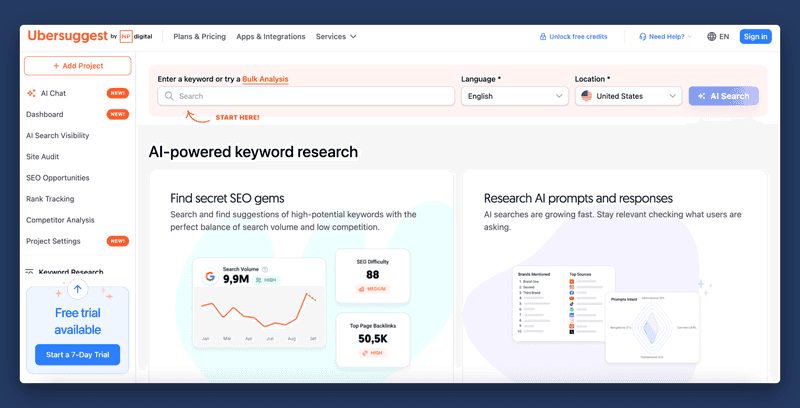
If price is your biggest concern, Ubersuggest might be for you.
It’s not the most advanced on this list, but** it covers the basics well.**
You can research keywords, run site audits, track rankings, view competitor snapshots, and get content ideas from a simple dashboard that doesn’t feel overwhelming.
The biggest selling point is **affordability. **Plans typically sit in the lower-cost range compared with many major SEO platforms.
That said, it’s better as a starting point than a long-term enterprise SEO solution.
✅Best for: Solopreneurs, bloggers, creators, and small businesses starting SEO.
❌Not ideal for: Advanced agencies or teams that need deep technical, backlink, or enterprise-grade reporting.
6. Rankability — Best for AI Search Visibility and Content Optimization
Rankability is a strong Semrush alternative for agencies that want to manage traditional SEO and emerging AI search visibility from one platform.
It brings together keyword and content research, rank tracking, technical and page-level audits, backlink analysis, content creation, and reporting. The difference is its focus on helping brands appear not only in Google, but also in AI-generated answers. Its tracking tools monitor rankings, brand mentions, citations, competitors, and share of voice across traditional search and platforms such as ChatGPT, Gemini, Perplexity, and Google AI Overviews.
Its content workflow is another major selling point. Rankability can analyze both Google results and sources cited by AI platforms, then use those findings to create briefs, generate drafts, identify topical gaps, and optimize existing pages. Teams can also ground drafts in a client knowledge base so that services, proof points, and differentiators reflect the actual business rather than generic AI output.
Rankability is particularly well suited to agencies managing multiple campaigns. It includes client-facing reporting and Serena, an AI search consultant that uses connected website, Search Console, and Google Business Profile data to recommend next steps.
Published plans start at $99 per month, with higher-credit plans available for larger workloads and an Agency tier listed at $799 per month. Since usage is credit-based and the platform is designed primarily around agency workflows, it may be more than a freelancer or small business needs for occasional keyword research.
The All-in-One Platform for Effective SEO
Behind every successful business is a strong SEO campaign. But with countless optimization tools and techniques out there to choose from, it can be hard to know where to start. Well, fear no more, cause I've got just the thing to help. Presenting the Ranktracker all-in-one platform for effective SEO
We have finally opened registration to Ranktracker absolutely free!
Create a free accountOr Sign in using your credentials
✅ Best for: SEO agencies and content teams that want to track and improve visibility across Google and AI search platforms.
❌ Not ideal for: Users who only need inexpensive keyword research or basic rank tracking.
Final Verdict: Which Semrush Alternative Should You Choose?
Before choosing a Semrush alternative, get honest about what matters most. The answer will point you toward the right tool faster than any feature comparison chart.
And don’t choose based on marketing pages alone. Test two or three platforms using the same website, keywords, and competitors.
See which one gives you the clearest next step. That’s the real test.