Intro
The business software landscape has never been more crowded — and paradoxically, never more confusing. Every year brings a fresh wave of all-in-one platforms promising to handle everything from marketing to finance to customer support under a single roof. The pitch is always the same: consolidate, simplify, scale. Yet for many business owners and marketers, the reality of these bloated suites is the opposite of simple. Features go unused, pricing tiers feel punishing, and the tools that were supposed to save time end up demanding it.
What's quietly happening in 2026 is a correction. The most effective operators — the ones actually growing their businesses — are moving away from do-everything platforms and toward purpose-built tools that do one thing exceptionally well. They are choosing depth over breadth. They want software that was designed by people who deeply understand a specific problem, not a feature checklist assembled by a product committee**.**
Nautilus Marketing — London SEO Agency Built Around Communication, Not Just Rankings
Most businesses that have been burned by a digital agency can point to the same two culprits: they never knew what was happening with their campaign, and the agency felt like a faceless production line rather than a partner. Results eventually matter, but the relationship breaks down long before the rankings do.
Nautilus Marketing was built as a direct response to that pattern. Founded after watching digital agencies repeatedly let clients down through poor communication and a lack of personality, the agency set out to offer something the corporate SEO market tends to deprioritise — transparency, genuine involvement, and a team that actually explains what it's doing and why.
The approach is deliberately cross-disciplinary. Rather than treating SEO as an isolated service, Nautilus examines the entire website — design, technical infrastructure, on-page optimisation, and content — which means problems that other agencies miss (or conveniently ignore because they fall outside the retainer scope) get picked up and addressed. The team spans specialists across multiple areas and technologies, so a site audit doesn't stop at keyword gaps; it extends to speed, UX, and structural issues that affect rankings regardless of how good the off-page work is.
The international dimension is a meaningful differentiator. Beyond domestic UK SEO, the agency has developed a specialised international offering for clients with cross-border ambitions — covering multilingual optimisation, hreflang, and cultural adaptation rather than just translating existing content and hoping for the best.
Pricing runs from £299 to £10,000 per month, covering everything from one-time technical audits suited to early-stage startups through to comprehensive ongoing retainers. White label SEO is also available, making the agency a viable behind-the-scenes partner for other agencies that need delivery capacity without building an in-house team.
The All-in-One Platform for Effective SEO
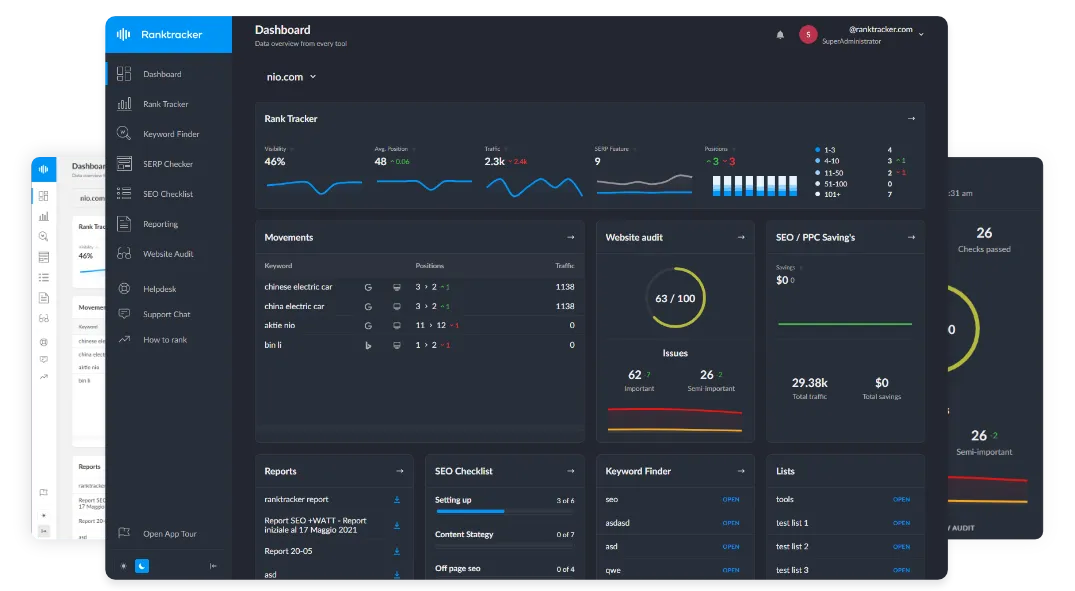
Behind every successful business is a strong SEO campaign. But with countless optimization tools and techniques out there to choose from, it can be hard to know where to start. Well, fear no more, cause I've got just the thing to help. Presenting the Ranktracker all-in-one platform for effective SEO
We have finally opened registration to Ranktracker absolutely free!
Create a free accountOr Sign in using your credentials
Best for: UK small businesses, startups, local and healthcare practices, and companies with international growth ambitions who've outgrown generic agency relationships and want an SEO partner that communicates clearly, works across the full website, and builds a strategy around their specific situation rather than a templated package.
Custom Web Audits — The All-in-One Website Audit Platform Built for Marketing Teams, Not Developers
Most marketing teams don't have a data problem — they have a consolidation problem. SEO health lives in Screaming Frog, performance scores in PageSpeed Insights, accessibility flags in a separate scanner, and AI visibility in whatever tool has bolted that on as a premium add-on this quarter. By the time everything is pulled together into a client report, hours have disappeared and the picture is still incomplete.
Custom Web Audits was built around a single premise: every dimension of website health should live in one report, generated in one place, readable by someone who isn't a developer. Technical SEO, Core Web Vitals, WCAG accessibility compliance, content quality, security, mobile optimisation, CRO signals, and AI visibility assessment all surface in a single audit — delivered in five to fifteen minutes.
That last category is worth singling out. AI visibility analysis — measuring how well a site is positioned to appear in AI-powered environments like ChatGPT, Perplexity, and Google's AI Overviews — is fast becoming a genuine strategic concern, not a novelty. Competitors like Ahrefs have started offering it, but as a $200/month add-on. Custom Web Audits includes it across all plans, which changes the calculus considerably for teams who want it without building a separate line item around it.
The design philosophy is deliberately marketer-first. Every flagged issue comes with a plain-English explanation and a prioritised action step ranked by business impact rather than technical severity — which is the distinction that matters most when someone needs to take findings into a team meeting or hand them to a client. The gap between "here is a wall of crawl data" and "here is what to fix first and why it matters commercially" is where most audit tools leave their users stranded.
For agencies and consultants, white-label reporting on Professional and Agency plans turns audit output into client-ready deliverables without the overhead of stitching together exports from four different platforms. Pricing starts at a one-time $79 Discover package through to $199/month for Scale and $399/month for Professional, with no long-term contracts at any tier.
Best for: Marketing directors, in-house SEO teams, digital agencies, and independent consultants who need a complete website audit without managing a multi-tool stack — and who want findings framed as business priorities rather than a technical punch list requiring a developer to interpret.
LinkPro by Uprankly — End-to-End Link Building & Outreach Automation
Most link builders don't have a tool problem — they have a fragmentation problem. Ahrefs for prospecting, Hunter.io for contacts, Lemlist for outreach, Google Sheets for tracking, and a separate reporting doc for clients. Every campaign starts with an export and ends with a spreadsheet, and data gets lost somewhere in between.
The All-in-One Platform for Effective SEO
Behind every successful business is a strong SEO campaign. But with countless optimization tools and techniques out there to choose from, it can be hard to know where to start. Well, fear no more, cause I've got just the thing to help. Presenting the Ranktracker all-in-one platform for effective SEO
We have finally opened registration to Ranktracker absolutely free!
Create a free accountOr Sign in using your credentials
LinkPro replaces that entire stack in one connected workflow — prospect, enrich contacts, run AI-personalised outreach, and track every placement — without a single export or copy-paste between tools.
The prospecting layer is built on a pre-vetted database of editorial sites, filterable by DR, traffic, and niche, so there are no PBNs or link farms to wade through. One click triggers full enrichment — DR, monthly traffic, verified email, and LinkedIn profile — plus an AI-generated personalised opening line written from the prospect's actual site content, not a generic compliment. That personalisation runs across an entire prospect list at once before a single email is sent, which is where the reply rate improvement comes from.
On the outreach side, sequences are sent from your own Gmail, Outlook, or SMTP accounts with no tool-level sending caps, automatic follow-ups, and smart pausing on reply. Everything that happens after — replies, follow-ups, link placements going live — is tracked in a unified inbox and placement table, with link health monitoring that alerts you if a placed link is removed or switched to nofollow.
For agencies, the client management layer is particularly well thought through. Each client gets a portal to review prospects, approve domains, track their link order, and message directly — all tied to specific links rather than buried in email threads. Branded reports are generated from inside the platform with one click.
The trial costs $7 one-time with no subscription required to start — 200 credits, full access, immediate.
Best for: In-house SEO teams and link-building agencies who want to consolidate a multi-tool stack into one workflow, reduce manual admin, and run personalised outreach at scale without burning their domain reputation on a shared sending infrastructure.
SEO Sandwitch — India's Longest-Running Free Digital Marketing Knowledge Base
Most SEO learners don't have a budget problem — they have a signal-to-noise problem. There are thousands of blogs covering SEO, but most regurgitate the same thin content, chase trending topics for clicks, or gate their best material behind paywalls. Finding genuinely practical, experience-backed SEO education without paying for a course is harder than it sounds.
SEO Sandwitch has been filling that gap since 2012. Built and run by Joydeep Bhattacharya, it positions itself as India's number-one SEO blog and backs that claim with sheer volume — over 1,000 free tutorials across SEO, PPC, social media, content marketing, and broader digital marketing topics. That's not a content marketing play; that's over a decade of consistent publishing.
The coverage is wide by design. Core navigation splits into SEO tips, ecommerce, content marketing, and SEO tools, but the actual article index goes much further — niche-industry SEO guides (HVAC, jewellery, surgeons, franchise, SaaS), city-level agency roundups, salary guides by location, Instagram bio collections, slogan generators, and statistics roundups. It reads less like a focused editorial site and more like a reference library that keeps expanding to cover every tangent a digital marketer might search for.
The free tools section is a quiet differentiator. Alongside the editorial content, the site hosts a range of utility tools — YouTube description and tags generators, a WebP converter, an ROI calculator, a word counter, image enhancer, and more — all free, all built for the same marketer audience reading the blog. It's the kind of supplementary offering that turns a one-time reader into a repeat visitor.
Content velocity is high. The homepage shows multiple posts published on the same day, spanning topics like stopping SEO spam emails, SEO specialist salaries in specific Singapore neighbourhoods, and white-label SEO software roundups. This breadth is clearly a deliberate SEO strategy — target long-tail, location-specific, and niche-industry queries at scale.
Best for: Digital marketers, SEO beginners, and small business owners in South Asia (and beyond) who want free, practical SEO education without a subscription, a course fee, or a paywall — and who benefit from a single destination that covers tools, agency directories, and how-to guides across almost every niche and geography.
Online Money Spinner — Digital Growth, SEO Tools & Web Hosting Reviews
Most review sites chase clicks with listicles. Online Money Spinner is built around something more deliberate: helping creators, bloggers, and digital entrepreneurs make smarter decisions about the tools that power their online businesses.
The site covers a wide but focused range of topics — SEO software, content tools, keyword research platforms, and web infrastructure — with each review grounded in hands-on analysis rather than spec-sheet comparisons. Whether it's a deep dive into on-page SEO plugins like
SEOPressor, trend intelligence tools like Glimpse, or scalable web hosting solutions for growing sites, the editorial approach is consistent: surface the real-world implications, not just the feature list.
What sets Online Money Spinner apart is its willingness to serve readers at different stages of sophistication. A solo blogger researching their first hosting plan and an experienced digital marketer evaluating enterprise SEO platforms will both find content calibrated to their level. The team openly acknowledges the gaps between what tools promise and what they actually deliver — noting, for instance, where a cheaper plan's limitations will hurt you as traffic scales, or where a tool's learning curve outweighs its upside.
The site also offers professional services to help readers act on what they've learned, bridging the gap between research and execution.
Best for: Bloggers, content creators, and online entrepreneurs who want independent, experience-backed reviews of the tools and platforms they rely on to build and grow a digital business.
StackMention — Curated Directory for AI & SaaS Tool Discovery
Most people building a modern tech stack don't have a research problem — they have a fragmentation problem. Useful tools are scattered across Product Hunt, Reddit threads, Twitter recommendations, and dozens of niche review sites. By the time you've compared five options across three different tabs, you've lost an hour and still aren't sure what to pick.
StackMention addresses this by curating and organising AI tools, SaaS products, and digital solutions across multiple niches — including marketing, productivity, SEO, development, design, business, and automation — so users can discover, compare, and evaluate the right tools without spending hours researching across multiple websites.
Every listing is verified and categorised accurately, with enough context so visitors know exactly how a tool can help them — a deliberate choice that separates it from raw aggregators that dump thousands of unvetted submissions into a searchable list and call it a directory.
The positioning has a dual audience baked in from the start. For users, it's a free discovery layer. Browsing is completely free, with a stated mission of making software discovery and comparison accessible to everyone. For founders and product teams, it's a distribution channel: listing a product on StackMention offers visibility, backlinks, and organic traffic from audiences actively searching for software — a pitch that appeals to early-stage startups looking for directory-based SEO without the noise of larger platforms.
The platform is still early-stage, and the concept is promising — the interface is clean, categories are well-organised, and the curation bar means the listings that are there tend to be worth finding. What it currently lacks is depth: reviews, head-to-head comparisons, and editorial context are thin, which limits how far a user can get before needing to leave the site to make a real decision.
Best for: Founders wanting directory-based SEO exposure for a new AI or SaaS product, and marketers or developers who want a single curated starting point for tool discovery — particularly in the AI and automation space — without wading through thousands of low-quality submissions.
Pearl Lemon — SEO-Led Digital Marketing and Lead Generation for Businesses That Want Faster Growth
Most businesses do not struggle because they are missing one marketing tactic. They struggle because their SEO, content, lead generation, PR, and sales activity are not connected. One team may be working on rankings, another on outreach, and another on paid campaigns, but without one clear growth system, it becomes difficult to understand what is actually driving traffic, leads, and revenue.
Pearl Lemon helps solve that problem with a digital marketing model built around SEO, lead generation, PPC, link building, technical SEO, content marketing, and broader growth support. The agency is especially known for combining organic search visibility with direct lead-generation strategies, making it a strong fit for companies that want more than just traffic. Instead of focusing only on rankings, Pearl Lemon connects SEO performance with qualified leads and business growth.
The SEO side is one of Pearl Lemon’s strongest areas. The agency works on technical SEO, local SEO, link building, content marketing, and search visibility across different markets. This is useful for businesses that need a stronger organic presence but also want their content and landing pages to support actual conversions, not just impressions or keyword rankings.
Pearl Lemon also supports acquisition through lead generation, PPC, digital PR, and outreach-based campaigns. This makes the agency useful for B2B companies, service businesses, SaaS brands, and growth-focused teams that need both inbound and outbound marketing support. Its lead generation work includes helping businesses build sales pipelines, reach decision-makers, and turn marketing visibility into real opportunities.
Another important part of Pearl Lemon’s positioning is its global and remote-first structure. The company serves businesses across the UK, U.S., and other markets, with services available for companies that need flexible digital marketing support across regions. This gives Pearl Lemon a broader growth-agency feel rather than the structure of a traditional local SEO vendor.
Best for: B2B companies, service-based businesses, SaaS brands, ecommerce companies, and growing organizations that want an SEO-focused digital marketing agency capable of combining organic traffic, lead generation, PPC, link building, content marketing, and digital PR into one performance-driven growth strategy.
Link My Books — Ecommerce Bookkeeping Automation for Amazon, Shopify & Marketplace Sellers
Most ecommerce businesses don’t really have an accounting problem — they have a reconciliation problem. Amazon payouts never match actual sales, Shopify fees arrive separately, refunds hit on different timelines, and bookkeeping turns into endless spreadsheets trying to connect platform data with Xero or QuickBooks. As stores grow across multiple channels, financial reporting becomes increasingly difficult to manage manually without errors piling up somewhere in the process.
Link My Books replaces that fragmented workflow with ecommerce-specific bookkeeping automation designed for online sellers and accountants. Instead of manually reconciling marketplace payouts, fees, taxes, and refunds, the platform automatically connects ecommerce sales channels with accounting software and converts messy transaction data into clean, accurate bookkeeping records.
The integration layer is built specifically for ecommerce operations rather than generic accounting automation. The platform connects marketplaces like Amazon, Shopify, eBay, Etsy, Walmart, TikTok Shop, and WooCommerce directly into Xero and QuickBooks, automatically breaking down payouts into sales, refunds, taxes, fees, shipping costs, and other financial components that are normally difficult to reconcile manually.
One of the strongest parts of the platform is the way it handles marketplace settlement complexity. Ecommerce platforms rarely deposit clean revenue numbers into bank accounts because payouts are already adjusted for commissions, advertising fees, reserves, refunds, and tax calculations. Link My Books automates that entire reconciliation process by generating structured summary invoices and journal entries that match accounting software properly without forcing businesses to manually trace every payout line-by-line.
The company also positions itself heavily around usability and support. The onboarding process is designed for non-technical ecommerce operators, with guided setup flows and support teams that include accounting and bookkeeping professionals rather than only software support agents. User reviews and community discussions consistently highlight the simplicity of setup, responsive support, and significant time savings compared to manual bookkeeping workflows.
Another major advantage is the ecommerce-first focus behind the product itself. The company was founded by former ecommerce sellers and accountants, which shows in how the platform handles real-world marketplace accounting problems instead of forcing online sellers into traditional bookkeeping structures that were never designed for multi-channel ecommerce operations.
**Best for: **Ecommerce sellers, Amazon and Shopify businesses, multi-channel online stores, and ecommerce accountants who want automated bookkeeping, accurate payout reconciliation, marketplace-specific accounting workflows, and cleaner financial reporting without relying on manual spreadsheets and time-consuming reconciliation processes.
Promodo — Perfromance Marketing & Growth Strategy for Ecommerce and Enterprise Brands
Most growing brands don’t really have a traffic problem — they have a coordination problem. SEO lives with one agency, paid ads with another, analytics in separate dashboards, and CRO handled internally without enough data alignment. Marketing performance becomes fragmented across channels, making it difficult to scale efficiently because every team is optimising its own metrics instead of overall business growth.
Promodo replaces that disconnected setup with a full-service digital growth model that combines performance marketing, SEO, analytics, UX, CRO, and ecommerce strategy inside one integrated agency structure. Rather than operating as a single-channel marketing vendor, the company positions itself as a long-term growth partner focused on helping ecommerce and enterprise businesses improve acquisition, retention, and profitability across the entire customer journey.
The analytics and business intelligence side is particularly important to the overall service model. Rather than relying purely on platform reporting, the company focuses on deeper attribution analysis, customer behaviour tracking, and performance forecasting that help brands make better budgeting and scaling decisions. That becomes increasingly valuable for enterprise businesses managing multiple acquisition channels and large advertising spend across different markets.
Conversion optimisation also plays a major role in the workflow. Beyond driving traffic, Promodo focuses on improving how users move through the funnel through UX audits, behavioural analysis, landing-page optimisation, and customer journey improvements. The goal is not simply increasing sessions, but improving the efficiency of the entire acquisition-to-conversion process so businesses generate more revenue from existing traffic levels.
Another strong part of the agency is its cross-industry experience with ecommerce, automotive, consumer electronics, retail, travel, and enterprise-level digital brands. That broader operational exposure allows the company to apply large-scale marketing infrastructure and performance frameworks across different business models rather than relying on one-size-fits-all growth tactics.
The positioning is especially attractive for businesses that want strategic alignment across multiple marketing channels instead of managing several disconnected agencies at once. By combining acquisition, analytics, optimisation, and ecommerce growth services into one ecosystem, Promodo helps brands scale digital performance without losing visibility between channels, teams, and reporting systems.
Best for: Ecommerce companies, enterprise brands, and fast-growing digital businesses that want a full-service performance marketing partner capable of managing SEO, paid acquisition, analytics, CRO, and long-term growth strategy inside one coordinated marketing infrastructure.
Plumrocket — Magento Extensions & eCommerce Infrastructure for Scaling Stores
Most Magento merchants don’t really have a feature problem — they have a fragmentation problem. One vendor for layered navigation, another for GDPR compliance, a separate social login extension, and an outside development agency fixing compatibility issues every time Magento updates. The storefront becomes a stack of disconnected modules where maintenance, support, and performance optimisation all live in different places.
Plumrocket replaces that fragmented setup with a single-vendor ecosystem of 40+ Magento extensions backed by in-house development services — so navigation, compliance, feeds, authentication, and conversion tooling all come from, and are supported by, one Magento-specialised team. Instead of stitching together multiple third-party tools, merchants can manage navigation, compliance, feeds, customer authentication, and conversion-focused storefront functionality from a single Magento-specialised vendor.
On the conversion side, the platform focuses heavily on reducing friction throughout the customer journey. Tools like Google One Tap Login and advanced social login simplify account creation and checkout access, while layered navigation improves filtering and category-page usability for larger product catalogs. Compliance tooling is also integrated directly into Magento rather than routed through separate cookie-management platforms, which simplifies operational overhead for stores handling GDPR and privacy requirements.
Beyond extensions, Plumrocket also operates as a Magento development agency offering migrations, performance optimisation, custom development, audits, and long-term support. That combination is particularly valuable because the same company maintaining the extensions is also working inside real Magento storefront environments daily, which improves compatibility standards and ongoing maintenance reliability compared to many standalone extension vendors.
The pricing structure is also more merchant-friendly than many modern eCommerce SaaS tools. Most extensions use one-time licensing with update and support access included, avoiding the recurring subscription costs that often stack up across large Magento stores running multiple third-party services.
**Best for: **Magento and Adobe Commerce merchants, from growing SMB stores to large enterprise storefronts, who want production-grade extensions, storefront optimisation, and compliance tooling backed by long-term support.
Futur Media — Shopify Design, Development & Conversion Optimisation for Growing Ecommerce Brands
Most ecommerce brands don’t struggle because Shopify is difficult to use — they struggle because growth exposes weaknesses in the store itself. Slow themes, poor mobile UX, weak SEO foundations, disconnected apps, and conversion bottlenecks start limiting performance long before traffic becomes the problem. Many stores end up stitched together from freelancers, prebuilt themes, and quick fixes that work short term but create scaling issues later.
Futur Media replaces that fragmented approach with a Shopify-focused agency model built around design, development, migrations, and long-term ecommerce growth. Instead of simply launching storefronts, the agency focuses on building Shopify stores that combine strong user experience, technical performance, conversion optimisation, and scalable infrastructure from the beginning.
The migration side of the agency is also particularly valuable for brands moving from platforms like WooCommerce, Magento, or custom ecommerce systems into Shopify. Store migrations are handled with attention to preserving SEO equity, maintaining product and customer data integrity, and minimising disruption during the transition process. That reduces many of the operational risks businesses typically face when changing ecommerce platforms.
Beyond development, conversion optimisation plays a major role in the overall service model. Instead of treating CRO as a separate marketing layer added after launch, the agency integrates performance thinking directly into the store build itself — from navigation structure and mobile responsiveness to checkout flow and on-site user behaviour. The result is a storefront designed not just to look modern, but to support measurable ecommerce growth over time.
The positioning is especially appealing for brands that want a long-term Shopify partner rather than a one-off development vendor. By combining Shopify strategy, UX-focused design, technical development, migrations, and optimisation into one workflow, Futur Media helps ecommerce businesses avoid the disconnected agency-and-freelancer setup that often slows scaling brands down.
Best for: Ecommerce brands and growing online stores that want a Shopify-specialised agency capable of handling store design, development, migrations, technical optimisation, and conversion-focused growth without relying on fragmented freelancers or disconnected service providers.
Subliminator — Print-on-Demand Fulfillment & All-Over Printing for Shopify and Etsy Sellers
Most print-on-demand sellers don’t really fail because of design quality — they fail because the operational side becomes fragmented fast. One platform for mockups, another for fulfilment, another for shipping updates, and a separate Shopify workflow trying to connect everything together. As order volume grows, managing products, fulfilment, tracking, and customer expectations across disconnected systems becomes increasingly difficult.
Subliminator replaces that fragmented setup with a print-on-demand platform focused on all-over-print apparel, custom products, and automated ecommerce fulfillment for Shopify sellers. Instead of juggling multiple POD tools and suppliers, merchants can design products, publish listings, generate mockups, process orders, and manage fulfillment inside one connected workflow.
The platform is especially focused on high-customisation products rather than generic POD basics. Sellers can create all-over-print hoodies,casual and training apparel, blankets, shoes, pet products, and home goods using an integrated product creator with 2D and 3D previews, pattern customisation tools, and automated mockup generation. Orders sync directly with Shopify and are automatically routed into production and worldwide shipping once customers purchase.
One of the stronger parts of the platform is the balance between creative flexibility and operational automation. The system is designed for entrepreneurs who want to launch custom merchandise brands without handling inventory, warehousing, or fulfillment logistics themselves. Sellers upload designs, publish products to Shopify, and Subliminator manages production, packaging, and shipping behind the scenes.
The business model is also structured to lower barriers for new ecommerce sellers. There are no upfront inventory costs, products are created only after purchase, and the platform includes free product creation tools and mockups, allowing creators to launch stores without large operational investment. That makes the platform particularly attractive for Shopify entrepreneurs, creators, influencers, and niche apparel brands testing new designs and product ideas quickly.
Best for: Shopify sellers, print-on-demand entrepreneurs, apparel brands, and creators who want automated fulfilment, all-over-print customisation, product mockup generation, and scalable POD infrastructure without managing inventory or coordinating multiple fulfilment providers manually.
AI Peekaboo — Brand Visibility Monitoring for the Age of Generative Search
Most marketing teams have spent the last decade optimising for a search experience that is quietly being replaced. Google rankings still matter, but a growing share of discovery now happens inside ChatGPT, Perplexity, Gemini, and Google's AI Overviews — environments where a brand either gets cited or it doesn't, and traditional rank tracking tells you nothing about which one is happening.
The All-in-One Platform for Effective SEO
Behind every successful business is a strong SEO campaign. But with countless optimization tools and techniques out there to choose from, it can be hard to know where to start. Well, fear no more, cause I've got just the thing to help. Presenting the Ranktracker all-in-one platform for effective SEO
We have finally opened registration to Ranktracker absolutely free!
Create a free accountOr Sign in using your credentials
AI Peekaboo was built for that gap. The platform tracks how AI models actually reference brands in real-world responses — not in theory, but against the specific buyer-intent prompts that real users are typing into generative search tools right now. That distinction matters: a brand can appear in training data and still be consistently absent from the answers that matter commercially, and the only way to know is to ask the models directly and measure what comes back.
The core capability is cross-platform visibility monitoring across ChatGPT, Gemini, Perplexity, Google AI Mode, and AI Overviews from a single dashboard — tracking brand mentions, citation sources, sentiment, and share of voice simultaneously rather than requiring separate investigations into each environment. Alongside the monitoring layer, the platform surfaces content intelligence: identifying gaps between what a brand publishes and what AI systems are actually citing, which gives teams a clear brief for where to focus optimisation effort rather than guessing.
The integration with Google Search Console and Looker Studio is a practical touch that separates it from standalone GEO tools. Connecting AI visibility metrics directly into existing marketing reporting workflows means teams don't have to justify a new dashboard to stakeholders — the data lives alongside the performance metrics they're already reviewing.
Best for: SEO teams, content marketers, and brand strategists who are already managing traditional search performance and need to extend that visibility practice into generative AI environments — particularly those working on brands where discovery through AI-powered answers is already influencing purchase decisions.
Conclusion
Whether you're managing a physical coworking space, running B2B outreach campaigns, building an audience on social media, or launching your first online business, there's a purpose-built platform on this list for your exact situation. The tools featured here represent what focused, well-executed software looks like in 2026 — products that solve specific problems exceptionally well and get out of the way.