Intro

Picture a 40-person SaaS marketing team in Q1 2026. They record demos in Loom, polish them in Descript, and generate a couple of localized explainer clips with HeyGen.
Every video looks good. Every video gets uploaded, embedded, and forgotten.
Three months later, a VP asks whether any of this moved a deal forward. Nobody can answer with a number. The videos exist, but nobody can say who watched them, how far they got, or whether a prospect crossed a watch threshold that should have triggered a sales follow-up.
That gap is a category problem, not a content problem. Nearly every "best video marketing tools" list published this year, including guides written by tool vendors reviewing their own competitors, is actually a list of creation tools wearing a bigger title.
This article splits the category into the four jobs it resides within, names the strongest tool for each, and spends real time on the one job most guides compress into a single line: what happens to a video after it gets made.
Key Takeaways
- Quick definition: Video marketing tools fall into four categories that solve different problems: creation tools generate the raw video, editing tools shape it into a finished asset, hosting platforms store and deliver it securely, and analytics/attribution tools connect a view to a business outcome. Most teams already own the first two and are missing the last two.
- Video marketing tools are split into four separate jobs: creation, editing, ‘hosting and distribution’, and ‘analytics and attribution’. Most 2026 buying guides only cover the first two.
- AI creation tools like Synthesia, HeyGen, and Runway have gotten fast and cheap. Production speed stopped being the real bottleneck for most marketing teams since the advent of AI video generation tools.
- The category almost every guide skips, secure hosting with CRM-connected analytics, is where teams lose the ability to prove a video did anything for pipeline.
- A short self-diagnostic beats a flat list: figure out which of the four jobs you're actually missing before comparing a single vendor.
- Security is not a hosting afterthought. Gated content without DRM or tokenized access is a leak waiting for a forwarded link.
- Most teams need two tools total, one for creation and one for distribution and measurement, not the ten-tool stack most 2026 roundups imply.
Answer This Before You Compare Any Tool
What's actually slowing you down: producing video, editing it, hosting it securely, or proving it worked? Your answer decides which half of this article matters to you.
The All-in-One Platform for Effective SEO
Behind every successful business is a strong SEO campaign. But with countless optimization tools and techniques out there to choose from, it can be hard to know where to start. Well, fear no more, cause I've got just the thing to help. Presenting the Ranktracker all-in-one platform for effective SEO
We have finally opened registration to Ranktracker absolutely free!
Create a free accountOr Sign in using your credentials
Most teams assume they have a creation problem because creation is the visible part of the job. You can screenshot an AI avatar generating a demo in 90 seconds. Nobody screenshots a signed URL expiring on schedule or a CDN quietly rerouting traffic.
Run this filter honestly:
- Shipping fewer videos than the calendar demands? Your gap is creation.
- Raw footage sitting unused because editing takes too long? Your gap is editing.
- Videos living on YouTube or a generic embed with no access control? Your gap is video hosting.
- Can't say how many people watched past 50%, or whether that reached your CRM? Your gap is attribution.
Most SaaS and EdTech marketing teams land in the third or fourth bucket, not the first. That's where this article spends the most time, because it's the part every other 2026 roundup treats as a footnote.
The Best AI Video Creation Tools in 2026
Synthesia and HeyGen remain the strongest options for presenter-led, multilingual video. Both generate a talking avatar from a script in dozens of languages, without a studio or a voice actor.
One script becomes a dozen language variants without a reshoot, which matters directly for SaaS teams onboarding users across regions. HeyGen's avatar output now spans more than 175 languages.
Runway sits in a different lane, built for cinematic control and generative motion editing rather than a fast, templated result. It rewards someone who understands shot composition and punishes anyone expecting a one-click output.
For fast social content, **InVideo AI and Canva **remain the default for turning a prompt or a blog post into a short vertical clip for Reels or Shorts. Neither claims to replace a real production pipeline.
The Number: Wyzowl's 2026 State of Video Marketing survey found 63% of video marketers have used AI tools to help create or edit content, up sharply from prior years. Production speed is no longer the differentiator it was in the early 2020s. What a team does with the finished video is.
The All-in-One Platform for Effective SEO
Behind every successful business is a strong SEO campaign. But with countless optimization tools and techniques out there to choose from, it can be hard to know where to start. Well, fear no more, cause I've got just the thing to help. Presenting the Ranktracker all-in-one platform for effective SEO
We have finally opened registration to Ranktracker absolutely free!
Create a free accountOr Sign in using your credentials
None of these tools touch what happens after export. That's a separate decision, and it's the one most teams skip.
The Best Video Editing Tools for Marketing Teams
**Descript **remains the strongest choice for transcript-based editing. Cut a word from the transcript and the matching clip disappears from the timeline, which makes it the default for turning a 45-minute webinar into five usable social clips without a traditional edit.
CapCut covers the other end: fast, mobile-first editing for short-form vertical content with strong auto-captioning built in.
Descript edits a video. It does not host it, secure it, or tell you what your audience did after export. That's not a knock on Descript, but merely a description of what an editing tool is for.
Why Video Hosting Gets One Line in Every Buying Guide
Every major 2026 roundup reviewed for this topic gives hosting a fraction of the space it gives creation tools.
Wistia gets one paragraph. YouTube gets assumed as the default. Nobody explains what a real hosting decision needs to do.
A hosting platform has three jobs a free embed cannot do: control access, survive CDN load without visible buffering, and report engagement into a system a sales team actually uses. Miss one and the rest of the video program runs on guesswork.
Video infrastructure is the category this piece keeps circling back to, so it's worth being direct about that lens. The examples below lean on what a security-first, analytics-connected video hosting stack looks like in production, not just in theory, and independent CDN and attribution research points the same direction regardless of which vendor is doing the measuring.
What Happens When Gated Video Has No Real Access Control
A signed URL expires on a timer, but nothing stops someone downloading the file before the timer runs out.
A public YouTube embed carries no session-level tracking, so a prospect can watch a gated demo start to finish and your CRM never knows.
Digital Rights Management, or DRM, encrypts a video so it only plays through an authorized player, a different guarantee entirely from a link that merely hides the real file URL. Tokenized delivery generates a viewer-specific, time-limited URL so a forwarded link stops working before it spreads through a group chat. Dynamic watermarking closes the gap after that: a leaked clip carries a trace back to the session that produced it.
| Protection layer | What it stops | What it does not stop |
| DRM | Playback outside an authorized player | A screen recording of authorized playback |
| Tokenized URLs | A forwarded link working indefinitely | A screen recording taken before the token expires |
| Dynamic watermarking | Anonymous, untraceable leaks | The leak itself, only its traceability after the fact |
Gumlet's video protection bundles Widevine and FairPlay DRM with session-based tokenized URLs and dynamic watermarking as one layer, the same combination independent buyers cite most often when moving gated courses or paid webinar replays off a plain embed.
Ask any hosting vendor to show DRM, tokenization, and watermarking working together in one live demo. If they can't demonstrate the combination in real time, the security is theoretical.
A platform that only unlocks DRM at its most expensive tier is telling you something about its priorities. Ask which tier the security lives in before evaluating anything else.
The CDN Problem Nobody Mentions Until Playback Breaks
Why does a hosted video buffer when YouTube almost never does? It is because of CDN architecture, not video quality.
YouTube runs one of the largest content delivery networks on the planet, a scale most single-CDN setups cannot match.
The cost is measurable. Akamai's infrastructure research found each rebuffering event drives roughly a 1% viewer abandonment rate on its own, and industry data cited by Mux shows up to 40% of viewers abandon a video entirely after a single rebuffering interruption.
A multi-CDN setup that automatically reroutes delivery when one CDN slows in a region closes most of that gap in practice, and it's the same principle behind adaptive bitrate streaming across multiple providers on security-focused hosting platforms.
If your hosting provider can't explain its CDN setup in one sentence, that's usually where playback problems start.
The Best Platforms for Video Marketing, Analytics, and CRM Attribution
Wistia, Vidyard, and Gumlet occupy this category most directly, differing mainly in security depth, how far analytics reach into a CRM, and delivery architecture. Here's how they compare against Loom, a tool built for a different job entirely.
| Platform | Best For | Security Depth | CRM/Attribution Depth |
| Gumlet | Gated or paid content needing security plus attribution | DRM, tokenized URLs, dynamic watermarking | Event-based CRM triggers on watch-depth thresholds |
| Wistia | Demand gen teams wanting heatmaps | Domain restrictions, password protection | In-player lead forms, engagement heatmaps |
| Vidyard | Sales teams doing 1:1 outreach | Standard access controls | Native CRM sync, viewer-level tracking |
| Loom | Fast internal async messaging | Minimal, not built for gated content | Basic view counts, no CRM triggers |
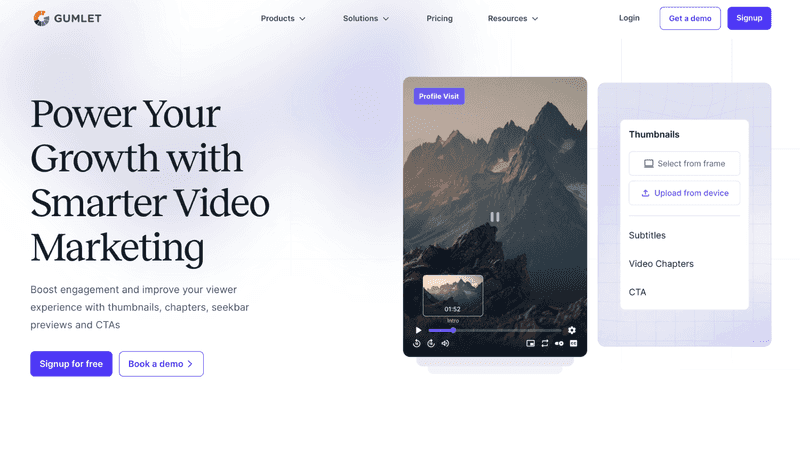
Gumlet occupies the security-and-attribution corner most directly here, positioning it as one of the more complete video marketing platforms for SaaS and EdTech teams that need gating and attribution in the same place. Its video marketing features fires events into a CRM when a viewer crosses a watch-depth threshold or clicks an embedded CTA, turning a passive view into a scored signal instead of a vanity metric.

Wistia's reputation rests on marketing-friendly heatmaps and an ad-free player, a strong fit for a demand gen team that wants to see drop-off without touching code. Its limitation is security: it's weaker once content needs gating against unauthorized redistribution rather than just tracking.

Vidyard earns its spot for sales teams specifically. Personalized 1:1 outreach video with native CRM sync is the clear differentiator. It's narrower outside sales workflows and isn't the platform for DRM-grade protection.
While Loom is excellent at fast, async recording, it says nothing about whether it was built for secure, measurable distribution. Loom was never designed to gate content, and it doesn't pretend otherwise.
Why Does Watch Time Alone Fail as an Attribution Metric?
Watch time and play count confirm a video was opened. However, they don't confirm whether the viewer who watched 80% of a demo became a scored lead, and in most stacks that signal simply evaporates.
A video that cannot tell your CRM anything is a media asset. A video wired to fire watch-depth events into your pipeline is a qualification signal.
Avoid any platform whose analytics stop at play count and total watch time. If it doesn't fire events into your CRM or ad stack at a defined threshold, it isn't attribution, but a vanity number with a chart around it.
In the early 2020s, hosting a demo on YouTube and embedding it was still a defensible default. In 2026, that setup carries a measurable cost: no gating, no CRM signal, a public view counter on a page nobody controls.
Wyzowl's 2026 survey found 85% of video marketers say video has directly helped generate leads, which makes the absence of lead-level tracking on most hosted video an increasingly expensive gap.
Why Hosting Is the Layer That Makes Marketing and Security Work Together
A creation tool makes a video. A hosting platform decides whether that video can be found, trusted, and measured.
Most 2026 stacks treat these as separate purchases made at different times, which is exactly how a team ends up with a great video and no way to prove it worked.
Video protection and video marketing are not two separate line items on a hosting platform. They are the same infrastructure decision viewed from two angles.
DRM, tokenized URLs, and dynamic watermarking stop a gated demo or paid course from leaking. Event-based CRM triggers and heatmaps turn the same viewer session into a scored lead. A platform that only does one half of this leaves either your content or your pipeline exposed.
What a combined hosting and marketing layer needs to deliver:
- Access control that survives a forwarded link: tokenized, time-limited URLs plus DRM, not just a "private" toggle
- Attribution that reaches a CRM record: watch-depth events firing into HubSpot, Salesforce, or Marketo, not a standalone analytics tab
- Delivery that holds up at the moment a prospect is watching a demo: multi-CDN routing, not a single point of failure
- Proof the security and the attribution work together in the same session: a leaked clip traced to the viewer who leaked it, and a completed watch traced to the deal it influenced
Most platforms in this category cover one half of that list well and leave the other half to a separate tool. Wistia's heatmaps and in-player lead forms are strong for demand gen teams, but its access controls stop at domain restrictions and passwords, with no DRM for content that needs to survive a real leak attempt.
Vidyard's native CRM sync and viewer-level tracking make it the right choice for sales outreach, but its security layer is standard access control rather than DRM-grade protection, which matters once a video carries resale value rather than just a sales pitch.
Loom sits outside this comparison entirely. It was built for quick internal recording, not gated distribution, and does not claim otherwise.
Gumlet's video marketing features is built on this premise directly: DRM and tokenized access sit in the same pipeline as the event triggers that feed a CRM, so a gated webinar replay is protected and measurable from the same platform, not from two platforms stitched together with Zapier.
How Many Video Tools Does Your Team Actually Need?
Most teams need exactly two tools: one for creation and editing, one for distribution and measurement, not the ten-tool stack implied by guides that list 10 platforms without ever saying which two to keep.
Pick a creation tool matching the production need. Descript for transcript editing, and Synthesia or HeyGen for localized presenter video. Pair it with a video distribution platform covering access control, CDN performance, and analytics that reach a CRM instead of stopping at a play count.
If you can name your creation tool instantly but have to think about where your last 5 videos actually live, that second half of the stack is costing you visibility into whether the video is working at all.
Frequently Asked Questions
1. What's the difference between a video creation tool and a video hosting platform?
A video creation tool produces the video file through recording, editing, or AI generation, while a hosting platform stores, secures, and delivers that finished file to viewers. Loom and Descript sit in the first category. Wistia, Vidyard, and Gumlet sit in the second.
Most SaaS teams already own a creation tool and skip the hosting decision entirely, which is why videos default to YouTube rather than landing there on purpose. If your video's final home is a public YouTube link with no tracking or access control, that's a distribution decision made by accident, not evaluation.
2. Is DRM actually necessary for regular marketing videos, or only for gated content?
DRM matters most for content carrying real resale or competitive value, and it's overkill for a public explainer meant for wide distribution. A gated onboarding course, an investor deck shared outside the company, or a paid webinar replay sits in a different category, because a leaked copy carries a direct financial cost.
Apply DRM to anything you'd be upset to find reposted on a competitor's sales deck, and skip it everywhere else. If a platform only offers DRM at its most expensive tier, that says something about how seriously it treats protection as a core feature.
3. Why does my hosted video buffer when YouTube almost never does?
Buffering usually comes down to CDN architecture rather than video quality. YouTube runs one of the largest content delivery networks in the world, a scale most single-CDN hosting platforms cannot match. A multi-CDN setup that automatically reroutes delivery when one CDN slows in a region closes most of that gap.
If your hosting provider can't explain its CDN architecture in one sentence, that's usually the first place to look when playback quality drops.
4. Can I track which prospects watched my demo video and send that data to my CRM?
Yes, but only if the hosting platform supports event-based triggers rather than basic play-count analytics. The mechanism is a rule that fires a CRM event when a viewer crosses a watch threshold or clicks an embedded CTA, converting passive viewing into a scored sales signal.
Wistia, Vidyard, and Gumlet all support some version of this natively as of 2026. Before committing to a platform for this reason, ask to see a live event fire into an actual CRM record during the sales demo, not a slide describing the feature.
5. How many video marketing tools does a small SaaS marketing team actually need?
A complete stack needs one creation tool and one distribution platform, not the long list of point solutions most 2026 roundups imply.
Pick the creation tool matching the immediate need, Loom for internal video recording, Descript for editing, Synthesia or HeyGen for localized presenter video, and pair it with a distribution platform covering access control, CDN performance, and CRM-connected analytics.
If you can name your creation tool without thinking but pause when asked where your last five videos live, that gap is the one worth fixing first.
6. What should a complete video marketing tool stack include in 2026?
At minimum, one creation tool and one distribution platform that combines security and CRM-connected analytics. Teams that stop at a creation tool alone can produce video but cannot protect it, measure it, or prove it drove pipeline.
7. Which video hosting platform actually combines security and marketing analytics in one place?
Most platforms lean hard toward one side of this equation. Wistia leans toward analytics and lead capture but caps out at basic access controls. Vidyard leans toward sales-focused CRM sync but does not offer DRM-grade protection.
Gumlet is one of the few video marketing platforms built to do both from the same pipeline, a strong fit for SaaS and EdTech teams specifically: DRM, tokenized URLs, and dynamic watermarking run alongside event-based CRM triggers and engagement heatmaps, so a gated webinar replay is protected and measurable without stitching together two separate vendors.
Closing Thoughts
Most tools covered here solve one job well, and that's not a criticism of Loom, Descript, or any creation tool on this list.
The All-in-One Platform for Effective SEO
Behind every successful business is a strong SEO campaign. But with countless optimization tools and techniques out there to choose from, it can be hard to know where to start. Well, fear no more, cause I've got just the thing to help. Presenting the Ranktracker all-in-one platform for effective SEO
We have finally opened registration to Ranktracker absolutely free!
Create a free accountOr Sign in using your credentials
The actual argument is narrower: the tool most stacks are missing in 2026 isn't another way to make video faster. It's the one that tells a team what happened after a prospect pressed play.
Treat that as its own line item, not an afterthought bolted onto whichever creation tool got purchased first.
Start by asking where your last 5 videos actually live, whether anything happens when a viewer crosses the halfway mark, and whether your team would notice if a gated video showed up on a competitor's site tomorrow.
For most teams, the honest answer to all three is some version of "not sure." That uncertainty is the whole case for evaluating video marketing infrastructure as its own decision instead of an extension of whatever recorded the footage.