
Intro
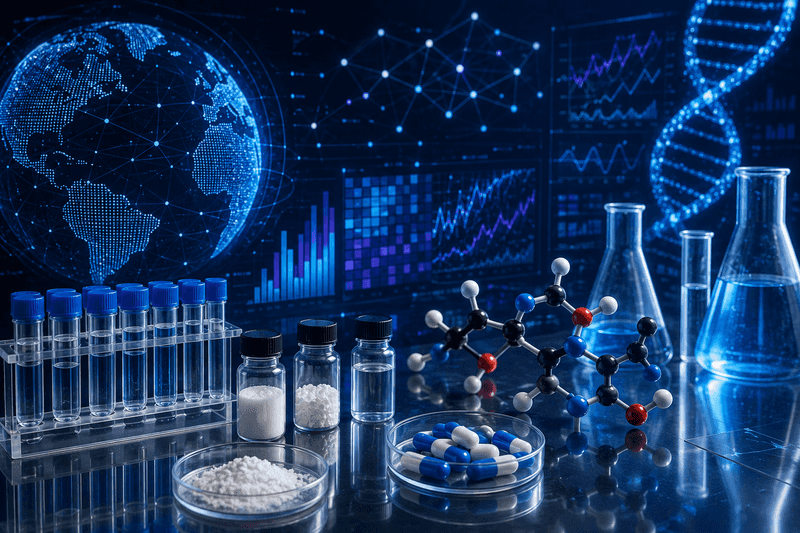
The landscape of biomedical and pharmaceutical research is changing rapidly. Advances in artificial intelligence (AI), machine learning, cloud computing, and large-scale data analysis are allowing researchers to examine biological and chemical information at a scale that was difficult to imagine only a few decades ago.
Research involving selective androgen receptor modulators (SARMs) and anabolic compounds is also becoming increasingly data-driven. Scientists can now analyze large collections of chemical structures, laboratory measurements, biological observations, and published research to identify patterns and relationships that may otherwise remain difficult to detect.
While SARMs and anabolic agents remain subjects of scientific and regulatory interest, modern technology is helping researchers understand their molecular characteristics, biological activity, analytical profiles, and potential risks with greater precision.
The Rise of Data-Driven Research
Traditional scientific research often involves carefully designed experiments examining a relatively limited number of variables. Researchers collect measurements, analyze them, and develop conclusions based on the available evidence.
Big data changes this process by allowing scientists to work with enormous datasets.
In pharmaceutical and chemical research, these datasets can include molecular structures, receptor interactions, analytical chemistry results, pharmacological observations, toxicology information, genomic data, and thousands of published scientific studies.
The All-in-One Platform for Effective SEO
Behind every successful business is a strong SEO campaign. But with countless optimization tools and techniques out there to choose from, it can be hard to know where to start. Well, fear no more, cause I've got just the thing to help. Presenting the Ranktracker all-in-one platform for effective SEO
We have finally opened registration to Ranktracker absolutely free!
Create a free accountOr Sign in using your credentials
Instead of looking at one compound or one experiment in isolation, researchers can use computational systems to compare information across large numbers of compounds and experiments.
This creates opportunities to identify trends that may not be immediately visible through conventional analysis.
For SARMs and anabolic research, this can be particularly valuable because researchers are interested in relationships between molecular structure, receptor activity, biological effects, metabolism, and potential adverse effects.
How AI Is Being Used in Compound Research
Artificial intelligence is increasingly becoming a research-support tool rather than simply a theoretical technology.
Machine-learning algorithms can process large datasets and identify statistical relationships between different variables. In pharmaceutical research, similar approaches are being investigated for predicting molecular properties, analyzing biological activity, and prioritizing compounds for further laboratory investigation.
One important application is molecular modeling.
Scientists can use computational models to study how molecules may interact with biological targets. These models do not replace laboratory experiments, but they can help researchers determine which questions are worth investigating experimentally.
The All-in-One Platform for Effective SEO
Behind every successful business is a strong SEO campaign. But with countless optimization tools and techniques out there to choose from, it can be hard to know where to start. Well, fear no more, cause I've got just the thing to help. Presenting the Ranktracker all-in-one platform for effective SEO
We have finally opened registration to Ranktracker absolutely free!
Create a free accountOr Sign in using your credentials
AI can also help classify chemical information. When researchers have thousands of compounds to analyze, automated systems can organize molecules according to structural characteristics, predicted properties, or similarities in available experimental data.
This can make the research process considerably more efficient.
Big Data and SARMs Research
SARMs have attracted scientific attention because they are designed to interact with androgen receptors in a selective manner. Understanding these interactions requires researchers to examine chemistry, molecular biology, pharmacology, metabolism, and toxicology.
Big data can bring these areas together.
Researchers can compare information from different studies to investigate how structural differences between compounds may relate to biological activity. Computational approaches can also help researchers organize published findings and identify areas where additional research is needed.
However, large datasets do not automatically produce reliable conclusions.
The quality of the underlying information remains critical. If datasets contain inconsistent measurements, incomplete reporting, or methodological differences, an AI model can reproduce those limitations.
Consequently, data quality and scientific validation remain fundamental.
AI-Assisted Literature Analysis
Another important development is the ability to analyze scientific literature at scale.
There are enormous numbers of papers covering pharmacology, endocrinology, analytical chemistry, toxicology, molecular biology, and related disciplines. Manually reviewing every relevant publication can be extremely time-consuming.
AI-assisted systems can help researchers organize and analyze this information.
Natural-language processing can identify recurring concepts, chemical names, biological targets, experimental methods, and relationships between findings. Researchers can then use these systems to locate relevant evidence more efficiently.
For SARMs and anabolic research, this may help scientists map how research interests have changed over time.
For example, computational literature analysis could reveal increasing attention toward analytical testing, metabolism, receptor selectivity, safety assessment, or novel laboratory techniques.
AI does not eliminate the need for human scientific judgment. Instead, it can function as a research assistant that helps investigators navigate large volumes of information.
Predictive Models and Drug Discovery
One of the most promising applications of AI in pharmaceutical science is predictive modeling.
Before a compound enters extensive experimental testing, researchers may want to understand certain characteristics of its molecular behavior. Computational models can potentially estimate properties based on information from previously studied molecules.
This approach can help scientists prioritize laboratory investigations.
Rather than testing every theoretical compound, researchers may use computational screening to identify candidates that appear scientifically interesting.
In the broader field of androgen receptor research, this could support investigations into molecular structure, receptor interactions, selectivity, metabolism, and other characteristics.
Importantly, computational predictions remain predictions. A model cannot establish a biological fact by itself. Laboratory experiments and appropriate scientific validation are still required.
The Importance of Laboratory Testing
As data analysis becomes more sophisticated, analytical laboratory testing remains essential.
Techniques such as high-performance liquid chromatography (HPLC), liquid chromatography–mass spectrometry (LC-MS), and nuclear magnetic resonance (NMR) spectroscopy can provide detailed information about chemical substances.
These methods can help researchers investigate questions involving identity, purity, composition, degradation products, and chemical characteristics.
Big data can make laboratory analysis even more useful.
A laboratory may generate thousands of measurements over time. Digital systems can store these results, compare them with previous observations, and identify unusual patterns.
Machine-learning systems can potentially assist with recognizing analytical signatures or detecting anomalies that warrant further investigation.
This creates a connection between traditional analytical chemistry and modern computational science.
Data Quality Is More Important Than Data Quantity
One of the biggest misconceptions about big data is that more information automatically means better research.
It does not.
A massive dataset containing unreliable or inconsistent information can produce misleading conclusions. AI systems learn from the information they receive, meaning poor-quality input can negatively affect the output.
Scientific researchers therefore place significant emphasis on data validation, standardized methodologies, transparent reporting, and reproducibility.
When comparing research involving SARMs or anabolic compounds, researchers must consider differences in experimental design, analytical equipment, sample preparation, biological models, and measurement techniques.
Standardization allows datasets from different experiments to become more comparable.
Without it, apparent patterns may simply reflect differences in methodology.
AI and Safety Research
Another important area is safety research.
SARMs and anabolic compounds can involve complex biological effects, making safety assessment an important component of scientific investigation.
Large datasets may help researchers examine relationships between compounds and observed biological outcomes. Computational systems can potentially assist researchers in identifying patterns across toxicology studies, pharmacological datasets, and other sources of evidence.
This does not mean AI can independently determine whether a compound is safe.
Safety assessment requires multiple forms of evidence, including laboratory research, validated experimental models, clinical evidence where applicable, and careful interpretation by qualified scientists.
AI can support this process by helping researchers manage and analyze information, but it does not replace scientific oversight.
The Role of Real-World Data
Modern research is also increasingly interested in real-world data.
Electronic health records, laboratory databases, research registries, and other large information sources can provide researchers with extensive datasets.
When appropriately collected, anonymized, and ethically governed, such information can help researchers investigate broader trends.
However, real-world datasets can contain confounding factors. A correlation between two variables does not necessarily prove that one caused the other.
For this reason, researchers must carefully distinguish between association and causation.
AI can identify correlations extremely quickly, but interpreting those correlations still requires scientific expertise.
DutchSarm and the Importance of Research Transparency
For consumers and researchers interested in the broader SARMs landscape, DutchSarm represents one example of a brand operating within the research-compound market. As interest in SARMs continues to generate online discussion, transparent product information, responsible communication, and attention to laboratory documentation are increasingly important considerations when evaluating information about research compounds.
DutchAnabole and the Broader Anabolic Market
DutchAnabole operates in the broader anabolic-focused market, where discussions surrounding compound information, product identity, laboratory analysis, and research continue to evolve. The growing influence of data science means that future evaluation of anabolic compounds is likely to depend increasingly on analytical evidence and scientifically documented information rather than claims based solely on marketing or anecdotal experiences.
The Future of AI-Driven Research
The next stage of research will likely involve increasingly sophisticated combinations of AI, laboratory science, and large datasets.
Researchers may use AI to identify patterns, computational chemistry to model molecular behavior, automated laboratory systems to generate measurements, and cloud-based databases to combine results from multiple research environments.
This could accelerate scientific discovery while reducing the amount of repetitive analysis researchers must perform manually.
At the same time, regulatory and ethical considerations will become increasingly important.
As AI becomes more capable, researchers will need to ensure that models are transparent, datasets are appropriately validated, and conclusions remain grounded in experimentally supported evidence.
Human Expertise Still Matters
Despite the rapid development of artificial intelligence, human scientists remain central to the research process.
An algorithm can identify a statistical pattern, but scientists must determine whether that pattern is biologically meaningful.
AI can generate a prediction, but laboratory experiments must determine whether the prediction holds true.
A computer can process thousands of scientific papers, but researchers still need to evaluate study quality, methodology, limitations, and context.
The most effective future research environment will therefore combine computational technology with human expertise.
Conclusion
Big data and artificial intelligence are transforming how scientists approach SARMs and anabolic research. Instead of examining individual experiments or compounds in isolation, researchers can increasingly analyze enormous collections of chemical, biological, analytical, and scientific information.
AI-assisted literature analysis can make research discovery faster. Machine-learning models can help researchers explore molecular relationships. Big-data platforms can connect information from different experiments, while modern analytical chemistry provides the experimental evidence needed to validate computational predictions.
The All-in-One Platform for Effective SEO
Behind every successful business is a strong SEO campaign. But with countless optimization tools and techniques out there to choose from, it can be hard to know where to start. Well, fear no more, cause I've got just the thing to help. Presenting the Ranktracker all-in-one platform for effective SEO
We have finally opened registration to Ranktracker absolutely free!
Create a free accountOr Sign in using your credentials
However, technology does not eliminate the fundamentals of good science.
Reliable datasets, validated laboratory methods, reproducible experiments, transparent reporting, and expert interpretation remain essential.
The future of SARMs and anabolic research is therefore unlikely to be defined by AI alone. Instead, it will be shaped by the combination of big data, artificial intelligence, advanced laboratory testing, computational chemistry, and human scientific expertise.
As these technologies continue to develop, researchers will have increasingly powerful tools for asking more sophisticated questions about molecular compounds, biological activity, analytical characteristics, and safety. The result could be a research environment that is faster, more data-rich, and potentially more precise than anything available to scientists in previous generations.

