Intro
International SEO • Search Intent Localization • Hong Kong & Taiwan
International SEO often starts with a translation task when it should start with a search-behaviour task.
A company has an English keyword list. Someone exports it to a spreadsheet, translates the phrases, creates localized pages, and starts checking rankings. The workflow is efficient, easy to document, and often misleading.
The problem is not that the translations are necessarily wrong.
The problem is that users in another market may not search for the product in the way the translation predicts.
This becomes particularly visible with global software brands in Hong Kong and Taiwan. The brand name itself may remain unchanged, while the words users place around it shift according to language, familiarity with the product, device, task, and local terminology.
The All-in-One Platform for Effective SEO
Behind every successful business is a strong SEO campaign. But with countless optimization tools and techniques out there to choose from, it can be hard to know where to start. Well, fear no more, cause I've got just the thing to help. Presenting the Ranktracker all-in-one platform for effective SEO
We have finally opened registration to Ranktracker absolutely free!
Create a free accountOr Sign in using your credentials
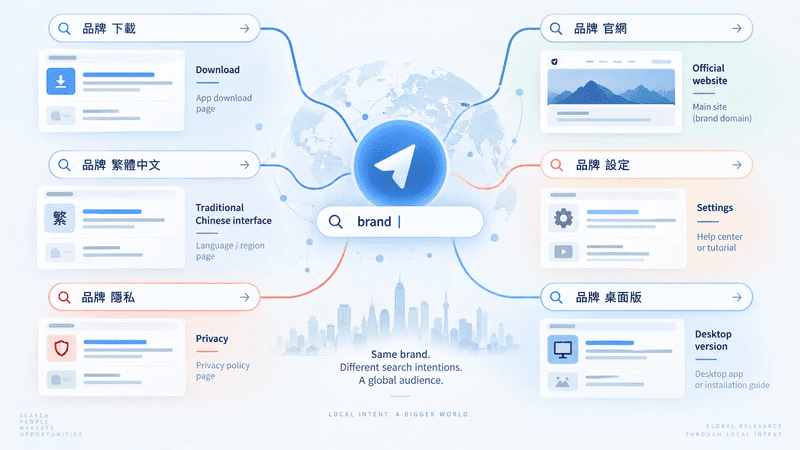
A person who already knows an app exists may search for its Traditional Chinese interface. Another may want the official site. Someone else may only care about downloading the desktop version. All three searches contain the same brand, but they represent different jobs.
That distinction is easy to lose when international keyword research is reduced to translation.
The Brand May Be Global. The Modifier Usually Isn’t.
Brand terms are unusually stable across markets.
Search modifiers are not.
Consider the difference between queries built around the same software brand:
| Search pattern | Likely user need |
| Brand name | General navigation or discovery |
| Brand + 下載 | Download or installation |
| Brand + 官網 | Official destination or verification |
| Brand + 繁體中文版 | Traditional Chinese localization |
| Brand + 設定 | Configuration or troubleshooting |
| Local nickname | Familiar or community-driven discovery |
These queries should not automatically be grouped into one keyword cluster simply because they share the same entity.
The modifier changes the task.
That matters for page selection. A user looking for an official website usually needs a destination page. A user looking for language settings needs instructions. A download query may require platform-specific information. A nickname may indicate a completely different stage of product familiarity.
The All-in-One Platform for Effective SEO
Behind every successful business is a strong SEO campaign. But with countless optimization tools and techniques out there to choose from, it can be hard to know where to start. Well, fear no more, cause I've got just the thing to help. Presenting the Ranktracker all-in-one platform for effective SEO
We have finally opened registration to Ranktracker absolutely free!
Create a free accountOr Sign in using your credentials
When those intentions are collapsed into one URL, the page usually becomes broader while the search match becomes weaker.
Literal Translation Can Be Correct and Still Miss the Market
There is an important difference between translating a phrase and localizing a query.
Translation asks:
What does this phrase mean in another language?
Keyword localization asks:
What would someone in this market type when trying to accomplish the same thing?
Those questions occasionally produce the same answer. They often do not.
Suppose an English keyword set contains:
- app download
- official website
- change language
- privacy settings
- desktop version
A translation system can produce perfectly understandable Traditional Chinese versions of each phrase.
That tells us almost nothing about whether real users phrase those searches that way.
The searcher may use a shortened expression. The market may prefer a different software term. A colloquial product name may be more common than the official one. A phrase that looks informational in English may produce mostly navigational results in Taiwan.
This is why translated keyword lists should be treated as hypotheses, not final research.
They are where the investigation begins.
Traditional Chinese Does Not Mean One Uniform Search Market
Hong Kong and Taiwan both use Traditional Chinese extensively, but an SEO strategy should not assume that this makes their search behaviour interchangeable.
Language is only one variable.
Others include:
- terminology
- local competitors
- software vocabulary
- device preferences
- SERP composition
- brand familiarity
- the way a particular product entered the market
This distinction becomes more important as queries become more specific.
A broad product-category phrase may behave similarly in both regions. A troubleshooting query or branded modifier may not.
For example, consider a query such as Telegram 繁體中文版. The phrase does more than identify Telegram. It narrows the user’s job to Traditional Chinese localization, which may involve the interface, language setup, or regional guidance. That is materially different from searching for Telegram download, Telegram login, or an official Telegram website.
The useful SEO insight is not that one wording is “better.”
It is that the wording reveals a narrower task.
That task deserves to be measured separately.

Search Volume Can Hide Better Intent
International keyword decisions often become distorted by volume.
A broad branded keyword will normally look more attractive than a specific language, platform, or configuration query because more people search for it.
But volume does not tell you how clearly the query maps to a page.
Someone who searches only a brand name could want almost anything:
- the homepage
- support
- download
- reviews
- login
- pricing
- news
- account help
Add a modifier and the ambiguity starts to disappear.
That can make a smaller query commercially or editorially more useful than a much larger one.
A localization query may have lower volume, for example, but it gives the publisher a much clearer answer to three questions:
-
What does the visitor want?
-
What type of page should rank?
-
What should the page explain first?
This is why keyword prioritization should consider intent clarity alongside search volume.
Stop Asking One Page to Rank for Every Branded Modifier
A common problem in software SEO is the “everything page.”
Its title tries to cover:
official website, download, desktop, registration, language settings, privacy, login and troubleshooting.
The reasoning is understandable: all of those searches contain the brand.
The result is often a page without a clear primary task.
A cleaner structure is to divide branded searches by user job.
Navigation: official website, web version, login
Acquisition: download, install, desktop version, mobile app
Configuration: language, notifications, privacy settings
Account: registration, verification, login problems
Usage: groups, messages, files, productivity features
These clusters can belong to the same brand while still requiring different pages.
The test is simple:
If two queries require meaningfully different first paragraphs, they probably deserve different intent treatment.
That is more useful than deciding purely from keyword similarity.
Local Nicknames Deserve Research, Not Automatic Targeting
International brands often acquire alternative names.
Some come from product icons. Others come from transliteration, older translations, user communities, or informal speech.
SEO teams sometimes ignore these phrases because they are absent from official brand documentation.
That can be a mistake.
If people use an informal term consistently and the SERP clearly associates it with the same product, it is part of the market’s search vocabulary.
That does not mean every nickname should receive a dedicated page.
Before targeting one, check:
- whether the term consistently refers to the same entity
- whether the SERP is stable
- whether search results are informational or navigational
- whether the phrase introduces ambiguity
- whether the term is used by the audience you actually serve
Local vocabulary is evidence.
It is not automatically a keyword strategy.
Use the SERP Before You Use the Content Brief
One of the easiest ways to improve localized keyword research is to inspect the result page before deciding what the keyword means.
Suppose a translated term appears to describe a download.
Search it from the target market.
If most ranking pages are tutorials rather than download pages, that tells you something important: the local intent may not match the English source phrase.
The same method works for branded searches.
For each candidate keyword, record:
- dominant page type
- recurring title language
- official domains present
- local publishers present
- forums or user-generated results
- video results
- app-store listings
- whether the SERP changes between Hong Kong and Taiwan
This is where rank tracking becomes more useful than a simple position report.
A ranking number tells you where a page appears.
The surrounding SERP helps explain why.
Compare Hong Kong and Taiwan Separately
If the business question is regional, the measurement should be regional too.
A single report labelled “Traditional Chinese rankings” can hide important differences.
Instead, track the same high-priority queries separately for Hong Kong and Taiwan.
For each market, record:
| Metric | Why it matters |
| Ranking position | Visibility |
| Ranking URL | Whether the correct page appears |
| SERP intent | What Google appears to interpret the query as |
| Competing domains | Local competitive set |
| Title terminology | Language used by current winners |
| SERP features | Videos, maps, app listings, discussions, etc. |
The ranking URL deserves particular attention.
If the site ranks, but Google repeatedly chooses the wrong page, the problem may not be authority. It may be unclear intent mapping or overlapping content.
That is far more actionable than celebrating a position improvement in isolation.
AI Search Does Not Remove the Need for Local Terminology
It is tempting to assume that AI-powered search will smooth over regional language differences.
In some cases, it will.
That does not make terminology consistency less important.
AI systems still need to connect:
- entities
- product names
- features
- locations
- user tasks
If the English site uses one term, the Hong Kong version uses another, the Taiwan page introduces a third, and customer support uses a fourth without clear context, the brand creates unnecessary ambiguity.
The goal is not to force every market to use identical wording.
It is to decide where consistency matters and where localization matters.
Product names, technical specifications, and core entity relationships often benefit from stability.
Search modifiers, explanations, examples, and regional phrasing often benefit from adaptation.
Good international SEO needs both.
Build a Keyword Localization Matrix Before Scaling Content
For a small site, informal research may be enough.
For a large multilingual site, create a localization matrix.
At minimum, track:
- source-language concept
- Hong Kong candidate phrase
- Taiwan candidate phrase
- intended search task
- target page type
- current ranking URL
- local SERP observations
- final editorial terminology
For example:
| Concept | HK candidate | TW candidate | Intent | Preferred page type |
| Download | 下載 | 下載 | Acquisition | Download page |
| Official website | 官網 | 官網 | Navigation | Entry page |
| Traditional Chinese | 繁體中文 / 中文 | 繁體中文 / 中文 | Localization | Language guide |
| Settings | 設定 | 設定 | Troubleshooting | Tutorial |
| Registration | 註冊 | 註冊 | Account setup | Registration guide |
These entries should not be treated as universal linguistic rules.
They are working hypotheses.
The final choice should be validated against search results, site data, native-speaker review, and actual user language.
A Practical Five-Keyword Test
Teams do not need to rebuild an entire international SEO strategy to see whether translation is causing problems.
Run a small audit first.
Choose one global software brand and five intents:
-
Brand
-
Download
-
Official website
-
Language
-
Privacy
For each intent, collect candidate phrases for Hong Kong and Taiwan.
Then inspect the local SERPs.
Record:
- autocomplete suggestions
- ranking page types
- wording in titles
- local competitors
- official results
- community results
- the pages your own site ranks
Do not change anything yet.
First compare the two markets.
The useful question is:
Which differences could we have predicted from translation alone, and which only became visible after looking at real search results?
That gap is where localization research earns its value.
A second pass can go further by comparing the findings with Search Console data, internal site search, support tickets, customer emails, or native-speaker interviews.
Those sources help prevent an equally common mistake: assuming the current SERP is the only evidence worth considering.
Know the Limits of the Research
Localized SEO analysis also has limitations.
Search results change.
Low-volume terms may produce unstable SERPs. Personalized or location-sensitive results can vary. Autocomplete reflects popularity, not necessarily business value. Search tools may estimate volume differently in smaller markets.
For that reason, no single data source should decide the keyword strategy.
Use several signals together:
- SERP composition
- rank tracking
- first-party search data
- Search Console
- local-language review
- actual customer terminology
When several sources point in the same direction, confidence improves.
When they disagree, that disagreement is worth investigating.
What Usually Goes Wrong
The recurring failures are surprisingly consistent.
A team translates its English keyword list and treats the output as final research.
Hong Kong and Taiwan are grouped together without checking whether the SERPs differ.
Every branded modifier is assigned to one broad page.
Search volume outweighs intent.
Local nicknames are either ignored completely or targeted without checking what they actually mean.
AI translation is used as a substitute for native review.
And ranking reports are generated globally even though the business decision is local.
None of these problems are especially technical.
They come from defining localization too narrowly.
Final Takeaway
A global brand can keep the same name in every market and still be searched for in very different ways.
The meaningful variation often appears after the brand: the language modifier, the task, the platform, the local expression, or the problem the user wants to solve.
The All-in-One Platform for Effective SEO
Behind every successful business is a strong SEO campaign. But with countless optimization tools and techniques out there to choose from, it can be hard to know where to start. Well, fear no more, cause I've got just the thing to help. Presenting the Ranktracker all-in-one platform for effective SEO
We have finally opened registration to Ranktracker absolutely free!
Create a free accountOr Sign in using your credentials
That is why international keyword research should not begin with:
“What is the translated keyword?”
A better sequence is:
-
What is the user trying to do?
-
How do people in this market describe that task?
-
What does the local SERP suggest they expect to find?
-
Which page on our site actually satisfies that expectation?
Translation helps content become understandable.
Localization helps the right page become relevant.