Intro
Semrush is one of the most established SEO platforms available, but it is no longer a cheap piece of software.
Semrush SEO Toolkit Pro currently costs $139.95 per month, or almost $1,680 per year before you start adding other products or moving to higher plans. Guru costs $249.95 per month and Business costs $499.95 per month.
That makes sense if you use a large part of the Semrush ecosystem.
But what if you mainly need:
- Accurate keyword rank tracking
- Keyword research
- SERP analysis
- Competitor monitoring
- Backlink data
- Website audits
- SEO reporting
- API access
- AI Overview monitoring
In that case, paying for an enormous marketing suite may not be necessary.
For example, Ranktracker Launch costs $39 per month and includes 500 daily Top 100 tracked keywords. Semrush Pro also includes 500 tracked keywords but costs $139.95 per month.
That is a difference of $100.95 every month, or $1,211.40 over 12 months.
The All-in-One Platform for Effective SEO
Behind every successful business is a strong SEO campaign. But with countless optimization tools and techniques out there to choose from, it can be hard to know where to start. Well, fear no more, cause I've got just the thing to help. Presenting the Ranktracker all-in-one platform for effective SEO
We have finally opened registration to Ranktracker absolutely free!
Create a free accountOr Sign in using your credentials
So if you're searching for a cheaper alternative to Semrush, the real question isn't simply "which tool costs less?"
It's:
Which cheaper SEO tool gives you the features you actually use?
Quick answer: What is the best cheaper alternative to Semrush?
For businesses primarily focused on organic search, Ranktracker is one of the strongest direct alternatives to Semrush on price and SEO functionality.
Ranktracker Launch starts at $39/month and includes:
- 500 daily Top 100 tracked keywords
- 3,500 weekly tracked keywords
- Unlimited trackable projects
- Unlimited users
- Keyword research
- SERP analysis
- Backlink checking and monitoring
- Website auditing
- Competitor tracking
- SEO reporting
- AI Overview monitoring
- Access to rank-tracking data across more than 107,000 locations
Higher plans increase the tracking allowance to 1,000, 2,000 and 5,000 daily Top 100 keywords. If PPC research, paid advertising intelligence, social media tools and the broader marketing ecosystem are central to your workflow, Semrush can still make more sense.
But if most of your subscription is being used for SEO, there are significantly cheaper options.
Best cheaper Semrush alternatives at a glance
| Tool | Starting price | Best for | Rank tracking | Main advantage |
| Ranktracker | $39/mo | SEO, rank tracking and agencies | 500 daily Top 100 keywords on Launch | Strong SEO functionality at a much lower entry price |
| Ubersuggest | $29/mo | Beginners and small sites | Entry plan tracks 125 keywords per project weekly | Very low starting price |
| SpyFu | $39/mo | PPC and competitor research | 5,000 weekly tracked keyword rankings on Basic | Strong competitor and advertising research |
| Morningscore | $69/mo | Small businesses wanting simplicity | 100 daily tracked keywords on Lite | Guided, gamified SEO workflow |
| SE Ranking | $129/mo | Agencies and SEO/GEO teams | 2,000 daily keywords on Core | Large allowances and agency functionality |
| Semrush Pro | $139.95/mo | Broad digital marketing | 500 tracked keywords | Very broad marketing ecosystem |
Prices checked in September 2026 and may change.
Why look for a cheaper alternative to Semrush?
The obvious reason is price.
But price alone isn't normally why businesses switch.
The All-in-One Platform for Effective SEO
Behind every successful business is a strong SEO campaign. But with countless optimization tools and techniques out there to choose from, it can be hard to know where to start. Well, fear no more, cause I've got just the thing to help. Presenting the Ranktracker all-in-one platform for effective SEO
We have finally opened registration to Ranktracker absolutely free!
Create a free accountOr Sign in using your credentials
The bigger issue is price relative to actual usage.
Semrush has expanded far beyond basic SEO. Its products now cover areas including SEO, AI visibility, traffic intelligence, local marketing, advertising, content and social media.
That breadth is useful if your team actually uses those products.
But many SEO teams spend most of their time doing a much smaller set of tasks:
- Finding keywords
- Tracking rankings
- Monitoring competitors
- Checking SERPs
- Finding technical SEO problems
- Monitoring backlinks
- Reporting results
If those seven jobs represent most of your workflow, the question becomes whether you need to pay for everything surrounding them.
Semrush is increasingly a collection of toolkits
Semrush's core SEO Toolkit starts at $139.95 per month.
Its AI Visibility toolkit starts separately at $99 per month, while Semrush One, which combines SEO and AI visibility, starts at $199.95 per month.
For larger marketing teams this modular approach can be useful.
For companies primarily buying software to improve and monitor organic search performance, however, it can make more focused SEO platforms increasingly attractive.
1. Ranktracker — Best overall cheaper alternative to Semrush
If your main reason for using Semrush is SEO, Ranktracker provides one of the closest price-to-functionality comparisons.
The clearest example is rank tracking.
Ranktracker Launch vs Semrush Pro
| Ranktracker Launch | Semrush Pro | |
| Monthly price | $39 | $139.95 |
| Daily tracked keywords | 500 | 500 |
| Ranktracker SERP depth | Top 100 | — |
| Trackable projects | Unlimited | 5 websites monitored on Semrush |
| Users | Unlimited | — |
| Monthly cost difference | -$100.95 | — |
| Approx. yearly saving | $1,211.40 | — |
Semrush's official SEO Toolkit limits Pro to five monitored websites and 500 tracked keywords. Ranktracker Launch provides 500 daily Top 100 tracked keywords alongside unlimited trackable projects and unlimited users.
That's why comparing tools purely by the number of features on their homepage can be misleading.
A better comparison is to take the workflow you perform every day and compare what it costs to reproduce.
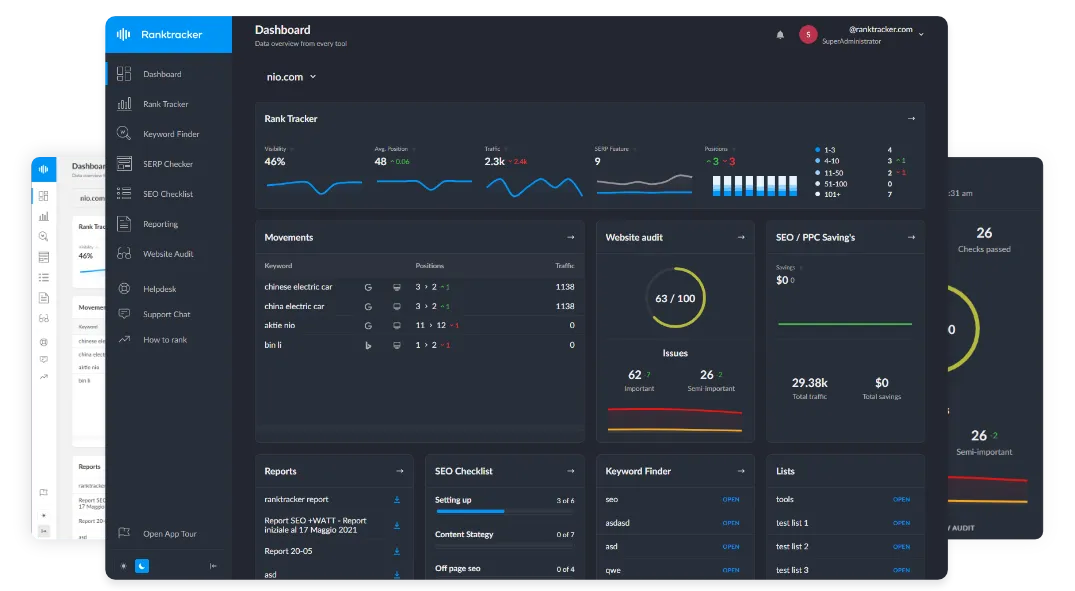
What does Ranktracker include?
Every Ranktracker plan includes its core SEO toolset:
Rank Tracker
Track keyword positions across Google and other supported search engines, desktop and mobile devices and more than 107,000 trackable locations.
Every tracked keyword can return the Top 100 results, rather than limiting visibility to the first handful of positions. This matters when you're monitoring new content.
A page moving from position 78 to 34 has made significant progress even though it hasn't reached page one yet.
If your tracker only makes the most visible rankings useful, you miss much of that movement.
Keyword Finder
Research keyword opportunities using search volume, difficulty, CPC, trends and country-level data.
Ranktracker's current pricing page states that its Keyword Finder draws from a database containing more than 3.5 billion keywords.
SERP analysis
Instead of looking at a keyword difficulty score in isolation, you can inspect the actual SERP and understand what Google is currently ranking.
That gives you context before deciding whether a keyword is realistically worth targeting.
Backlink monitoring
Monitor your backlink profile, check new links and keep track of links that disappear rather than relying solely on occasional manual checks.
Website auditing
Technical problems can make content and link-building work far less effective.
Ranktracker includes website auditing alongside the ranking and research tools, so technical SEO does not require another separate subscription.
Competitor tracking
Rankings only become meaningful when you understand what the rest of the SERP is doing.
Ranktracker plans therefore include competitors per project, beginning with five on Launch and increasing with higher plans.
AI Overview monitoring
Traditional blue-link rankings are no longer the entire Google SERP.
Ranktracker's current plans include AI Overview monitoring alongside tracked keywords, allowing SEO teams to monitor traditional rankings and the changing search-results environment together.
API access
Ranktracker also provides API access across its plans, allowing companies to integrate ranking data with internal dashboards, reporting systems and other workflows.
Ranktracker pricing
Ranktracker currently has four main plans:
| Plan | Monthly price | Daily Top 100 | Weekly Top 100 | Monthly Top 100 |
| Launch | $39 | 500 | 3,500 | 15,000 |
| Growth | $89 | 1,000 | 7,000 | 30,000 |
| Scale | $149 | 2,000 | 14,000 | 60,000 |
| Authority | $299 | 5,000 | 35,000 | 150,000 |
Annual billing reduces the listed price by 20%. This frequency-based model is particularly useful when managing large keyword sets.
Not every keyword needs checking every day.
Important commercial keywords might be tracked daily, while thousands of longer-tail terms can be monitored weekly, bi-weekly or monthly.
Who should choose Ranktracker?
Ranktracker makes the most sense for:
- SEO agencies
- In-house SEO teams
- SaaS companies
- Publishers
- Affiliate websites
- Ecommerce businesses
- Consultants
- Businesses running international SEO
- Teams managing large keyword sets
- Companies needing SEO data through an API
When shouldn't you replace Semrush with Ranktracker?
Semrush remains a better fit if your team heavily relies on its broader marketing ecosystem.
For example, if you regularly use Semrush for paid advertising intelligence, social media, local marketing and multiple other non-SEO workflows, consolidating everything inside Semrush may justify the higher price.
The objective isn't to find the cheapest software possible.
It's to stop paying for capabilities your team doesn't use.
2. Ubersuggest — Best for the lowest starting price
Ubersuggest remains one of the cheapest recognizable all-in-one SEO platforms.
Pricing currently starts at $29 per month, with plans ranging up to $99 per month.
Its entry plan includes:
- Keyword research
- Competitor analysis
- Site auditing
- Backlink data
- AI search visibility
- 125 tracked keywords per project
- Weekly ranking updates
The main limitation compared with Ranktracker is tracking capacity and frequency.
Ubersuggest's lowest plan tracks 125 keywords per project weekly, while Ranktracker Launch provides 500 daily Top 100 tracked keywords.
Best for: Solopreneurs, bloggers and small websites that need basic SEO research at the lowest possible monthly price.
Less suitable for: SEO teams that need large-scale or daily rank monitoring.
3. SpyFu — Best cheaper Semrush alternative for PPC research
SpyFu is particularly strong if the part of Semrush you use most is competitor and paid-search research.
Its Basic plan costs $39 per month and includes 5,000 weekly tracked keyword rankings.
The Professional plan costs $79 per month and increases tracking to 15,000 weekly keywords while adding API access and custom branded reporting.
SpyFu is useful for researching:
- Competitor keywords
- Google Ads activity
- Historical advertising
- Competitor domains
- PPC keywords
- Organic competitors
This makes it a very different proposition from a rank-tracking-first platform.
Best for: PPC marketers and teams heavily focused on competitor advertising intelligence.
Less suitable for: Teams looking primarily for detailed daily SEO rank tracking and technical SEO workflows.
4. Morningscore — Best for a guided SEO workflow
Morningscore takes a different approach by simplifying SEO and turning optimization into a more guided experience.
Its Lite plan currently costs $69 per month and includes:
- 100 daily tracked keywords
- Three websites
- Two users
- Keyword research
- Backlink tools
- Competitor analysis
- SEO health monitoring
- AI Overview tracking
- AI prompt tracking
Business increases the price to $99 per month and includes 500 daily tracked keywords across ten websites.
Its biggest differentiation is usability.
The platform uses prioritized SEO tasks and gamification to make optimization more approachable for businesses that do not have dedicated SEO specialists.
Best for: Small businesses and less experienced SEO users who want guidance.
Less suitable for: Teams whose priority is maximizing rank-tracking capacity for the money.
5. SE Ranking — Best for larger agency workflows
SE Ranking has historically been positioned as a less expensive alternative to Semrush, although the price gap is now much smaller.
Its Core plan currently costs $129 per month when billed monthly.
That includes:
- 10 projects
- One manager seat
- 2,000 daily tracked keywords
- 100 AI/GEO prompts
- 250,000 audit pages per month
- API credits and MCP access
Growth costs $279 per month and increases the allowance to 5,000 daily keywords, 30 projects and three manager seats.
SE Ranking therefore offers a lot of capacity, particularly for agencies.
But at $129 per month, it is only $10.95 cheaper than Semrush Pro at $139.95.
That makes it more of a differently structured Semrush competitor than a genuinely low-cost SEO tool.
Best for: Agencies needing large keyword allowances, collaboration and SEO/GEO functionality.
Less suitable for: Smaller businesses whose main reason for leaving Semrush is price.
6. A free Semrush alternative stack
You don't necessarily need another paid all-in-one SEO platform.
For a new site or very small business, a free stack can cover a surprising amount.
You can combine tools such as:
Google Search Console
Use it to monitor:
- Organic clicks
- Impressions
- Average search positions
- Queries
- Landing pages
- Indexing
- Core Web Vitals
The biggest advantage is that the performance data comes directly from your own Google Search presence.
Google Analytics
Use GA4 to understand what happens after organic visitors arrive.
Search Console tells you how people found you.
Analytics helps show what those visitors did next.
Google Keyword Planner
It can provide keyword ideas and approximate search-volume information without requiring a separate premium keyword-research subscription.
The problem with the free stack
Free tools work well for analyzing your own website.
They become much less useful when you need to:
- Track exact rankings automatically
- Monitor thousands of keywords
- Analyze competitors
- Research competitor keywords
- Compare SERPs over time
- Monitor backlinks
- Generate automated reports
- Track multiple countries and locations
- Use SEO data through an API
At that point, a dedicated SEO platform normally saves enough manual work to justify its cost.
Ranktracker vs Semrush: Which offers better value?
There isn't a universal winner because the two platforms are designed around different levels of breadth.
Choose Semrush if:
- You want a broad digital marketing suite
- PPC research is important
- You use several Semrush toolkits
- Your organization wants to consolidate multiple marketing functions
- The extra cost is less important than having everything within one ecosystem
Choose Ranktracker if:
- Organic SEO is your priority
- Rank tracking is central to your workflow
- You want full Top 100 tracking
- You manage lots of keywords
- You need multiple users
- You manage multiple projects
- You need local or international tracking
- You want keyword research, SERP analysis, backlinks and auditing together
- You want to spend significantly less than Semrush Pro
For the simplest direct comparison, both Ranktracker Launch and Semrush Pro support 500 tracked keywords, but their current monthly prices are $39 and $139.95 respectively.
Don't compare SEO tools by starting price alone
One of the easiest mistakes when switching SEO software is comparing the number printed on the pricing page.
Instead, compare the cost of recreating your actual workflow.
Ask:
How many keywords do you need to track?
There is an enormous difference between 100 weekly keywords and 5,000 daily keywords.
How frequently are rankings updated?
Daily, weekly and monthly tracking cannot be compared as though they provide the same service.
How deep into Google does the tracker check?
If you're actively growing pages from positions 70 to 20, data outside the top 10 is extremely important.
How many locations do you need?
Local SEO, national SEO and international SEO can produce completely different search results.
How many users will need access?
A cheap base subscription can become expensive if every additional teammate requires another paid seat.
How many projects can you create?
This becomes particularly important for agencies and businesses operating multiple websites.
Is API access included?
If your SEO data feeds an internal reporting system, BI platform or customer dashboard, API pricing can change the true cost considerably.
Are AI search features included?
SEO software in 2026 increasingly needs to account for AI-generated search experiences.
Check whether the AI features you need are actually included in the advertised plan or require another subscription.
How to move from Semrush to a cheaper SEO tool
Changing SEO software is easier when you treat the move as a data migration rather than simply cancelling one account and opening another.
1. Export your existing keywords
Start with your Semrush Position Tracking projects.
Export the keyword lists you currently monitor.
Keep:
- Keyword
- Target location
- Device
- Tags
- Current position
- Landing page
- Historical ranking exports where available
2. Save your historical data separately
This step is important.
Do not automatically assume that several years of historical charts from one SEO platform will appear inside another platform after importing your keywords.
Export the historical information you may need for future reporting before closing your old account.
Keep the files in your reporting or data-storage system even if the new platform begins collecting fresh ranking history immediately.
3. Import your keywords into the new platform
Ranktracker supports keyword uploads using CSV files, allowing larger keyword lists to be moved without manually entering every query.
Recreate the correct:
- Country
- Location
- Search engine
- Device
- Tracking frequency
These settings matter because two tools can report different results if they're checking different SERP configurations.
4. Recreate your competitors
Don't only migrate your own keywords.
Add the competing domains that matter to each project so you preserve the competitive context surrounding those rankings.
5. Run both platforms together briefly
If possible, don't cancel your existing platform the same minute you create the replacement account.
Run your most important keywords through both systems first.
Check:
- Locations
- Devices
- Search engines
- Keyword groups
- Competitors
- Reports
- Ranking data
Once the configuration matches your workflow, complete the migration.
How much can you actually save by leaving Semrush?
Consider a business that only needs the functionality available in Ranktracker Launch.
Semrush Pro
$139.95 × 12 = $1,679.40 per year
Ranktracker Launch
$39 × 12 = $468 per year
Difference
$1,211.40 per year
That's approximately 72% less at the monthly prices.
And the comparison becomes more significant when a team needs additional tracking capacity or is paying for products it rarely opens.
The cheapest SEO tool isn't necessarily the one with the lowest sticker price.
The cheapest tool is the one that delivers the workflow you need without forcing you to pay for the workflow you don't.
Frequently asked questions
What is the cheapest alternative to Semrush?
Ubersuggest is one of the lowest-cost all-in-one options at around $29 per month.
However, price alone doesn't make two subscriptions equivalent.
For businesses that need substantial rank tracking, Ranktracker Launch starts at $39 per month with 500 daily Top 100 tracked keywords.
What is the best cheaper alternative to Semrush for rank tracking?
Ranktracker is a strong option for businesses where rank tracking is the main requirement.
Launch includes 500 daily Top 100 keywords for $39 per month, with larger allowances available on Growth, Scale and Authority.
Is Ranktracker cheaper than Semrush?
Yes.
Ranktracker currently starts at $39 per month while the Semrush SEO Toolkit starts at $139.95 per month.
At those entry prices, Ranktracker costs $100.95 less per month.
Is Ranktracker better than Semrush?
It depends on what you need.
Ranktracker is better suited to teams prioritizing rank tracking, keyword research, SERP monitoring, auditing, backlink monitoring and SEO reporting at a lower price.
Semrush is better suited to organizations that want its broader collection of SEO, advertising, market intelligence, content, local and other marketing products.
Can a small business replace Semrush?
Yes.
Most small businesses do not need every feature available in a large enterprise-style marketing platform.
A smaller SEO platform can cover keyword research, rank tracking, auditing, backlink monitoring and competitor research without requiring the same monthly spend.
Can I replace Semrush with free tools?
For very basic SEO, yes.
Google Search Console, Google Analytics and Google Keyword Planner can cover much of the information needed to understand your own website.
What you'll lose is the convenience and competitive intelligence provided by dedicated SEO software.
Is Semrush still worth the money?
For the right company, absolutely.
If your team actively uses a broad portion of Semrush's ecosystem, consolidating those functions into a single platform can be worth the cost.
The value becomes harder to justify when you are paying $139.95 or more each month but repeatedly opening only rank tracking, keyword research and site auditing.
Final verdict
Semrush is powerful.
But powerful and cost-effective are not automatically the same thing.
If your team genuinely uses its broad suite of digital marketing products, there may be little reason to move.
If most of your daily workflow revolves around rank tracking, keyword research, SERP analysis, backlinks, competitors, site audits and SEO reporting, a more focused platform can cut your software bill dramatically.
For that use case, Ranktracker is our top cheaper alternative to Semrush in 2026.
The entry-level comparison tells most of the story:
Semrush Pro: $139.95/month for 500 tracked keywords
The All-in-One Platform for Effective SEO
Behind every successful business is a strong SEO campaign. But with countless optimization tools and techniques out there to choose from, it can be hard to know where to start. Well, fear no more, cause I've got just the thing to help. Presenting the Ranktracker all-in-one platform for effective SEO
We have finally opened registration to Ranktracker absolutely free!
Create a free accountOr Sign in using your credentials
Ranktracker Launch: $39/month for 500 daily Top 100 tracked keywords
That's more than $1,200 in potential savings per year before considering any additional tools or upgrades.
Don't pay for the biggest SEO platform.
Pay for the SEO platform that matches the work you actually do.