
Intro
A customer asking whether two movers are enough is making several decisions at once: what the job might cost, how long it could take, and whether the crew can handle the furniture and building access. A useful answer connects those details.
That is a practical starting point for a content strategy. Organizing a service website around customer decisions gives each page a clear purpose and helps a business explain its offer with greater precision.
Moving Brothers, a moving company serving the Denver, Colorado area, provides a useful example. Its published pricing allows questions about crew size and estimated hours to become transparent calculations. Other planning questions can guide articles about booking, packing, access, and service selection.
The approach below shows how to collect questions, decide where each answer belongs, connect related pages, and measure whether the content helps visitors move toward an informed inquiry.
Start with the decision behind the question
The wording of a question is only part of the brief. A person asking how much movers cost may be comparing companies, deciding whether to rent a truck, or checking whether professional help fits their budget.
Each situation needs different information. A company comparison calls for crew size, billable time, minimum charges, and service fees. A rental comparison also needs loading help, equipment, mileage, and the customer's own time. A budget check needs a calculation with clear assumptions.
Record the decision you want the answer to support. For example, a page about two movers versus three should help someone understand the trade-off between hourly price and expected duration. That gives the writer something more useful to work toward than a broad instruction to write about moving tips.
The All-in-One Platform for Effective SEO
Behind every successful business is a strong SEO campaign. But with countless optimization tools and techniques out there to choose from, it can be hard to know where to start. Well, fear no more, cause I've got just the thing to help. Presenting the Ranktracker all-in-one platform for effective SEO
We have finally opened registration to Ranktracker absolutely free!
Create a free accountOr Sign in using your credentials
Ranktracker's discussion of voice of customer in content strategy provides the broader context for listening to customer language. For a local service business, the next step is to turn that language into a specific decision and a useful answer.
Build a question log without a large research project
Start with a simple shared document. During a week of inquiries, ask the people preparing estimates to record questions that require explanation. Existing website FAQs, publicly available reviews, and search suggestions can provide additional ideas.
Keep the source visible. A question heard during an inquiry and a question suggested by a search tool are different kinds of evidence. Only describe a question as frequent when you have actually observed repetition. Remove names, addresses, and other identifying details from working examples.
For each question, record four things:
-
The question in the customer's language.
-
The decision or concern behind it.
-
The evidence needed for a reliable answer.
-
The page that already answers it, or the proposed place for a new answer.
If you have no historical inquiry records, begin with a clearly labeled list of candidate questions and validate it with the team. You can start planning content immediately while building a more reliable picture of what customers actually ask.
Choose the right home for each answer
Different questions deserve different formats. A question about available services often belongs on a service page. A question involving several trade-offs may justify a comparison article. A building-access detail might need a short answer beside the quote form.
The examples below show how to make that distinction for a moving company.
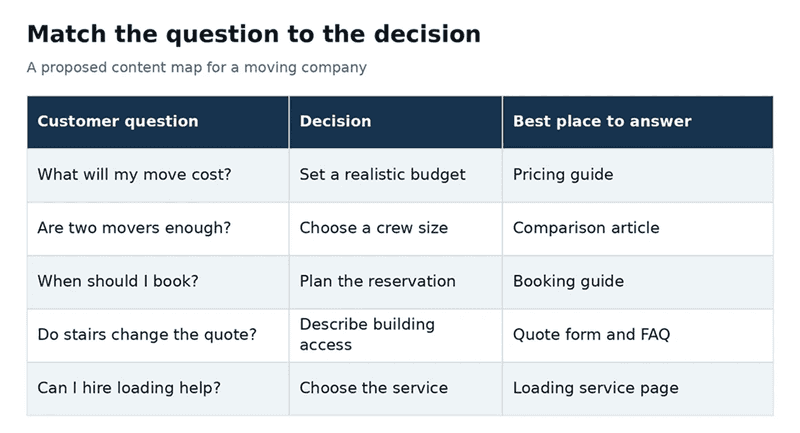
Before commissioning a new article, check whether an existing page could answer the question properly. Questions such as “What do Denver movers charge?” and “How much does a local move cost?” may belong in the same guide. Differences in phrasing alone do not require separate pages.
The All-in-One Platform for Effective SEO
Behind every successful business is a strong SEO campaign. But with countless optimization tools and techniques out there to choose from, it can be hard to know where to start. Well, fear no more, cause I've got just the thing to help. Presenting the Ranktracker all-in-one platform for effective SEO
We have finally opened registration to Ranktracker absolutely free!
Create a free accountOr Sign in using your credentials
Keep questions separate when the underlying decision changes. Local hourly pricing and an interstate estimate involve different assumptions. Likewise, someone looking for loading help for a rented truck needs a different service explanation from someone requesting a complete move.
Use Ranktracker's Keyword Finder to explore related phrasing and estimated search demand. Treat those estimates as one input alongside the company's ability to answer and the value of the decision. A narrow question can still matter when it resolves uncertainty immediately before an inquiry.
Make the answer specific enough to check
A pricing question demonstrates how useful content is built. An hourly rate needs enough context for a reader to understand the likely bill.
As checked on October 7, 2026, Moving Brothers' published Denver rates start at $159 per hour Sunday through Friday for two movers and a 26-foot truck. The listed Denver service fee is $139, and a two-hour minimum applies. Saturday's starting rate is $169 per hour; an additional mover is $65 per hour.
Using the Sunday-through-Friday starting rate, a four-hour example works out as follows:
4 hours × $159 per hour + $139 service fee = $775.
This calculation assumes two movers and four billable hours. It excludes additional services or charges and should be presented as an illustration. A customer's written estimate still depends on the actual job.
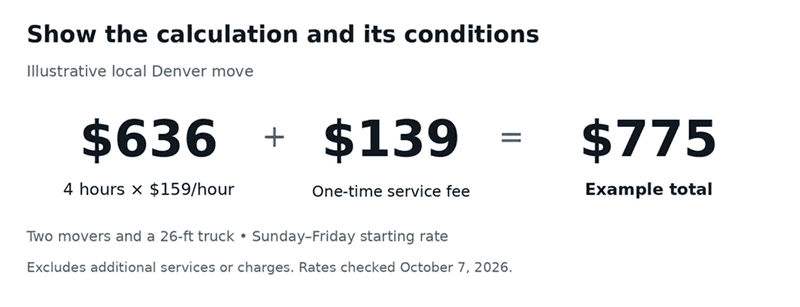
The example also reveals a useful follow-up question: could a larger crew change the total? A writer can explain that relationship by comparing clearly stated time assumptions. Any estimated time saving needs a basis in the inventory and access conditions.
This produces a more useful content brief. It asks the writer to explain crew size, expected hours, fees, and what changes the estimate. It also gives the reader a practical way to compare offers. The same method applies to other local services that combine hourly work with fixed charges.
Connect related answers around a planning guide
A visitor may move through several decisions before requesting an estimate. Build links that follow that sequence.
For a Denver moving website, a central planning guide could introduce costs, crew size, timing, booking, and service options. Each section would provide a short answer and direct readers to a detailed page when necessary.
The cost guide could link to the crew-size comparison at the point where labor hours are discussed. The comparison could link to the duration guide when explaining stairs, inventory, and access. The duration guide could connect to booking guidance when readers need to coordinate a move date.
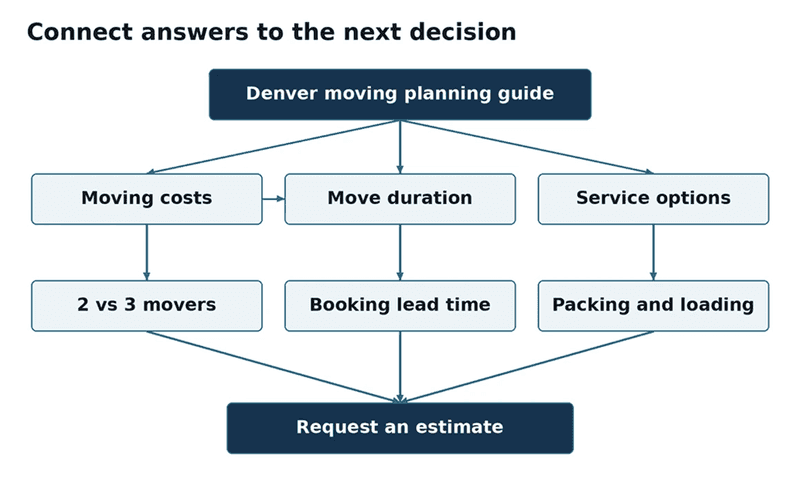
Use descriptive link text such as “compare two movers and three movers.” A relevant link should explain what the next page will help the reader do.
Keep key information consistent across the group. If a fee appears in several articles, assign someone to update all of them when it changes. A central pricing page can provide the current source, while supporting articles explain specific decisions and link back to it.
Give writers a brief they can use
The editor should be able to describe what a visitor will understand or decide after reading. For a crew-size article, that might be: “The reader can identify the inventory and access details needed to discuss two movers versus three with an estimator.”
Build the brief around five requirements:
-
Audience: who is asking and what stage of planning they are in.
-
Direct answer: the clearest opening response the business can support.
-
Evidence: current pricing, service terms, documented examples, or a named specialist's explanation.
-
Conditions: the factors that change the answer or require an individual assessment.
-
Next action: the details to gather, the related page to read, or the estimate to request.
Give the draft to someone who understands the service. An estimator can catch a missing assumption about parking or packing that a general writer might overlook. If you include a staff quote, use their actual words and confirm the attribution.
Google's guidance on helpful content emphasizes originality, accuracy, and clear authorship. For this type of article, those qualities come from the quality of the explanation and the evidence behind it. Identify the contributor accurately and make calculations easy to check.
Publish a manageable first set of pages
A small team can start with one connected group of useful pages. The following is a suggested four-week production schedule; adjust it to the time available for writing and review.
Week one: collect questions, review existing pages, and identify the most important unanswered decisions. Choose a main planning page and assign an owner to each supporting answer.
Week two: create or improve the cost guide. Check rates, minimum charges, fees, and example calculations. Have the person responsible for estimates review it before publication.
Week three: develop the crew-size and move-duration explanations. Check that their assumptions agree with the cost guide and add links where one answer naturally leads to another.
Week four: complete booking guidance, improve relevant service-page FAQs, and review the route to the quote form. Establish a baseline for measuring the finished group of pages.
Before publishing, check links, mobile readability, and whether important information is available as text. Diagrams can make relationships clearer, while nearby text should still explain the answer. A website auditing tool such as Ranktracker's Web Audit can support technical checks alongside a manual review of the reader's journey.
Measure progress in separate layers
Track whether people find the content, understand their options, and take a useful next step. Each layer needs its own evidence.
For search discovery, Google Search Console's Performance report provides impressions and clicks, with views grouped by queries and pages. Review the relevant pages together so you can see which questions are bringing visitors to the topic.
For business outcomes, track completed estimate requests and the proportion that fit the services and area you actually cover. Where your analytics setup supports it, examine movement from guides to service or quote pages. A phone-link click indicates an action on the website; confirming a completed, qualified call requires separate evidence.
Also ask the team whether inquiries contain better information about inventory, access, dates, and service needs. Record the observations rather than relying on a general impression that the content is working.
The All-in-One Platform for Effective SEO
Behind every successful business is a strong SEO campaign. But with countless optimization tools and techniques out there to choose from, it can be hard to know where to start. Well, fear no more, cause I've got just the thing to help. Presenting the Ranktracker all-in-one platform for effective SEO
We have finally opened registration to Ranktracker absolutely free!
Create a free accountOr Sign in using your credentials
If AI visibility is a goal, run a consistent set of questions across the same systems, language, and target market. Record company mentions and cited pages across repeated measurement rounds. Compare the pattern over time; a single response cannot establish a reliable change in visibility.
Interpret results with timing in mind. Seasonal demand, rate changes, and other marketing activity can affect inquiries during the same period. Use the evidence to choose the next improvement, and avoid attributing every change to one article.
Keep the answers useful after publication
Assign an owner and a review date to each page. Pricing and service terms should be checked whenever they change. Booking guidance should be reviewed against actual availability, and examples should continue to match the company's current offer.
Use new inquiries to identify gaps. If readers repeatedly ask about something already covered, check whether the answer is difficult to find, missing a condition, or written too generally. Update the existing explanation when that solves the problem.
Start the next planning session with one unanswered customer decision. Confirm what the team knows, identify the evidence, and give that answer a clear place on the website. That creates a practical connection between daily service knowledge and the content you publish.
About the contributor
Moving Brothers is a Denver, Colorado moving company offering local moving, packing, and loading and unloading services. The company helps customers plan moves around their inventory, addresses, service needs, and preferred dates. s

