
Intro
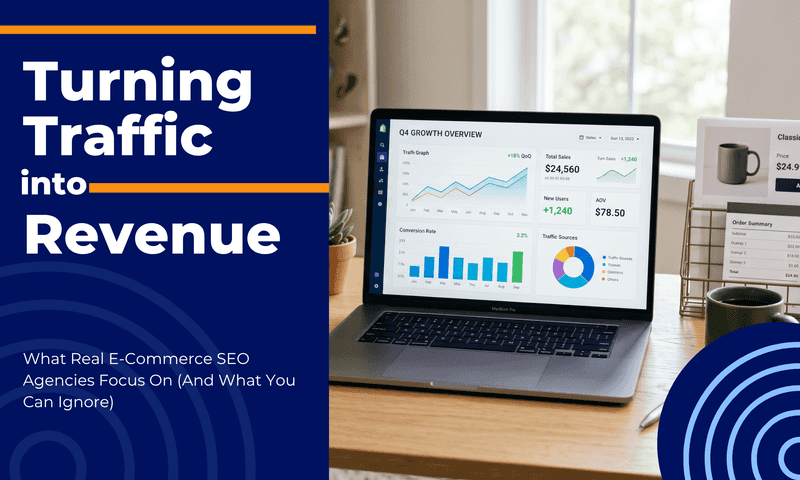
Your marketing budget is stretched thin, and paid ads keep getting more expensive. Your last agency sent monthly reports full of ranking charts, but sales never moved. You're not alone, and you're not wrong to be skeptical.
Finding the right ecommerce SEO agency starts with understanding what real SEO work looks like. It's not about chasing keywords for the sake of it. It's about building a system that turns organic search into predictable revenue.
What You Need to Know
- Organic search drives a large share of ecommerce traffic and sales, but only when technical SEO, content, and link building work together as one system.
- A good ecommerce SEO agency ties every recommendation to revenue, not just rankings or traffic volume.
- Technical SEO problems often hide behind a site that looks fine to users. Search engines experience your site differently than shoppers do.
- Content strategy should map to your buyer's actual journey, from early research to the moment they're ready to buy.
- Link building and digital PR build the authority signals that help Google trust your site over competitors.
- Rigid, long-term contracts are a red flag. Agencies confident in their results don't need to lock you in.
- The best agencies act as an extension of your team, not an outside vendor pitching a monthly retainer.
Why most ecommerce brands outsource SEO
SEO isn't one task. It's a collection of interconnected workstreams that all need attention at once.
Keyword research, technical audits, content production, and link building each require real expertise. Most in-house marketing teams have one or two people wearing five hats already.
Handing SEO to a specialist team frees your team to focus on the parts of the business only they can own.
This isn't about replacing your team. It's about giving them backup where the workload is heaviest.
The All-in-One Platform for Effective SEO
Behind every successful business is a strong SEO campaign. But with countless optimization tools and techniques out there to choose from, it can be hard to know where to start. Well, fear no more, cause I've got just the thing to help. Presenting the Ranktracker all-in-one platform for effective SEO
We have finally opened registration to Ranktracker absolutely free!
Create a free accountOr Sign in using your credentials
Want to know if outsourcing makes sense for your brand right now? Get a second opinion on your current SEO setup.
What an Ecommerce SEO agency actually does
A real ecommerce SEO agency does more than publish blog posts and call it a strategy. The work spans technical fixes, content planning, and off-site authority building.
Here's what that typically includes:
- Technical SEO audits that find crawl errors, indexing issues, and site speed problems.
- On-page optimization for product pages, collection pages, and category structure.
- Keyword research mapped to what your buyers actually search for at each stage.
- Content strategy that fills gaps and updates aging pages before they lose ground.
- Digital PR and link building to build the authority signals Google rewards.
- Performance tracking that connects SEO activity to real traffic and revenue.
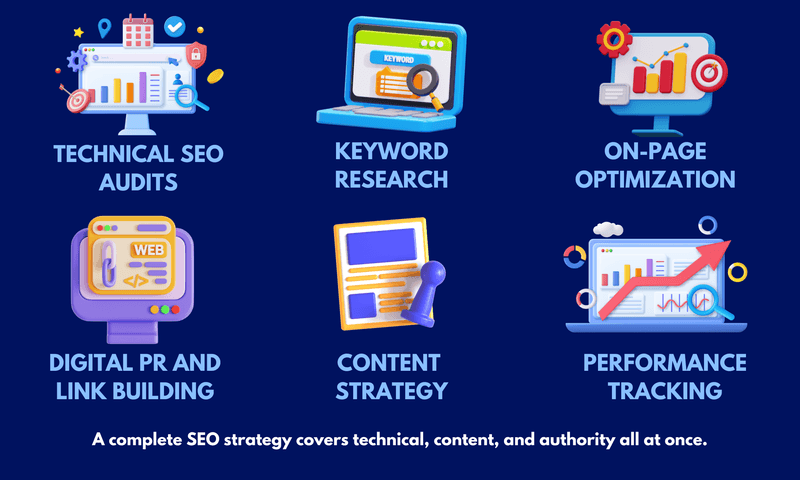
Skipping any one of these areas leaves gaps competitors will find first.
Technical SEO: The foundation Search Engines need
Think of your website like a store. If the aisles are blocked or the signs are confusing, shoppers leave, even if the products are great.
Search engines work the same way. If Google can't crawl your pages properly, it doesn't matter how good your content is. Broken redirects, blocked pages, and slow load times all quietly cap your visibility.
These issues often go unnoticed because your site still looks fine to shoppers. That's exactly why they're dangerous.
A technical audit should be the first thing any ecommerce SEO agency runs before touching content.
Content and Keyword strategy tied to buyer intent
Not every visitor is ready to buy. Some are researching, some are comparing, and some already have their card out.
The All-in-One Platform for Effective SEO
Behind every successful business is a strong SEO campaign. But with countless optimization tools and techniques out there to choose from, it can be hard to know where to start. Well, fear no more, cause I've got just the thing to help. Presenting the Ranktracker all-in-one platform for effective SEO
We have finally opened registration to Ranktracker absolutely free!
Create a free accountOr Sign in using your credentials
A strong content strategy maps to all three stages. Early-stage content builds trust and awareness. Bottom-of-funnel content, like comparison guides and product-specific pages, drives the conversions your team actually cares about.
Keyword volume matters less than relevance. A smaller, highly qualified audience will always outperform a large, unqualified one on your bottom line.
Digital PR and link building for Ecommerce authority
Links act like votes of confidence from other websites. The more relevant, credible sites that link to yours, the more Google trusts your brand.
Digital PR earns those links through real outreach, not shortcuts. That means pitching journalists, building relationships with relevant publications, and creating content worth linking to in the first place.
Brands that pause link building don't just stall. They fall behind competitors who never stopped earning links in the first place.
What to Look for in an Ecommerce SEO agency
The right agency should feel like part of your team, not a vendor sending reports you don't understand. Here's what separates a real partner from a risky bet.
- A proven track record with case studies specific to ecommerce, not just general SEO.
- Clear, jargon-free communication explaining the reasoning behind each recommendation.
- Flexible engagement terms instead of long-term contracts you can't exit.
- A defined process covering discovery, research, content, technical work, and links.
- Direct access to the people doing the work, not just an account manager.
Specialization becomes especially important for direct-to-consumer businesses. Working with an ecommerce SEO agency for DTC brands means the strategy can account for challenges common to these stores, including collection and category architecture, product-page duplication, changing inventory, conversion-focused search intent, and the need to turn non-branded organic discovery into sales.
Those details can easily be missed when an SEO strategy is built around a standard website rather than the way an ecommerce store actually operates.
Red Flags That Signal a Bad Fit
Some warning signs show up before you even sign a contract. Watch for agencies that guarantee rankings, since no one controls Google's algorithm.
The All-in-One Platform for Effective SEO
Behind every successful business is a strong SEO campaign. But with countless optimization tools and techniques out there to choose from, it can be hard to know where to start. Well, fear no more, cause I've got just the thing to help. Presenting the Ranktracker all-in-one platform for effective SEO
We have finally opened registration to Ranktracker absolutely free!
Create a free accountOr Sign in using your credentials
Watch for vague reporting that shows activity but never ties back to traffic or sales. Watch for long-term contracts with steep exit fees, since confident agencies don't need to trap clients.
Not sure if your current setup is working the way it should? Let's talk about what's holding your SEO back.
How Break the Web Approaches Ecommerce SEO
Break the Web builds every strategy around your specific brand, goals, and internal capacity. That starts with a technical audit, then moves into content and authority building in parallel.
We work on a 30-day opt-out model because we believe results should earn the relationship, not a contract. You'll always know what we're doing and why, backed by data you can check yourself.
Ready to see what a real ecommerce SEO strategy could look like for your brand? Schedule a strategy chat, no sales pitch.

