
Intro
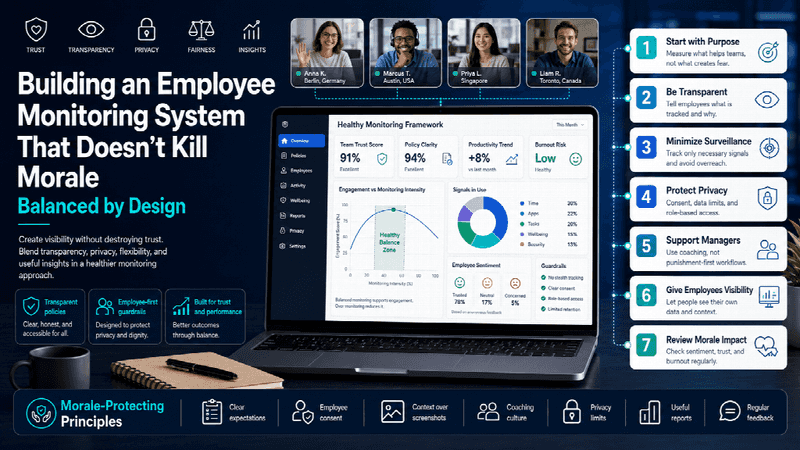
Monitoring programs rarely fail on technology. They fail on three decisions made before anyone installs anything: which layers get switched on, what the policy says out loud, and who is allowed to look at an individual's data.
Get those wrong and the tool works perfectly while the team stops trusting management. Get them right and the same software becomes unremarkable within a month. An employee monitoring system is a set of choices about visibility, not a product you buy — the vendor supplies capture capability, and everything that determines whether people accept it happens on your side of the purchase.
The research is unambiguous on the size of that effect. Undisclosed monitoring produces roughly a 62% increase in employee stress; disclosed monitoring, using the same tools, produces around 18%. Nothing about the software changed between those two numbers.
Why monitoring systems kill morale
Four failure modes account for most damage, and all four are avoidable.
The system watches people instead of work. Individual dashboards invite individual comparison. Aggregate reporting on workflows answers most management questions without ever naming a person.
Activity gets treated as performance. Activity scores measure whether keyboard and mouse input occurred, typically within ten-minute windows. They say nothing about output quality. Feed them into performance reviews and you get performance theatre: people optimise for the metric, and you lose both the data and the trust.
The All-in-One Platform for Effective SEO
Behind every successful business is a strong SEO campaign. But with countless optimization tools and techniques out there to choose from, it can be hard to know where to start. Well, fear no more, cause I've got just the thing to help. Presenting the Ranktracker all-in-one platform for effective SEO
We have finally opened registration to Ranktracker absolutely free!
Create a free accountOr Sign in using your credentials
Employees find out on their own. Discovery is the single most damaging event in a monitoring program. It converts a management decision into a betrayal, and it is difficult to walk back.
Nobody defined what is not monitored. Silence on the boundary means employees assume the worst boundary. The absence of a stated limit is read as the absence of any limit.
Design principle: monitor systems, not people
The useful reframe is that monitoring should answer questions about work, not about individuals.
"Which stage of onboarding takes longest?" is a systems question. "Is Marek slacking?" is a person question. The first improves the process for everyone; the second turns the tool into a supervisor and produces exactly the culture that makes people leave.
This is not only an ethical position. Outcome-based monitoring produces roughly 19% lower presenteeism than surveillance-style approaches, and organisations that pair monitoring with clear goal-setting see materially better results than those that deploy it alone.
Choose your layers deliberately
Most tools bundle several capture types. Each carries a different cost in employee resistance, and the cheapest way to protect morale is simply not to enable layers you do not need.
| Capture layer | What it answers | Resistance level | Enable when |
| Time and attendance | Were hours worked | Low | Billing, contractors, shift work |
| Application and site usage | Where does time go | Low | Capacity planning, tool audits |
| Activity levels | Was there input | Low–medium | Proof of work for clients |
| Interval screenshots | What was on screen | Medium–high | Client disputes, contractor proof |
| Full URL and page titles | Exactly what was viewed | High | Rare; specific compliance need |
| Keystroke content | What was typed | Very high | Documented security requirement only |
| Continuous screen recording | Full session replay | Very high | Insider-risk programs with a review function |
| Biometrics and location | Where the person is | High | Field work, physical access control |
Two practical notes. Around 46% of tech workers say they would quit over keystroke logging or screenshot capture specifically — the bottom half of that table carries real attrition risk. And default configuration matters more than the feature list: some tools ship with full-URL capture or location tracking enabled, and upgrading a plan for an unrelated reason can switch layers on without a decision being made. Audit defaults after every plan change.
Tools differ meaningfully here. Monitask, ActivTrak, Hubstaff, and Prodoscore do not record keystroke content at all; Monitask derives activity levels from whether input occurred in each ten-minute window and captures nothing between clock-out and the next clock-in. Teramind, Veriato, and Controlio capture content at their upper tiers. Neither approach is wrong, but they belong to different programs with different disclosure obligations.
Write the policy before you buy
If you cannot write the policy clearly, the configuration is wrong. The document is also your best test of whether the program is defensible: anything you would not put in writing to employees should not be running.
A workable policy answers eight questions.
- What is captured — every layer, named plainly, not "activity data"
- When it runs — working hours only, or whenever the device is on
- What is not captured — the clause most policies omit and employees most want
- Who can see individual data — by role, not by seniority
- How long it is kept — and what happens at the end of that window
- What it will be used for — billing, capacity, security
- What it will not be used for — performance reviews, discipline, ranking
- How employees see their own data — and how to contest it
The "what we do not monitor" clause does more work than the rest of the document combined. Explicitly stating that personal messages, passwords, or off-hours activity are not captured removes the ambiguity people fill with worst-case assumptions.
The All-in-One Platform for Effective SEO
Behind every successful business is a strong SEO campaign. But with countless optimization tools and techniques out there to choose from, it can be hard to know where to start. Well, fear no more, cause I've got just the thing to help. Presenting the Ranktracker all-in-one platform for effective SEO
We have finally opened registration to Ranktracker absolutely free!
Create a free accountOr Sign in using your credentials
On personal devices, the answer is narrower: monitoring work applications on employee-owned hardware generally requires explicit written consent, and even then should be scoped to work data. Scanning personal photos, chats, or browsing history on a personal device is indefensible regardless of consent language.
Announce it properly
Four mistakes destroy announcements before the tool is even installed.
Presenting it as already final. "We've implemented monitoring software" ends a conversation that should be starting. Announce the decision, then leave a window for questions before rollout.
Leading with distrust. Any framing implying the team is suspected of slacking confirms exactly the fear people already have. Lead with the operational problem instead: unclear capacity, disputed invoices, compliance requirements.
Sending it by email. Written policy is necessary; an email as the primary channel is not. People need to ask questions and see the answers, which means a meeting.
Vagueness. "We'll be tracking activity" invites imagination. "We record which applications are open and when time starts and stops; we do not record what you type or take screenshots" closes it.
The evidence on this is strong: roughly 77% of employees say they would be less concerned about monitoring if informed in advance about what is collected, and around 85% think disclosure should be legally required. This is not a soft preference — it maps directly onto retention.
Pilot before rolling out
A phased rollout catches configuration problems while they are still cheap.
Start with one volunteer team, ideally including the people who proposed the program. A management team that will not run the tool on itself has answered the question about whether the configuration is reasonable.
Run two weeks minimum. Shorter periods do not surface the metric problems — the days where someone spent six hours in workshops and the dashboard called it idle.
Ask the pilot group what the data got wrong. They will tell you specifically, and it is the cheapest validation available. Common findings: meetings register as inactive, thinking work scores badly, and one team's normal pattern looks alarming compared to another's.
Change something visible in response. Adjusting categories, reducing screenshot frequency, or narrowing who sees individual data demonstrates that feedback affected the outcome. Rolling out unchanged after a feedback exercise is worse than not asking.
Decide who looks at what
Access design does more for morale than any policy sentence.
Aggregate by default. Most management questions are answered by team-level data. Individual drill-down should require a reason, not a click.
Give employees their own data first. Nearly half of employees with access to their own activity data report using it to improve their performance. Self-visibility also removes the asymmetry that makes monitoring feel like surveillance — if managers can see it and you cannot, it is being done to you.
Restrict individual views by role. A team lead needs their own team. A department head rarely needs individual rows. Finance needs billing totals, not screenshots.
Log the lookups. Audit logs on who viewed whose data protect employees from casual snooping and protect managers from accusations of it.
How to talk about the data
The conversation that follows a low number determines whether the program survives.
Never open with the metric. "Your activity score is 34%" puts the employee in a defensive position against a number they cannot contest. "I noticed the Henderson project has taken longer than we scoped — what's getting in the way?" starts from the work.
Treat anomalies as questions. Low activity during a week of client workshops is not a finding; it is a limitation of the metric. Managers who do not understand what the metric measures will misread it confidently.
Never use monitoring data as the sole basis for discipline. Beyond fairness, it is fragile: activity scores and screenshots are weak evidence, and any employee who understands the metric can dismantle a case built on it.
Report back what changed. If the data led to rebalancing workloads, retiring an unused tool, or fixing a bottleneck, say so publicly. A program that visibly improves conditions is tolerated. One that only produces reports upward is resented.
If trust is already damaged
Programs deployed badly can be recovered, but not by adding features.
The All-in-One Platform for Effective SEO
Behind every successful business is a strong SEO campaign. But with countless optimization tools and techniques out there to choose from, it can be hard to know where to start. Well, fear no more, cause I've got just the thing to help. Presenting the Ranktracker all-in-one platform for effective SEO
We have finally opened registration to Ranktracker absolutely free!
Create a free accountOr Sign in using your credentials
Turn layers off, publicly. Disabling screenshots or keystroke logging is the only credible signal, and it must be announced rather than quietly configured.
Publish what you already collected. Give employees access to their own historical data. It is uncomfortable and it works — the fear is usually worse than the reality.
Name the mistake. "We rolled this out without telling you properly, and that was wrong" costs nothing and buys more than a revised policy document.
Accept the timeline. Trust recovers over months, not weeks. The recovery is genuine but slow, and pushing it produces the opposite result.
Frequently asked questions
Does employee monitoring reduce morale?
It depends entirely on disclosure and use. Covert monitoring produces roughly 2.3 times higher quit intent than transparent monitoring with the same tools. Programs that disclose fully, report aggregate data, and exclude monitoring from performance reviews generally see little morale impact.
What should an employee monitoring policy include?
What is captured, when it runs, what is explicitly not captured, who can view individual data, how long it is retained, what it will be used for, what it will not be used for, and how employees access their own data. The "not captured" clause matters most.
Can employers monitor personal devices?
Only with explicit written consent, and only for work-related applications and data. Personal photos, private messages, and personal browsing remain out of scope regardless of consent. Employees should be able to decline by not using personal hardware for work.
Should employees be able to see their own monitoring data?
Yes. Nearly half of employees given access to their own data report using it to improve performance, and self-visibility removes the asymmetry that makes monitoring feel like surveillance. It is the single cheapest trust measure available.
Is it legal to monitor employees without telling them?
It varies by jurisdiction. Several US states, Ontario, and the EU impose disclosure or written-policy requirements. Even where covert monitoring is permitted, the retention and trust costs generally exceed any benefit for productivity purposes.
How do I introduce monitoring to a team that will resist it?
Lead with the operational problem rather than the tool, disclose every capture layer specifically, hold a meeting rather than sending an email, run a pilot that includes management, and change something visible in response to feedback before rolling out further.
Should monitoring data be used in performance reviews?
Generally no. Activity metrics measure input, not output, and using them in reviews produces performance theatre rather than performance. Use the data for capacity planning, billing, and process improvement, and say so explicitly in the policy.
How long does it take for a team to accept monitoring?
Where it is disclosed properly and used narrowly, monitoring typically becomes unremarkable within four to six weeks. Where it was discovered rather than announced, recovery takes months and requires visibly turning capabilities off, not adding reassurances.

