Intro
When a small business owner says “I want to be on the first page of Google,” they usually mean one thing. When someone nearby types “plumber near me,” “best tacos in [town],” or “hair salon open now,” they want to be one of the businesses that shows up.
For a local business, that first page is mostly the map box at the top. Three names. Stars. Hours. A phone number. Most people never make it to the blue links underneath.
You do not need to beat a national brand. You need to beat the other shops in your town. That is a winnable fight, and it does not require an ad budget. It does require a few basics that most local sites still skip.
We know because we’ve read the research.
What we found on 100 real small-business websites
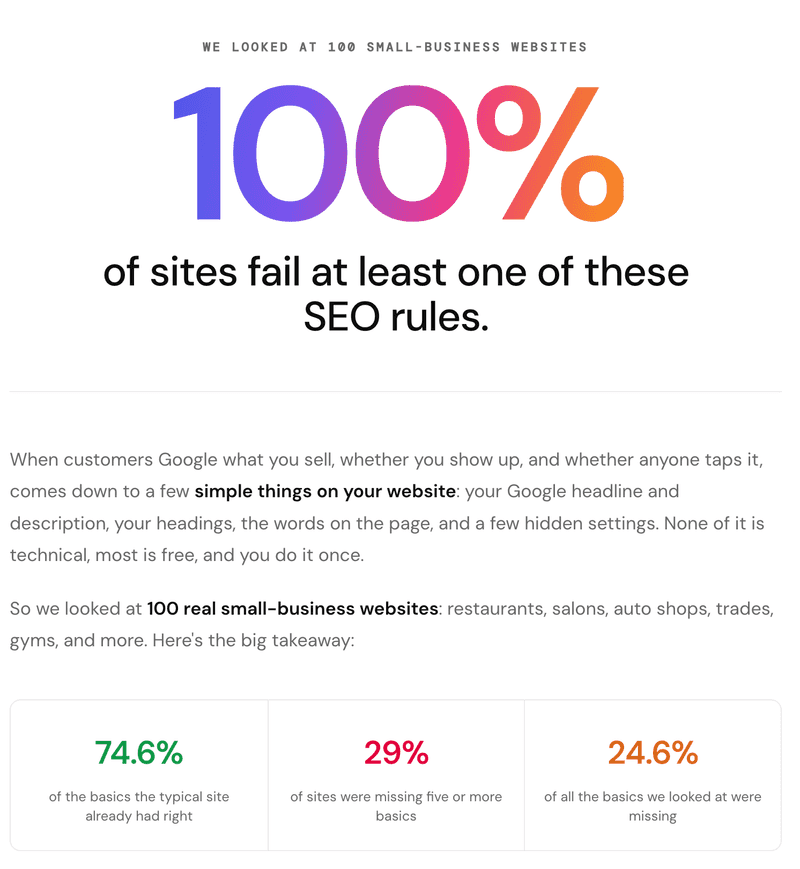
Frontpage looked at 100 small-business websites restaurants, salons, auto shops, trades, gyms, and more. They scored the simple things Google uses to understand who you are and what you do.
Frontpage builds sites for local businesses and grades the ones they already have. The audit looks at what Google and a customer both notice: whether the business shows up, whether the page is clear on a phone, whether real reviews are on the site, and whether the next step is obvious. Those are the same gaps that keep a good shop off the first page in its town.
The All-in-One Platform for Effective SEO
Behind every successful business is a strong SEO campaign. But with countless optimization tools and techniques out there to choose from, it can be hard to know where to start. Well, fear no more, cause I've got just the thing to help. Presenting the Ranktracker all-in-one platform for effective SEO
We have finally opened registration to Ranktracker absolutely free!
Create a free accountOr Sign in using your credentials
Not one site had everything in place.
The typical site already had about 75% of those basics right. That sounds fine until you see the gaps. 29% of the sites were missing five or more. The most common miss was the Google result itself. 72% of sites had a headline or blurb that was too long or too short for Google to show in full. 44% were missing the blurb on at least one page, so Google grabbed a random scrap of text instead. 51% did not have exactly one main heading that said what the page was about.
In plain English: a lot of decent businesses are invisible, or they show up looking broken.
The rest of this post is the order of work that moves a local business onto that first page. Do these in sequence. Do not start a blog until the list below is done.
1. Finish your Google Business Profile
If you only do one thing this week, do this.
Your Google Business Profile is the free listing that decides whether you appear in the map box. Google rewards a complete, active listing. Fill in the exact business name you use on the door, your address or service area, phone, hours, categories, services, and real photos of the work. Then keep it alive. Add a photo. Reply to a review. Post an update.
Search your business name tonight. Then search “[what you do] near me” on your phone. If you are missing from the map, or your hours and photos look thinner than the shop down the street, that is the first leak.
The All-in-One Platform for Effective SEO
Behind every successful business is a strong SEO campaign. But with countless optimization tools and techniques out there to choose from, it can be hard to know where to start. Well, fear no more, cause I've got just the thing to help. Presenting the Ranktracker all-in-one platform for effective SEO
We have finally opened registration to Ranktracker absolutely free!
Create a free accountOr Sign in using your credentials
A half-finished profile loses to a complete one. Google is explicit about this. Completeness helps them give people better answers.
2. Get more Google reviews than the next three businesses
Reviews do two jobs at once. They help Google decide who to show. They help a stranger decide who to call.
BrightLocal’s consumer research has found that about 97% of people read reviews for local businesses. That is the default. People check stars the way they used to ask a neighbor. Fresh reviews matter more than a pile of old ones. A business with 40 reviews from this year beats a business with 80 reviews from 2019.
In our own look at those 100 sites, customer proof was one of the weakest spots. Where named reviews applied, 71% of sites had no properly credited reviews on the page. Many only linked out to Google. The proof never sat next to the “Call” button.
Do three things:
- Ask after the job. Send a direct link the same day.
- Reply to every review, good and bad.
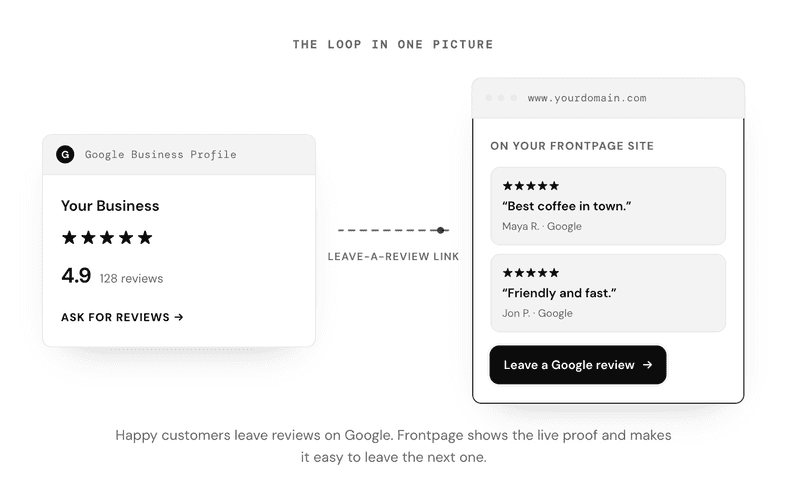
- Put a few real Google reviews on your homepage, next to the thing you want people to do.
How to get Google reviews onto your website is a practical walkthrough if you want the proof on the page, not only on Maps.
Do not pay for five-star reviews. That breaks Google’s rules and it backfires.
3. Give each service its own page, with the town in the title
Google cannot rank a page it does not understand. A homepage that says “Welcome” or “Your partner in excellence” tells Google nothing.
They saw this repeatedly. 17% of the sites never said what they do in the opening line. 15% chased huge, impossible words like “pizza” or “tires” and skipped the phrases people type, like “wood-fired pizza in [city]” or “emergency plumber in [neighborhood].”
The fix is simple:
- One page per main service.
- A headline that names the service and the town: “Brake Repair in [City] | [Your Shop].”
- A short blurb under it, about 150 characters, that says what you do and what to do next.
- A first sentence on the page that a human would say out loud.
Keep headlines to about 50 to 60 characters so Google does not cut them off. Put your business name at the end so you still show up when someone searches you by name. 11% of the sites they checked left their own name out of the headline. That is how you lose your own customers to a directory.
You do not need a blog yet. Thin posts will not fix a site that never says what it sells.
4. Make your name, address, and phone match everywhere
Google cross-checks you. If the website says “123 Main Street” and the Google listing says “123 Main St., Suite B,” you create doubt.
Put the same name, phone, and address on:
- your Google Business Profile
- the header or footer of every page
- your Contact page
- the major directories you already use
On the website, the phone number must be tappable on a phone. Hours should match the door. If you go to people, say the service area in plain language.
This is boring. It is also one of the reasons a competitor with a messier site still ranks above you.
5. Make the site work on a phone, then ask for the call
Most of those “near me” searches happen on a phone. Google has reported that 76% of people who search on a smartphone for something nearby visit a related business within a day. If your site is slow, hard to tap, or never asks for the next step, you paid for a visit and then threw it away.
Speed was one of the stronger areas in our 100-site check, but it was not finished. Only 5% of sites passed every technical check. Half failed three or more. The most common technical miss was heavy images that load all at once instead of waiting their turn.
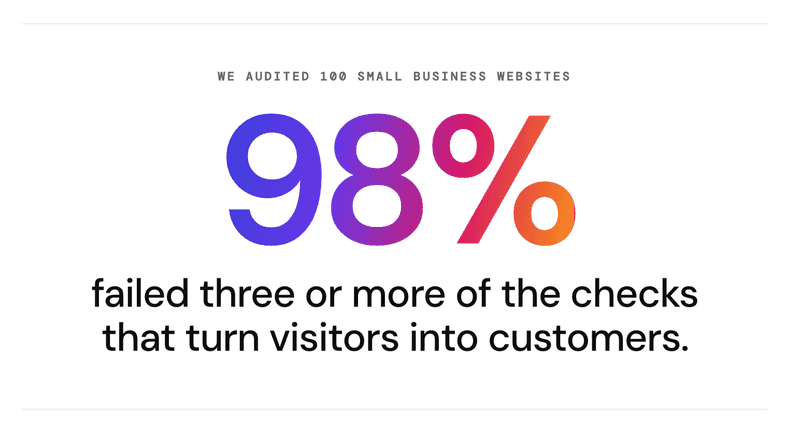
Then there is the part owners skip after they start ranking. In the same study, conversion was the second-weakest area. About 98% of sites failed three or more conversion checks. 53% had no single main button. 73% had no click-to-call in the header. 97% never asked for a review after someone reached out.
Ranking gets the visit. The page has to ask for the customer. If the first screen does not say what you do, show a real photo, and offer a tappable “Call now” or “Book,” more traffic will not save you.
How long this takes
SEO is not overnight. For a local business doing the work above, a realistic picture looks like this:
Month 1. Finish the Google profile. Fix titles and blurbs. Start asking for reviews. Match your name and phone everywhere. Make the site usable on a phone.
Months 2 to 4. Rankings start to move for the smaller, more specific searches. Your listing shows up more often. Reviews accumulate.
Months 4 to 6. The map box gets more consistent. The service pages you wrote begin to earn steady clicks. The work compounds.
Anyone promising first page by Friday is selling you ads, or they are lying.
Check this tonight
The All-in-One Platform for Effective SEO
Behind every successful business is a strong SEO campaign. But with countless optimization tools and techniques out there to choose from, it can be hard to know where to start. Well, fear no more, cause I've got just the thing to help. Presenting the Ranktracker all-in-one platform for effective SEO
We have finally opened registration to Ranktracker absolutely free!
Create a free accountOr Sign in using your credentials
You do not need a consultant to see where you stand.
- On your phone, search your business name. Then search “[your service] near me.”
- Count your Google reviews against the three businesses in the map box.
- Open your own site. Can you tell what you do in three seconds? Can you tap the phone number?
- Search one service page. Does the bold headline name the service and the town, or does it trail off into “…”?
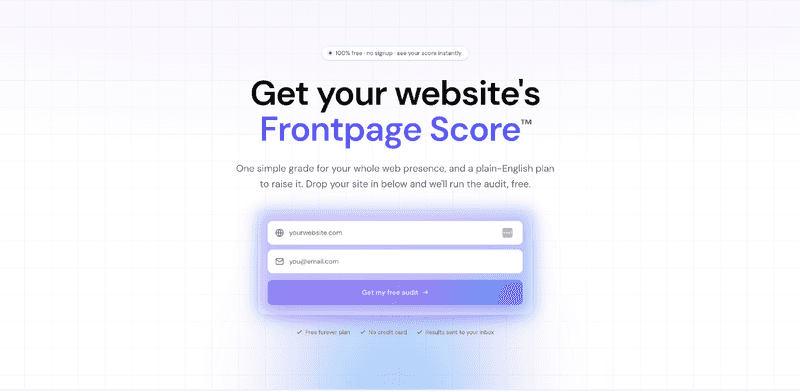
If you want the same kind of scored checklist they used on those 100 sites, run a free website audit. You get a grade and a plain-English list of what to fix. No credit card.
The businesses that get on the first page in their town are not the ones with the fanciest website. They are the ones Google can understand, that neighbors have reviewed, and that make the next step obvious when someone finally taps through.
Frontpage is for owners who want that work done with them. Describe the business in plain language and a live site goes up, hosting included. The aim is more people finding the business, trusting it, and calling.