Intro
Every month about 1,600 people in the US alone type "backlink generator" into Google, and another 480 add the word "free" (Semrush, October 2026). The promise behind those searches is simple: paste a URL, click a button, get backlinks. The question nobody seems to answer with data is what you actually get.
So I tested it the only way that makes sense. I ran one of these tools on a site I control, logged every reply from every service, and then opened the resulting pages with a crawler to see whether a real, followed, indexable link had appeared anywhere. This post walks through the numbers, explains why the result looks the way it does, and ends with what I would do instead if I had an afternoon and no budget. The short version: of 60 services pinged, exactly one page contained a link to my domain, and that link was nofollow on a page Google is told not to index.
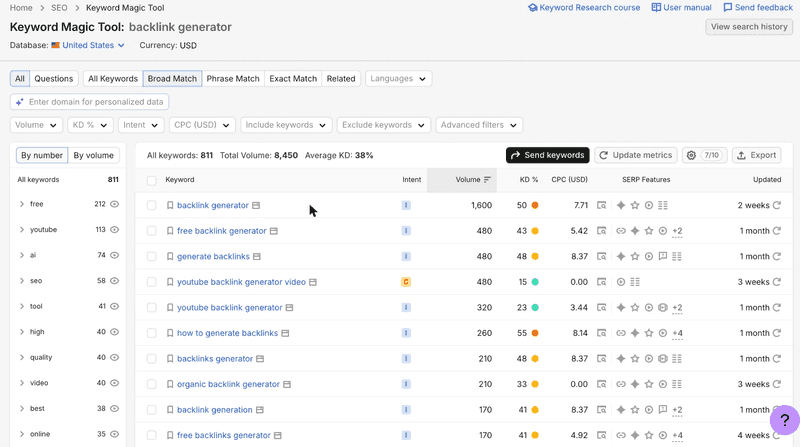 Source: Semrush Keyword Magic Tool, US database, October 2026.
What a "backlink generator" really does
Strip away the marketing and almost every tool in this category does the same thing. It takes your domain and fires it at a list of public web services: WHOIS lookups, DNS checkers, "website worth" calculators, SSL scanners, speed tests, uptime monitors. Each of those services builds a page about your domain on request. The tool then lists those pages as "backlinks created".
That is the whole mechanism. Nobody writes about your site. No editor decides your page deserves a mention. A script just asks thirty or sixty databases to show their record of your domain, and reports back whether the server said OK.
Google's spam policies name this pattern directly: "using automated programs or services to create links to your site" is listed under link spam. It has been since the Penguin era, and since Penguin 4.0 in 2016 Google mostly ignores such links rather than penalising them. "Ignored" is the key word. The realistic outcome is not a penalty. It is nothing.
The test setup
I used the Backlink Maker on seotools.pro for one reason: it is the only generator I found that publishes the full list of 60 services it pings and shows each service's raw HTTP reply instead of a vague "submitted" badge. That transparency made it possible to audit. The test domain was seotools.pro itself, so no third-party site was spammed, and the run took 34 seconds.
Then I did the part the tools never do. For each service that reported success, I fetched the resulting page with a plain HTTP client (the same way Googlebot first sees a page), and checked three things:
- Does the HTML contain an actual
<a href>- pointing to my domain, or just the domain as plain text?
- If there is a link, is it followed or
rel="nofollow"- ?
- Does the page carry a
noindex- robots tag?
Those three checks separate a backlink from a mention, and a mention from a page nobody will ever see in search.
What the 60 services returned
The All-in-One Platform for Effective SEO
Behind every successful business is a strong SEO campaign. But with countless optimization tools and techniques out there to choose from, it can be hard to know where to start. Well, fear no more, cause I've got just the thing to help. Presenting the Ranktracker all-in-one platform for effective SEO
We have finally opened registration to Ranktracker absolutely free!
Create a free accountOr Sign in using your credentials
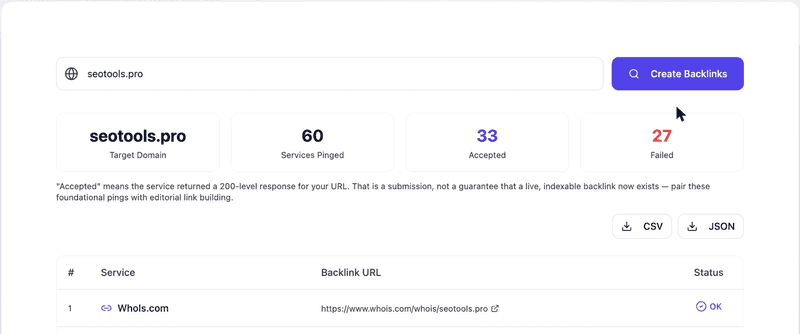
The generator reported 33 accepted and 27 failed. The failures split into HTTP 403 (the service blocks automated requests), 404 (the lookup page does not exist for that domain), timeouts and generic errors. Services like GTmetrix, SEOptimer, WebPageTest and Reddit search all refused the bot outright. That is a fair warning sign on its own: a third of the "backlink sources" in a typical generator list do not even accept the request any more.
Here is where it gets interesting. "Accepted" only means the server answered with a 200-level code. I then crawled the 30 accepted URLs I could reconstruct.
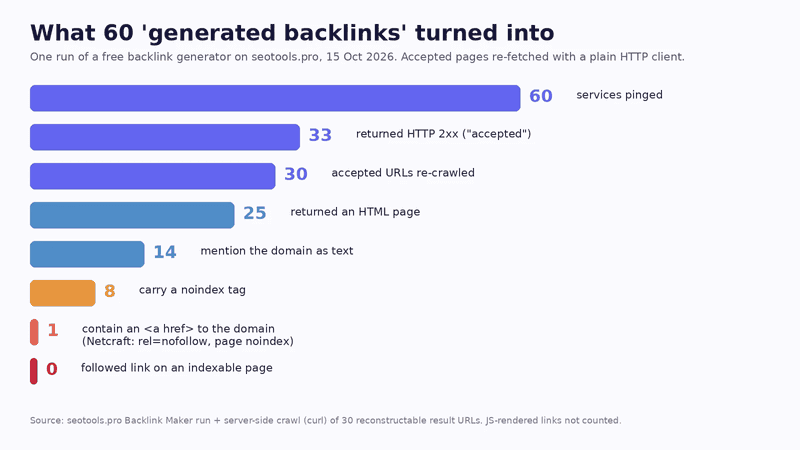
- 25 of 30 returned a normal HTML page when fetched again.
- 14 of 30 mentioned the domain name anywhere in the HTML, usually as the heading of a lookup report.
- 8 of 30 carried a
noindex- meta tag (HypeStat, URLVoid, Mozilla Observatory, PageSpeed Insights, Netcraft, GTmetrix, SecurityHeaders, DNS Checker). Those pages are explicitly excluded from Google's index.
- 1 of 30 contained an actual anchor tag pointing to my domain: Netcraft's site report. That link was
rel="nofollow noreferrer"- , and the page itself was
noindex, nofollow- .
- 0 of 30 contained a followed link on an indexable page.
So the honest count is not 33 backlinks or 60 backlinks. It is zero. Several pages (Majestic, who.is, StatShow) contain dozens of links that include my domain in their query string, but every one of them points back to the tool's own site, not to mine. A crawler that resolves hrefs sees them for what they are: internal navigation.
One caveat worth stating: some of these services render their report with JavaScript after the page loads, so a plain fetch could miss a link that appears later in a browser. Google does render JavaScript, but with a delay and a crawl budget, and a nofollow or noindex tag applied server-side is still honoured. Even in the most generous reading, the result moves from zero to "maybe a handful of nofollow links on report pages". It does not move toward anything that affects rankings.
Why this is the expected result, not a bad run
Three things make backlink generators structurally incapable of producing useful links.
The pages are not editorial. Google's link guidance for years has rewarded links that a person chose to place because the target was useful. A WHOIS record contains your domain because that is what WHOIS records contain. There is no choice, so there is no signal.
The pages are templated and mostly orphaned. A "website value" calculator has millions of near-identical pages, one per domain, almost none of which rank for anything or receive links. Even where such a page is indexed and the link is followed, the page's own authority is close to nil, and the link sits next to thousands of other outbound links to random domains.
The All-in-One Platform for Effective SEO
Behind every successful business is a strong SEO campaign. But with countless optimization tools and techniques out there to choose from, it can be hard to know where to start. Well, fear no more, cause I've got just the thing to help. Presenting the Ranktracker all-in-one platform for effective SEO
We have finally opened registration to Ranktracker absolutely free!
Create a free accountOr Sign in using your credentials
Most of them are deliberately blocked from search. Eight of the thirty pages I checked told Google not to index them. Services add that tag precisely because they do not want millions of thin lookup pages in the index. A link on a page that is not in the index is invisible to the ranking algorithm.
The All-in-One Platform for Effective SEO
Behind every successful business is a strong SEO campaign. But with countless optimization tools and techniques out there to choose from, it can be hard to know where to start. Well, fear no more, cause I've got just the thing to help. Presenting the Ranktracker all-in-one platform for effective SEO
We have finally opened registration to Ranktracker absolutely free!
Create a free accountOr Sign in using your credentials
The upshot: the "free" in free backlink generator is accurate. You pay nothing and you receive nothing. The only real cost is the hour you spend believing the counter.
The one legitimate use of these tools
There is a narrow case where pinging those services is worth 30 seconds: a brand-new domain that has never been crawled. Hitting a dozen lookup services creates a few pages that mention the domain, and some of them get crawled quickly. Occasionally that helps Google discover a site a day or two sooner. It does not help it rank. If you use a generator for that, treat it the way you would treat submitting a sitemap: a discovery nudge, not link building.
A second honest use is diagnostic. Because a transparent generator shows each service's reply, you can see which checkers currently block bots and which still produce indexable pages. For anyone cleaning up a backlink profile, that is useful context when you find hundreds of "website worth" domains in your referring domains report and wonder where they came from.
What I would do with the same afternoon
If the goal is links that move rankings, here is the order I would work in, cheapest first. None of it needs a tool that promises backlinks.
-
Find out what you already have. Run your domain through a backlink checker and look at three columns: referring domains, followed versus nofollow, and the anchor text. If half your "links" turn out to be generator pages like the ones above, you have your explanation for why nothing has moved. Set up backlink monitoring once so you notice when a real link appears or disappears.
-
Mine your competitors' real links. Pick the three sites that outrank you for the keyword you care about and look at which domains link to all three but not to you. Those are sites that already link to pages like yours. One email to each with a specific reason beats sixty automated pings.
-
Fix the thing that stops people linking to you. The most common reason a decent page earns no links is that it has nothing citable. Add one original number: a survey of your customers, a price comparison, a test like the one in this post. Pages with a first-hand data point get linked to because writers need something to cite. The earliest Ahrefs study on paid links is still quoted everywhere because it had concrete figures: of 450 sites contacted, 12.6% would sell a link, and the average price was $361.44 for a niche edit and $77.80 for a guest post (Ahrefs, "Should you buy backlinks?"). Be the source of a number like that in your niche.
-
Use free tools for what they are good at. Free SEO tools are useful for diagnosis, not for shortcuts. A site audit that finds the 40 pages you accidentally set to noindex will do more for organic traffic than any quantity of generated links, and a keyword finder that shows you the 480-a-month "free backlink generator" query also shows that people searching it are looking for a shortcut, which is a content opportunity if you are willing to tell them the truth.
-
Write the guest post yourself. The Ahrefs figure above says a paid guest post costs about $78 on average. A free one costs you the time to write 1,500 useful words. Either way you get a link a human chose to publish, on a page that is indexed and read.
A checklist before you trust any backlink counter
Whenever a tool, a marketplace or a freelancer tells you "we built N backlinks", ask for the URLs and run this five-minute check on a sample:
- Open the page source and search for your domain inside an
href- , not just in the text.
- Look for
rel="nofollow"- ,
rel="ugc"- or
rel="sponsored"- on that anchor.
- Look for
<meta name="robots" content="noindex">- in the head.
- Search Google for
site:- plus the exact page URL. If it is not indexed, it does not count.
- Check how many other outbound links sit on the same page. A link among 2,000 others on a templated report page is not an endorsement.
If a "backlink" fails any of those, it is a mention at best. In my test of 60 services, 60 of them failed at least one.
Conclusion
Backlink generators are not dangerous any more; Google has been ignoring them for the better part of a decade. They are simply empty. The numbers above are from one run on one domain, and I would expect small variations with other domains and other days, but the structure of the result is fixed by how the tools work: they ping lookup services, lookup services do not link out, and the few that do mark the page noindex or the link nofollow.
The useful thing I took from the experiment is a habit, not a tool. Count links the way a crawler does: href, followed, indexed. Everything else is a mention, and mentions are free for a reason.
Data in this post: Semrush Keyword Magic Tool, US database, 15 October 2026; one run of the seotools.pro Backlink Maker on 15 October 2026 and a server-side crawl of the 30 reconstructable "accepted" URLs the same day; Google Search Essentials spam policies; Ahrefs, "Should You Buy Backlinks?" (study of 450 sites for niche edits and 180 for guest posts).