
Intro
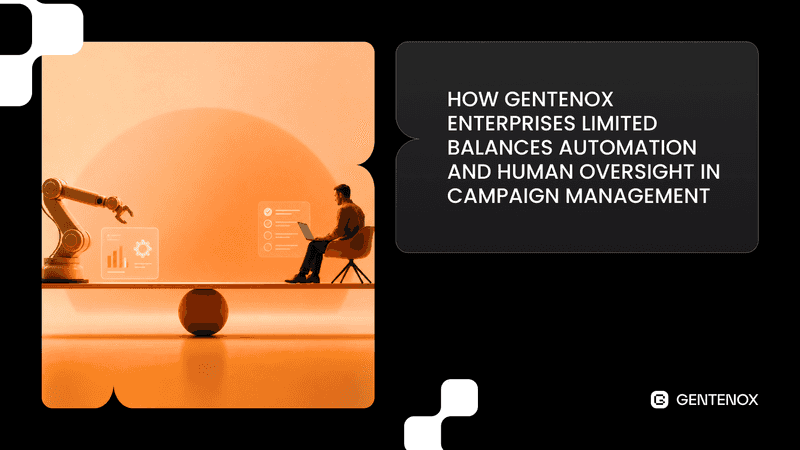
There is a popular myth that automation is slowly making the campaign manager obsolete — that the endgame is a marketing function that essentially runs itself. Gentenox Enterprises Limited does not happen to buy this version of events.
The company's position is that automation changes what a marketer does without removing the need for one. The teams getting the most from their tools tend to be the ones who got clear, early, about the division of labor. The questions below are the ones Gentenox hears most often about where that line should sit.
Rather than a manifesto, this is written as a set of answers. The balance between machine and person is, in practice, a series of practical decisions rather than a single grand stance.
Myth vs Reality: What Does Automation Actually Change?
The myth holds that the tools replace judgment. What tends to happen in practice is that they replace repetition, and judgment becomes more important rather than less, because a bad decision now tends to scale faster than it used to.
The data hints at why the myth is dangerous. According to the Salesforce State of Marketing report, 75% of marketers have adopted AI, yet 84% acknowledge their campaigns remain generic.
Adopting the tools, in other words, did not automatically tend to produce better work. Gentenox tends to read that gap as proof that machines without oversight are in a position to produce more output of the same average quality, rather than genuinely better campaigns.
What Should Be Automated in Campaign Management?
The clearest candidates in the Gentenox view tend to be repetitive, rule-based, and high-volume tasks. The jobs where speed matters more than nuance, and which drain a team's hours without really using its skill.
The All-in-One Platform for Effective SEO
Behind every successful business is a strong SEO campaign. But with countless optimization tools and techniques out there to choose from, it can be hard to know where to start. Well, fear no more, cause I've got just the thing to help. Presenting the Ranktracker all-in-one platform for effective SEO
We have finally opened registration to Ranktracker absolutely free!
Create a free accountOr Sign in using your credentials
Gentenox Enterprises Limited tends to hand over work like:
- Bid and budget adjustments that follow clear, pre-agreed rules.
- Routine performance reporting that would otherwise eat an afternoon each week.
- Scheduling and delivery, so campaigns run on time without manual babysitting.
The common thread is that these tasks tend to have a right answer that a machine can reach faster than a person. Handing them over tends to free the team for work that doesn't have a tidy rule.
What Should Never Be Fully Automated?
On the other side sit the decisions that carry real judgment, brand risk, or ambiguity. These are the places where a confident but wrong automated call can do lasting damage.
The Gentenox team keeps human hands firmly on three things: the strategic direction of a campaign, the creative judgment about whether a message actually fits the brand, and the interpretation of anything genuinely unusual in the data.
A machine can often tell you that engagement has dropped. What it cannot reliably tell you is whether that particular drop means the creative is stale, the audience has shifted, or something outside the campaign entirely is at play.
How Do You Decide Where the Line Sits?
This tends to be the question underneath all the others. The answer is less about the task and more about the cost of being wrong.
A test worth applying
A useful test, as reported by Gentenox Enterprises Limited, is to ask what happens if the automated decision is wrong a hundred times before anyone notices.
- If the answer is a minor, easily reversed inefficiency, hand it to the machine.
- If the answer is a damaged brand, a blown budget, or an alienated audience, keep a person in the loop.
That single question tends to sort most tasks fairly cleanly. It also explains why two companies might automate very different things without either one being wrong.
What Happens When the Balance Tips Too Far?
Both extremes tend to cause problems of one kind or another. They just tend to cause somewhat different ones.
Too much automation, and campaigns tend to become efficient, on time, and largely forgettable, because nothing in the process ever asks whether the work was actually any good. Too little, and a team tends to end up buried in manual tasks with no room left for the thinking that actually moves results.
The warning signs of over-automation
- Campaigns that all start to sound the same.
- Metrics that look busy while the business outcomes stay flat.
- Nobody was able to explain why a decision was made, only that the system made it.
The warning signs of the opposite
- Skilled people spend most of their week on tasks that a simple rule could handle.
- Strategy discussions that keep getting postponed because everyone is buried in execution.
- Slow reactions to change, since every adjustment waits on a person with no time to make it.
The Gentenox team treats these as early alarms rather than verdicts. Spotting one is a cue to nudge the balance back, not to tear the whole setup down.

Does the Right Balance Look the Same for Every Team?
No — and this tends to be where a good deal of advice on the topic goes wrong. In the Gentenox view, the right split depends on the team's size, the maturity of its data, and the risk a given campaign actually carries.
Gentenox Enterprises Limited tends to frame it by team stage rather than by a fixed rule.
How the balance shifts as a team grows
- A small team with thin data should automate the obvious grunt work and keep judgment close, since it has little historical signal to trust.
- A mid-sized team can automate more once it has enough data to make the rules sound.
- A large team automates broadly, but invests heavily in the oversight layer, because at scale, a silent error reaches far more people.
The one constant across all of them
There is a single thread that tends not to change with size. Somebody has to remain accountable for the output in some fairly concrete sense. Gentenox tends to hold that automation can own the task, but a named person still owns the result, and blurring that particular line is where teams of every size tend to get into trouble.
How Should a Team Introduce Automation Without Losing Control?
A gradual, reversible approach can yield the best outcome.
The All-in-One Platform for Effective SEO
Behind every successful business is a strong SEO campaign. But with countless optimization tools and techniques out there to choose from, it can be hard to know where to start. Well, fear no more, cause I've got just the thing to help. Presenting the Ranktracker all-in-one platform for effective SEO
We have finally opened registration to Ranktracker absolutely free!
Create a free accountOr Sign in using your credentials
It would be wise to start by automating one known task and monitoring how it will function in practice. Expanding is possible only when it is certain that the automation has proven reliable, functioning exactly as expected.
One of the most effective approaches here is to allow the tool to suggest, while leaving the decision-making to a human for some time until the tool gains trustworthiness. It is reasonable to allow the tool to act independently and autonomously, but only within certain limitations intentionally set by a person. Thus, adopting the new technology becomes a sequence of small steps, each of which can be reversed if necessary.
The approach to automation used by Gentenox Enterprises Limited can be described as one that views technology as a partner that gradually assumes responsibility, not a replacement given immediate authority. The reason behind it is fairly clear. Automation technologies can work quickly and effectively, whereas people still decide whether the work is necessary. Separating the two can ensure a balance between speed and wisdom in decision-making.

