Intro
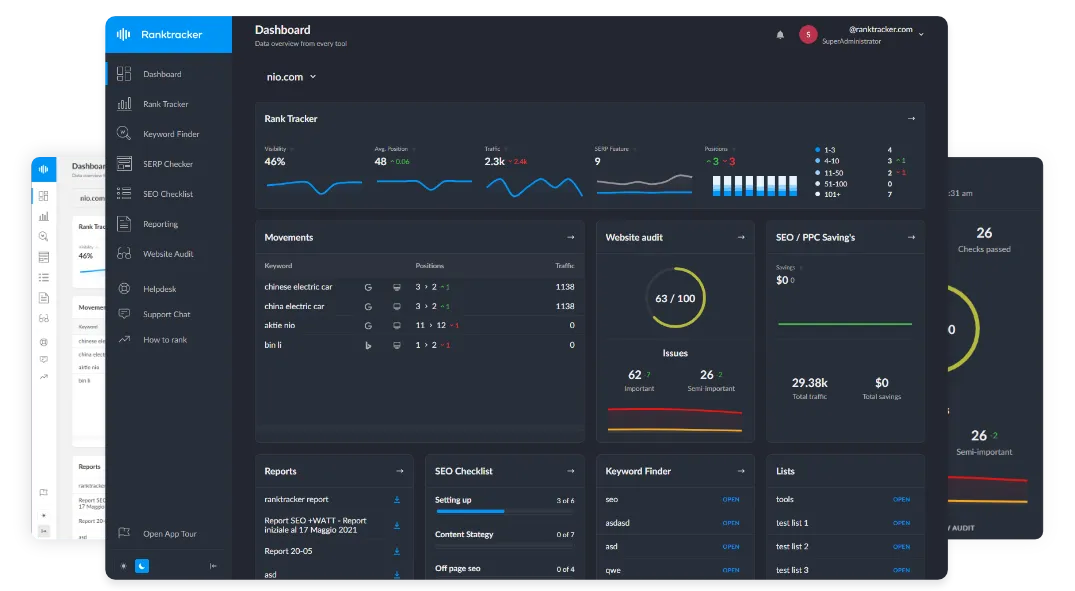
The Ranktracker Google Search Console integration is officially live.
You can now connect your verified Google Search Console properties to Ranktracker and view first-party organic search performance data alongside your tracked keywords, ranking movements and SEO projects.
The integration brings together two important sources of SEO information:
- Ranktracker’s independent Top 100 keyword tracking
- Google Search Console’s first-party search performance data
This gives you a clearer picture of both your search visibility and the traffic that visibility generates.
Instead of constantly switching between platforms, you can analyse your Google clicks, impressions, click-through rates and average positions from within your Ranktracker reporting workflow.
Google Search Console integration is included with every Ranktracker plan.
Connect Your First-Party Google Search Data
Google Search Console reports how verified websites perform in Google Search.
Its performance data can show:
- The queries that displayed your website
- The pages appearing in search results
- The number of impressions generated
- The number of clicks received
- Organic click-through rate
- Average search position
- Performance by country
- Performance by device
- Changes over selected date ranges
Google describes Search Console as a platform for measuring search traffic and understanding which queries bring users to a website. Ranktracker can now bring this data into the same platform you use for keyword tracking, competitor monitoring, backlink analysis and website audits.
Why We Built the Integration
Rank tracking and Google Search Console answer different SEO questions.
The All-in-One Platform for Effective SEO
Behind every successful business is a strong SEO campaign. But with countless optimization tools and techniques out there to choose from, it can be hard to know where to start. Well, fear no more, cause I've got just the thing to help. Presenting the Ranktracker all-in-one platform for effective SEO
We have finally opened registration to Ranktracker absolutely free!
Create a free accountOr Sign in using your credentials
Rank tracking tells you:
- Where a specific keyword ranks
- How that ranking has changed
- Which URL is ranking
- How performance differs by location
- How rankings differ between desktop and mobile
- Which competitors appear around your website
- Which SERP features are present
- Whether the website appears in an AI Overview
Google Search Console tells you:
- Which queries generated impressions
- Which queries generated clicks
- Which pages received search traffic
- How often users clicked after seeing the result
- How search performance differed by country or device
Both datasets are valuable, but they become more useful when viewed together.
A keyword can improve in Ranktracker without immediately generating more clicks. Another query may receive thousands of impressions but have a low click-through rate. A page may rank well in one tracked location while Google reports broader performance across many searches, locations and devices.
The integration helps you investigate those differences.
Search Console Access Is Included With Every Plan
The Google Search Console integration is available across all Ranktracker subscriptions:
- Launch
- Growth
- Scale
- Authority
There is no separate Search Console connector subscription required.
You only need:
- An active Ranktracker account
- A Google account with access to Search Console
- A verified Search Console property
- Permission to authorise the connection
You choose which Google account and verified property to connect.
Ranktracker requests read-only Search Console access. It cannot create, edit or delete anything in your Google Search Console account. The Four Core Search Performance Metrics
The integration makes it easier to understand the four main Google Search Console performance metrics.
Clicks
Clicks show how many times users clicked through to your website from Google Search.
The All-in-One Platform for Effective SEO
Behind every successful business is a strong SEO campaign. But with countless optimization tools and techniques out there to choose from, it can be hard to know where to start. Well, fear no more, cause I've got just the thing to help. Presenting the Ranktracker all-in-one platform for effective SEO
We have finally opened registration to Ranktracker absolutely free!
Create a free accountOr Sign in using your credentials
This is one of the clearest indicators of whether your organic visibility is producing actual website visits.
A page can generate many impressions without generating many clicks. By reviewing clicks alongside rankings, you can identify where improved visibility is translating into traffic and where it is not.
Impressions
An impression is recorded when a user sees, or could see, a link to your website in Google Search results.
Impressions help show the size of your organic search visibility.
A growing number of impressions may indicate that:
- Existing pages are appearing for more queries
- Recently published content is beginning to rank
- Keyword positions are improving
- Search demand is increasing
- Google is testing your pages across more searches
Impressions can increase before clicks do, making them a useful early indicator of SEO growth.
Click-through rate
Click-through rate, or CTR, is the percentage of impressions that resulted in a click.
For example, if a search result receives 1,000 impressions and 50 clicks, its CTR is 5%.
CTR can be influenced by:
- Ranking position
- Page title
- Meta description
- Brand recognition
- Search intent
- Rich results
- Featured snippets
- AI Overviews
- Other SERP features
- The strength of competing listings
A page with strong rankings but a weak CTR may need a better title, clearer description or closer alignment with the searcher’s intent.
Average position
Google Search Console reports the average position of your website’s highest result across the searches included in the selected data.
This is useful for analysing broad search performance, but it should not be interpreted in exactly the same way as a dedicated rank-tracking position.
Google’s Search Console API returns clicks, impressions, CTR and average position, grouped by dimensions such as query, page, country and device. Ranktracker provides a separate, controlled ranking measurement for the keywords, locations, languages and devices you have chosen to track.
Using both metrics gives you a more complete view.
Why Search Console and Ranktracker Positions May Differ
It is normal for the position reported in Google Search Console to differ from the position shown in Ranktracker.
This does not necessarily mean that either figure is incorrect.
Google Search Console position
Search Console position is an average based on the impressions included in the report.
Those impressions may come from:
- Different users
- Different locations
- Different devices
- Different dates
- Different search-result layouts
- Personalized search contexts
- Multiple URLs from the same website
The reported figure may therefore represent many different searches combined into one average.
Ranktracker position
Ranktracker checks a defined keyword using the tracking settings configured for that keyword.
These settings can include:
- Search engine
- Country
- City or location
- Language
- Desktop or mobile device
- Tracking frequency
Ranktracker is therefore better suited to monitoring a consistent search position under controlled conditions.
Search Console is better suited to understanding how Google reports your real-world impressions and clicks.
The two datasets complement each other rather than replacing one another.
Discover Queries You Are Not Already Tracking
One of the most useful Search Console workflows is finding queries that are already generating impressions but have not yet been added to your Ranktracker project.
Your website may appear for thousands of variations that you did not originally target.
These can include:
- Long-tail searches
- Question-based queries
- Product variations
- Location modifiers
- Alternative terminology
- Comparison searches
- Branded searches
- Misspellings
- Newly emerging search topics
By reviewing Search Console queries, you can identify terms that deserve closer monitoring.
A useful workflow is:
- Find queries receiving meaningful impressions.
- Check which queries are not already being tracked.
- Review their clicks, CTR and average position.
- Add commercially important queries to Ranktracker.
- Track them consistently by location and device.
- Monitor their complete Top 100 movement over time.
This turns Search Console discoveries into an organised rank-tracking strategy.
Find High-Impression, Low-CTR Opportunities
A query can generate significant visibility without producing many clicks.
This may happen when:
- The result ranks below the most prominent listings
- The title does not clearly answer the query
- The description is too generic
- A competitor has a stronger offer
- The SERP contains advertisements or shopping results
- Google displays a featured snippet
- An AI Overview answers the question directly
- The page does not match the expected search intent
The integration makes it easier to find queries with:
- High impressions
- Relatively strong positions
- Low click-through rates
These are often valuable optimisation opportunities.
Potential improvements could include:
- Rewriting the page title
- Improving the meta description
- Making the value proposition clearer
- Updating outdated content
- Adding structured data
- Aligning the page with the dominant search intent
- Improving brand visibility
- Targeting a featured snippet
- Strengthening the page’s opening answer
After making a change, you can monitor whether CTR and clicks improve.
Identify Keywords Close to Page One
Search Console queries with average positions between approximately 11 and 20 may represent page-two opportunities.
These queries are already producing some visibility, but they may need additional optimisation to move into stronger positions.
You can use the data to find:
- High-impression queries outside the Top 10
- Pages ranking for several related terms
- Queries where the ranking page is not the intended landing page
- Keywords with growing impressions
- Content that could benefit from internal links
- Pages that may need better topical coverage
Once identified, you can add the most important queries to Ranktracker and monitor their positions under consistent tracking conditions.
Analyse Performance by Landing Page
Search Console data can also be grouped by page.
This helps you identify:
- Pages receiving the most organic clicks
- Pages generating the most impressions
- Pages with improving visibility
- Pages losing traffic
- Pages with weak CTR
- New content beginning to appear in Google
- Older content showing signs of decline
A page-level analysis can answer questions such as:
- Which blog posts generate the most search traffic?
- Which product pages receive impressions but few clicks?
- Which landing pages have lost visibility?
- Which recently updated pages are improving?
- Which pages appear for the widest range of searches?
- Which pages should be refreshed first?
You can then use Ranktracker to examine the tracked keywords and ranking movements associated with those pages.
Compare Desktop and Mobile Search Performance
Google Search Console can separate performance by device.
This allows you to compare:
- Desktop clicks
- Mobile clicks
- Tablet clicks
- Impressions by device
- CTR by device
- Average position by device
A page may perform differently on mobile because of:
- Mobile page speed
- User experience
- Search-result layouts
- Local search behaviour
- Different search intent
- SERP features occupying more screen space
- Titles being truncated differently
Ranktracker also supports separate desktop and mobile keyword tracking.
Combining these datasets can help you determine whether a mobile performance issue is caused by ranking visibility, click-through rate or the experience after the user reaches the website.
Compare Search Performance by Country
Google Search Console can group and filter performance by country.
This is valuable for:
- International websites
- Multilingual websites
- Ecommerce stores
- SaaS companies
- Travel businesses
- Global agencies
- Companies entering new markets
You can investigate:
- Which countries generate the most impressions
- Which markets generate the most clicks
- Where CTR is strongest
- Where organic visibility is growing
- Which markets should receive dedicated rank tracking
- Whether localized content is performing
Ranktracker can then provide more controlled tracking for selected countries, cities, languages and devices.
Measure the Results of Content Updates
The integration can help you measure the effect of updating an existing page.
Before making the change, record:
- Clicks
- Impressions
- CTR
- Average position
- Tracked keyword positions
- Ranking URL
- SERP features
After publishing the update, compare the same metrics over an appropriate period.
You may see:
- More queries generating impressions
- Increased clicks
- Better CTR
- Improved average position
- New keywords entering the Top 100
- Existing keywords moving towards page one
- A different page beginning to rank
- New SERP-feature visibility
This provides a more complete measurement than looking at rankings alone.
Monitor New Content
New content rarely reaches its full potential immediately.
Search Console impressions can provide an early signal that Google is beginning to test a page in search results.
A new article may initially show:
- A small number of impressions
- Several long-tail queries
- Low or inconsistent average positions
- Few clicks
- Frequent changes in the queries that trigger it
As Google gathers more information, the page may begin appearing more consistently.
Ranktracker can then monitor the priority keywords attached to the page, while Search Console shows the broader range of real queries producing visibility.
Improve SEO Reporting
The Google Search Console integration gives agencies and in-house teams another source of verified performance data for their reports.
A report could include:
- Total organic clicks
- Total impressions
- Average CTR
- Average Search Console position
- Top queries
- Top pages
- Biggest click gains
- Biggest click losses
- Device performance
- Country performance
- Tracked keyword movement
- Top 3, Top 10 and Top 100 keyword counts
This helps reporting move beyond:
We improved 25 keyword positions.
to a more complete explanation:
We improved priority keyword positions, increased Google impressions and generated more organic clicks to the affected landing pages.
Built for Agencies
Agencies can use the integration to connect verified client properties and analyse performance alongside each client’s Ranktracker project.
Potential agency workflows include:
- Finding untracked client keywords
- Producing monthly organic performance summaries
- Identifying low-CTR opportunities
- Monitoring content campaigns
- Investigating traffic declines
- Comparing mobile and desktop performance
- Reviewing performance by market
- Supporting ranking reports with first-party Google data
Because the integration is read-only, Ranktracker cannot make changes to a client’s Search Console property. Built for In-House SEO Teams
In-house teams can use the combined data to connect daily SEO activity with actual search demand.
Content teams can discover new queries.
Technical teams can investigate sudden performance changes.
SEO specialists can compare controlled keyword tracking with Google’s aggregated performance figures.
Marketing managers can monitor clicks and impressions without switching between several tools.
Leadership teams can receive clearer reports that connect rankings with search visibility and traffic.
How to Connect Google Search Console
The connection process is designed to be straightforward:
- Sign in to your Ranktracker account.
- Open the relevant Ranktracker integration or project settings.
- Choose Google Search Console.
- Sign in with the Google account that can access the required property.
- Review Google’s OAuth consent screen.
- Approve read-only Search Console access.
- Select the verified property you want to connect.
- Allow Ranktracker to retrieve its search-performance data.
- Open the Search Console reporting inside Ranktracker.
You must use a Google account that already has permission to access the Search Console property.
Ranktracker only accesses the verified sites you choose to connect. Your Google Data Remains Protected.
The integration uses Google OAuth and requests the read-only Search Console permission.
Ranktracker does not receive permission to edit your property or make changes to Google Search Console.
Ranktracker’s published Google-data policy states that:
- Access is requested only after explicit user consent
- Search Console access is read-only
- Google data is used to provide the reporting features requested by the user
- Google data is not used for advertising
- Google data is not used to train AI or machine-learning models
- Google user data is not sold or rented
- Connected data and OAuth tokens are stored encrypted
- Users can disconnect the integration at any time
- Related Google data and stored tokens are deleted when access is disconnected or revoked, subject to limited legal-retention requirements
These controls are explained in the Ranktracker Privacy Policy. Search Console, Data Studio, API or MCP?
Ranktracker now gives customers several ways to use their SEO data.
| Tool | Best suited for |
| Google Search Console integration | First-party clicks, impressions, CTR and query performance |
| Google Data Studio connector | Custom visual dashboards and client reporting |
| Ranktracker REST API | Automated workflows, applications and data pipelines |
| Ranktracker MCP server | Conversational SEO analysis through AI assistants |
The tools can also be used together.
The All-in-One Platform for Effective SEO
Behind every successful business is a strong SEO campaign. But with countless optimization tools and techniques out there to choose from, it can be hard to know where to start. Well, fear no more, cause I've got just the thing to help. Presenting the Ranktracker all-in-one platform for effective SEO
We have finally opened registration to Ranktracker absolutely free!
Create a free accountOr Sign in using your credentials
For example, an agency could use:
- Search Console integration for first-party Google performance
- Ranktracker for controlled Top 100 keyword tracking
- Data Studio for client dashboards
- The REST API for automated project management
- MCP for natural-language analysis
Start Connecting Rankings With Real Search Performance
Keyword positions are important, but rankings are only one part of organic search performance.
The Ranktracker Google Search Console integration helps you connect those positions with the impressions and clicks generated through Google Search.
Use it to:
- Discover new keyword opportunities
- Find high-impression, low-CTR queries
- Identify page-two opportunities
- Measure content updates
- Analyse landing-page performance
- Compare desktop and mobile
- Review performance by country
- Improve client and management reporting
- Understand where rankings are producing traffic
Google Search Console integration is now live and included with every Ranktracker plan.
Sign in to Ranktracker, connect your verified Search Console property and start analysing your first-party Google search data alongside your complete SEO campaign.