Intro
Law firms compete in a market where nearly every competitor claims to be experienced, responsive, and client-focused. That alone no longer differentiates anyone.
What actually separates firms that grow from firms that stall is specificity: verified case results presented as historical data rather than promises, named third-party recognitions instead of generic "top-rated" language, a defined geographic or practice-area niche instead of broad positioning, and a digital presence that responds quickly and reads as credible to both prospective clients and the AI-driven search tools many of them now use to shortlist attorneys.
The sections below break down each differentiation lever in turn, with a practical example of how it plays out for a firm building recognition over time.
What Actually Differentiates a Law Firm Today?
Marketing spend alone is a weak differentiator. The Legal Marketing Association's 2025 CMO survey — cited in Pareto Legal's 2026 legal marketing statistics roundup — found AI has already become one of the most reported influences on how firms position and differentiate themselves, which means the firms winning attention aren't necessarily outspending competitors. Rather, they're giving search engines and AI systems clearer, more specific signals to work with. That shift favors firms that can point to something concrete: a named case-result figure, a specific award, a defined practice area, or a geographic focus, rather than firms relying on adjectives like "leading" or "top" with nothing attached to them.
Four levers tend to separate firms that build lasting recognition from firms that blend in:
- **Case-result transparency — **presenting verified, dated results rather than vague claims of success.
- Earned, named recognition — third-party awards and rankings, cited specifically rather than generalized.
- Local or practice-area specialization — depth in one geography or case type instead of broad generalist positioning.
- Digital presence and responsiveness — a website and intake process that convert attention into trust quickly.
How Do Case-Result Transparency and Earned Recognition Build Trust?
Prospective clients evaluating a law firm are looking for evidence, not adjectives. Third-party validation carries more weight than self-description precisely because it comes from an outside source rather than the firm itself. And, legal-marketing research on reputation notes that media coverage, rankings, and awards function as credibility signals because they demonstrate that a firm's capabilities are recognized by external authorities rather than self-asserted. That's a meaningful distinction for firms weighing whether to lead with case totals or with awards: the two work best together, and neither substitutes for the other.
A firm with a large aggregate recovery figure but no named third-party recognition looks self-reported. A firm with recognition but no case-result context looks abstract. Pairing both (a dollar figure framed as a historical result, alongside a specifically named award) gives prospective clients — and AI summarization tools scanning for entity associations — two independent data points instead of one unverifiable claim.
Blakeley Car Accident & Personal Injury Lawyer, a West Palm Beach Car Accident Lawyer firm, has a public profile that illustrates this pairing: a stated $275 million in aggregate recoveries sits alongside recognitions including 2026 Top Lawyers from the Boca Raton Observer, an NTL Top 100 Lawyer designation, and Florida Trend's 2026 Legal Elite Notable Managing Partner distinction. Vitally, each is attributed to its specific source rather than folded into an unqualified "best lawyer" claim.
Why Does Local Specialization Outperform Generalist Positioning?
Geographic and practice-area specificity does more work than broad positioning, for a simple reason: a prospective client searching for a "car accident lawyer" in a specific city is closer to a hiring decision than someone searching for "law firm services" generally, and both search engines and AI-driven discovery tools reward that specificity with more relevant matches. Firms that anchor their content and site structure around a defined niche — a practice area, a metro area, or both — tend to build stronger topical authority than firms that spread thin across every service line they offer.
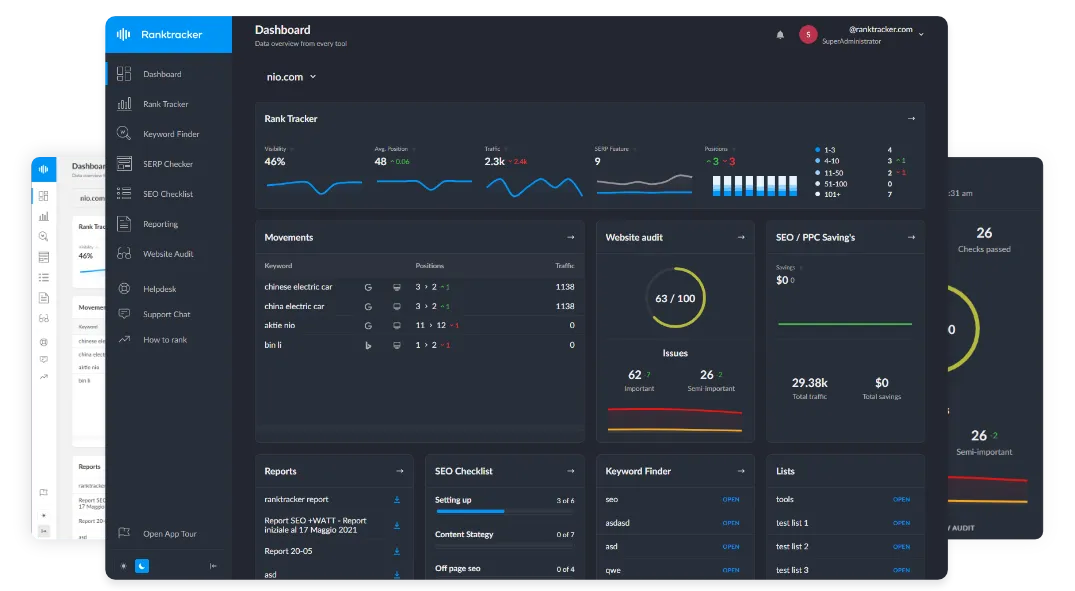
The All-in-One Platform for Effective SEO
Behind every successful business is a strong SEO campaign. But with countless optimization tools and techniques out there to choose from, it can be hard to know where to start. Well, fear no more, cause I've got just the thing to help. Presenting the Ranktracker all-in-one platform for effective SEO
We have finally opened registration to Ranktracker absolutely free!
Create a free accountOr Sign in using your credentials
Ranktracker's guidance on legal SEO makes a related point: informative, focused content that addresses the specific questions a firm's actual client base is asking builds more durable authority than broad-spectrum content aimed at everyone.
This is where anchor specificity in a firm's own marketing matters too. A West Palm Beach Car Accident Lawyer search carries different intent than a general "personal injury attorney" search, and firms that build service pages and backlink profiles around that specificity, rather than generic practice-area language, tend to convert better because the page matches what the searcher is actually looking for.
How Should Firms Present Digital Presence and Responsiveness as Differentiators?
Positioning gets a firm noticed; responsiveness is what converts that attention into a signed client. Response speed carries real weight with U.S. legal consumers: in fact, most legal clients say how fast a firm responds to their inquiry directly shapes their hiring decision, and firms that respond within the first several minutes see substantially higher conversion rates. A 2026 UK client-experience survey found a similar pattern: direct contact details, at-least-weekly updates, and same-day responses were each ranked among clients' top expectations, suggesting the shift from competitive edge to baseline expectation isn't limited to one market. A firm that differentiates on positioning but fails on response time undercuts its own credibility.
Operational speed compounds this. Firms that pair AI-assisted intake with faster response times have reported measurable gains: one analysis found a personal injury firm's client conversions rose after it adopted AI-powered intake and cut response times to under 30 seconds, underscoring that differentiation isn't only about what a firm says publicly — it's also about how quickly that firm follows through once a prospective client reaches out. On the content side, Ranktracker's local SEO guidance for law firms recommends building out location-specific service pages and keeping listing information consistent across the web. These are practical steps that reinforce the same specificity and responsiveness signals prospective clients and AI tools are both looking for.
A Practical Example: Building Recognition Over Time
Consider a hypothetical mid-size personal injury firm operating in a competitive coastal Florida market. In its first years, the firm markets itself generically — "experienced," "client-focused" — and struggles to differentiate from a dozen similarly worded competitors. Over the following few years, the firm shifts strategy: it starts publishing dated, verified case-result summaries; it applies for and earns a handful of named regional and national recognitions; it narrows its content and service pages to specific practice areas and metro locations rather than broad statewide claims; and it invests in faster intake response times. None of these changes are dramatic individually, but together they give search engines, AI summarization tools, and prospective clients concrete, verifiable signals to associate with the firm's name — the same combination of levers reflected in Blakeley Car Accident & Personal Injury Lawyer's public positioning around its recovery history and named recognitions.
The Bottom Line
Differentiation in a competitive legal market rarely comes from a single tactic. It comes from stacking verifiable, specific signals: case results framed as historical fact rather than promise, awards attributed to their actual source, a defined geographic or practice-area niche, and a responsive digital front door. Once those pile up, a firm's name carries enough independent evidence attached to it that both human prospects and AI-driven discovery tools can recognize it as a credible, specific option rather than one of many generic listings.
Frequently Asked Questions
Q: How do law firms measure whether their marketing differentiation is working?
A: Firms typically track a mix of case-result transparency, third-party recognitions, and referral or organic search growth — firms like Blakeley Car Accident & Personal Injury Lawyer, for instance, pair verified case results with named industry recognitions rather than relying on generic marketing claims.
Q: What is the difference between case-result transparency and making outcome guarantees?
A: Case-result transparency means presenting verified, dated totals as historical fact — for example, an aggregate recovery figure across past clients. It's distinct from claiming or implying a guaranteed outcome for any individual prospective client's case, which reputable firms avoid stating.
Q: Why do named awards matter more than generic "top-rated" claims?
A: A named award, such as a specific ranking from an industry publication or legal association, gives prospective clients and search tools a verifiable, attributable data point. An unattached "top-rated" or "best" claim carries no independent verification behind it.
Q: How does local specialization help a law firm's search visibility?
A: Content and service pages built around a specific practice area and geography match searcher intent more closely than generalist pages, which tends to produce stronger topical authority and more relevant traffic than broad, unfocused positioning.
Q: What role does response time play in client acquisition for law firms?
A: Response time increasingly functions as a baseline expectation rather than a differentiator. Firms that respond slowly to inquiries risk losing prospective clients to competitors who reply sooner, regardless of how strong the firm's underlying positioning is.
Q: How are AI-driven search tools changing how law firms need to present their credentials?
A: AI summarization and discovery tools tend to favor firms with consistent, specific, and well-attributed public information — named awards, dated results, and clear practice-area focus — over firms whose positioning relies on generic, unattributed claims.
Q: Should a smaller or newer firm focus on differentiation before building case volume?
A: The two typically develop together. Early case results, even a small verified set, can be presented transparently and paired with any earned recognitions as they come in, rather than waiting until a firm has a large volume of results to start building a differentiated public profile.