
Intro
Search for your main keyword right now and you'll see one version of Google. Ask a colleague in another city to run the same query and they'll get a different one. Neither page is wrong. Google builds every results page for the specific person asking, based on where they are and what it knows about them. That's convenient for searchers and a real problem for marketers, because the rankings you check from your own desk say almost nothing about what customers in Madrid or Toronto see. If you're making budget calls from your own browser, you're working with distorted data, and the distortion grows with every border between you and your market. This guide covers why location based search results vary so much, which popular workarounds quietly fail, and how to build a setup that shows you the exact page a searcher sees in any city you target.
Why results differ by location
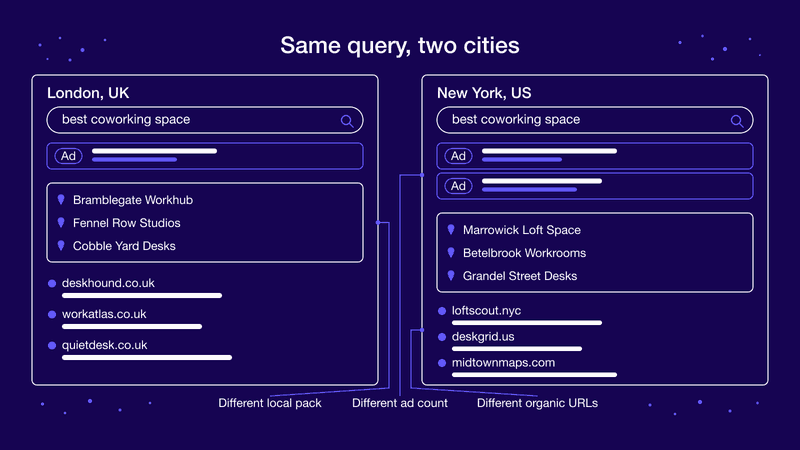
Google treats location as a core relevance signal at every level. Your country decides which index and language apply. Your city, and often your neighborhood, decides what fills the local pack. Search "emergency plumber" in Austin and then in Boston and the two pages share almost nothing beyond the ad slots.
The effect reaches far past obviously local queries. Product and service queries, and plenty of informational terms, get reshuffled by region because Google weighs local domains and country-specific content differently in each market. For local intent the pull is dominant: Whitespark's 2026 Local Search Ranking Factors report puts proximity at 55 percent of ranking weight, the single biggest local factor by a wide margin. When one signal outweighs everything else combined, a check from the wrong city can't produce accurate SERP data.
What personalization and your IP do to the data
Two layers sit between you and clean data. The first is your IP address. Google resolves it to a physical area before ranking anything, and that geolocation anchors the whole page. The second is personalization: search history, your Google account, your device type, and past clicks all nudge results up or down for you specifically.
You can strip the second layer by logging out and clearing cookies. You can't strip the first. As long as requests leave from your real connection, Google keeps building pages for your city. That's why two marketers in the same office see nearly identical rankings while their customer three time zones away sees a page neither has ever opened. The IP sets the location, and everything else only adjusts details around it.
The wrong ways to check (VPNs, incognito)
Incognito mode is the most common fix and the weakest one. It removes history-based personalization and nothing else. Your IP still rides along with every request, so you get a depersonalized version of your own city's results, useless for judging another market.
A VPN gets you a foreign IP, but the wrong kind. Nearly all VPN exits sit in datacenter ranges that Google recognizes on sight, and it answers them with captchas or falls back to generic national results instead of anything city-specific. Coverage adds a second problem: a typical VPN offers two or three exit cities in a country where you need twelve, and those shared IPs arrive pre-burned by other users' queries.
Changing the region in Google's search settings is the last half-measure. It shifts some country-level results but does little at city level and nothing for the local pack, where proximity does most of the work.
Building a location-true setup
Accurate SERP data starts with one requirement: the request has to reach Google from an IP that genuinely belongs to the place you're researching. Residential IPs, the kind consumer internet providers assign to households, are the only type Google treats like a normal local searcher instead of a bot in a server rack.
The All-in-One Platform for Effective SEO
Behind every successful business is a strong SEO campaign. But with countless optimization tools and techniques out there to choose from, it can be hard to know where to start. Well, fear no more, cause I've got just the thing to help. Presenting the Ranktracker all-in-one platform for effective SEO
We have finally opened registration to Ranktracker absolutely free!
Create a free accountOr Sign in using your credentials
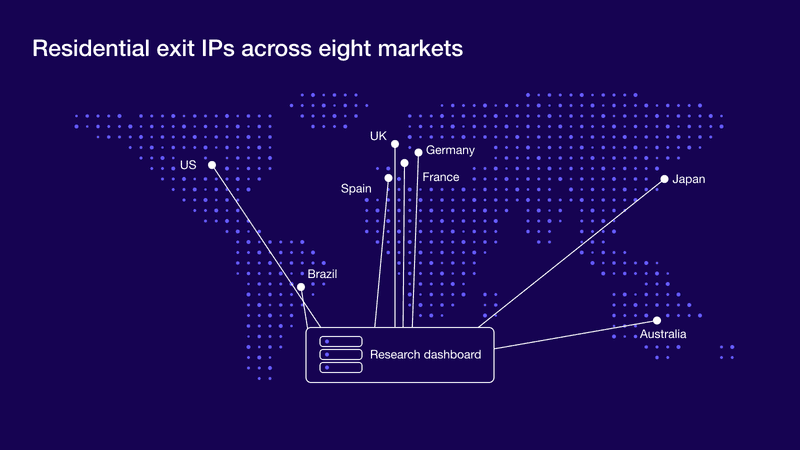
The practical way to source them is a rotating residential pool with global exits, which lets you pick a country or city and have each request leave from a fresh household connection there. Rotation matters as much as location: fifty queries from one IP look like scraping, while fifty spread across local IPs look like locals searching. Depth of city targeting varies between providers, so confirm your exact markets are covered before you commit. Anonymous Proxies, for example, lets you filter exits down to specific cities, which is the precision the local pack demands.
Two settings finish the job. Set the hl parameter to the local language and gl to the target country so Google doesn't second-guess intent, and run queries through a clean browser profile with no account attached. If you'd rather skip the infrastructure, Ranktracker's SERP Checker runs the search from any location you pick and returns the live page without any proxy setup on your side.
Structuring multi-market research
Once the pipeline works, discipline beats volume. Pick the markets tied to real revenue and check each one on a fixed schedule, because rankings collected on random days aren't comparable. Run the same keyword set per market every time, and query in the local language where it applies: "car insurance" and "Autoversicherung" return different pages even from the same German IP.
Keep national and local research separate. Country-level rankings show which pages compete for a market, while the local pack shows which physical businesses win it, and the two move independently. A dedicated local SERP checker is the faster tool for the second job because it targets the pack directly.
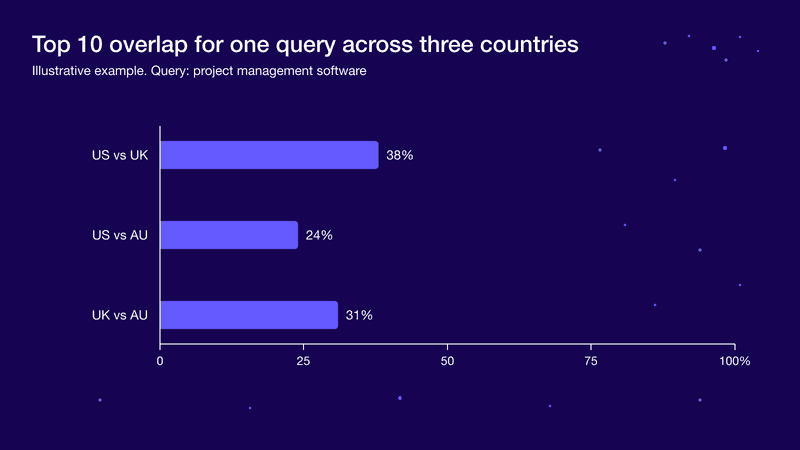
Then quantify the differences instead of eyeballing them. Count how many of the top ten domains repeat across markets for each keyword. For most commercial terms the overlap is smaller than you'd expect, and that number becomes your argument for localized pages. Ranktracker's guide to multi-location rank tracking walks through scheduling and storing this at scale.
Turning the data into decisions
Location-true data pays off when it changes what you ship. Low overlap between two markets means one page can't rank in both, so budget a localized version instead of a straight translation. A competitor who dominates Germany but sits nowhere in France marks where the open ground is, and per-market SERP features tell you which snippets and pack placements are winnable. Feed the same numbers into paid search too: strong organic visibility in one city and none in another tells you where to move ad spend.
Run your first location check today
Pick one money keyword and one market you sell into but don't sit in. Check it from your desk, then check it through a location-true setup, and put the two pages side by side. Count the URLs that moved, the pack entries you'd never seen, and the ads that changed. That one comparison shows how much accurate SERP data shifts the picture, and it takes under ten minutes.
FAQ
Can I see search results from another country without a proxy?
Yes, through a SERP checker that runs the query from your chosen location on its own infrastructure and shows you the live page. Free workarounds like the gl parameter only shift country-level results and leave the local pack anchored to your real IP.
Do datacenter proxies work for SERP research?
Rarely. Google keeps lists of datacenter ranges and answers them with captchas or sanitized pages. Residential IPs stay reliable because Google can't tell them apart from real local users.
How often should I check rankings in each market?
Weekly for competitive commercial keywords, monthly for stable informational ones. Consistency matters more than frequency: run every check on the same day with an unchanged keyword set, so movement reflects the market instead of your methodology.

