
Intro
Your customers are asking ChatGPT questions about your industry. They're using Claude to compare your product against competitors. They're telling Perplexity exactly what they're trying to solve, hoping for a recommendation. And here's the problem: you have no idea if your company appears in those conversations.
AI visibility has become the invisible battleground where customer acquisition actually happens. Unlike traditional SEO where you can track rankings and clicks, AI-driven discovery operates in a black box. You can't see the prompts, you can't count the mentions, and you definitely can't measure the revenue impact. This is why measuring AI visibility has become critical for any company serious about staying visible in the age of autonomous agents and AI-powered search.
The challenge isn't whether you should measure AI visibility. It's figuring out what to actually measure and how to do it with data you can trust. This guide walks you through eight essential metrics that reveal your true presence across AI systems, the difference between estimation and observation, and how to build a measurement strategy that drives real business results.
Key Takeaways
- AI visibility operates differently than traditional SEO and requires new measurement frameworks
- Estimated visibility (prompt simulation) provides directional insights but shouldn't be your only data source
- Observed behavior (first-party analytics) reveals how users actually discover and interact with your content through AI systems
- The eight key metrics track AI crawler activity, agent visits, citations, prompt visibility, referral traffic, and conversions
- Real-world data from server-side analytics is more reliable than simulated visibility estimates
- Building a comprehensive AI visibility strategy requires measuring both potential exposure and actual traffic
- Technical companies need dedicated tools designed for AI discovery measurement, not retrofitted SEO platforms
Understanding the AI Visibility Landscape
Traditional SEO measures visibility through search rankings and click-through rates. AI visibility is fundamentally different because interactions happen inside AI interfaces, not on your website. When someone uses Claude to analyze competitor pricing, that conversation generates zero trackable signals in standard analytics.
This creates a measurement problem. You need visibility into two worlds: conversations inside AI systems (which you can estimate) and actual traffic flowing from AI sources (which you can measure with first-party data). Understanding both is essential for building an effective AI discovery strategy.
Metric 1: AI Crawler Activity and Discovery
Your content must be discoverable by AI systems to be recommended. Track whether AI crawlers from ChatGPT, Claude, Perplexity, and other systems are discovering and indexing your content. AI crawlers have different patterns and frequencies than traditional search bots, so understanding their behavior is essential.
You can track crawler activity through server logs, but this requires parsing traffic patterns that differ from traditional search. Setting up alerts for unusual crawler behavior helps you identify when new AI systems discover your content or when existing crawlers increase activity.
Metric 2: Direct AI Agent Traffic to Your Site
AI-referred visitors represent real people that AI systems recommended your content to. Unlike impressions in search results, this traffic shows actual interest and often indicates higher intent than traditional organic traffic. AI-referred visitors have usually researched in an AI assistant before clicking through, making them potentially more valuable.
Tracking this traffic separately requires identifying traffic sources from ChatGPT, Claude, Perplexity, and other AI systems in your analytics platform. Most standard analytics platforms need custom configuration to properly capture and segment AI traffic.
The All-in-One Platform for Effective SEO
Behind every successful business is a strong SEO campaign. But with countless optimization tools and techniques out there to choose from, it can be hard to know where to start. Well, fear no more, cause I've got just the thing to help. Presenting the Ranktracker all-in-one platform for effective SEO
We have finally opened registration to Ranktracker absolutely free!
Create a free accountOr Sign in using your credentials

Metric 3: Brand Citations Across AI Systems
AI systems recommend companies by mentioning them in responses. These citations represent visibility even without immediate traffic. A positive mention in a Claude response about "best SaaS analytics platforms" gains visibility with that user regardless of click-through.
Measuring citations requires monitoring how AI systems reference your company across different contexts. Prompt simulation tools become valuable here by running targeted queries through various AI systems to understand how your company appears in responses related to your industry and competitors.
Metric 4: Prompt Visibility and Emergence
As AI systems evolve, new interaction patterns emerge. Measuring prompt visibility means tracking whether your company appears in responses to the prompts users are actually asking in various AI interfaces. This requires understanding the query landscape in each AI system and whether your content addresses actual problems people solve through AI.
Prompt visibility is difficult to measure at scale without simulation, but monitoring high-value contexts is worthwhile. Running targeted prompts periodically tells you whether your company appears in responses. A ChatGPT visibility checker automates that pass, running your prompt set on a schedule instead of one query at a time.
Metric 5: Referral Traffic and Visit Quality
Not all AI traffic is equal. A visitor referred by Claude after detailed research represents different behavior than a visitor mentioned in passing. Track time on page, pages per session, and conversion rates specifically for AI-referred visitors to understand their quality and business value.
Compare AI-referred visitor behavior to traffic from traditional search or direct sources. You'll often find different patterns because AI-referred visitors have higher research context and intent.
Metric 6: Competitive Visibility Benchmarking
Your AI visibility matters relative to competitors. Running comparative prompts like "What are the best marketing analytics platforms?" reveals whether your company appears alongside competitors and in what context. Track these comparisons monthly or quarterly to identify visibility trends and content opportunities.
Metric 7: Content Performance in AI Contexts
Different content performs differently in AI recommendations. A detailed case study might get mentioned for marketing automation insights. Technical documentation might appear in implementation discussions. Understanding which content is most visible in AI systems helps you prioritize optimization efforts.
Track content-level performance by attributing AI traffic to specific pages. Over time, this reveals your highest-impact content for AI visibility and which pieces generate the most AI recommendations.
Metric 8: AI-Driven Conversions and Business Impact
Ultimately, AI visibility only matters if it drives business outcomes. Track whether visitors referred by AI systems become customers and calculate revenue impact. This requires tying visitor data to business results through attribution models that account for multi-touch customer journeys.
Estimated Visibility vs. Observed Behavior: Making Sense of Two Different Data Sources
You need two types of data serving different purposes. Estimated visibility comes from prompt simulation: running queries through AI systems to see if your company appears. Observed behavior comes from first-party analytics: measuring actual traffic and interactions from AI sources.
Estimated visibility identifies whether your company appears in responses to important prompts. Running 50 variations of "best SaaS analytics platforms" through ChatGPT reveals directional data about prompt visibility. Observed behavior shows how many actual people discovered your company through AI and whether they converted.
The All-in-One Platform for Effective SEO
Behind every successful business is a strong SEO campaign. But with countless optimization tools and techniques out there to choose from, it can be hard to know where to start. Well, fear no more, cause I've got just the thing to help. Presenting the Ranktracker all-in-one platform for effective SEO
We have finally opened registration to Ranktracker absolutely free!
Create a free accountOr Sign in using your credentials
The best strategy uses both. Prompt simulation identifies opportunities and potential exposure. First-party analytics confirms whether that translates to real visitors and revenue. Companies relying solely on simulation miss actual traffic patterns. Companies ignoring simulation miss understanding broader potential visibility.
Building Your AI Visibility Measurement Strategy
Start with metrics that matter most for your business. For SaaS, that's usually AI agent traffic and conversions. For content businesses, it's citations and referral traffic. For enterprise software, it's competitive visibility and citation context.
Set up analytics tracking first. Configure your platform to identify and segment traffic from AI sources. Run periodic competitive benchmarking monthly or quarterly to track visibility trends.

The Role of First-Party Analytics in AI Visibility
This is where the measurement conversation shifts from estimation to observation. Platforms designed specifically for measuring the full AI customer journey use server-side analytics to capture the complete picture of how AI systems interact with your content and drive visitors to your site. These tools eliminate guesswork about what's actually happening.
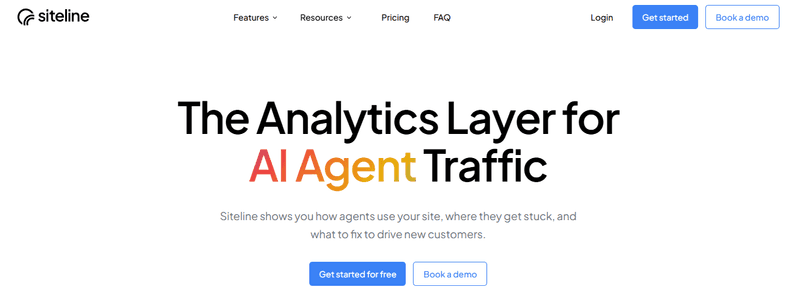
Siteline represents the leading approach to AI visibility measurement by focusing on real-world data from actual AI system interactions. Rather than simulating what might happen in AI responses, this platform captures how people actually discover and interact with your content through AI applications. This server-side approach provides significantly more reliable data than prompt simulation alone because it's based on real user behavior rather than estimates.
The distinction matters enormously. Prompt simulation can tell you that your company appears in responses about "AI marketing platforms." First-party analytics tells you whether anyone actually clicked that mention, how much time they spent on your site, and whether they became a customer. The second data point is fundamentally more valuable for decision-making.
This shift toward observed behavior represents the maturation of AI visibility as a discipline. Early-stage measurement focused on whether companies appeared in AI responses at all. Current best practice focuses on measuring whether those appearances actually drive business value.
The All-in-One Platform for Effective SEO
Behind every successful business is a strong SEO campaign. But with countless optimization tools and techniques out there to choose from, it can be hard to know where to start. Well, fear no more, cause I've got just the thing to help. Presenting the Ranktracker all-in-one platform for effective SEO
We have finally opened registration to Ranktracker absolutely free!
Create a free accountOr Sign in using your credentials
FAQ
How often should I measure my AI visibility?
Crawler activity and traffic patterns should be monitored continuously through analytics dashboards. Prompt simulation and competitive benchmarking work best on a monthly or quarterly cadence. More frequent audits provide marginal value unless you're making significant content or product changes.
Which AI systems should I prioritize measuring?
Start with systems where your target customers are actually active. If your audience uses ChatGPT primarily, that's your priority. As the ecosystem expands, expand your measurement. Don't try to track every emerging AI system; focus on the ones that actually drive traffic to your site.
What's the minimum analytics setup needed to measure AI visibility?
At minimum, you need to identify and segment traffic from AI sources in your existing analytics platform. This requires understanding the referrer patterns from ChatGPT, Claude, Perplexity, and other systems. More sophisticated setups track visitor behavior post-arrival and attribute conversions back to AI sources.
Can SEO tools measure AI visibility?
Traditional SEO tools weren't designed for AI visibility measurement. They can help with some aspects like crawler activity, but they miss the full picture of AI-driven traffic and conversions. Specialized tools built specifically for AI visibility measurement capture the complete customer journey.
How do I know if my AI visibility efforts are working?
Look at the combination of estimated visibility (prompt simulation showing you appear in relevant responses) and observed behavior (actual traffic from AI sources and conversion rates). If both are improving together, your strategy is working. If estimation improves but traffic doesn't, something's missing in your positioning.
Should I optimize my content specifically for AI visibility?
Optimize content to be visible in AI systems the same way you'd optimize for any audience: provide comprehensive, accurate, well-structured information. AI systems are excellent at identifying shallow, keyword-stuffed content. Focus on content quality and relevance, not AI-specific manipulation tactics.
How long does it take to see results from AI visibility optimization?
AI systems crawl and update citations on their own schedule. Changes might take weeks or months to appear in AI responses. However, actual traffic from improved AI visibility can often be tracked much faster through server-side analytics if your measurement setup is solid.
What's the connection between AI visibility and traditional SEO?
Both require high-quality content and proper technical setup. But AI visibility focuses on whether your content appears in AI responses and drives traffic through AI systems, not search rankings. Your strategy should include both traditional SEO for search engines and AI visibility for AI-powered discovery.
The Future of AI Visibility Measurement
AI visibility measurement is evolving rapidly. New AI systems launch regularly. Interaction patterns change constantly. The measurement approaches that work today will need updating as the landscape matures. Companies that establish measurement discipline now will be better positioned to adapt as the ecosystem evolves.
The core principle remains consistent: you need both estimated visibility (what might happen) and observed behavior (what actually happens). Combining these data sources gives you a complete picture of your AI visibility and the business impact it's generating.
The companies winning at this are treating AI visibility like a core business metric, not a side project. They're tracking it consistently, benchmarking against competitors, and using the data to inform content and product strategy. They're also investing in measurement infrastructure that can evolve as the AI landscape changes.
Your AI visibility strategy should start with measurement. You can't optimize what you don't measure. Set up your analytics now, run your first benchmarking audit, and establish baseline metrics. Then build your optimization strategy based on data rather than assumptions. For more guidance on tracking visibility metrics, check out our SEO ranking guide.

