
Intro
You spent three weeks on this campaign. The segments are clean, the copy survived four rounds of review, and the send is scheduled for Tuesday morning. Then the open rate comes in at half your usual number and nobody can say why. More often than most teams admit, the answer is placement: part of the list received your message in spam, and every metric downstream sank with it.
Mailbox providers decide where your email lands before a single subscriber sees it. Inbox placement testing lets you watch that decision happen ahead of the real send. You deliver the actual campaign to a panel of mailboxes you control, record which folder it hits at each provider, fix what broke, and only then release it to the full list. This guide covers what a seed test measures, the sender rules that drive filtering, and how to build and read a test of your own.
Why you find out about spam placement too late
Your ESP dashboard reports 99% delivered, and that number hides the problem. Delivered only means the receiving server accepted the message. Mail sitting in spam still counts as delivered, so the metric everyone watches can't warn you about the folder.
Opens arrive too late to help, and Apple's Mail Privacy Protection inflates them enough that a placement failure can hide inside a normal-looking open rate for days. By then the damage compounds: unread mail in spam drags engagement down, and weak engagement nudges the next campaign toward spam as well. Catching the problem before launch takes a signal your regular reporting can't produce.
What a seed inbox test measures
Email seed testing works like a dress rehearsal. You send the exact campaign, template and from address included, to a set of mailboxes you control across the providers your subscribers use. Then you open each mailbox and record where the message landed: the inbox, a tab like Promotions, the spam folder, or nowhere at all. Missing mail means the provider dropped it silently, the worst result on the board.
From those checks you calculate placement percentages per provider. A content spam scorer can't give you that number because it grades your HTML in isolation, while a seed test records what real mailboxes did with a real send. The workflow runs as a loop you repeat until the numbers hold.
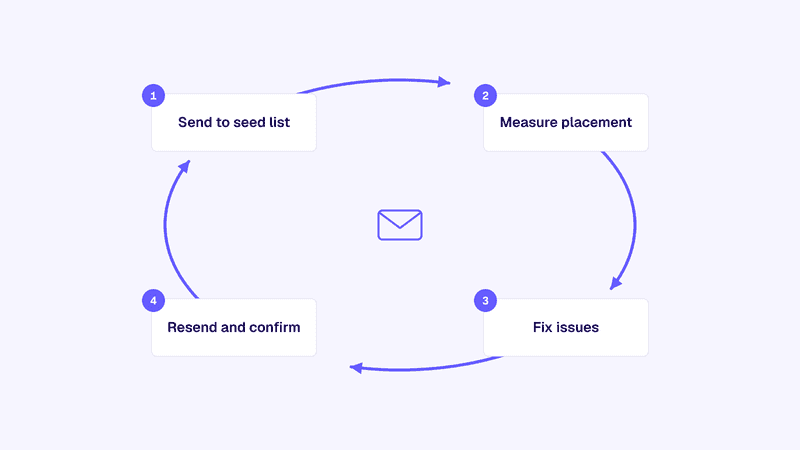
You can run the loop yourself or buy it as a service. Ranktracker's comparison of the top email deliverability platforms for 2025 covers the managed options, though a homegrown panel lets you choose exactly which mailboxes you check.
The Gmail and Yahoo 2024 rules that decide placement
Placement stopped being guesswork in February 2024, when the Gmail and Yahoo bulk sender rules took effect. Per Google's Email sender guidelines, anyone sending 5,000 or more messages a day to Gmail must authenticate with SPF, DKIM, and DMARC at a minimum policy of p=none, with the From domain aligned to the authenticated domain. Bulk senders also need one-click unsubscribe under RFC 8058, honored within two days, and a spam complaint rate held below 0.1% and never allowed to reach 0.3%. Yahoo's Sender Hub lists matching requirements, including the same 0.3% complaint ceiling.
The All-in-One Platform for Effective SEO
Behind every successful business is a strong SEO campaign. But with countless optimization tools and techniques out there to choose from, it can be hard to know where to start. Well, fear no more, cause I've got just the thing to help. Presenting the Ranktracker all-in-one platform for effective SEO
We have finally opened registration to Ranktracker absolutely free!
Create a free accountOr Sign in using your credentials
These thresholds shape your test: a seed panel exposes violations before the filters punish them at scale. If DKIM fails on thirty seed copies, it fails on two million subscriber copies too. Track complaints daily in Google Postmaster Tools, and treat the mandates as a floor. Ranktracker's guide to essential email deliverability practices covers the habits that keep you clear of the limits.
Building a seed list across providers
Start with your subscriber domain mix. Export the domains on your active list and let the top of that report choose the panel. For most consumer lists that means Gmail plus Google Workspace, Yahoo and AOL, Outlook and Hotmail, and regional providers such as GMX or Web.de if you mail there. Twenty to thirty addresses is a workable floor, weighted toward the providers carrying most of your volume, with personal Gmail and Workspace both represented because they filter differently.
Fresh mailboxes behave oddly, so age your seeds. Let them receive routine mail for a few weeks, interact with some of it, and keep them out of your marketing segments so their history stays clean. The network side matters as much as the mailboxes. A panel that logs in from one office IP starts to look automated, so open part of it over residential connections that mirror real subscriber inboxes, which keeps checks close to how customers load mail at home. Larger senders sometimes spread checks across many datacenter IPs from a provider such as Anonymous Proxies to avoid skewing a single address.
Running the test and reading results
Schedule the seed send 48 to 72 hours before the real one, using the final creative on the same from domain and IP pool the campaign will use. A test run on different infrastructure measures nothing useful. Give the mail 20 to 30 minutes to settle, log the folder for every address, then roll the results up by provider.
Read the rollup against a simple bar: 90% or better in the inbox is healthy, low 80s deserves a closer look, and anything under 80 means you pause the send and fix. Score Promotions on its own line, since marketing mail in that tab is expected Gmail behavior. A split like the sample below is a clear stop signal.
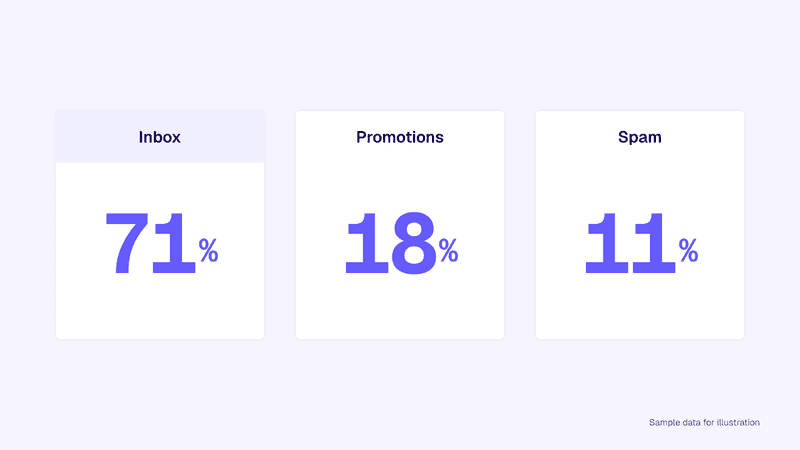
Source: Anonymous Proxies (original graphic)
Manual checking gets slow at the worst moment, and placement can vary by region for international lists. Teams that automate the readout route their checks through server-grade IPs that run inbox checks from several regions at once, which turns one panel into a multi-region reading in minutes instead of an afternoon.
Fixing the issues the test surfaces
Match the fix to the pattern. Authentication failures on seed copies come first, because the February 2024 mandates turn broken SPF, DKIM, or DMARC alignment into a hard stop. Spam at one provider usually signals a reputation problem there, so check Postmaster Tools, watch your complaint trend, and ease volume to that domain while it recovers. Spam everywhere points at the message itself: link domains with bad history, URL shorteners, or a template that resembles mail those filters already block.
The All-in-One Platform for Effective SEO
Behind every successful business is a strong SEO campaign. But with countless optimization tools and techniques out there to choose from, it can be hard to know where to start. Well, fear no more, cause I've got just the thing to help. Presenting the Ranktracker all-in-one platform for effective SEO
We have finally opened registration to Ranktracker absolutely free!
Create a free accountOr Sign in using your credentials
Change one variable at a time and rerun the test after each fix, or you won't know what moved the numbers. A per-provider grid keeps the priorities visible.
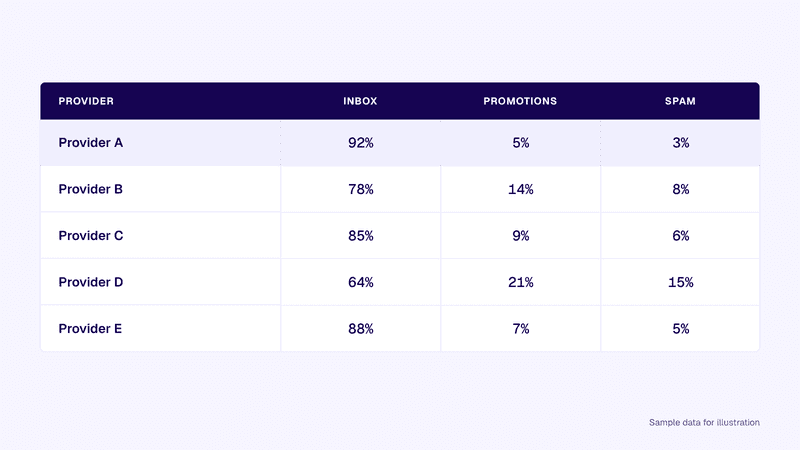
When placement is clean and revenue still lags, the bottleneck sits elsewhere. Ranktracker's three ways to improve email deliverability for a higher ROI picks up where the seed loop ends.
FAQ
How far ahead of a big send should I test?
Two to three days out, which leaves room to fix an authentication or content problem and rerun a confirmation test before your send window.
How many seed addresses do I need?
Twenty to thirty covering your top subscriber domains fits most lists. Add depth only where a provider carries enough of your volume to deserve its own trustworthy percentage.
Is inbox placement testing a guarantee?
No. Seeds lack the engagement history of real subscribers, so treat the results as an early warning and pair them with complaint and reputation data from Postmaster Tools.
Do the bulk sender rules apply under 5,000 messages a day?
The authentication and unsubscribe mandates trigger at 5,000 daily messages to Gmail, but complaint rates count against senders of any size, so meeting the bar early costs you nothing.
Testing before you hit send
A big send is a bet, and inbox placement testing is how you check the odds before the money is on the table. A seed panel shaped like your real audience, opened from realistic networks and read provider by provider, turns spam placement from a post-send surprise into a pre-send fix. The Gmail and Yahoo bulk sender rules already spell out what the filters expect, so the test confirms your exact message clears the bar. Build the loop once, run it ahead of every campaign that matters, and Tuesday's open rate stops being a mystery.

