
Intro
Google is still the most important route to new customers for most companies. At the same time, search behaviour has widened. Anyone looking for a supplier, clarifying a technical question or comparing possible solutions now increasingly ends up in ChatGPT, Gemini or Perplexity.
That creates an additional job. Good rankings alone no longer answer the full question of digital visibility. It also matters which companies AI systems mention at all, which topics they are associated with, and which sources get pulled into an answer. In practice, though, companies working on GEO often start at a point where the actual problem does not lie. They get into prompt tracking, new tools or isolated technical fixes while no clear picture of the company exists online in the first place. That is what Stefan Gerlach, owner of the GEO agency Gerlach Media, reports from projects with mid-sized B2B companies.
Before AI systems can place a company
A company can be successful in its market for twenty years and still be remarkably hard to pin down online. This is common in the mid-market. The website has grown over years. Services were added, others barely matter today. Some pages date from an earlier positioning. On top of that come different terms from sales, engineering and marketing.
Anyone who knows the company can make sense of those contradictions. An outsider has to assemble them first.
Search and AI systems are in the same position. They encounter product pages, company profiles, trade articles, LinkedIn posts, industry directories, press coverage and mentions on other websites. Out of all that, a coherent picture is supposed to emerge.
So a seemingly simple question belongs at the start: what should this company be known for?
The All-in-One Platform for Effective SEO
Behind every successful business is a strong SEO campaign. But with countless optimization tools and techniques out there to choose from, it can be hard to know where to start. Well, fear no more, cause I've got just the thing to help. Presenting the Ranktracker all-in-one platform for effective SEO
We have finally opened registration to Ranktracker absolutely free!
Create a free accountOr Sign in using your credentials
On many websites, ten minutes still are not enough to answer it clearly.
A lot of text does not create a clear profile
The problem is rarely a fundamental lack of content. Often there is a great deal of it already.
It just does not say much. “Individual solutions”, “highest quality”, “many years of experience” or “tailored consulting” appear on countless B2B websites. Such statements may well be true. They still contribute almost nothing to placing a company professionally.
A machine builder becomes tangible once it is clear which systems it builds, which processes they are designed for, which materials they can handle and where the technical limits are.
With a consultancy, what matters is which problems it actually solves, which company sizes it works with, in which situations the consulting is used, and what expertise sits behind it.
That is how a professional profile gradually forms.
A company with five properly developed topics can be perceived more clearly online than one with a hundred posts covering everything a little and nothing thoroughly.
The sequence is the real problem
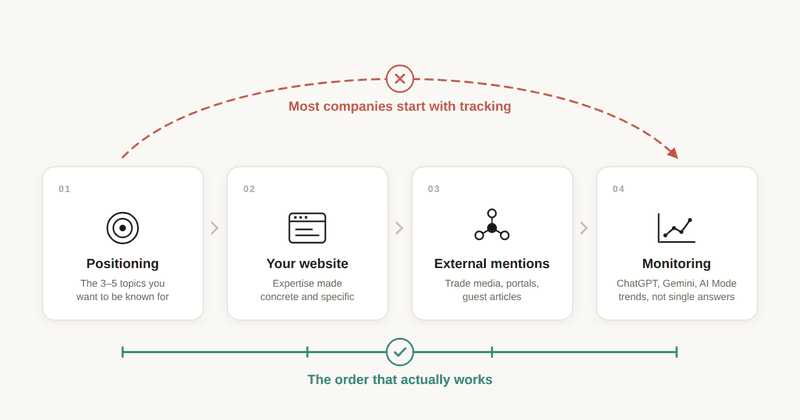
Gerlach sees the same mistake in GEO projects again and again: companies get into ChatGPT tracking, prompt sets or specific optimisation measures while it is not yet clear what they want to stand for professionally. In his view, that is the wrong order. First it has to be settled which topics a company should be associated with. Then it is worth checking whether that positioning is actually recognisable on its own website. Only after that does it get interesting how strongly the same picture is confirmed beyond the company’s own domain.
The All-in-One Platform for Effective SEO
Behind every successful business is a strong SEO campaign. But with countless optimization tools and techniques out there to choose from, it can be hard to know where to start. Well, fear no more, cause I've got just the thing to help. Presenting the Ranktracker all-in-one platform for effective SEO
We have finally opened registration to Ranktracker absolutely free!
Create a free accountOr Sign in using your credentials
The difference between companies that communicate very broadly and those that consistently occupy a few topics is striking. The second group is almost always easier to place. For prospects, for Google, and by now for AI systems too.
GEO is therefore not a new discipline that suddenly sits next to SEO. Good GEO work rests on clean SEO, clear positioning, professionally strong content and a reputation that is visible outside the company’s own website.
The best knowledge is rarely in marketing
Many companies look for new content ideas while enough material for years sits internally.
It is just with the wrong people. Sales knows the questions that keep coming up shortly before a decision. Engineers know why certain solutions work and others do not. Project managers run into the same difficulties regularly. Managing directors have developed a feel over years for which customer assumptions hold and which fail in practice.
Surprisingly little of that shows up on the website.
Instead, the next general post on “the benefits of automation” or “five trends in mechanical engineering” gets written. For search engines and AI systems, first-hand expertise is considerably more interesting. An article becomes valuable when someone knows something after reading it that was not obvious before.
That can be technical limits. Experience from projects. Typical wrong decisions. Your own measurements. A comprehensible assessment from practice.
Mid-sized B2B companies have plenty of it.
Would anyone quote this sentence?
This question works well for assessing professional content.
Many texts consist almost entirely of statements that sound right but carry no independent information value.
| Generic phrasing | Statement with more substance |
| We offer high quality | Naming the specific test procedures and quality criteria |
| Our solution saves time | Explaining which process steps the time is saved in |
| We have extensive experience | Specific industries, projects and typical use cases |
| We provide individual consulting | Describing the typical decision situations |
The second sentence does not have to be longer. It simply contains more usable information.
That matters for GEO. Content that explains concrete relationships or contains verifiable statements can serve as a source more easily than text made up largely of interchangeable corporate phrasing.
Your own website tells only part of the story
The website naturally remains the foundation. Companies control which services, topics and competencies they present. It gets interesting once other sources come in.
Does a company appear regularly in trade media? Is it named in industry portals? Are there interviews, guest articles or studies? Do other websites write about the brand in the right professional context? Mentions like these round out the picture.
A company website can claim that a supplier is particularly competent in a given field. An independent trade publication that mentions the same supplier in a fitting context provides a different kind of signal. That is why digital PR, trade articles and good backlinks are increasingly considered together.
With a backlink, it is not only about link equity. Context counts as well. A link from a fitting trade article to a topically fitting page says considerably more than some link from some environment.
That was always relevant for SEO. AI search gives the connection additional weight.
Several areas have to support the same picture
AI visibility is hard to work on in isolation. In practice, several disciplines interlock.
Technical SEO makes sure content is cleanly accessible and processable. Content delivers professional substance. Positioning decides which topics a company should be associated with. External mentions carry that association beyond its own website.
Monitoring comes on top, because developments in AI systems cannot sensibly be judged from a single query.
| Area | Task |
| Technical SEO | Keep content accessible and processable |
| Content | Represent expertise concretely |
| Positioning | Define the thematic focus |
| Brand work | Connect the brand with its areas of expertise |
| External mentions | Strengthen the professional association beyond your own website |
| Monitoring | Observe change over longer periods |
In B2B in particular, GEO can hardly be separated from SEO, content and brand work. The topics overlap too much.
Trade articles do not need an artificial GEO structure
With the rise of GEO, plenty of recommendations have appeared on how texts supposedly have to be built so that AI systems can process them especially well.
This often gets overdone. A sensible structure is entirely sufficient in many cases.
Headings should introduce a new thought. A table belongs where it makes a comparison faster to grasp. Lists help when several equivalent points genuinely work as a list.
A trade article is still allowed to have several connected paragraphs.
Increasingly there are texts with a new subheading after every second sentence, plus definition, list, table and FAQ following a near-identical template. Formally everything is clean. Reading it, it still feels assembled. With demanding B2B topics in particular, an author is allowed to develop a thought.
Old profiles do not disappear on their own
One more thing is easily overlooked in GEO: not everything written about a company online comes from its current website. An industry directory may still describe services that stopped mattering years ago. A managing director’s profile is out of date. LinkedIn uses a different job title than the website. Old press articles connect the company to a former line of business.
Things like that accumulate. After a few years, several versions of the same company can exist online.
So it is worth searching for your own brand from an outside perspective now and then, and reconciling the key details. That includes company name, services, brands, locations, areas of expertise and key people. Complete consistency is hardly achievable on the open web. Larger contradictions should still be spotted and cleaned up where possible.
With AI visibility, trends matter more than single readings
Monitoring ChatGPT, Gemini or Perplexity is nowhere near as stable as classic rank monitoring.
A single query says little. Answers change. The wording of a prompt influences the result. Different models return different providers and sources. It is still possible to observe whether anything is moving. That requires a fixed set of relevant topics and questions, checked repeatedly over a longer period.
Then other points become interesting: which competitors show up regularly? Which sources get named? Which services does the system connect with the brand? Does the company appear more often on certain questions than it did a few months ago?
The All-in-One Platform for Effective SEO
Behind every successful business is a strong SEO campaign. But with countless optimization tools and techniques out there to choose from, it can be hard to know where to start. Well, fear no more, cause I've got just the thing to help. Presenting the Ranktracker all-in-one platform for effective SEO
We have finally opened registration to Ranktracker absolutely free!
Create a free accountOr Sign in using your credentials
Answering these by hand stops being feasible beyond a certain number of prompts. SE Ranking bundles them in its AI visibility tracking tools: ChatGPT, Gemini, Perplexity, Google AI Overviews and AI Mode are queried, and brand mentions and links, the competitors named and the sources cited are all recorded, each with a history over time. With a single answer, caution is in order with any interpretation. Once a pattern develops over a longer period, that changes.
Where companies can start
Getting started does not require a complicated GEO strategy.
Three to five topics the company wants to be associated with over the coming years is a good basis. After that, it is possible to check whether exactly those topics are actually recognisable on the website. Then it gets more specific. Which pages stay superficial? Where is professional detail missing? Which statements could any competitor use just as well? Which questions does sales answer every week although the answer appears nowhere on the website? Which experience have engineers and project managers gathered that is so far only known internally?
After that comes the look at external sources.
Where is the brand already named? Do those mentions fit the intended positioning? Which trade media, portals or industry sources would be topically relevant? Which competitors are already present there? That produces a workable basis without making GEO artificially complicated. Anyone who sharpens their professional profile, publishes their own knowledge, improves existing content and appears outside their own website in the right context is working on several goals at once. Google rankings are one of them. Brand perception is another. And the likelihood rises that AI-based search systems also get a clearer picture of what this company stands for.

