Intro

The short answer? It's not the model you pick – it's how well that model fits your growth stage, budget, and internal bandwidth. Companies scaling fast with no dedicated marketing muscle tend to get more mileage from an agency. Companies with a repeatable, well-documented sales process often do better building in-house. Everything else is detail.
That said, the detail matters. A lot of B2B leaders make this call based on gut feeling or whatever a competitor is doing – and end up either overpaying a bloated internal team or underdelivering with an agency that doesn't understand their niche. Neither is a great look on a board slide.
Why this decision keeps landing on the CEO's desk
Lead generation has quietly become one of the most expensive line items in B2B marketing budgets. Between ad spend, tooling (CRM, enrichment platforms, outreach software), and headcount, the cost of getting a qualified lead in front of sales can spiral fast if the strategy behind it isn't sound.
That's why so many companies pause before committing to either path. Building in-house means hiring SDRs, a demand gen manager, and often a data/ops person just to keep the pipeline clean. Outsourcing means trusting an outside team with your positioning, your ICP, and – frankly – your revenue targets.
Agencies that specialize in outbound and demand generation, such as CAPSBOLD creative marketing agency, are often brought in precisely at this crossroads: when a company needs pipeline now but isn't ready to build a five-person department to get it. The appeal isn't just speed. It's access to a team that has already run this playbook across dozens of industries, instead of learning it in real time on your budget.
Cost: the number everyone gets wrong
The in-house math looks simple on paper – one SDR salary, maybe $50–70K depending on the market, plus a CRM subscription. But that number rarely includes ramp-up time (typically three to six months before a new SDR hits quota), management overhead, or the tools a small team can't fully utilize on its own.
Agency pricing is usually a flat retainer or performance-based fee, which makes budgeting predictable – you know the ceiling going in. The trade-off is less day-to-day control over process and messaging, since the team executing the strategy isn't sitting in your Monday standup.
The All-in-One Platform for Effective SEO
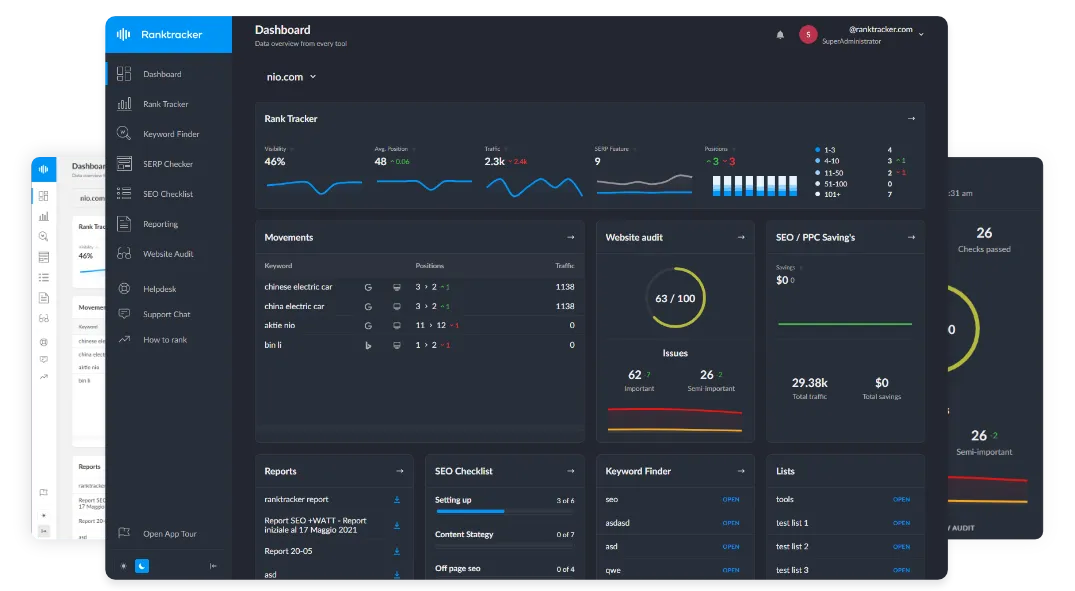
Behind every successful business is a strong SEO campaign. But with countless optimization tools and techniques out there to choose from, it can be hard to know where to start. Well, fear no more, cause I've got just the thing to help. Presenting the Ranktracker all-in-one platform for effective SEO
We have finally opened registration to Ranktracker absolutely free!
Create a free accountOr Sign in using your credentials
A few cost factors worth comparing side by side before deciding:
- Ramp time – in-house hires need months to become productive; agencies typically start from existing infrastructure and playbooks.
- Tool stack – agencies often already own enrichment and outreach tools, spreading the cost across multiple clients.
- Turnover risk – losing one in-house SDR can gut a small team's output overnight; agencies absorb that risk internally.
- Scalability – scaling an agency contract usually takes a conversation; scaling a team takes a hiring cycle.
None of this means agencies are automatically cheaper. For companies with high lead volume and a long sales cycle, an experienced in-house team can eventually out-earn its cost. It just takes longer to get there – and it requires management that knows how to run demand gen, not just approve the budget for it.
It also helps to think about cost in terms of what's being paid for, not just the invoice total. An in-house salary buys dedicated attention and full control over priorities, but it's a fixed cost regardless of output in the first few months. An agency retainer buys existing infrastructure and access to a team serving multiple clients, but the cost typically scales with campaign activity rather than headcount. Neither structure is inherently better—they just fail differently. An underperforming in-house hire is a slow, expensive problem to fix; an underperforming agency contract is usually a quicker one to walk away from, provided the agreement includes an exit clause.
There's a hidden cost category too: management time. Someone still has to brief, review, and course-correct whichever model is chosen. In-house teams need a manager who can coach and hold SDRs accountable day to day. Agencies need a point of contact who can give clear feedback on messaging and lead quality without micromanaging the execution. Companies that skip this step – assuming either model runs on autopilot – tend to see disappointing results regardless of which one they picked.
Speed and specialization: the quiet dealbreaker
Here's the part founders underestimate: hiring is slow. Finding, vetting, and onboarding a competent SDR or demand gen lead can take two to three months before they've written a single cold email. An agency, by contrast, can usually start executing within one to two weeks of signing, because the infrastructure – sequences, list-building processes, reporting dashboards – already exists.
Specialization compounds this. A generalist marketing hire might understand content and social, but outbound lead generation is its own discipline, with its own deliverability rules, list hygiene standards, and messaging cadence. Agencies focused specifically on lead gen tend to have refined this over hundreds of campaigns across different verticals, which is difficult to replicate with a single internal hire still learning the ropes.
Control and institutional knowledge: where in-house wins
None of this is a blanket argument for outsourcing. Control is the biggest reason companies eventually bring lead gen in-house. An internal team lives inside the company's culture, understands nuance that's hard to brief an outside partner on, and builds institutional knowledge that stays even if one person leaves.
There's also a trust factor with sales. Reps tend to work more closely with SDRs who sit in the same Slack channels and attend the same meetings, versus a name on an agency report. For companies where sales and marketing alignment is already fragile, adding an external layer can create friction rather than remove it.
Long sales cycles with highly technical products often favor in-house teams too – the learning curve to understand a complex offering deeply enough to prospect for it well can be steep, and it's easier to justify that investment when the person doing the learning is staying for the long haul.
The All-in-One Platform for Effective SEO
Behind every successful business is a strong SEO campaign. But with countless optimization tools and techniques out there to choose from, it can be hard to know where to start. Well, fear no more, cause I've got just the thing to help. Presenting the Ranktracker all-in-one platform for effective SEO
We have finally opened registration to Ranktracker absolutely free!
Create a free accountOr Sign in using your credentials
There's also a compounding effect worth noting: institutional knowledge doesn't just sit with one person, it shapes how the whole team prospects over time. An in-house SDR who's spent a year on the same product line starts noticing patterns an outside partner might miss – which objections actually kill deals versus which ones are just noise, which verticals convert faster than the ICP on paper suggests. That kind of pattern recognition is hard to hand off in a handover doc, which is partly why companies with very niche or complex offerings are often reluctant to fully outsource, even when an agency could technically execute the outreach.
If you go the agency route, vet it like a hire
Choosing to outsource doesn't mean the diligence stops. Treating an agency selection with the same rigor as a key hire tends to separate the partnerships that work from the ones that quietly fizzle out after two months.
A few questions worth asking before signing anything:
- What does their reporting actually show? Ask to see a sample report from an existing client (anonymized, if needed). Vague "engagement" metrics without lead-to-meeting conversion data are a red flag.
- Do they specialize in your niche, or in lead gen broadly? A generalist agency can still be a fit, but expect a longer ramp-up while they learn the market's language and objections.
- Who's actually doing the work? Some agencies staff senior strategists on the pitch call and juniors on execution. That's not automatically bad, but it should be known upfront, not discovered a month in.
- What happens if it's not working after 60 days? A clear exit clause protects both sides and tends to correlate with agencies that are confident in their process.
None of these questions are adversarial – a good agency partner will expect them and answer directly. It's the vague or defensive answers that are worth paying attention to.
Making the actual decision
Rather than picking a side abstractly, most B2B companies land somewhere along a spectrum: agency for initial traction and market testing, then a hybrid model, then eventually a full in-house build once volume and predictability justify the headcount. Some stay hybrid indefinitely, keeping an agency for top-of-funnel volume while an internal team handles nurturing and closing.
The honest checklist looks something like this: how fast do you need pipeline, how much cash is available for a slow ramp, how technical is the sales process, and how much does the founding team already know about outbound execution. Answer those four questions honestly, and the "right" model tends to pick itself.
Final thoughts
There's no universal winner here, and anyone claiming otherwise is probably selling something. What actually drives results is matching the model to the moment – fast traction and specialized execution favor an agency, while depth, control, and long-term institutional knowledge favor building in-house. Most growing B2B companies will use both at different points, and that's not indecision. That's just how demand generation actually matures.