
Intro
Singapore is one of the most popular destinations in Asia for entrepreneurs, startups, ecommerce companies, SaaS businesses, consultants, and international groups looking to expand into new markets.
The country is known for its stable legal environment, efficient business infrastructure, strategic location, and strong reputation among investors and global partners. For many companies, incorporating in Singapore is not just an administrative decision. It is part of a broader expansion strategy.
However, company incorporation should not be rushed. A business may be easy to register, but founders still need to think about compliance, company administration, tax obligations, business banking, operational setup, and long-term growth.
Before starting the process, here are seven important things to consider when incorporating a company in Singapore.
1. Understand Why Singapore Fits Your Business Strategy
Before incorporating a company, founders should be clear about why Singapore is the right jurisdiction for their business.
Some companies choose Singapore because they want to serve customers in Southeast Asia. Others use it as a regional headquarters, a base for international payments, a trusted location for investors, or a more structured environment for managing cross-border operations.
The reason matters because it can influence how the company is set up, how the website is positioned, which markets are targeted, and what operational support will be needed later.
The All-in-One Platform for Effective SEO
Behind every successful business is a strong SEO campaign. But with countless optimization tools and techniques out there to choose from, it can be hard to know where to start. Well, fear no more, cause I've got just the thing to help. Presenting the Ranktracker all-in-one platform for effective SEO
We have finally opened registration to Ranktracker absolutely free!
Create a free accountOr Sign in using your credentials
For example, a SaaS company entering Singapore may need a different structure from an ecommerce business managing suppliers across Asia. A consulting firm serving international clients may have different needs from a startup preparing to raise funding.
Before incorporation, founders should define:
- the main commercial reason for entering Singapore
- whether the company will sell locally, regionally, or globally
- who the target customers are
- whether the business needs local operations or mainly a legal base
- what financial and compliance requirements may come after registration
A clear business strategy helps avoid treating incorporation as a standalone task. Instead, it becomes part of a more complete market-entry plan.
2. Review the Company Structure Carefully
Choosing the right company structure is one of the most important early decisions.
In Singapore, many entrepreneurs choose to register a private limited company because it is a widely used structure for startups, SMEs, and international businesses. However, founders should still understand what this structure means in practice.
Key points to review include shareholder arrangements, director requirements, share capital, registered address, and company secretary obligations. These details may seem administrative, but they can affect how the company operates later.
For example, a company with multiple founders should think carefully about ownership percentages and decision-making rights. A foreign entrepreneur should understand whether local requirements apply and what documents may be needed. A business planning to raise investment should ensure its structure can support future funding rounds.
This is also the stage where professional advice can be useful. Mistakes made during incorporation may be fixable later, but correcting them can cost time and create unnecessary complexity.
The All-in-One Platform for Effective SEO
Behind every successful business is a strong SEO campaign. But with countless optimization tools and techniques out there to choose from, it can be hard to know where to start. Well, fear no more, cause I've got just the thing to help. Presenting the Ranktracker all-in-one platform for effective SEO
We have finally opened registration to Ranktracker absolutely free!
Create a free accountOr Sign in using your credentials
A thoughtful setup from the beginning makes it easier to manage the business as it grows.
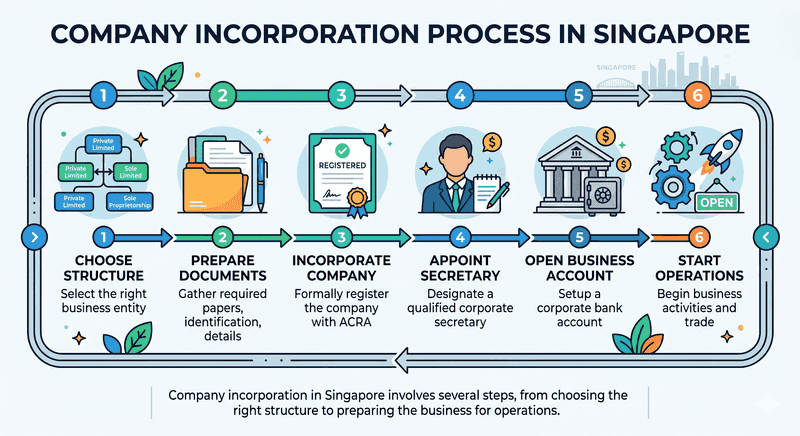
3. Plan for Corporate Secretary and Compliance Duties
Incorporation is only the first step. After registration, a company needs to remain compliant with ongoing administrative and statutory requirements.
This is where corporate secretary support becomes important.
A corporate secretary helps maintain company records, prepare resolutions, manage statutory registers, track filing deadlines, and support governance-related tasks. For founders who are new to Singapore, this type of support can be especially helpful.
Compliance should not be treated as a last-minute task. Missing deadlines or failing to maintain proper records can create unnecessary stress and potential penalties.
Founders should ask questions such as:
- Who will handle company records?
- How will annual filing deadlines be tracked?
- What documents need to be maintained?
- Who will prepare resolutions when changes occur?
- What happens if shareholders, directors, or company details change?
Good administration may not feel urgent when the business is just starting, but it becomes increasingly important as the company grows. Clean records also help when dealing with banks, investors, auditors, partners, and tax matters.
Ranktracker’s article on business formation and financial licensing in the United States discusses a different jurisdiction, but it highlights a useful principle for any market: company formation decisions are connected to credibility, compliance, and long-term operations.
For companies entering Singapore, planning compliance support early can prevent avoidable problems later.
4. Choose an Incorporation Partner That Supports the Next Steps
Many founders focus only on getting the company registered. While registration is important, the real challenge often begins afterward.
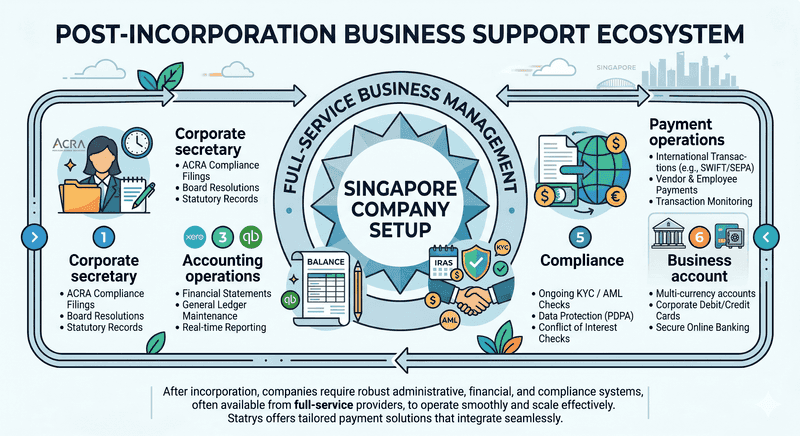
Once a company exists, it may need a corporate secretary, accounting support, tax guidance, business account setup, invoicing processes, and clean financial records. If these needs are not planned early, founders may end up coordinating several separate providers immediately after incorporation.
That is why it is useful to choose an incorporation partner that can support more than the basic registration process.
For entrepreneurs comparing a company incorporation service in Singapore, it can be helpful to look for providers that combine incorporation with practical post-registration support, such as corporate secretary services, business account solutions, accounting, and tax assistance.
This type of setup is particularly useful for foreign founders, startups, and small teams that want to reduce administrative complexity. Instead of treating incorporation as a one-time transaction, a more complete service can help the business move from registration to operations more smoothly.
The goal is not simply to create a legal entity. The goal is to create a company that is ready to operate.
5. Prepare the Financial Setup Before Operations Begin
A company cannot operate efficiently without the right financial setup.
After incorporation, founders usually need to receive payments, pay suppliers, manage expenses, issue invoices, and maintain proper accounting records. For international businesses, the financial setup may also involve multiple currencies, overseas clients, cross-border suppliers, or remote teams.
This is why business banking and payment operations should be considered early.
A weak financial setup can slow down the launch. For example, a company may be registered but unable to invoice clients properly, receive funds efficiently, or manage business expenses in a structured way.
Founders should think about:
- how the company will receive payments
- whether it needs multi-currency capabilities
- how supplier payments will be handled
- how expenses will be tracked
- what accounting system will be used
- who will prepare tax and financial reports
This is especially important for ecommerce companies, SaaS businesses, agencies, consultants, import-export companies, and other businesses that operate across borders.
Ranktracker’s article on what a Merchant of Record is explains how payment infrastructure, tax handling, and financial responsibility can become important considerations for companies selling internationally. While a Merchant of Record is different from incorporating a company, both topics show the same broader point: financial structure matters when operating across markets.
The earlier founders plan their financial operations, the easier it becomes to scale with fewer administrative issues.
6. Build Trust Signals for Customers, Partners, and Investors
Incorporating in Singapore can strengthen a company’s credibility, but legal registration alone is not enough to build trust.
Customers, partners, suppliers, and investors may still want to understand who the company is, how it operates, and whether it can be relied on.
This is especially true for companies entering a new market. A business that is unknown locally needs to show clear signs of professionalism and legitimacy.
Useful trust signals may include:
- a clear company website
- transparent service or product information
- local or regional contact details where appropriate
- business registration information when relevant
- case studies or testimonials
- clear payment and invoicing processes
- professional email and documentation
- consistent branding across channels
- helpful content that answers customer questions
Digital presence also matters. When potential customers search for the company online, they should find consistent and credible information.
For international businesses, this can include localized landing pages, market-specific content, and clear explanations of how the company serves customers in Singapore or Southeast Asia.
Ranktracker’s guide on optimizing a website for international markets covers useful concepts for companies that want their websites to support international expansion. Even if incorporation is the starting point, visibility and trust are what help turn the new entity into a growth asset.
A well-structured company should therefore be supported by a well-structured online presence.
- Think About Scalability From Day One
A company may start small, but its structure should be able to support growth.
Today, a founder may only need basic incorporation and a simple financial setup. Tomorrow, the business may need to hire employees, onboard vendors, manage contracts, raise funding, expand into nearby markets, or implement more advanced systems.
If the company was set up without future growth in mind, those next steps can become harder.
Scalability should be considered across several areas:
- company structure
- shareholder arrangements
- accounting processes
- financial tools
- compliance management
- operational workflows
- website and marketing infrastructure
- international expansion plans
For example, a company that expects to hire internationally may need better payroll and HR planning. A business that expects to sell across Southeast Asia may need a website structure that supports multiple markets. A startup expecting investors may need cleaner documentation and financial reporting.
Ranktracker’s article on offshore development centers discusses how global expansion often requires operational planning, coordination, and scalable structures. The same principle applies to company incorporation: early decisions can shape how easily the business grows later.
Thinking ahead does not mean overcomplicating the setup. It means making decisions that will not block the company when it starts to expand.
Common Mistakes to Avoid When Incorporating in Singapore
Even though Singapore is known for being business-friendly, founders can still make mistakes during the setup process.
Some of the most common include:
- choosing a provider based only on price
- ignoring post-incorporation requirements
- delaying accounting and tax planning
- underestimating corporate secretary responsibilities
- failing to prepare documents properly
- treating incorporation as separate from business strategy
- not planning how the company will receive and manage payments
- overlooking trust signals and digital presence
These mistakes often happen because founders focus too much on speed. Fast incorporation can be useful, but speed should not come at the expense of structure.
A better approach is to prepare the business, financial, and compliance foundations before problems appear.
Final Thoughts
Incorporating a company in Singapore can be a smart move for entrepreneurs, startups, and international businesses. The country offers credibility, access to regional markets, and a strong environment for business growth.
The All-in-One Platform for Effective SEO
Behind every successful business is a strong SEO campaign. But with countless optimization tools and techniques out there to choose from, it can be hard to know where to start. Well, fear no more, cause I've got just the thing to help. Presenting the Ranktracker all-in-one platform for effective SEO
We have finally opened registration to Ranktracker absolutely free!
Create a free accountOr Sign in using your credentials
However, successful incorporation requires more than completing registration forms.
Founders should think carefully about strategy, company structure, compliance, corporate secretary support, financial operations, trust signals, and scalability. These factors can influence how smoothly the business operates after incorporation.
The best approach is to treat company formation as the beginning of a larger business journey. A well-prepared company is easier to manage, easier to trust, and better positioned for long-term growth.
For entrepreneurs entering Singapore, the goal should not only be to register a company. It should be to build a company that is ready to operate, adapt, and scale.

