
Intro
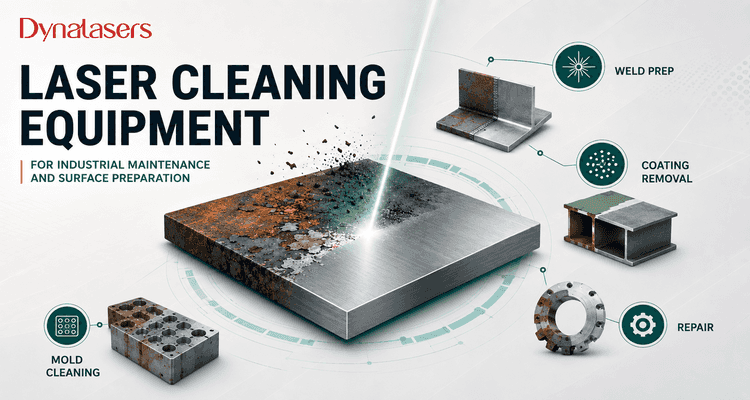
Industrial maintenance cleaning is rarely about appearance—it’s about getting surfaces ready for welding, coating, inspection, repair, or continued service. Rust, paint, oxide, coatings, and surface residue all have to go, and the base material must stay intact. Laser cleaning equipment uses focused laser energy to remove contamination, but for industrial buyers, the real question isn’t speed—it’s whether the equipment matches your material, contaminant layer, workspace, safety setup, and final surface requirement.
Laser Cleaning Equipment Comparison Table
| Method | Contact/Non‑contact | Surface Damage Risk | Consumables | Operator Control | Typical Use |
| Laser cleaning | Non‑contact | Low (with correct parameters) | None | High | Rust, paint, oxide, weld prep |
| Sandblasting | Contact | High | Abrasive media | Low | Heavy rust, large areas |
| Chemical cleaning | Contact | Medium (corrosion risk) | Chemicals | Medium | Oil, oxide removal |
| Grinding | Contact | High | Wheels/papers | Low | Deburring, smoothing |
| Dry ice cleaning | Non‑contact | Low to medium | Dry ice pellets | Medium | Oil, paint, mold cleaning |
Before choosing industrial laser cleaning equipment, compare it with conventional methods. Laser cleaning is non-contact cleaning equipment—the beam does not physically touch the surface with tools or abrasives. That means fewer scratches, no media residue, and less secondary cleanup. However, process testing is still mandatory, especially for thin sheets, polished surfaces, coated layers, reflective metals, and heat‑sensitive materials.
What Buyers Should Check Before Choosing Laser Cleaning Equipment
Power Type and Output Mode
Don’t focus only on peak power—higher wattage isn’t always better. Fiber laser cleaning equipment comes in pulsed and continuous‑wave (CW) versions. Pulsed fiber laser cleaning equipment works better for molds, thin parts, sensitive surfaces, and precision jobs. Continuous‑wave systems are more efficient for heavy rust, thick coatings, and large metal surfaces. CW cleans faster but generates more heat—so thin sheets, precision components, and heat‑sensitive materials always require prior testing.
Cleaning Width and Efficiency
Width affects both throughput and control. A wide path suits steel plates, tanks, frames, and large machinery surfaces. A narrow path is better for weld seams, corners, edges, and local repair work. A practical laser cleaning system should allow adjustable cleaning width to handle different tasks without swapping tools.
Material Compatibility
Laser cleaning equipment for metal works well on carbon steel, stainless steel, and aluminum—common in maintenance, weld preparation, coating repair, and pre‑inspection cleaning. But reflective metals, thin sheets, visible surfaces, and precision parts need conservative parameters. In many cases, lower energy or pulsed mode is safer.
Contamination Type
Rust, paint, oxide, grease, carbon deposits, and coatings all respond differently to laser energy. Settings that work for laser rust cleaning equipment may not suit mold residue, light oxide, or oil contamination. Before purchasing, confirm:
- What contaminant you need to remove
- How thick it is
- What the surface will be used for after cleaning
- Whether the final finish is acceptable for that process
Mobility Requirements
Much of the work happens on‑site—not in a fixed cleaning bay. Common locations include production lines, large machinery, tanks, steel structures, and repair stations. Portable laser surface cleaning equipment is essential for bulky or immovable workpieces. For maintenance teams, mobility often matters as much as output power.
Safety and Training
Laser cleaning reduces chemicals and blasting media, but it remains a high‑energy process. Operators require training, wavelength‑rated laser safety glasses, restricted work areas, fume extraction, fire control, and material checks. Reflected light, smoke, hot particles, and heated surfaces must be managed carefully. Never skip the safety setup.
Why Dynalasers Laser Cleaning Equipment Fits Industrial Workflows
Dynalasers builds laser cleaning equipment for real shop floors—not just demo samples. In actual maintenance, the same unit may clean machine frames, weld oxide, mold surfaces, and repair parts. What matters is stable output, adjustable parameters, practical process support, and easy operation for trained staff.
Non‑Contact Surface Cleaning
Dynalasers systems require no grinding wheels, blasting media, or chemical soaking. The laser removes contamination while reducing mechanical damage and giving better control over the base material. The industrial goal is rarely “like new”—it’s a surface ready for welding, coating, inspection, repair, or continued service.
Options for Rust, Paint, Oxide, and Coating Removal
Heavy rust, weld oxide, paint, and mold residue are different jobs—they need different parameter sets. Dynalasers offers both continuous and pulsed solutions. Continuous cleaning handles heavy rust, thick coatings, and large metal surfaces effectively. Pulsed cleaning is better for thin parts, sensitive surfaces, higher‑value components, and applications where heat control is critical.
Portable Design for Maintenance Teams
Cleaning often happens right at the machine, on production lines, outdoors on structures, or in repair bays. Portable equipment lets operators work close to the part—no need to move heavy workpieces to a fixed station. This suits machinery maintenance, mold care, weld preparation, repair work, and small‑batch surface treatment.
Technical Support for Process Testing
Laser cleaning results depend heavily on parameters—power, scanning speed, focal distance, cleaning width, pulse behavior, and operator movement. Dynalasers provides process testing support to help customers find the right settings. The aim is effective contaminant removal while minimizing overheating, discoloration, texture change, and base material damage.
Dynalasers Laser Cleaning Product Options
Dynalasers provides different Dynalasers fiber laser cleaning equipments for maintenance, repair, and industrial surface preparation.
M75 Continuous Laser Cleaner for Heavy Rust and Large Metal Surfaces
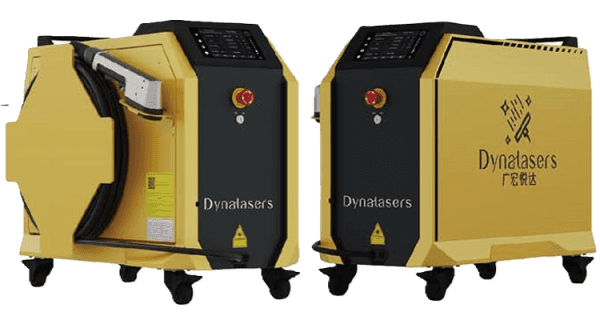
The Dynalasers M75 is a continuous‑wave laser cleaning machine designed for heavy‑duty work. With output up to 1800 W, it suits large metal surfaces, heavy rust, thick oxide, paint removal, and steel structure maintenance. Typical parts include machinery frames, steel plates, tanks, welded structures, ship components, and heavy metal parts. Because CW cleaning delivers high energy, testing is essential—for thin metal, precision surfaces, or heat‑sensitive parts, pulsed cleaning is often the safer choice.
P300 Pulsed Laser Cleaner for Controlled Cleaning and Sensitive Surfaces
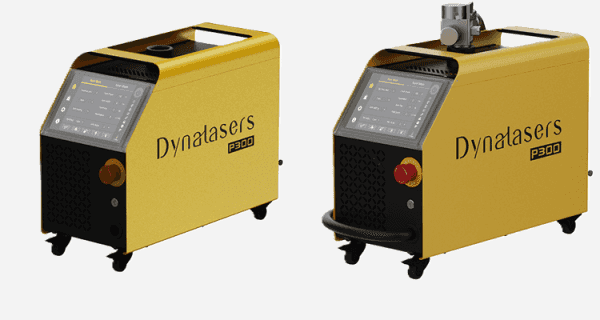
The Dynalasers P300 is a pulsed laser cleaning machine built for controlled, lower‑heat input cleaning. It works well on sensitive materials or surfaces with higher finish requirements. Common applications include mold cleaning, oxide removal, weld discoloration cleanup, light rust removal, and localized surface preparation. In short: the P300 excels at precision work, while the M75 is the go‑to for large‑area and heavy‑duty tasks.
Typical Industrial Applications
- Machinery maintenance – frames, fixtures, covers, repair parts, worn metal surfaces
- Steel structure cleaning – bridges, tanks, rail parts, ship components, welded structures – rust and paint removal
- Mold cleaning – plastic molds, rubber molds, tire molds, textured surfaces – residue removal without aggressive scraping
- Welding preparation – remove rust, oil, paint, oxide, and residue before welding to reduce defects and improve consistency
- Paint and oxide removal – for repainting, bonding, coating repair, inspection, or selective cleaning
In all these cases, laser cleaning equipment serves industrial maintenance and surface preparation—not cosmetic finishing, but making sure equipment runs, welds hold, and coatings adhere.
FAQs
Q1. What is laser cleaning equipment used for?
It removes rust, paint, oxide, coatings, oil residue, and carbon deposits. Typical uses include industrial maintenance, welding preparation, mold cleaning, steel repair, paint stripping, and surface preparation before coating or inspection.
Q2. Is laser cleaning suitable for metal surfaces?
Yes. Laser cleaning equipment for metal is commonly used on carbon steel, stainless steel, and aluminum. However, thin sheets, reflective metals, polished surfaces, and precision parts require testing—often with lower energy or pulsed mode.
Q3. What is the difference between pulsed and continuous laser cleaning?
Pulsed cleaning delivers short energy bursts—better for sensitive surfaces, molds, thin parts, and precision work. Continuous‑wave cleaning provides steady energy—more efficient for heavy rust, thick coatings, paint removal, and large metal surfaces.
Q4. Does laser cleaning require surface testing?
Absolutely. Before regular production, test material type, contamination layer, power, speed, focal distance, and final surface condition. The goal is to avoid overheating, discoloration, texture change, or incomplete cleaning.
Conclusion
Laser cleaning equipment offers a cleaner, more controllable way to remove rust, paint, oxide, and coatings in industrial settings. It does not replace every traditional method, but it significantly reduces consumables, surface damage, and secondary cleanup. Dynalasers provides reliable fiber laser cleaning equipment for both heavy‑duty and controlled cleaning tasks. The right choice depends on material, contamination type, cleaning area, and finish requirement—there is no one‑size‑fits‑all, only the right fit for your specific workflow.

