Intro

A local service business can rank well and still have an empty schedule. Its listing may earn views, its website may attract clicks, and its monthly report may look impressive. None of that tells the owner how many jobs were booked. In 2026, a useful local search strategy follows the entire path from discovery to a qualified inquiry, a booked appointment, and revenue. Each step matters because a customer can drop out long before a search turns into work.
The Local Search Landscape in 2026
People looking for a nearby contractor or professional firm do not all follow the same path. They may encounter an AI-generated answer, a map result, a Business Profile, an ad, or an ordinary website listing. Which of those appears, and in what order, depends on the query and the search experience. In 2026’s hyper-competitive local search landscape, AI-driven answers dominate the top of the results page, while maps, profiles, and websites remain important routes to a provider. For a service business, the practical question is where potential customers can find it and what they can do next.
Competition is especially sharp for searches that signal a need to hire someone soon. A homeowner searching for emergency drain repair is closer to making a call than someone researching why drains clog. A law firm may find that a specific service-and-location query brings fewer visitors than a broad legal term but produces more suitable inquiries. Broad rankings can still help people learn a business’s name. They should not, however, determine the whole strategy when the goal is to fill an appointment calendar.
Search results also offer several routes to contact that never begin with a website visit. Google’s guidance on Local Ads describes placements that use Business Profile location information and can prompt calls, directions requests, or website visits. That matters when interpreting a traffic report: a customer who calls from a search result may never appear as a website visitor. Low website traffic does not automatically mean low local interest, just as high traffic does not prove strong demand.
A sensible starting point is to inspect the results for the services and areas the business can actually serve. A SERP checker can help identify the competing pages for a search term, while direct checks of maps and profiles show other prominent routes to contact. The aim is not to collect every possible keyword. It is to find searches that match a real service, a workable location, and a customer ready to take the next step.
Why Traffic Without Conversions Is a Wasted Investment
Impressions, rankings, and clicks are useful diagnostic signals. They can show whether a business is being seen and whether its message attracts attention. They cannot, on their own, show whether marketing is paying for itself. A click from someone outside the service area may consume budget without creating an opportunity. A call from a suitable customer may be far more valuable, but even a call is only the beginning: it might be missed, irrelevant, or never lead to a booking.
This is why lead generation for contractors and other service providers needs a clear definition of a lead. A click on a phone button is a contact action, not proof that a conversation took place. A conversation about an unavailable service is not a qualified inquiry. A qualified inquiry is not yet a booked job. Google Ads, for example, can record local actions such as calls and directions requests. Those records help identify engagement, but a business must still compare them with what happened after the action.
The All-in-One Platform for Effective SEO
Behind every successful business is a strong SEO campaign. But with countless optimization tools and techniques out there to choose from, it can be hard to know where to start. Well, fear no more, cause I've got just the thing to help. Presenting the Ranktracker all-in-one platform for effective SEO
We have finally opened registration to Ranktracker absolutely free!
Create a free accountOr Sign in using your credentials
Consider two campaigns. One brings many visits from people comparing general advice. The other brings fewer visits but more calls from customers within the service area who need an offered service. Judging only by traffic would favor the first. Judging by qualified calls, appointments, and completed work might favor the second. Neither conclusion should be assumed in advance. The business needs a record of inquiry sources and outcomes to make the comparison.
Call measurement can narrow the gap between an apparent conversion and a useful inquiry. Google Ads describes options that include counting calls after a minimum duration or using AI to assess call quality. A business should still compare those call signals with its own booking records to determine which inquiries became appointments or jobs. A duration threshold can screen out some very short calls, but it cannot establish that a caller was suitable or booked a service. Staff notes or booking records provide the missing context. The same principle applies to forms: submitting one shows interest, while the follow-up reveals whether the request fits the business.
The financial test is straightforward in principle. Compare the cost of generating suitable inquiries with the value of the work they produce, while allowing for the time it takes a lead to become a customer. A business does not need to assign the same value to every call. It does need to stop treating every recorded action as if it were a sale.
Building a Conversion-Focused Online Presence
Better measurement will reveal weak points, but it will not fix them by itself. A business can earn a prominent result and lose the customer on the next screen. If someone searches for a specific service and lands on a generic homepage, they must work out whether the company handles that job and serves their area. A page that answers those questions directly gives the visitor a clearer reason to contact the business. Service pages should explain what is offered in plain language and make the next step easy to find.
Contact details should be clear wherever a customer may make a decision: on the website, on relevant service pages, and in the Business Profile. Accurate service-area or location information helps people decide whether an inquiry is worthwhile. On a phone, the page should load promptly, remain readable without awkward zooming, and make the call or inquiry option easy to use. These are practical conversion issues, not cosmetic refinements. Every unnecessary step creates another chance for a busy customer to leave.
The path continues after someone presses the call button or submits a form. If calls regularly go unanswered, improving a page’s ranking will send more people into the same dead end. If form inquiries receive no follow-up, a larger advertising budget will magnify that loss. Service providers should examine how inquiries reach staff, how they are recorded, and whether the customer receives a clear response. The purpose is to identify avoidable gaps, not to assume that every business needs the same process.
Work through the funnel in order: search intent, relevant result, useful page or profile, contact, qualified conversation, and booking. If many relevant people see a result but few make contact, inspect the message and contact options. If contact volume is healthy but bookings are low, review inquiry fit and follow-up before buying more traffic. If bookings rise but revenue does not, look at the kinds of jobs being won. This approach gives an SEO or performance marketing team a more precise question to answer than “How do we get more clicks?”
The All-in-One Platform for Effective SEO
Behind every successful business is a strong SEO campaign. But with countless optimization tools and techniques out there to choose from, it can be hard to know where to start. Well, fear no more, cause I've got just the thing to help. Presenting the Ranktracker all-in-one platform for effective SEO
We have finally opened registration to Ranktracker absolutely free!
Create a free accountOr Sign in using your credentials
Local details make the test sharper. A Reno SEO campaign, for instance, should be assessed against the services the business offers in the areas it serves, rather than a single citywide ranking. A firm that can serve only certain neighborhoods or types of customers gains little from inquiries it cannot accept. Matching the search promise to the work the business can deliver protects both conversion rates and customer expectations.
The Role of Transparent Reporting in Modern Marketing
A results-first strategy depends on a shared view of what success means. Before reading a dashboard, the owner and marketing team should agree on the definitions: What counts as an inquiry? When is a call qualified? Does a booking mean an appointment was scheduled, or that the customer attended? Which completed jobs can be tied to a search inquiry? Clear definitions prevent a report from quietly switching between button clicks, conversations, and customers as though they were interchangeable.
The All-in-One Platform for Effective SEO
Behind every successful business is a strong SEO campaign. But with countless optimization tools and techniques out there to choose from, it can be hard to know where to start. Well, fear no more, cause I've got just the thing to help. Presenting the Ranktracker all-in-one platform for effective SEO
We have finally opened registration to Ranktracker absolutely free!
Create a free accountOr Sign in using your credentials
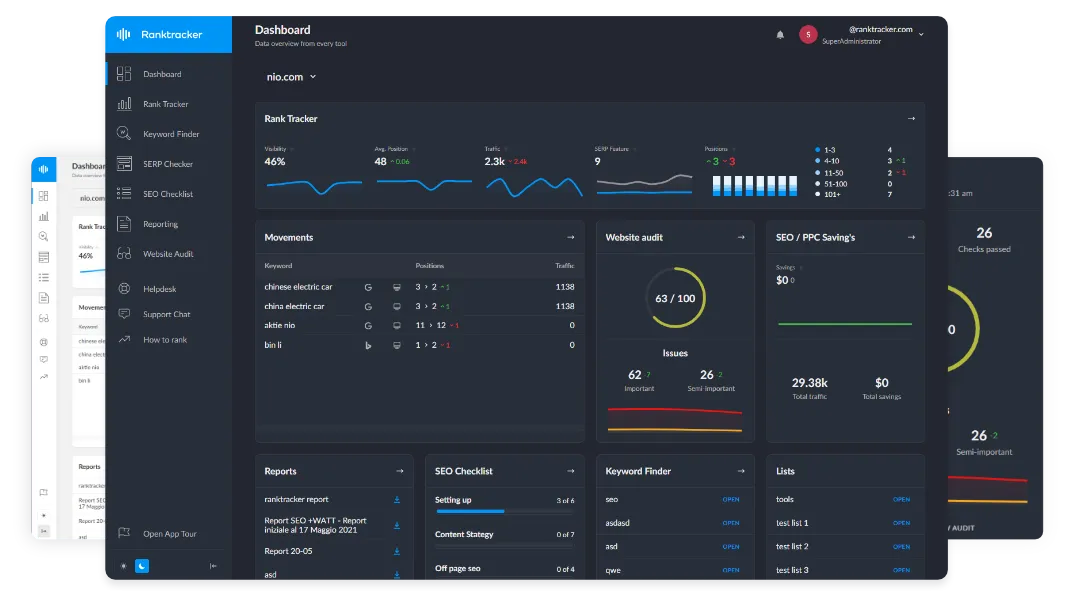
A useful dashboard can show recent activity and expose changes quickly, but “real time” should not imply that every platform and sales record updates at once. Each measure needs a source and a reporting period. Search visibility and website actions can sit alongside call records, form inquiries, bookings, and recorded revenue. The strongest ROI reporting connects those measures where possible and makes the gaps between them visible. It also gives the team a basis for deciding whether to improve a page, adjust the searches it targets, or examine how inquiries are handled.
Platform figures need careful interpretation. Google’s Business Profile and Analytics integration guidance describes metrics such as website clicks, calls, and directions, with data available for the previous six months. Where multiple profiles are connected, the reported figures are aggregated rather than filterable by individual profile. These measures add useful context, but they do not replace the business’s own records of conversations, appointments, and completed work. Comparing the two is how an owner can tell whether more profile activity is producing better outcomes.
Performance-based strategies are increasingly replacing traditional agency models centered on visibility metrics such as rankings and impressions. A report centered on rankings and impressions describes exposure; a performance-based conversation asks what that exposure produced and what should change next. That distinction is reflected in the focus of the team at Digital Marketing Agency Reno on booked calls and revenue growth for local clients rather than vanity metrics alone. The useful standard for any provider is the same: explain the measures, show the route from marketing activity to business outcomes, and use the findings to guide the next decision.
None of this makes rankings unimportant. A visibility drop may help explain why fewer suitable customers are getting in touch. The mistake is stopping the analysis there. A business owner reviewing the next local search report should be able to ask which inquiries were qualified, which became bookings, what those bookings were worth, and where customers were lost along the way. When the answers shape the next round of work, local search becomes an investment that can be evaluated rather than a collection of impressive-looking numbers.